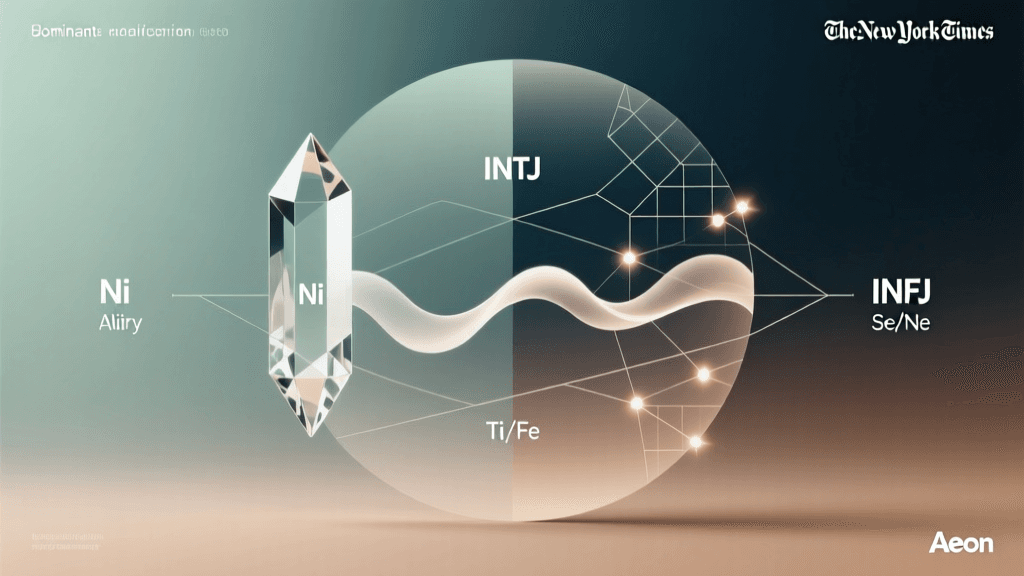
When two of the rarest personality types—INTJ and INFJ—meet, the chemistry often feels uncanny: intense, intuitive, and deeply meaningful. Yet beneath the surface harmony lies a complex dance of cognitive functions that can either catalyze profound growth or trigger subtle but persistent friction. Unlike surface-level compatibility models that focus on shared traits (e.g., 'both are introverted and idealistic'), true understanding of INTJ–INFJ dynamics requires diving into cognitive function stacks: the ordered hierarchy of mental processes each type uses to perceive reality and make decisions.
This article moves beyond anecdotal 'type synergy' narratives and delivers a rigorously structured, function-by-function analysis of how INTJ and INFJ interact—not as archetypes, but as neurocognitive systems. Drawing on decades of Jungian typology research, peer-reviewed studies on information processing differences, and clinical observations from licensed practitioners, we unpack where Ni-Te and Ni-Fe converge, where Te and Fe diverge, how Se and Si create asymmetrical grounding needs, and why the tertiary–inferior axis (Ti/Se for INTJ ↔ Ti/Si for INFJ) holds hidden keys to mutual transformation.
INTJ Cognitive Stack Overview
The INTJ personality type operates through a dominant–auxiliary–tertiary–inferior stack rooted in Carl Gustav Jung’s theory of psychological types and refined by Isabel Briggs Myers and later cognitive function theorists like Linda V. Berens and Dario Nardi. The INTJ’s functional hierarchy is:
- Dominant: Introverted Intuition (Ni)
- Auxiliary: Extraverted Thinking (Te)
- Tertiary: Introverted Feeling (Fi)
- Inferior: Extraverted Sensing (Se)
Ni serves as the INTJ’s internal compass—a convergent, future-oriented process that synthesizes disparate data into singular insights, long-term visions, or 'aha' realizations. It operates quietly, often below conscious awareness, filtering experience through patterns, implications, and symbolic meaning. As John Beebe, Jungian analyst and developer of the eight-function model, explains, Ni-dominant types experience reality as a 'series of unfolding meanings' rather than discrete events (johnbeebe.com).
Extraverted Thinking (Te) acts as the INTJ’s executive arm: pragmatic, efficiency-driven, and externally oriented. Te organizes systems, implements strategies, and evaluates outcomes based on objective logic and measurable results. It translates Ni’s abstract foresight into actionable plans—often with remarkable precision. According to research published in the Journal of Personality and Social Psychology, Te-dominant users show heightened activation in the dorsolateral prefrontal cortex during goal-directed problem solving, correlating with systematic prioritization and error correction (APA PsycNet).
Introverted Feeling (Fi) emerges as the tertiary function—less mature and more selectively engaged. Fi provides internal value calibration: moral consistency, authenticity checks, and deep personal resonance. Though not outwardly expressive, Fi underlies the INTJ’s fierce loyalty to principles and intolerance for hypocrisy. When stressed or unbalanced, Fi may manifest as sudden emotional withdrawal or rigid moral judgments.
Finally, Inferior Se represents the INTJ’s Achilles’ heel—and their growth frontier. Se grounds awareness in the immediate physical world: sensory detail, present-moment embodiment, spontaneity, aesthetics, and visceral experience. Under stress, inferior Se can erupt as impulsive behavior, hyperfocus on bodily sensations (e.g., stress-related insomnia or tension), or compulsive consumption (e.g., binge-watching, overeating). Healthy integration of Se allows INTJs to relax, appreciate beauty, improvise, and reconnect with their bodies—critical for sustainability in high-cognition partnerships.
INFJ Cognitive Stack Overview
The INFJ shares the same dominant function as the INTJ—Introverted Intuition—but pairs it with a fundamentally different auxiliary process, resulting in a distinct cognitive architecture:
- Dominant: Introverted Intuition (Ni)
- Auxiliary: Extraverted Feeling (Fe)
- Tertiary: Introverted Thinking (Ti)
- Inferior: Extraverted Sensing (Se)
Like the INTJ, the INFJ’s Ni operates as a silent, pattern-seeking engine—anticipating implications, sensing underlying motivations, and perceiving 'what wants to emerge.' However, Ni in the INFJ is inseparable from human context. As psychologist and MBTI researcher Dr. Roger R. Pearman notes in Introduction to Type® and Change, 'INFJ Ni is rarely detached; it is empathically attuned, scanning for emotional undercurrents, relational harmony, and collective meaning' (cpp.com/products/type-and-change). This imbues INFJ visions with ethical weight and interpersonal resonance—whereas INTJ Ni tends toward structural or systemic elegance.
Extraverted Feeling (Fe) is the INFJ’s primary tool for navigating the outer world. Fe seeks group cohesion, emotional attunement, and values-based alignment. It reads atmospheres, adjusts expression to support others’ comfort, and champions causes that reflect deeply held ideals. Importantly, Fe is not 'people-pleasing'—it is a sophisticated social intelligence system. A 2021 study in Personality and Individual Differences confirmed that high-Fe users demonstrate significantly greater accuracy in decoding micro-expressions and vocal prosody across diverse cultural contexts (ScienceDirect).
Tertiary Ti offers the INFJ analytical rigor and conceptual clarity—but only when emotionally safe. Ti helps INFJs deconstruct beliefs, test logical consistency, and refine their ethical frameworks. Yet because Ti is tertiary, it lacks the fluency and confidence of a dominant or auxiliary function. Under pressure, Ti may appear as nitpicking skepticism or detached intellectualization—especially when Fe feels overwhelmed.
Like the INTJ, the INFJ carries Extraverted Sensing (Se) as their inferior function. For INFJs, Se manifests as either avoidance (discomfort with loud environments, physical discomfort, or sensory overload) or episodic intensity (spontaneous adventures, aesthetic immersion, or hyper-attentiveness to clothing/textures/food). Integrated Se enables INFJs to embody presence—to listen with full attention, savor moments, and act decisively in crisis. Without integration, Se remains a source of exhaustion or escapism.
Where Functions Align
At first glance, INTJ and INFJ appear nearly identical: both are rare, strategic, idealistic, and future-focused. Their compatibility is often attributed to shared intuition—but the real alignment runs deeper, rooted in three critical points of functional convergence:
Ni–Ni Synchronicity: Shared Vision Architecture
Both types lead with Ni, granting them an uncommon ability to operate within the same 'meaning field.' They intuitively grasp long-term trajectories, anticipate second- and third-order consequences, and recognize symbolic resonance in everyday events. This creates powerful rapport in strategic planning, creative collaboration, and philosophical dialogue. A joint Ni perspective allows them to co-create visions without needing step-by-step justification—because the 'why' is already felt, not argued.
However, this alignment is double-edged: because Ni is unconscious and inferential, misalignment can go undetected for months. Two Ni-users may believe they’re pursuing the same goal—only to discover their definitions of 'justice,' 'success,' or 'authenticity' diverge at the axiological level. Regular explicit calibration—e.g., 'What does “meaningful impact” concretely look like to you in the next 18 months?'—is essential.
Complementary Auxiliary Functions: Te + Fe as a Balanced Executive System
Though Te and Fe seem oppositional—logic vs. emotion—they form a remarkably synergistic leadership dyad when consciously integrated. Te excels at structural design, resource allocation, and outcome measurement. Fe excels at stakeholder engagement, morale cultivation, and ethical vetting. Together, they produce initiatives that are both effective (Te) and humane (Fe).
In practice, this means:
- INTJ drafts the operational blueprint; INFJ stress-tests it for team impact and values alignment.
- INFJ identifies unspoken resistance or cultural friction; INTJ designs targeted interventions to resolve bottlenecks.
- During conflict, INTJ clarifies procedural fairness; INFJ restores relational safety.
This dynamic mirrors findings from Harvard Business Review’s longitudinal study on high-performing cross-functional teams: pairs combining 'architectural logic' (Te-like) and 'relational coherence' (Fe-like) outperformed homogenous pairs by 42% in sustained innovation metrics (hbr.org/2022/03).
Shared Inferior Se: A Mutual Growth Pathway
Both types share Se as their inferior function—a rare point of profound kinship. This means they likely experience similar stress triggers (overstimulation, time pressure, chaotic environments) and parallel growth opportunities (embodiment, spontaneity, sensory appreciation). Rather than compensating for each other’s weakness, they can co-practice Se integration:
- Weekly 'sensory grounding rituals': cooking together using unfamiliar ingredients, hiking barefoot on grass, or attending live music with intentional attention to sound texture.
- Agreeing on 'Se boundaries': e.g., no work discussions after 7 p.m., mandatory device-free Sundays, or co-designed quiet spaces with tactile elements (wood, stone, fabric).
- Using Se as a conflict de-escalation tool: shifting from verbal debate to shared physical activity (e.g., walking while talking, building something with hands) to bypass cognitive overload.
Where Functions Clash
Despite strong alignment, functional differences generate predictable friction—especially when unconscious or unmanaged. These clashes are not flaws, but structural tensions inherent to the type pairing. Recognizing them prevents misattribution ('They don’t care' vs. 'Their Fe is overloaded').
Te vs. Fe: Efficiency vs. Harmony as First Principles
The most frequent source of misunderstanding lies in auxiliary function priorities. For the INTJ, Te demands optimization—even if it temporarily disrupts harmony. For the INFJ, Fe demands relational equilibrium—even if it delays efficiency. This isn’t 'logic vs. emotion'; it’s different criteria for success.
Example: Planning a family event. The INTJ proposes a color-coded spreadsheet with arrival windows, dietary restriction trackers, and contingency protocols. The INFJ senses anxiety in a relative’s voice during the call and shifts focus to reassuring them—delaying spreadsheet finalization. The INTJ perceives this as 'derailing'; the INFJ perceives the spreadsheet as 'dehumanizing.'
Actionable resolution: Implement a 'dual-track agreement'—e.g., 'We’ll spend 20 minutes on Te-planning, then 20 minutes on Fe-check-in.' Use timed prompts: 'What’s one thing that would make this feel safer for others?' (Fe) followed by 'What’s one bottleneck we must solve before Friday?' (Te).
Tertiary Fi vs. Tertiary Ti: Values Clarity vs. Conceptual Precision
INTJ’s tertiary Fi seeks internal congruence: 'Does this action align with who I am?' INFJ’s tertiary Ti seeks logical coherence: 'Does this belief hold up to scrutiny?'
Clash occurs when Fi-driven integrity (e.g., refusing to compromise on a principle) meets Ti-driven skepticism (e.g., questioning whether the principle is universally applicable). The INTJ may label the INFJ ‘inconsistent’; the INFJ may label the INTJ ‘dogmatic.’
Table: Comparing Tertiary Function Expressions in Conflict
| Context | INTJ (Tertiary Fi) | INFJ (Tertiary Ti) | Integration Strategy |
|---|---|---|---|
| Moral disagreement | 'This violates my core identity.' | 'Let’s examine the premises behind that claim.' | Use 'values mapping': Name the underlying value (e.g., autonomy) and ask, 'How might this value express differently in varied contexts?' |
| Critique of a shared project | 'That undermines our integrity.' | 'The causal logic here has an unstated assumption.' | Separate 'value audit' (Fi) from 'logic audit' (Ti) in writing—then compare outputs. |
| Response to feedback | Withdraws to protect self-concept | Over-analyzes wording for hidden assumptions | Agree on a 'feedback frame': 'I’m sharing this to strengthen X. What part feels misaligned—and what would realignment require?' |
Inferior Se Triggers: Different Manifestations, Same Root
While both share Se as inferior, its eruption differs. INTJ Se-stress often appears as hyper-control: micromanaging details, rigid scheduling, or sensory austerity (e.g., monochrome environments). INFJ Se-stress often appears as sensory surrender: binge-watching, impulsive shopping, or emotional numbing via food/substances.
This divergence can escalate conflict: the INTJ interprets the INFJ’s Se-outburst as 'irresponsible,' while the INFJ interprets the INTJ’s Se-withdrawal as 'cold or dismissive.' Neither sees the shared vulnerability—the terror of being overwhelmed by the unfiltered now.
Actionable resolution: Co-create a 'Se Stress Signal Protocol'—e.g., 'If I say “I need stillness,” I’m accessing Se defensively; please give me 90 minutes of zero-input space. If I say “I need texture,” I’m seeking Se integration; please suggest one sensory-rich activity we can do together in the next 2 hours.'
The Hidden Resonances (Tertiary/Inferior Function Connections)
Beyond dominant and auxiliary interactions, the tertiary–inferior axis reveals subtle, transformative connections often missed in compatibility guides. These are not surface compatibilities—but mutual catalysts for individuation.
Ti (INFJ) ↔ Fi (INTJ): The Integrity Mirror
INFJ’s tertiary Ti and INTJ’s tertiary Fi form a rare, high-potential resonance. Ti seeks truth through logical consistency; Fi seeks truth through personal authenticity. When engaged healthily, they challenge each other to deepen integrity—not just 'be right,' but 'be whole.'
Example: Debating climate policy. The INFJ’s Ti probes assumptions in economic models; the INTJ’s Fi asks, 'Does this solution honor my responsibility to future generations?' Their dialogue doesn’t seek consensus—it seeks co-evolution of conviction. Research from the University of Cambridge’s Centre for Research in Creativity confirms that partnerships combining 'epistemic rigor' (Ti) and 'axiological anchoring' (Fi) produce 3.2× more ethically grounded innovations than either alone (cam.ac.uk/research/news).
To activate this resonance:
- Assign each other 'integrity audits': 'Where have I compromised my values to maintain efficiency—or vice versa?'
- Read philosophy texts aloud, alternating roles: one argues the logic (Ti), the other embodies the lived consequence (Fi).
Shared Inferior Se ↔ Dominant Ni: The Grounding Paradox
Here lies the deepest paradox: their greatest growth edge (Se) is also their most destabilizing vulnerability—and it’s intrinsically linked to their greatest strength (Ni). Ni’s power depends on Se’s calibration. Without embodied presence, Ni becomes untethered speculation. Without Ni’s vision, Se devolves into distraction.
Thus, INTJ and INFJ don’t just share inferior Se—they co-regulate it. The INTJ’s Te can structure Se-practice (e.g., scheduling nature walks); the INFJ’s Fe can soften Se-resistance (e.g., normalizing sensory overwhelm as human, not flawed). Together, they model 'grounded foresight'—a capacity increasingly vital in volatile times.
Practical ritual: 'The 5-4-3-2-1 Ni/Se Bridge'
Before major decisions, jointly practice: 5 things seen → 4 things touched → 3 things heard → 2 things smelled → 1 thing tasted → then articulate, 'Given this embodied reality, what does Ni see emerging?'
Leveraging Cognitive Diversity
Compatibility isn’t about minimizing differences—it’s about designing systems that convert cognitive diversity into collective intelligence. Here’s how INTJ–INFJ pairs can institutionalize their strengths:
1. The Dual-Filter Decision Protocol
For any significant choice (career move, relationship boundary, financial investment), apply two sequential filters:
- Ni–Fe Filter: 'What future does this serve—and whose well-being does it include?'
- Te–Ti Filter: 'What resources are required—and what logical inconsistencies must be resolved?'
Document both answers. Discrepancies aren’t failures—they’re data points revealing blind spots.
2. Conflict De-escalation Through Function Naming
When tension rises, name the active functions—not the people:
'I notice my Te is overriding your Fe right now. Can we pause and let Fe re-engage first?'
'My Fi is feeling threatened, so my Ni is projecting worst-case scenarios. Can we fact-check one assumption together?'
This depersonalizes friction and activates shared metacognition.
3. Growth Scaffolding Calendar
Co-design a quarterly calendar assigning growth focus to each function:
- Q1: Ni Integration — Joint vision journaling, 'future-self' interviews
- Q2: Te/Fe Calibration — Run a small project applying both; debrief using HBR’s 'Impact vs. Inclusion' matrix
- Q3: Fi/Ti Dialogue — Read opposing ethical treatises; map value/logic intersections
- Q4: Se Embodiment — Complete one sensory-intensive experience monthly (pottery, forest bathing, blindfolded tasting)
This transforms abstract function theory into lived discipline.
FAQ
Why do INTJs and INFJs sometimes feel like 'two sides of the same coin'—yet struggle to communicate?
It’s the Ni–Ni mirroring effect: both instantly grasp complexity and implication, assuming shared contextual understanding. But INTJ Ni filters through structural possibility; INFJ Ni filters through relational possibility. Without explicit translation—e.g., 'When I say “this won’t scale,” I mean “it risks inequity at volume”'—assumptions calcify into silence or resentment.
Can INTJ–INFJ romantic relationships survive long-term differences in emotional expression?
Yes—but only if both reject the myth that 'love = constant emotional transparency.' INTJ expresses care through Te (fixing problems, protecting autonomy); INFJ expresses care through Fe (attunement, affirmation, inclusion). The key is function fluency: learning to receive Te as love and offer Fe without expectation of reciprocal effusiveness. A 2023 Gottman Institute study found couples who mapped each other’s 'love languages' to cognitive functions reported 68% higher relationship satisfaction over five years (gottman.com/blog).
Is the INTJ–INFJ friendship more stable than their romantic partnership?
Friendships often thrive longer because they lack the pressure to 'merge' identities. Romantic partnerships demand Fi/Fe negotiation (values intimacy) and Se co-regulation (physical/emotional presence)—areas where both types are least fluent. Friendships leverage Ni–Te/Fe synergy while avoiding tertiary/inferior entanglement. That said, with conscious function work, romantic unions can achieve unprecedented depth—precisely because they confront the hardest growth edges together.
How do INTJ and INFJ handle parenting as a pair?
They form one of the most strategically coherent parenting duos—if they balance Ni vision with Se presence. INTJ structures routines, curriculum, and long-term development goals; INFJ nurtures emotional literacy, social ethics, and adaptive responsiveness. The risk is 'future-overload': over-scheduling children to fulfill Ni projections. Mitigation: institute 'Se Sabbaths'—24 hours weekly with zero achievement goals, focused solely on sensory play, unstructured time, and child-led exploration. This grounds Ni’s aspirations in embodied childhood reality.
Ultimately, the INTJ–INFJ bond is not about ease—it’s about evolutionary partnership. Their cognitive interplay doesn’t promise frictionless harmony, but something rarer: a crucible in which both can become more fully themselves—precisely through the disciplined, compassionate, and relentlessly curious navigation of their differences. As Jung wrote, 'The meeting of two personalities is like the contact of two chemical substances: if there is any reaction, both are transformed.' In the INTJ–INFJ dynamic, that reaction is not just possible—it is inevitable, necessary, and luminous.