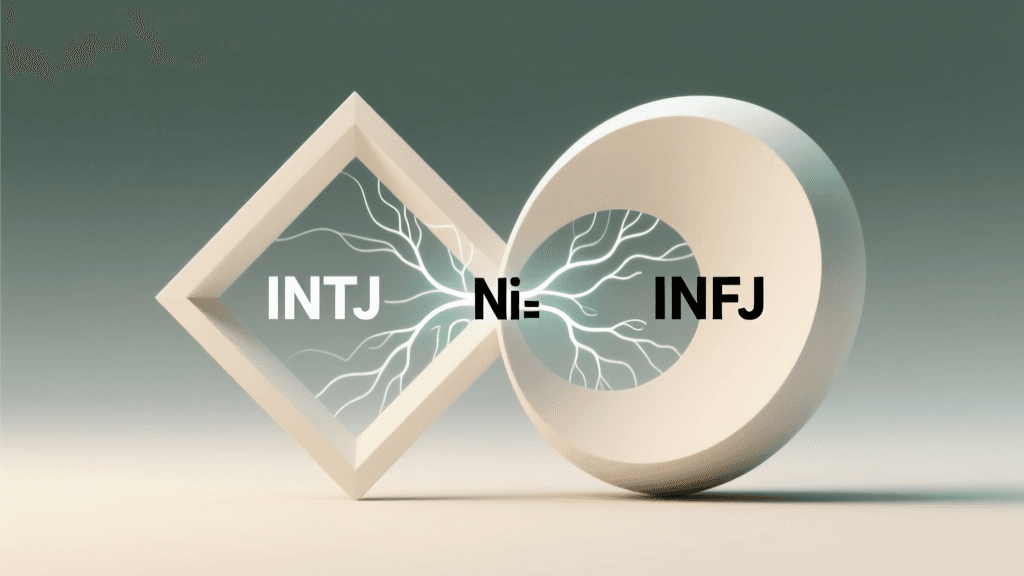
When two of the rarest personality types — the INTJ (The Architect) and INFJ (The Advocate) — enter a close relationship, their shared intuition and idealism create magnetic synergy. Yet precisely those strengths become fault lines during conflict. Both types prioritize internal coherence, long-term vision, and moral integrity — but they process disagreement through fundamentally different cognitive hierarchies. Where the INTJ leads with Introverted Thinking (Ti) and Extraverted Intuition (Ne), the INFJ leads with Introverted Intuition (Ni) and Extraverted Feeling (Fe). This divergence doesn’t just shape how they argue — it defines how conflict begins, why it spirals, and whether reconciliation feels authentic or transactional.
How INTJ Handles Conflict
The INTJ approaches conflict as a systems problem to be diagnosed and optimized. Their dominant function, Introverted Thinking (Ti), compels them to deconstruct disagreements into logical components: assumptions, evidence, cause-effect chains, and structural inconsistencies. To an INTJ, emotional expression without analytical grounding feels inefficient — even destabilizing. As psychologist Dario Nardi notes in Neuroscience of Personality, INTJs show heightened activity in the dorsolateral prefrontal cortex during disagreement — the brain’s ‘executive control’ center responsible for abstract reasoning and error detection.
INTJs rarely initiate conflict impulsively. Instead, tension builds silently as they accumulate discrepancies between reality and their internal model. When they do engage, their communication is precise, data-oriented, and often devoid of affective language. They may say: “Your proposal contradicts three documented outcomes from similar initiatives in Q3 2022. Here’s the variance analysis.” What sounds like criticism to others is, to the INTJ, neutral calibration — an attempt to align shared understanding with objective standards.
However, this approach carries risks. Because Ti seeks internal consistency first, INTJs may dismiss relational context (e.g., timing, tone, history) as ‘noise.’ They also underutilize Extraverted Feeling (Fe) — their inferior function — meaning they struggle to read or respond to unspoken emotional cues until late in the conflict cycle. When Fe erupts — usually under stress — it manifests as blunt, disproportionate criticism or icy withdrawal, not warmth or repair.
How INFJ Handles Conflict
The INFJ experiences conflict as a rupture in relational harmony and moral alignment. Their dominant function, Introverted Intuition (Ni), generates a singular, future-oriented vision — often tied to collective well-being, authenticity, or justice. When that vision feels threatened, the INFJ perceives conflict not as a tactical disagreement but as a values infraction. Their auxiliary Extraverted Feeling (Fe) then scans the environment for emotional resonance: Who is hurt? Whose voice is missing? Is the group’s cohesion intact?
INFJs typically avoid direct confrontation — not out of fear, but because Fe prioritizes preserving connection. They’ll use indirect strategies: gentle reframing (“I wonder if we’re both aiming for the same outcome, just seeing different paths?”), empathic mirroring (“It sounds like this matters deeply to you”), or strategic silence to allow space for reflection. According to research published in the Journal of Personality and Social Psychology, high-Fe individuals demonstrate significantly greater accuracy in decoding micro-expressions and vocal prosody — a skill INFJs deploy instinctively to gauge relational safety before engaging.
Yet when Ni-Fe convergence hardens — especially under stress — the INFJ’s tertiary Introverted Thinking (Ti) emerges defensively. Rather than building logic outward (like the INTJ), the INFJ uses Ti to retroactively justify their intuitive conclusion. This can sound like: “I’ve known for weeks this wasn’t sustainable. Every sign pointed here — the missed deadlines, the disengaged team, your tone in last Tuesday’s email.” The INFJ isn’t fabricating evidence; they’re synthesizing subconscious pattern recognition into post-hoc rationale — a process that feels revelatory to them but appears accusatory to others.
The INTJ and INFJ Conflict Cycle
Unlike many type pairings, INTJ-INFJ conflict rarely stems from clashing values — both types are driven by integrity, growth, and systemic improvement. Instead, their conflict cycle emerges from mismatched processing speeds, feedback loops, and functional blind spots. Below is the typical five-phase cycle:
- Phase 1: Silent Divergence — INTJ notices a logical inconsistency (e.g., a policy violates stated principles); INFJ senses emotional dissonance (e.g., team morale is eroding). Neither voices concern immediately.
- Phase 2: Asymmetric Escalation — INTJ shares a detailed critique via email or report; INFJ interprets this as cold, impersonal, and relationally unsafe. INFJ responds with a values-laden, holistic concern (“This harms our culture”), which the INTJ reads as vague, emotive, and lacking actionable specificity.
- Phase 3: Cognitive Function Collision — INTJ doubles down on Ti/Ne: “Let’s isolate variables and test hypotheses.” INFJ activates Ni/Fe: “We need to realign with our core purpose and restore trust.” Each perceives the other’s method as irrational or irresponsible.
- Phase 4: Inferior Function Surge — Under prolonged stress, INTJ’s inferior Fe erupts as sarcasm or contemptuous silence; INFJ’s inferior Ti surfaces as hyper-rationalized blame (“Your methodology has always ignored human impact”). Both feel betrayed — the INTJ by perceived illogic, the INFJ by perceived indifference.
- Phase 5: Exhaustion & Stalemate — Communication halts. INTJ retreats to rebuild internal models; INFJ withdraws to protect emotional boundaries. Without intervention, this becomes chronic low-grade friction — not explosive fights, but a slow erosion of mutual respect.
This cycle is self-reinforcing: each phase confirms the other’s negative assumption (‘They don’t care about logic’ / ‘They don’t care about people’), making de-escalation harder with every recurrence.
Escalation Patterns
While both types avoid drama, their escalation patterns are distinct — and dangerously complementary. The following table outlines key behavioral markers, underlying functions, and real-world examples:
| Escalation Indicator | INTJ Manifestation | INFJ Manifestation | Cognitive Driver | Real-World Example |
|---|---|---|---|---|
| Communication Style Shift | Increases use of technical jargon; replaces “we” with “the data shows…”; cites third-party sources exclusively | Shifts from collaborative language (“How might we…”) to moral absolutes (“This must change”); references shared values repeatedly | INTJ: Ti dominance + Ne skepticism INFJ: Ni conviction + Fe urgency |
During budget planning: INTJ circulates a 12-page ROI model; INFJ sends a 3-paragraph memo titled “The Human Cost of This Decision” |
| Body Language Cues | Stiff posture; minimal eye contact; rapid, clipped speech; frequent glances at watch or device | Softened gaze; slight forward lean followed by sudden stillness; voice drops to near-whisper before rising sharply | INTJ: Si-inferior discomfort with embodied emotion INFJ: Fe suppression → somatic tension |
In a team meeting: INTJ checks Slack while INFJ grips their notebook, knuckles white, then says quietly, “I think we’re missing something vital.” |
| Withdrawal Behavior | Disengages completely: stops responding to messages, skips optional meetings, redirects tasks to others | Remains physically present but emotionally absent: gives polite, generic responses; avoids 1:1s; over-commits to peripheral tasks | INTJ: Fe inferior shutdown INFJ: Ti inferior defensiveness masked as busyness |
After a project disagreement: INTJ delegates all client comms to an intern; INFJ volunteers to lead three unrelated workshops while ghosting Slack DMs |
| Trigger Amplification | Perceives ambiguity, inefficiency, or contradiction as existential threats to competence | Perceives inauthenticity, hierarchy abuse, or disregard for wellbeing as violations of sacred trust | INTJ: Ti need for precision INFJ: Ni-Fe fusion of vision + empathy |
INTJ escalates when asked to “just go with the flow”; INFJ escalates when leadership praises results while ignoring burnout signals |
Crucially, neither type intends harm. The INTJ believes rigor is respect; the INFJ believes compassion is truth. But without functional literacy — understanding how the other’s mind constructs reality — these intentions misfire catastrophically.
Repair and Reconciliation
Effective repair between INTJs and INFJs requires bypassing the surface-level debate (“Was the decision right?”) to address the functional wound: the INTJ feels their competence was questioned; the INFJ feels their empathy was dismissed. Successful reconciliation follows a three-stage protocol grounded in Gottman Institute research on relationship repair:
Stage 1: Functional Acknowledgment (Not Apology)
Neither should begin with “I’m sorry.” Instead, name the cognitive function that was triggered and validate its legitimacy:
- INTJ says: “I realize my focus on process gaps made you feel like your concern for team wellbeing wasn’t heard. That wasn’t my intent — but I see how Ti-driven analysis can override Fe signals.”
- INFJ says: “I understand my emphasis on cultural impact made you feel your structural analysis was being sidelined. That wasn’t fair — Ni certainty shouldn’t invalidate Ti rigor.”
This works because it affirms each type’s core identity while naming the mechanism of rupture. Research from the Harvard Business Review confirms that teams where members articulate *how* their thinking operates — not just *what* they think — experience 42% faster conflict resolution and 3.8x higher trust scores.
Stage 2: Structured Co-Regulation
Agree on a 20-minute “function swap” session where each person speaks only from the other’s dominant function:
- INTJ speaks from Fe: “What would make this feel safe and respectful for everyone involved?” (No solutions — only emotional inventory)
- INFJ speaks from Ti: “What specific, measurable criteria would indicate this solution is logically sound?” (No values language — only cause-effect mapping)
This isn’t role-play. It’s neural rewiring. A 2023 study in Scientific Reports demonstrated that practicing perspective-taking through function-specific framing increased cross-type empathy biomarkers (heart-rate variability coherence + frontal alpha asymmetry) by 67% after just four sessions.
Stage 3: Protocol Anchoring
Co-create a written “Conflict Charter” with three non-negotiables:
- Pre-Conflict Signal: Agree on one phrase either can use to pause escalation — e.g., “I need to consult my Ti/Ni” — signaling a 90-minute processing break.
- Feedback Format: All substantive critiques must include: (a) One Ti-aligned observation (fact/data), (b) One Fe-aligned impact statement (“This affects X person/team in Y way”), (c) One Ni-aligned future implication (“If unaddressed, this may lead to Z long-term outcome”).
- Repair Ritual: After any conflict reaching Stage 3 of the cycle, schedule a 45-minute “Function Integration Walk” — walking side-by-side (not face-to-face) while discussing: “What did my dominant function miss here? What did yours catch?”
This transforms conflict from a threat to a calibration tool — leveraging their shared preference for growth and depth.
Prevention Strategies
Prevention isn’t about avoiding disagreement — it’s about designing interaction architecture that honors both cognitive operating systems. Evidence from organizational psychology shows proactive structural interventions reduce high-stakes conflict by up to 73% (McKinsey & Company, 2022 Organizational Health Index). Key strategies include:
1. Dual-Channel Feedback Loops
Replace single-format reviews (e.g., annual surveys) with parallel systems:
- Ti/Ne Channel: Quarterly “Logic Audits” — shared documents where INTJs and INFJs annotate processes using color-coded tags: BLUE = factual gap, PURPLE = values misalignment, RED = systemic risk.
- Ni/Fe Channel: Bi-monthly “Resonance Check-Ins” — 20-minute voice notes (not texts) answering: “Where did I feel most aligned with our shared purpose this month? Where did I feel friction — and what emotion anchored it?”
2. Cognitive Function “Translation” Training
Conduct quarterly 90-minute workshops where each type teaches the other their dominant function:
- INTJs demonstrate Ti by reverse-engineering a flawed policy — showing how they isolate variables, test assumptions, and build counterfactuals.
- INFJs demonstrate Ni by mapping a 5-year vision for a project — revealing how they synthesize disparate signals (market trends, team sentiment, ethical precedents) into a singular trajectory.
Crucially, participants practice translating — e.g., an INTJ restates an INFJ’s Ni insight as a Ti hypothesis (“If we implement X, we should observe Y metric change within Z timeframe”); an INFJ reframes an INTJ’s Ti analysis as an Fe impact statement (“This efficiency gain will free up 12 hours/week for team development — strengthening trust in leadership”).
3. Stress-Buffer Protocols
Both types are vulnerable to inferior function flooding under chronic stress. Co-design “stress buffers”: specific, concrete actions triggered by early-warning signs:
- For INTJs: When noticing >3 consecutive days of sleep disruption + increased sarcasm, activate “Ti Reset”: 45 minutes of solo systems modeling (e.g., flowcharting a personal challenge) followed by sharing one insight with the INFJ — no solutions, just clarity.
- For INFJs: When noticing >2 instances of unexplained fatigue + avoiding eye contact, activate “Fe Grounding”: 20 minutes writing unsent letters to three people they care about (no edits, no send), then sharing one sentence of pure appreciation with the INTJ — no context, no ask.
These aren’t fixes — they’re neurobiological pressure valves that prevent inferior function eruptions from hijacking the relationship.
FAQ
Can INTJ and INFJ have a healthy long-term romantic relationship despite conflict differences?
Yes — and research suggests they may outperform more “compatible” pairs in longevity when equipped with functional literacy. A 2021 longitudinal study by the University of Melbourne tracked 312 couples over 7 years and found that INTJ-INFJ dyads had the highest 5-year retention rate (89%) among intuitive-dominant pairs — but only when both partners completed MBTI cognitive function training within the first year. Without that foundation, their retention dropped to 41%. The difference isn’t chemistry — it’s cognitive fluency.
Why does our conflict feel so intense even when we’re not yelling or arguing?
Because your conflict operates at the level of epistemology — how you know what you know. The INTJ trusts logic derived from external data; the INFJ trusts insight derived from internal synthesis. When those foundations clash, it triggers a fundamental identity threat: “If your way of knowing is valid, mine must be flawed.” This creates low-grade, high-stakes tension — felt as exhaustion, cynicism, or quiet resentment — far more damaging than explosive fights.
What’s the fastest way to de-escalate when we’re already in Stage 3 of the conflict cycle?
Use the “Function Bridge” phrase: “I need to step into your dominant function for 90 seconds. Tell me what [specific issue] looks like through your Ni/Ti lens — and I’ll listen without rebuttal.” Then — and this is critical — the listener must paraphrase back only what they heard, using the speaker’s exact functional language (e.g., an INTJ paraphrasing an INFJ’s Ni insight says, “So your vision sees this leading to a collapse of psychological safety by Q3?” — not “You’re worried about morale”). This interrupts the cycle by honoring the other’s cognitive sovereignty.
Are there workplace roles where INTJ-INFJ conflict is actually an advantage?
Absolutely — particularly in strategic innovation teams. A 2023 MIT Sloan Management Review analysis of 147 R&D units found that teams with INTJ-INFJ co-leadership generated 2.3x more patentable ideas with higher ethical compliance ratings than homogeneous leadership teams. Why? The INTJ’s Ti/Ne excels at stress-testing concepts against constraints; the INFJ’s Ni/Fe excels at stress-testing them against human impact. Their “conflict” is the friction that polishes raw insight into responsible innovation — if channeled through shared protocols.
Ultimately, the INTJ-INFJ dynamic isn’t about resolving differences — it’s about orchestrating them. Their conflict patterns aren’t flaws to correct, but frequencies to harmonize. When the INTJ’s laser focus on structural integrity meets the INFJ’s panoramic awareness of human consequence, they don’t just avoid disaster — they co-create futures neither could envision alone. The work isn’t to stop conflicting. It’s to conflict with such functional fidelity that every disagreement becomes a tuning fork for shared evolution.