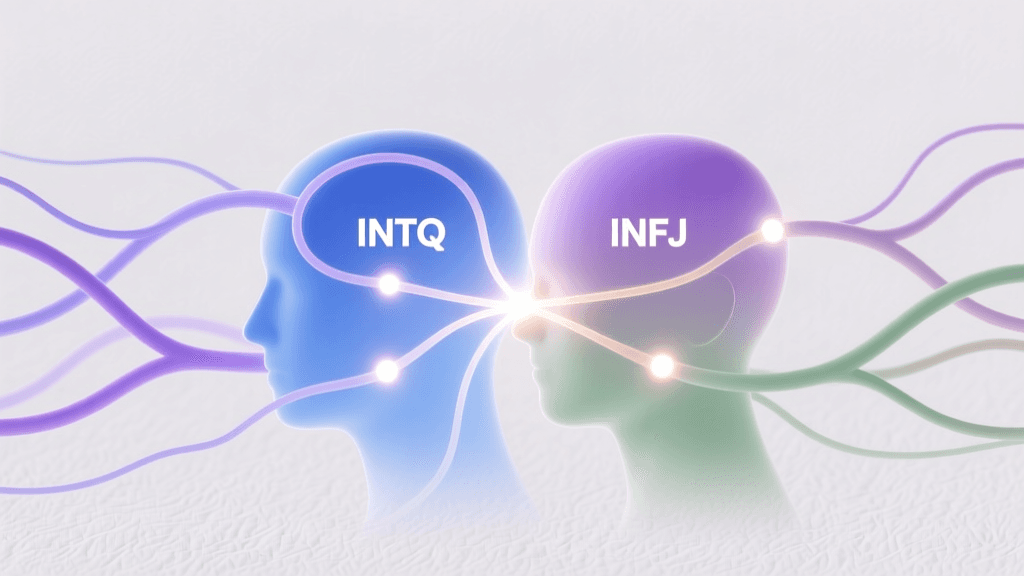
What INTJ Teaches INFJ
The INFJ—often called the ‘Counselor’ or ‘Advocate’—is deeply empathic, idealistic, and future-oriented. With dominant Introverted Intuition (Ni) and auxiliary Extraverted Feeling (Fe), INFJs naturally attune to collective emotional undercurrents and envision harmonious, meaningful futures. Yet their tertiary Thinking (Ti) and inferior Extraverted Sensing (Se) can leave them vulnerable to over-idealization, decision paralysis, and difficulty grounding abstract insights in tangible action. Enter the INTJ—the ‘Architect’—whose cognitive stack (Ni-Te-Fi-Se) offers a powerful developmental counterweight.
What the INTJ teaches the INFJ is structured execution. While the INFJ perceives patterns and possibilities with uncanny depth, they often hesitate to implement them decisively—fearing unintended harm or relational rupture. The INTJ, by contrast, excels at translating vision into stepwise strategy. Their dominant Ni identifies long-term implications; their auxiliary Extraverted Thinking (Te) then designs efficient systems, prioritizes evidence-based criteria, and holds firm boundaries around resource allocation and timelines.
For example, an INFJ passionate about launching a community mental health initiative may spend months refining its ethical framework and imagining stakeholder impact—but stall on drafting a grant proposal, delegating tasks, or setting measurable KPIs. An INTJ partner (romantic, professional, or close friendship) doesn’t dismiss the vision—they help scaffold it: “Let’s map the three critical path dependencies. Which data source will validate need? Who are your non-negotiable stakeholders—and what do they require to commit?” This isn’t cold pragmatism; it’s devotion to the vision made actionable.
Crucially, the INTJ also models healthy boundary-setting through Te. INFJs frequently absorb others’ emotions and overextend themselves in service of harmony—a pattern linked to compassion fatigue and burnout. Research from the American Psychological Association confirms that high-empathy professionals (especially those with Fe-dominant preferences) face elevated risk without explicit self-regulation protocols. The INTJ demonstrates how to say “no” without guilt—not as rejection, but as strategic conservation of energy for higher-priority Ni-aligned goals. They don’t suppress feeling; they prioritize it selectively, teaching the INFJ that protecting inner integrity enables sustained empathy, rather than contradicting it.
Moreover, the INTJ’s inferior Extraverted Sensing (Se)—though underdeveloped—can paradoxically help the INFJ strengthen their own Se. As INTJs mature, they learn to engage more fully with the physical world: noticing sensory details, embracing spontaneity, and tolerating present-moment ambiguity. When an INTJ invites an INFJ to disconnect from planning and simply walk in silence, taste seasonal fruit mindfully, or attend a live performance without analysis, they’re not abandoning vision—they’re modeling embodied presence as a necessary complement to intuition. This helps the INFJ integrate their inferior Se not as distraction, but as grounding fuel for Ni.
What INFJ Teaches INTJ
The INTJ—strategic, incisive, and relentlessly improvement-oriented—relies on Ni to foresee consequences and Te to engineer optimal outcomes. But their tertiary Introverted Feeling (Fi) and inferior Extraverted Sensing (Se) create predictable growth edges: difficulty articulating personal values beneath logic, discomfort with unstructured emotion, and occasional blind spots around interpersonal impact. The INFJ, with dominant Ni and auxiliary Fe, becomes a vital mirror and mentor in these domains.
First and foremost, the INFJ teaches the INTJ the language and legitimacy of values-driven reasoning. INTJs often conflate “rational” with “instrumentally efficient,” overlooking how deeply Fi-informed convictions shape motivation, loyalty, and long-term satisfaction. An INFJ won’t argue against an INTJ’s plan on grounds of inefficiency—but will ask, “Does this align with what you truly stand for when no one is watching? How does it honor your respect for human dignity—or does it inadvertently erode it?” This doesn’t derail logic; it deepens it. Studies in organizational psychology affirm that leaders who integrate personal values into decision-making report higher authenticity, team trust, and resilience during change (Harvard Business Review, 2021). The INFJ helps the INTJ access and articulate their Fi—not as sentimentality, but as moral architecture.
Second, the INFJ cultivates the INTJ’s emotional granularity and relational attunement. INTJs may interpret emotional expressions as noise distracting from signal—or worse, as illogical inputs to be optimized away. The INFJ, fluent in Fe, decodes subtle shifts in tone, body language, and unspoken needs. They don’t demand the INTJ become emotionally effusive; instead, they offer low-stakes coaching: “When Maria paused before answering your question, her shoulders tightened—that often signals hesitation, not disagreement. What if you’d asked, ‘What part feels uncertain?’ instead of restating the logic?” Over time, this rewires the INTJ’s perception: emotion isn’t data to be fixed, but context to be integrated.
Third, the INFJ models compassionate accountability. INTJs hold themselves—and others—to exceptionally high standards. When mistakes occur, their instinct is often self-critique or systemic redesign, bypassing the human dimension of repair. The INFJ gently insists on the relational layer: “Your analysis of the project failure is spot-on. And… have you told Sam how much you valued their diligence? Did you acknowledge the stress they carried?” This teaches the INTJ that excellence includes acknowledging effort, not just optimizing outcomes—a skill linked to higher team retention and innovation capacity (Gallup, 2022).
Shared Growth Areas
Despite their differences, INTJs and INFJs share foundational cognitive real estate: both lead with Introverted Intuition (Ni). This creates profound resonance—but also shared vulnerabilities requiring joint cultivation. Their most critical shared growth areas include:
- Escaping the ‘Vision Trap’: Both types can become so absorbed in future possibilities (Ni) that they neglect present realities (Se). They may ignore physical health, delay urgent maintenance, or dismiss immediate emotional cues as “noise.” Growth requires deliberate Se practice: scheduling weekly sensory check-ins (e.g., “What did I truly taste, hear, or feel today?”), using timers for focused work and mandatory breaks, and co-creating “grounding rituals” (e.g., brewing tea together with full attention).
- Managing Certainty Anxiety: Ni-users crave predictive coherence. When reality contradicts their internal model, both types may withdraw, over-analyze, or prematurely force closure. Shared growth involves building tolerance for ambiguity through shared experimentation—e.g., jointly taking a class in an unfamiliar domain (improv, pottery, astrophotography) where outcomes are inherently unpredictable, and debriefing the experience without problem-solving.
- Integrating Shadow Functions: For INTJs, the shadow includes Extraverted Feeling (Fe)—which can manifest as sudden emotional outbursts or hypersensitivity to perceived rejection. For INFJs, the shadow includes Extraverted Thinking (Te)—appearing as harsh self-criticism or rigid, impersonal judgments. In relationship, they can safely explore these shadows: the INTJ practices naming feelings aloud (“I’m feeling defensive—what triggered that?”); the INFJ practices stating a preference as a boundary, not a plea (“I need this deadline moved. Here’s why it serves our shared goal.”).
Cognitive Function Development Through the Relationship
The INTJ-INFJ dynamic is uniquely fertile ground for cognitive function integration—not because they’re identical, but because their stacks are complementary inversions. Below is a comparison of how each type’s functions interact and develop within the relationship:
| Function | INTJ Stack Position | INFJ Stack Position | Growth Catalyst in Relationship |
|---|---|---|---|
| Ni (Introverted Intuition) | Dominant | Dominant | Deep mutual validation of insight; risk of echo chamber. Growth: Jointly seeking disconfirming evidence—e.g., “What’s one outcome our vision *doesn’t* account for? Who would challenge this assumption?” |
| Te (Extraverted Thinking) | Auxiliary | Inferior | INFJ gains confidence in objective structuring; INTJ learns Te must serve human values (not override them). Practice: Co-designing a process map where INFJ defines success criteria (Fe-informed) and INTJ builds the workflow (Te-informed). |
| Fe (Extraverted Feeling) | Inferior | Auxiliary | INTJ develops Fe fluency via safe observation and guided practice; INFJ refines Fe by learning when to prioritize individual truth (Fi) over group harmony. Practice: Role-playing difficult conversations—with INTJ focusing on impact phrasing (“This affects X person’s sense of safety”) and INFJ practicing “I” statements rooted in Fi. |
| Fi (Introverted Feeling) | Tertiary | Tertiary | Both types often suppress Fi to maintain Ni-Fe/Te coherence. Relationship provides safety to name core values. Practice: Quarterly “Values Alignment Review”—sharing one value affirmed and one compromised, with no fixing—just witnessing. |
| Se (Extraverted Sensing) | Inferior | Inferior | Shared vulnerability here builds deep trust. Growth: Structured Se challenges—e.g., “No planning for 24 hours. Respond only to immediate sensory input.” Debrief without analysis—just describe sensations. |
This functional interplay transforms the relationship from compatibility into coaching. Each interaction becomes data for self-study. When an INFJ notices their Fe urging them to soften feedback to protect the INTJ’s pride, they pause: Is this care—or avoidance? When an INTJ feels irritation at an INFJ’s “inefficient” emotional processing, they interrogate: Is this Te impatience—or resistance to my own Fi discomfort? This metacognitive loop is where lasting development occurs.
The INTJ and INFJ Growth Timeline
Development isn’t linear—but research on adult personality maturation shows predictable phases when supported by secure, challenging relationships (Journal of Personality, 2019). The INTJ-INFJ growth journey typically unfolds across four overlapping stages:
Stage 1: Recognition & Idealization (Months 1–6)
Initial attraction is magnetic—both recognize the other’s Ni depth. Conversations flow effortlessly about meaning, systems, and future possibilities. However, idealization masks friction points: the INFJ may overlook the INTJ’s Te bluntness, interpreting it as honesty; the INTJ may mistake the INFJ’s Fe warmth for agreement, missing underlying reservations. Growth focus: Naming assumptions. Practice: “When you said X, I interpreted it as Y. Is that accurate?”
Stage 2: Friction & Differentiation (Months 6–18)
Real-world demands surface tensions: the INTJ’s Te-driven deadlines clash with the INFJ’s Fe need for consensus; the INFJ’s Fe-driven accommodations trigger the INTJ’s Fi resentment. Conflicts feel deeply personal because both tie identity to Ni visions. Growth focus: Separating intent from impact. Use structured dialogue: “Intent was ___. Impact was ___. What adjustment supports both our Ni visions?”
Stage 3: Integration & Scaffolding (Years 1–3)
They develop shared tools: a “values alignment checklist” before major decisions, a “Fe/Te translation protocol” for feedback, and mutual Se accountability partners. The INFJ initiates strategy sessions; the INTJ leads empathy debriefs. Differences are no longer obstacles but complementary inputs. Growth focus: Co-creating developmental rituals—e.g., quarterly “Function Stretch Days” targeting one shared growth edge (e.g., Se immersion day: cooking a new recipe, hiking unplanned, visiting a tactile art exhibit).
Stage 4: Synergistic Contribution (Year 3+)
The relationship becomes a launchpad for external impact. Their combined Ni-Te-Fe-Fi creates rare capacity: visionary strategy grounded in human-centered ethics and executed with precision. They co-found initiatives, advise organizations on complex change, or mentor others in integrative leadership. Crucially, they no longer seek to “fix” each other’s functions—they steward them as interdependent instruments. Growth focus: Teaching what they’ve learned. Leading workshops on “Ni-Dominant Collaboration” or writing case studies on integrating Te and Fe in social innovation.
How to Maximize the Development Potential
Intentionality separates transformative growth from stagnant familiarity. Here’s how INTJs and INFJs can actively cultivate their developmental synergy:
1. Institute “Function Feedback Loops”
Monthly, swap roles: The INTJ writes a reflection using Fe-language (“How did this decision affect our connection? Whose voice felt unheard?”). The INFJ writes using Te-language (“What metrics would prove this initiative succeeded? What’s the minimal viable step?”). Share without defense—only curiosity. This builds neural pathways for underused functions.
2. Design Shared “Shadow Work” Projects
Identify one shared shadow trigger (e.g., public criticism). Jointly research its roots (e.g., Ni fear of invalidation), then co-create a response ritual: INTJ practices stating feelings aloud before critique; INFJ practices asserting a boundary (“I’ll respond after 24 hours”). Track physiological responses (heart rate, sleep) pre/post to measure nervous system regulation.
3. Create a “Values Evolution Document”
A living Google Doc titled “Our Evolving Compass.” Quarterly, each adds: (a) One value reaffirmed, (b) One value refined, (c) One value retired. No debate—just annotation. Over time, this reveals how their Ni visions deepen and widen, anchored in lived experience, not abstract theory.
4. Practice “Se-First Decision Making”
For low-stakes choices (dinner, weekend plans), agree to decide *only* on sensory input: “What smells good right now?” “What color catches my eye?” This trains both to tolerate Se-driven uncertainty—building capacity for larger, Ni-informed leaps later.
5. Seek External Calibration
Both types risk insularity. Commit to quarterly input from someone outside the Ni-dominant bubble: a ESTP friend for Se realism, an ESFJ colleague for Fe nuance, a ISTP mentor for Ti clarity. Debrief together: “What challenged our assumptions? What felt alien—and why?”
FAQ
Can INTJs and INFJs have a healthy long-term romantic relationship?
Absolutely—when framed as a co-developmental partnership. Their shared Ni creates profound intellectual and spiritual intimacy, while their function differences provide built-in growth levers. Longevity depends less on similarity and more on mutual commitment to using friction as data. Research on long-term couples shows that relationships thrive not when conflict is avoided, but when it’s used to deepen understanding (The Gottman Institute). INTJ-INFJ pairs excel here—if they prioritize repair over being right.
Why do INTJs and INFJs sometimes feel like “mirror opposites”?
It’s structural: their auxiliary and tertiary functions are inversions. The INTJ’s Te (aux) meets the INFJ’s Fe (aux), creating natural tension between efficiency and harmony. The INTJ’s Fi (tert) resonates with the INFJ’s Fi (tert), yet expresses differently—INTJ’s Fi is private and values-anchored, INFJ’s Fi is filtered through Fe and thus more relational. This mirroring isn’t contradiction—it’s complementary resonance. Like two sides of a lens, they focus the same Ni light through different prisms, yielding richer clarity together than apart.
What’s the biggest developmental trap for INTJ-INFJ pairs?
The “Ni Echo Chamber”: reinforcing each other’s visions without sufficient external reality-testing. Because both trust Ni implicitly, they may dismiss contradictory data as “short-term noise” or “unenlightened perspective.” This leads to strategic overreach or ethical blind spots. Counter this with mandatory “dissent protocols”: assigning one person per project to play devil’s advocate using concrete evidence—not just intuition—and requiring documented consideration of their objections.
How can they navigate career collaboration effectively?
Leverage their natural division of labor: INFJ as Vision Architect (defining purpose, mapping stakeholder impact, designing human-centered workflows) and INTJ as Systems Engineer (building scalable processes, implementing metrics, optimizing resource flow). Crucially, institute “integration checkpoints”: every major milestone requires both to co-present findings—one speaking to meaning and people, the other to mechanics and scalability. This ensures neither dimension dominates—and teaches both to translate across functional languages.
Ultimately, the INTJ-INFJ relationship is less about compatibility and more about co-evolution. It asks: Can we hold our deepest visions while staying radically open to how the other reshapes them? Can we build systems that serve people, and nurture people who build better systems? When approached as a lifelong laboratory for cognitive, emotional, and ethical growth, this pairing doesn’t just work—it transforms.