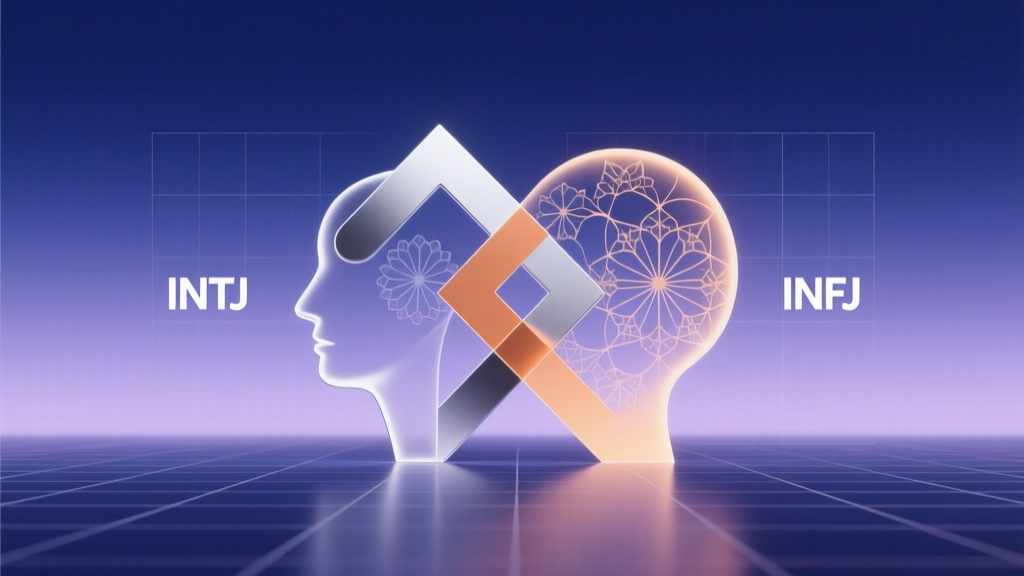
Core Values of INTJ
The INTJ (Introverted, Intuitive, Thinking, Judging) personality type—often dubbed the Architect or Mastermind—is guided by a rigorously internalized value system rooted in intellectual integrity, long-term efficacy, and principled autonomy. Unlike types that prioritize social harmony or emotional resonance as primary moral compasses, the INTJ’s ethical framework emerges from logical consistency, empirical validity, and systemic coherence.
At the heart of the INTJ value hierarchy lies truth over comfort. This isn’t merely a preference for factual accuracy—it’s a non-negotiable commitment to epistemic responsibility. As Isabel Briggs Myers noted in Gifts Differing, INTJs “value knowledge not for its own sake, but for what it enables: effective action grounded in reality.”https://www.mbtionline.com/books/gifts-differing/ For the INTJ, moral decisions are evaluated through a consequentialist–deontological hybrid lens: an action must both adhere to internally derived principles and produce objectively optimal outcomes over time.
INTJs deeply esteem intellectual sovereignty—the right and responsibility to think independently, revise beliefs in light of evidence, and reject dogma without apology. This often manifests as skepticism toward inherited traditions, institutional authority, or emotionally charged rhetoric unless substantiated by reason and data. Their sense of duty is less about fulfilling social roles and more about stewarding competence: they feel ethically obligated to deploy their strategic insight where it yields measurable improvement—whether in organizational systems, technological infrastructure, or philosophical frameworks.
Another cornerstone value is efficiency-as-ethics. To the INTJ, wastefulness—of time, resources, attention, or human potential—is not merely impractical; it’s morally negligent. This underpins their aversion to performative rituals, bureaucratic inertia, or sentiment-driven policies that lack demonstrable utility. Importantly, this efficiency ethic extends inward: INTJs hold themselves to exceptionally high standards of self-mastery, discipline, and continuous growth—viewing personal development as a lifelong moral project.
While often mischaracterized as emotionally detached, INTJs possess a quiet, fiercely held commitment to justice-as-structural integrity. They advocate not for egalitarianism as emotional idealism, but as a necessary condition for systemic resilience. An unjust hierarchy—say, one that rewards conformity over merit or silences dissenting expertise—undermines long-term viability. Thus, fairness to the INTJ is defined functionally: fair systems are those that reliably optimize for truth, competence, and sustainability.
Core Values of INFJ
The INFJ (Introverted, Intuitive, Feeling, Judging)—the Counselor or Advocate—operates from a value architecture centered on human dignity, empathic coherence, and transcendent meaning. Where the INTJ seeks truth through logic, the INFJ seeks truth through resonance: does this belief, action, or vision harmonize with the deepest potential of people and the world? Their moral intuition functions like a finely tuned moral sonar, detecting dissonance between stated ideals and lived impact.
INFJs are animated by what Carl Jung called the visionary function: Introverted Intuition (Ni) paired with Extraverted Feeling (Fe). This creates a unique moral orientation—one that synthesizes long-range foresight with collective emotional attunement. As psychoanalyst and MBTI researcher Naomi Quenk explains in Was That Really Me?, INFJs “experience values not as abstract rules but as living currents—energies that either nurture or erode the soul of individuals and communities.”https://www.cpp.com/products/was-that-really-me/ Their sense of right and wrong arises from an embodied sense of alignment: when words and actions cohere with inner conviction and uplift relational wholeness, moral clarity follows.
A defining INFJ value is authenticity-as-sacred-duty. To live in contradiction—to mask one’s convictions, betray one’s vision, or compromise core empathy for convenience—is experienced viscerally as spiritual injury. This fuels their strong aversion to hypocrisy, superficiality, and systems that commodify human experience. INFJs don’t just want justice; they seek restorative justice—outcomes that heal fractures, reintegrate alienated voices, and renew communal trust.
Equally central is meaning-making as vocation. INFJs rarely separate work from worship. Whether teaching, counseling, writing, or designing social programs, their labor is infused with a sense of sacred calling. As highlighted in research published by the Journal of Personality and Social Psychology, INFJs score highest among all 16 types on measures of intrinsic motivation tied to purpose, transcendence, and prosocial impact.https://psycnet.apa.org/record/2019-27843-001 Their life philosophy assumes that reality contains latent patterns of significance—patterns that can be revealed, honored, and woven into healing narratives.
INFJs also hold compassionate boundaries as an ethical imperative. While deeply attuned to others’ emotions, they do not equate empathy with self-abandonment. Their Fe is filtered through Ni: they protect their inner world not out of coldness, but to preserve the clarity needed to serve authentically. Saying “no” is not rejection—it’s stewardship of the very energy required to say “yes” with integrity.
Where Values Align for INTJ and INFJ
Despite surface differences—Thinking vs. Feeling, objective analysis vs. empathic resonance—INTJs and INFJs share profound, often underappreciated, value convergences. These alignments form the bedrock of their rare and potent compatibility, especially in long-term partnerships, intellectual collaborations, or mission-driven ventures.
First and foremost: both types are dominant Intuitives with Judging attitudes. This means they share a future-oriented, pattern-seeking cognition and a drive to structure meaning—not just gather information. Neither is satisfied with surface explanations or reactive solutions. Both ask: What underlying principle governs this? What long-term trajectory does this initiate? How does this serve the highest-order vision? This shared cognitive architecture fosters deep mutual respect—even when conclusions differ, the process feels familiar and valid.
Second, both types rank integrity above popularity. Neither will sacrifice core convictions to appease group consensus. The INTJ refuses to dilute truth for social ease; the INFJ refuses to mute compassion for ideological purity. Though their definitions of “integrity” differ—logical fidelity versus empathic fidelity—their courage to stand apart is structurally identical. In relationships, this creates a rare sanctuary: a space where disagreement is not betrayal, but evidence of shared seriousness.
Third, both are purpose-obsessed. While INTJs define purpose through mastery and systemic optimization (“How do we build the most resilient, truthful, efficient world?”), INFJs define it through integration and soulful flourishing (“How do we awaken the highest potential in people and systems?”). Yet these are complementary vectors—not opposing forces. An INTJ’s blueprint gains moral gravity through INFJ vision; an INFJ’s vision gains structural viability through INTJ execution. Together, they form what psychologist Mihaly Csikszentmihalyi might call a flow partnership: each elevates the other’s strengths while compensating for blind spots.
Fourth, both exhibit deep reverence for knowledge—but with distinct epistemologies. The INTJ venerates knowledge that predicts, controls, and refines. The INFJ venerates knowledge that reveals, connects, and heals. When aligned, this duality becomes extraordinary: the INTJ identifies the leverage point (e.g., algorithmic bias in hiring tools); the INFJ articulates the human cost and designs the reparative intervention (e.g., inclusive assessment frameworks co-created with marginalized candidates). Their combined output isn’t just smarter—it’s wiser.
To illustrate these alignments concretely, consider the following comparative table:
| Value Dimension | INTJ Expression | INFJ Expression | Alignment Mechanism |
|---|---|---|---|
| Moral Foundation | Principled rationality: Ethics derived from logical consistency + long-term consequences | Empathic coherence: Ethics derived from relational impact + archetypal resonance | Both reject utilitarianism divorced from principle; both require moral reasoning to be grounded—in logic or in humanity—not arbitrary. |
| View of Truth | Objective, verifiable, and revisable via evidence | Subjective-experiential, yet universalizable through shared human depth | Both treat truth as dynamic, not static; both see it as something to be discovered, not imposed. |
| Role of Vision | Strategic foresight: Mapping optimal pathways to desired futures | Prophetic insight: Perceiving latent potentials and moral imperatives | Shared Ni dominance means both live in the “long now”—prioritizing legacy over immediacy. |
| Response to Injustice | Designs systemic corrections (e.g., policy reform, AI auditing) | Facilitates healing narratives (e.g., restorative circles, trauma-informed design) | Complementary action: INTJ builds the scaffold; INFJ breathes life into it. |
Navigating Value Differences
Alignment does not mean identity—and the very strengths that bind INTJs and INFJs can intensify friction when values diverge. Recognizing these fault lines—and developing precise, actionable strategies to navigate them—is essential for sustainable compatibility.
Difference #1: The Pace and Priority of Emotional Processing
The INFJ’s Fe requires time and safety to process relational tension—not as delay, but as ethical necessity. They need to articulate feelings, test interpretations against shared values, and co-regulate before committing to decisions. The INTJ, whose auxiliary Extraverted Thinking (Te) seeks rapid resolution via logic, may misinterpret this as indecisiveness or emotional inefficiency. Conversely, the INFJ may perceive the INTJ’s swift, solution-oriented approach as dismissive or spiritually shallow.
Actionable Strategy: Institute a “two-phase dialogue protocol.” Phase One (INFJ-led): 20 minutes of open, non-judgmental feeling-sharing using reflective listening (“What I hear you saying is…”). Phase Two (INTJ-led): 20 minutes of collaborative problem-framing, using whiteboards or shared documents to map root causes, constraints, and viable options. Crucially, agree in advance that Phase One is not optional—it’s the ethical prerequisite for Phase Two’s efficacy.
Difference #2: Tolerance for Ambiguity in Moral Gray Zones
INTJs often seek definitive ethical algorithms: if X condition applies, then Y action is optimal. INFJs, however, dwell comfortably in moral paradox—holding contradictory truths (e.g., “This policy protects vulnerable populations and erodes civil liberties”) as necessary tensions requiring nuanced stewardship, not binary resolution.
Actionable Strategy: Co-create a “Moral Complexity Matrix.” List current dilemmas (e.g., workplace transparency vs. psychological safety; personal ambition vs. family needs). For each, define four quadrants: (1) Clear principle + clear action, (2) Clear principle + ambiguous action, (3) Ambiguous principle + clear action, (4) Ambiguous principle + ambiguous action. Assign each dilemma to a quadrant—and agree that Quadrant 4 issues require deliberate non-resolution for 48–72 hours, followed by joint journaling using prompts like: “What would my 80-year-old self advise here? What would be lost if we chose certainty over wisdom?”
Difference #3: Expression of Care and Commitment
INTJs show devotion through competence: fixing problems, optimizing systems, protecting autonomy. INFJs show devotion through attunement: remembering small details, offering presence, affirming identity. Without translation, these languages register as neglect. The INTJ hears “You never help me fix the leaky faucet” as criticism of utility; the INFJ hears “I scheduled your dentist appointment” as emotional bypassing.
Actionable Strategy: Implement a bi-weekly “Value Translation Exchange.” Each partner writes two sentences: (1) “One way I expressed care this week that felt meaningful to me,” and (2) “One way I wish care had been expressed, translated into the other’s language.” Example: INTJ writes, “I debugged the shared budget spreadsheet → I protected our future stability.” INFJ writes, “I brought you tea while you worked → I honored your focus as sacred.” Then discuss: “How could I have made the tea gesture feel like ‘protecting stability’? How could debugging feel like ‘honoring focus’?” This builds bidirectional fluency.
Spiritual and Philosophical Compatibility
INTJs and INFJs often find unexpected common ground in spirituality—not as doctrine, but as disciplined inquiry into ultimate questions. Neither type thrives in dogmatic religiosity; both are drawn to contemplative, non-literal, or philosophically rigorous traditions.
INTJs resonate with Stoicism, secular Buddhism, Advaita Vedanta, or systems philosophy—all of which emphasize discernment, impermanence, and the cultivation of rational equanimity. Their spiritual practice tends toward structured reflection: daily logic journals, causal mapping of suffering, or studying complexity theory as sacred text. As philosopher Martha Nussbaum observes in The Therapy of Desire, Stoic practice is “not emotional suppression but the redirection of attachment toward what is truly within our control—judgment, intention, response.”https://press.princeton.edu/books/paperback/9780691074592/the-therapy-of-desire This aligns seamlessly with the INTJ’s ethical project.
INFJs gravitate toward mystical Christianity, Sufism, Jungian depth psychology, or eco-spirituality—traditions that honor paradox, symbolic language, and the sacredness of inner transformation. Their practice emphasizes receptive stillness: dream journaling, active imagination, or ritualized acts of witness (e.g., lighting candles for collective grief). Here, spirituality is less about control and more about surrender-to-resonance.
Where they converge is in spiritual pragmatism: both demand that beliefs yield tangible fruit in character, relationship, and action. An INTJ will discard a meditation technique that doesn’t improve cognitive clarity; an INFJ will abandon a prayer practice that doesn’t deepen compassion. This shared empiricism prevents spiritual drift—and creates fertile ground for co-creation.
Practical integration example: Design a “Dual-Path Ritual.” Every Sunday morning, spend 30 minutes together—first 15 minutes in silent, structured reflection (INTJ’s domain: journal prompts like “What assumption did I defend this week that deserves scrutiny?”), followed by 15 minutes in guided imaginative dialogue (INFJ’s domain: “If my highest self were speaking to me now, what metaphor would it use? What color, texture, season?”). Then share insights—not to resolve, but to witness each other’s inner landscapes. Over time, this cultivates what theologian Parker Palmer calls “the courage to be torn apart and put back together again”—a shared spiritual resilience.
Building a Shared Life Vision
A shared life vision is not a static document—it’s a living covenant, regularly renewed through intentional dialogue and embodied action. For INTJ-INFJ pairs, this vision must satisfy two non-negotiable criteria: it must be logically coherent (INTJ) and soulfully resonant (INFJ). Achieving both demands methodological rigor.
Step 1: Draft Separate “Vision Manifestos”
Each partner spends 90 minutes writing unedited answers to: “In 20 years, what does our life do, create, and become—in ways that would make our younger selves weep with recognition?” No editing. No negotiation. Just raw, unfiltered aspiration.
Step 2: Conduct a “Resonance Audit”
Exchange manifestos. Independently highlight: (a) phrases that spark visceral yes-feelings (INFJ) or logical “aha” clarity (INTJ); (b) phrases that trigger discomfort—note whether it’s cognitive dissonance (INTJ) or empathic dissonance (INFJ); (c) concepts that appear in both but with different emphasis (e.g., “legacy” appears for both—INTJ defines it as “systems I built that endure”; INFJ defines it as “lives I helped remember their wholeness”).
Step 3: Co-Create the “Convergence Charter”
Using only the highlighted “yes” elements, draft a 1-page charter with three sections:
- North Star Principles (3–5 non-negotiable values, phrased to satisfy both: e.g., “We steward truth with compassion” instead of “We value honesty” or “We value kindness”)
- Legacy Metrics (measurable, non-transactional outcomes: e.g., “By 2040, at least 3 people credit our mentorship with enabling their courageous life pivot”)
- Ritual Anchors (quarterly practices that reinforce the vision: e.g., “Annual ‘Impact Inventory’: Review all projects through dual lenses—‘Did this optimize systemic integrity?’ (INTJ) and ‘Did this deepen human belonging?’ (INFJ)”)
This charter is reviewed every 6 months—not to change goals, but to assess whether daily habits, resource allocation, and relational energy align with the vision’s spirit. Discrepancies aren’t failures; they’re data points for recalibration.
FAQ
Can INTJs and INFJs have spiritual disagreements that break trust?
Yes—but rarely over doctrine, and almost always over epistemic violence: when one dismisses the other’s way of knowing as invalid. An INTJ saying, “That’s just emotional reasoning” wounds an INFJ as deeply as an INFJ saying, “You’re being heartless” wounds an INTJ. Trust breaks not from difference, but from contempt. Repair requires explicit acknowledgment: “I invalidated your way of arriving at truth. My intent was precision, not dismissal. Help me understand how your insight emerged.”
Do INTJ-INFJ couples struggle with political differences?
Surprisingly, less than most pairings—because both types prioritize principled consistency over tribal affiliation. An INTJ libertarian and INFJ democratic socialist may fiercely debate policy, but often discover shared foundations: both oppose authoritarianism, both champion evidence-based solutions, both view poverty as systemic failure—not moral failing. The conflict is usually methodological (how to achieve justice), not moral (whether justice matters).
How do INTJs and INFJs handle moral failures—like lying or betrayal?
Both respond with profound gravity—but differently. The INTJ initiates repair through structural accountability: “Here’s exactly what happened, why it violated our agreed principles, and the concrete steps I’ll take to prevent recurrence.” The INFJ initiates through relational reconnection: “I feel devastated. Can we sit with this rupture together before solving it?” Successful reconciliation requires honoring both sequences: INTJ must allow space for grief before solutions; INFJ must accept that accountability is itself an act of love.
Is long-term compatibility possible if one partner is religious and the other atheist?
Yes—if both treat spirituality as a practice of meaning-making, not a set of truth-claims. An INFJ Christian might frame prayer as “attuning to divine compassion,” while an INTJ atheist frames meditation as “optimizing neuroplasticity for ethical responsiveness.” What matters is shared commitment to the function of the practice—not its metaphysical label. Research from the Pew Research Center confirms that interfaith couples with high levels of shared values and low levels of doctrinal rigidity report marital satisfaction equal to or higher than same-faith couples.https://www.pewresearch.org/religion/2023/05/17/interfaith-marriages-in-the-u-s/
In conclusion, the INTJ-INFJ bond is not about finding a mirror—it’s about forging a prism. Their differences in moral expression, spiritual language, and philosophical emphasis don’t cancel each other out; they refract shared values into richer, more multidimensional light. When grounded in mutual reverence for the integrity of thought and feeling, such a partnership doesn’t just survive value complexity—it thrives within it, becoming a living laboratory for what it means to build a life that is both brilliantly rational and profoundly humane.