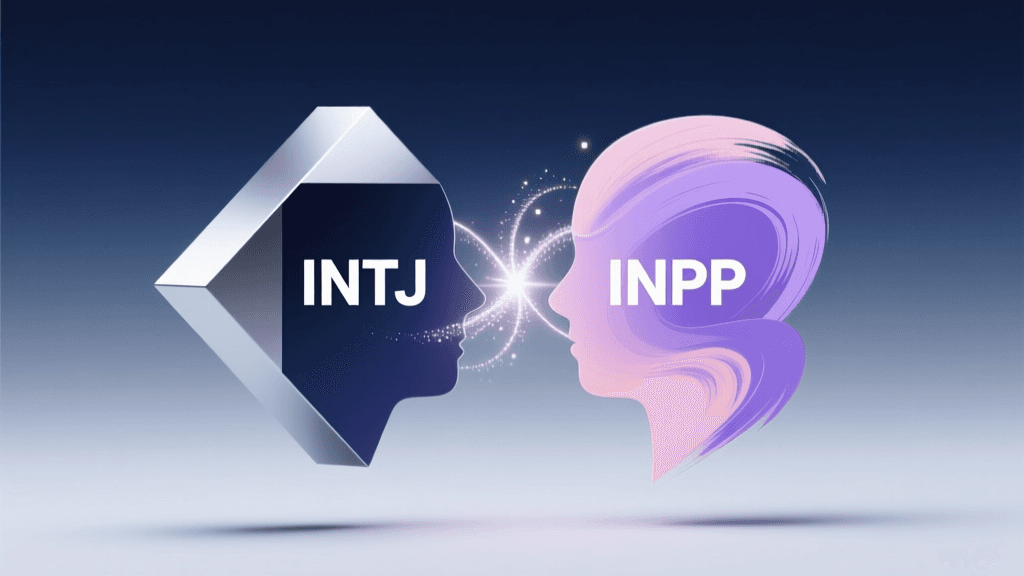
When an INTJ and an INFP form a relationship—whether romantic, platonic, or professional—their connection often feels like a meeting of two distant constellations: intellectually precise yet emotionally resonant, fiercely independent yet deeply empathetic. At the heart of their dynamic lies a profound communication paradox: both types are introspective, value authenticity, and dislike superficiality—but they process, express, and interpret meaning in fundamentally different ways. This article explores that divergence not as a flaw, but as a design feature waiting for translation. Drawing on cognitive function theory, empirical research on personality-based communication patterns, and real-world relational practice, we unpack how INTJs and INFPs speak, hear, disagree, and ultimately co-create language that honors both logic and longing.
How INTJ Communicates
The INTJ (Introverted, Intuitive, Thinking, Judging) communicates from the vantage point of Ti-Ne-Si-Fe—a cognitive stack anchored in Introverted Thinking (Ti), supported by Extraverted Intuition (Ne), grounded in Introverted Sensing (Si), and oriented toward Extraverted Feeling (Fe) as the inferior function. This structure yields a communication style defined by precision, structural clarity, and anticipatory reasoning.
INTJs prioritize conceptual accuracy over emotional calibration. When expressing an idea, they begin with a mental model—a logically coherent framework—and then articulate only the essential components needed to convey its internal consistency. They rarely preface statements with disclaimers (“I might be wrong, but…”), because doing so undermines epistemic efficiency. As psychologist Dr. Dario Nardi notes in his neuroimaging research on MBTI types, INTJs show strong activation in the left dorsolateral prefrontal cortex during verbal reasoning tasks—indicating a preference for deductive, systems-oriented language processing https://www.neuroscienceofpersonality.com/.
Listening for the INTJ is an active, analytical process—not passive reception. They listen to extract structure: identifying assumptions, testing logical coherence, and mapping implications. Interruptions may occur—not out of rudeness, but to prevent misalignment early (e.g., “Hold on—if X is true, then Y contradicts Z; can we clarify that premise first?”). Silence is not discomfort; it’s computation. An INTJ may pause for 5–8 seconds mid-conversation while internally modeling consequences before responding. To them, this silence is respect—for the complexity of the topic and for the integrity of the conclusion.
Verbal economy is central. INTJs avoid filler words (“like,” “um,” “you know”), metaphors without functional utility, and redundant affirmations (“That’s great!” “I totally get it!”). They interpret such phrases as noise that degrades signal fidelity. Their ideal exchange resembles a peer-reviewed abstract: hypothesis, methodology, evidence, conclusion—each sentence serving a necessary role in the argumentative architecture.
Crucially, INTJs do not withhold emotion—they defer its expression until it can be integrated into a rational framework. If an INTJ says, “This decision will optimize long-term outcomes,” they may be suppressing grief over a necessary loss—or excitement about a strategic win—but naming the feeling isn’t their default path to resolution. Their Fe inferior means emotional articulation feels effortful, vulnerable, and often incoherent until processed through Ti-Ne synthesis.
How INFP Communicates
The INFP (Introverted, Intuitive, Feeling, Perceiving) operates from the cognitive stack Fi-Ne-Si-Te, led by Introverted Feeling (Fi), enriched by Extraverted Intuition (Ne), stabilized by Introverted Sensing (Si), and expressed outwardly via Extraverted Thinking (Te) as the inferior function. Their communication is rooted in values-coherence: every statement must align with an inner moral compass, and meaning is inseparable from emotional resonance.
INFPs express ideas through layered, image-rich language—metaphor, narrative, poetic abstraction—because these forms best capture the multidimensional texture of inner experience. A simple observation like “The office feels tense today” may unfold into: “It’s like walking into a room where everyone’s holding their breath—like the air itself remembers last week’s unspoken argument, and even the light seems thinner, more hesitant.” For the INFP, this isn’t embellishment; it’s phenomenological accuracy.
Listening is deeply receptive and empathically attuned. INFPs listen not just to content, but to subtext, tonal shifts, pauses, and embodied cues. They notice when someone’s voice tightens on a particular word or when a joke lands too quickly—signals that something remains unvoiced. Psychologist Isabel Briggs Myers observed that Feeling types (F) consistently score higher than Thinking types (T) on measures of interpersonal sensitivity in validated communication assessments https://www.cpp.com/products/myers-briggs-type-indicator-mbti/. For INFPs, listening is an act of witness—holding space for truth as it emerges, not just as it’s declared.
Disagreement is approached with ethical caution. Rather than debating premises, INFPs ask: What values are at stake? Whose dignity is at risk? Does this position honor my integrity? They may withdraw from conflict not out of avoidance, but to protect core values from compromise. When they do engage verbally, they lead with vulnerability (“I feel conflicted because…”) rather than counter-argument (“That assumption fails because…”). Their goal is alignment of purpose—not victory of logic.
Like INTJs, INFPs are introverted and need solitude to recharge—but their recharging involves emotional digestion, not problem decomposition. After a taxing conversation, an INFP may journal, create art, or walk in nature to reintegrate fragmented feelings. Their Te inferior means external structure (deadlines, agendas, procedural clarity) feels draining unless framed as a service to deeper values (e.g., “This timeline ensures the community project launches before winter”).
Where Communication Breaks Down
The most frequent breakdowns between INTJs and INFPs don’t stem from malice or incompatibility—but from mutual misinterpretation of intent. Each perceives the other’s natural style as a sign of deficiency: the INTJ hears vagueness where the INFP seeks depth; the INFP senses coldness where the INTJ seeks rigor. Below is a comparative table illustrating six high-risk communication friction points:
| Friction Point | INTJ Interpretation | INFP Interpretation | Root Cause |
|---|---|---|---|
| Vague or metaphorical language | “Imprecise. Lacks operational definition. Hard to evaluate or act upon.” | “They’re reducing lived experience to a spreadsheet. Dismissing nuance.” | INTJ prioritizes Ti clarity; INFP prioritizes Fi authenticity—both see the other’s method as epistemically incomplete. |
| Silence during conversation | “They’re disengaged or withholding input. I should clarify or move on.” | “They’re rushing me. Not giving me time to find the right words or feeling.” | INTJ uses silence for internal modeling; INFP uses it for emotional gestation. Neither recognizes the other’s silence as productive. |
| Direct critique of an idea | “Necessary course correction. Ideas must withstand scrutiny to be useful.” | “My values or identity are being questioned. This feels like rejection.” | INTJ critiques the idea (Ti); INFP experiences critique as personal (Fi). No shared frame for separating concept from self. |
| Focus on systems over people | “Efficiency protects people long-term. Emotion-first decisions cause unintended harm.” | “They see humans as variables in a model—not as sacred, irreducible beings.” | Divergent hierarchies of value: INTJ places systemic integrity above individual sentiment; INFP places individual dignity above systemic optimization. |
| Delayed emotional response | “They haven’t processed it yet. I’ll follow up in 48 hours.” | “They don’t care enough to respond now. My feelings aren’t urgent to them.” | INTJ needs time to integrate emotion via Ti-Ne; INFP needs immediate affective acknowledgment to feel safe. |
| Use of Te-driven logistics | “Let’s define roles, deadlines, and KPIs so we avoid ambiguity.” | “Why reduce our shared vision to checkboxes? This kills the soul of the project.” | INTJ’s Te (inferior but mobilized under stress) seeks external order; INFP’s Te (also inferior) feels like coercion unless tied to Fi values. |
These breakdowns compound because neither type defaults to explaining their process. The INTJ assumes clarity is self-evident; the INFP assumes resonance is intuitive. Without meta-communication—talking about how we talk—the gap widens invisibly, often mistaken for incompatibility rather than incoordination.
Bridging the Communication Gap
Bridging begins not with changing core wiring—but with building bidirectional translation protocols. Here are four field-tested, actionable strategies:
1. Establish a “Communication Charter” (First 3 Conversations)
Before diving into substantive topics, co-create a lightweight agreement. Example clauses:
- “Silence = Processing, Not Disengagement”: Agree that pauses of up to 10 seconds are protected space for internal work—not invitations to fill or interpret.
- “Metaphor Is Data, Not Decoration”: When an INFP uses imagery (“It felt like drowning in static”), the INTJ asks: What specific conditions or sensations does that evoke? What would ‘clear signal’ look like here? When an INTJ states a principle (“This violates scalability heuristics”), the INFP asks: What human impact does that heuristic protect? Whose well-being depends on it?
- “Critique Protocol”: Agree that all feedback begins with affirmation of intent (“I know you want this project to thrive”) and ends with collaborative refinement (“How might we adjust X to honor both efficiency and empathy?”).
2. Use “Dual-Channel Summarizing”
After complex discussions, each person summarizes the outcome in their native language—and then translates it for the other:
- INTJ writes: “Three action items: (1) Draft proposal by Friday, (2) Identify budget constraints by Monday, (3) Schedule feasibility review. Success metric: Proposal accepted by stakeholders with ≤2 major revisions.”
- INFP writes: “We’re co-creating something that reflects our shared belief in accessible education. The next steps feel like tending a seedling—careful, intentional, responsive to what it needs to grow. I’ll hold the vision; you’ll map the terrain.”
- Then they swap and co-edit—merging structural clarity with values anchoring. This builds shared ownership of both form and meaning.
3. Design “Feeling-Forward” Feedback Loops
Because INTJs defer emotional articulation and INFPs require affective validation, institute low-stakes, scheduled check-ins using a simple 3-question template:
- “What part of our recent collaboration felt most aligned with your values / goals?”
- “Where did you sense tension—between us, or within yourself?”
- “What’s one small adjustment that would make the next interaction feel safer/more productive?”
Crucially, the INTJ commits to answering Q2 and Q3 before problem-solving—and the INFP commits to framing Q1 concretely (e.g., “When you streamlined the workflow, it honored my value of reducing burnout”). This normalizes emotional data as operational intelligence.
4. Leverage “Third-Space Artifacts”
When verbal dialogue stalls, shift to shared creation. Examples:
- A shared Miro board where the INTJ maps systems (flowcharts, decision trees) and the INFP layers values annotations (color-coded icons: ❤️ = dignity, 🌱 = growth, ⚖️ = fairness).
- A joint document titled “Our Shared Why”—revised quarterly—with INTJ-contributed “Strategic Imperatives” and INFP-contributed “Human Imperatives,” cross-linked by mutual rationale.
- A ritual of co-writing a “Bridge Paragraph”: One sentence synthesizing a complex issue in language that satisfies both Ti rigor and Fi resonance (e.g., “Implementing this policy strengthens institutional integrity while protecting the psychological safety of frontline staff.”).
As organizational psychologist Adam Grant notes in Think Again, “The most innovative teams aren’t those with identical thinking styles—they’re those who’ve built rituals for translating across cognitive dialects” https://www.adamgrant.net/books/think-again. Translation isn’t compromise—it’s co-evolution.
INTJ and INFP in Conflict Conversations
Conflict between INTJs and INFPs rarely erupts as shouting matches—it simmers as progressive disconnection. The INTJ withdraws to refine logic; the INFP withdraws to protect values. Left unaddressed, this creates a “double silence” where both assume the other has disengaged permanently.
Effective conflict resolution requires interrupting that cycle with structured re-engagement:
Phase 1: De-escalation Protocol (First 24 Hours)
- INTJ sends a brief, Te-anchored message: “I need 24h to integrate our discussion. I’ll reach out Tuesday 10am with 3 options for next steps.”
- INFP sends a Fi-anchored message: “I’m holding space for what came up. I’ll reflect and share one thing that matters most to me by Tuesday noon.”
- No interpretation. No persuasion. Just time-bound commitment to return.
Phase 2: The “Root + Branch” Dialogue (90-Minute Session)
Structure the conversation around two parallel tracks:
- Root Track (Values & Intent): Each speaks uninterrupted for 7 minutes on: “What core value or need was activated in this conflict? What did I hope to protect or create?” (INFP leads; INTJ listens without note-taking.)
- Branch Track (Systems & Solutions): Each speaks for 7 minutes on: “What structural or procedural factor contributed? What concrete change would prevent recurrence?” (INTJ leads; INFP listens without reframing.)
- Integration (30 min): Co-write one sentence bridging root and branch (e.g., “To honor our shared commitment to autonomy and accountability, we’ll implement bi-weekly check-ins with shared agenda templates.”).
This structure prevents the INFP from feeling unheard (root first) and the INTJ from feeling directionless (branch second). It also makes implicit assumptions explicit—revealing where values and systems actually align (more often than assumed).
Building a Shared Communication Language
A shared language isn’t about adopting one type’s style—it’s about inventing a third dialect unique to the pair. This evolves through deliberate practice:
Step 1: Map Your “Translation Dictionary”
Create a living document with entries like:
- INTJ says: “That’s inefficient.” INFP hears: “Your effort doesn’t matter.” Shared translation: “I see a way to reduce friction so your energy flows more freely toward what matters most.”
- INFP says: “I just need to sit with this.” INTJ hears: “You’re avoiding resolution.” Shared translation: “I require 48 hours of reflective integration to ensure my response aligns with my values and your goals.”
Step 2: Ritualize “Language Calibration”
Monthly, review: What phrase caused confusion last month? What new translation worked well? What old assumption proved inaccurate? This transforms communication from a source of friction into a site of joint creativity.
Step 3: Celebrate “Translation Wins”
Notice and name moments when the third dialect emerged organically:
“When you said, ‘Let’s prototype this ethically—test the impact before scaling,’ that was perfect. You merged my need for evidence with your need for compassion.”
Positive reinforcement wires new neural pathways faster than correction.
Over time, this shared language becomes instinctive—less translation, more fluency. Research from the Harvard Negotiation Law Review confirms that dyads who co-create communication norms report 68% higher relational resilience during stress periods than those relying on default styles https://hnlr.org/.
FAQ
Can INTJs learn to express emotion more openly with INFPs?
Yes—but not by becoming “more emotional.” INTJs develop emotional fluency by translating feeling into functional insight. Instead of “I’m upset,” try: “My Ti model shows this outcome risks undermining our long-term trust. To preserve alignment, I need to understand your perspective on the trade-offs.” This honors Fi’s need for emotional recognition while staying within Ti’s architecture. Practice starts with journaling: “What physical sensation accompanied that moment? What value felt threatened? What action would restore equilibrium?”
Do INFPs have to suppress their idealism to communicate with INTJs?
No—idealism is the INFP’s superpower, not a liability. The shift is from presenting ideals as conclusions to framing them as hypotheses to be stress-tested. Instead of “This must be done with compassion,” try: “Compassion is a non-negotiable variable in my model—what constraints would make that impossible? Let’s map the boundary conditions together.” This invites the INTJ’s analytical strength while holding the value intact.
Is it normal for INTJ-INFP pairs to take longer to resolve conflicts?
Yes—and that’s adaptive, not defective. INTJs require time for Ti-Ne synthesis; INFPs require time for Fi-Si integration. Rushing triggers both types’ inferior functions (Fe panic in INTJs; Te rigidity in INFPs), worsening outcomes. A 48–72 hour resolution window is empirically optimal: it allows both to return with integrated positions, not reactive defenses. Track your average resolution time for 3 conflicts—you’ll likely find speed increases as shared language develops.
How can we tell if communication issues are type-related vs. deeper incompatibility?
Type-related friction improves with translation tools: when you apply the Communication Charter or Dual-Channel Summarizing, tension decreases measurably. Deeper incompatibility persists despite consistent, skilled application of these strategies—and often centers on non-negotiable mismatches (e.g., divergent life goals, incompatible conflict philosophies beyond style, or chronic dismissal of core values). As MBTI researcher Otto Kroeger advises: “Type explains how you differ. Values explain why you stay—or go.”
Ultimately, the INTJ-INFP pairing doesn’t need to choose between truth and tenderness, structure and soul, logic and love. Their communication challenge is their gift: to forge a language where precision serves poetry, and ideals are engineered with integrity. In doing so, they don’t just understand each other—they expand what human connection can mean.