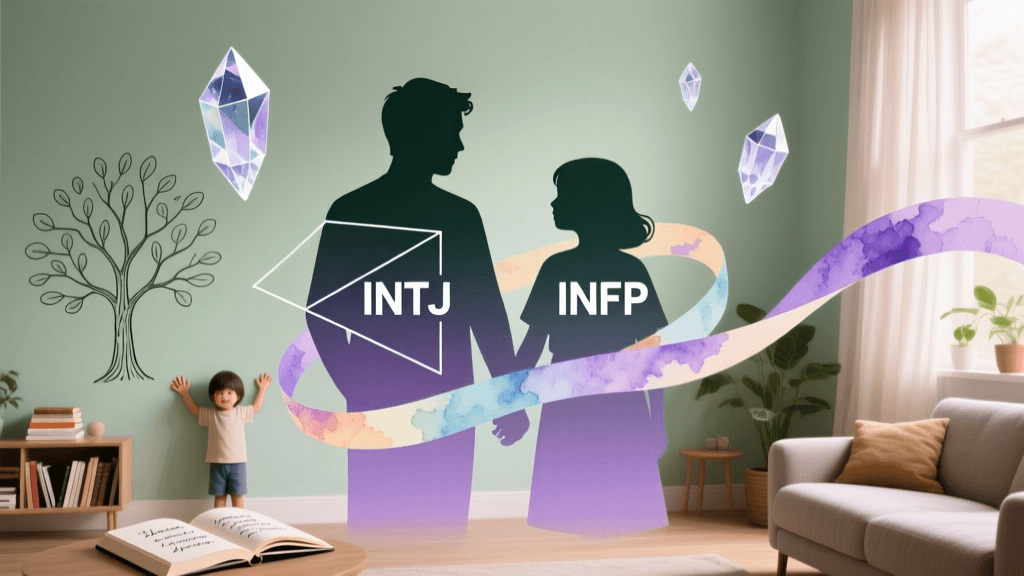
INTJ as a Parent
The INTJ (Introverted, Intuitive, Thinking, Judging) parent approaches family life with strategic foresight, intellectual rigor, and quiet consistency. Often described as the ‘Architect’ or ‘Mastermind,’ the INTJ parent is less likely to express affection through effusive praise or spontaneous hugs—and more likely to demonstrate love through meticulous planning, long-term educational scaffolding, and unwavering reliability. Their parenting style is rooted in competence, autonomy, and principled logic.
INTJs typically begin preparing for parenthood well before conception—researching developmental milestones, comparing school curricula, mapping out extracurricular pathways, and even drafting household routines using digital tools like Notion or Trello. They value evidence-based practices and are highly skeptical of trends lacking empirical support. For example, an INTJ parent may reject screen-time recommendations that contradict peer-reviewed findings from the American Academy of Pediatrics, opting instead for a personalized, data-informed media plan calibrated to their child’s cognitive load and attention span.
Emotionally, INTJs often struggle with overt emotional expression—not due to lack of care, but because their dominant function, Introverted Intuition (Ni), processes feelings internally and abstractly, while their auxiliary Extraverted Thinking (Te) prioritizes problem-solving over emotional validation. As a result, they may respond to a child’s meltdown by offering a logical solution (“Let’s break this down: what triggered it? What’s one small step we can take?”) rather than immediate comfort (“It’s okay—I’m here”). This can leave sensitive children—especially those with Feeling preferences—feeling unheard or misunderstood.
Yet INTJs excel at cultivating independence. They encourage critical thinking early: asking open-ended questions during bedtime stories (“What would you have done differently if you were the main character?”), assigning age-appropriate responsibilities with clear expectations (e.g., a rotating ‘Systems Manager’ role for organizing shared spaces), and modeling intellectual curiosity through personal projects—whether coding a home automation script or writing a comparative analysis of ancient governance models. Their strength lies not in warmth-on-demand, but in steadfast presence, integrity, and the quiet confidence they instill in children who learn that effort, reflection, and principled action yield meaningful results.
INFP as a Parent
The INFP (Introverted, Intuitive, Feeling, Perceiving) parent embodies gentle idealism, empathic attunement, and deep moral imagination. Known as the ‘Healer’ or ‘Mediator,’ the INFP parent leads with heart-centered intuition and a profound commitment to authenticity. Their parenting philosophy centers on nurturing the child’s inner world—their values, creative voice, emotional truth, and sense of purpose—often long before academic or behavioral benchmarks enter the picture.
INFPs intuitively notice subtle shifts in mood, body language, or artistic expression. A child’s scribbled drawing might prompt an INFP parent to gently ask, “I see a lot of purple here—what does that color feel like today?” They create emotionally safe spaces where vulnerability is honored, not fixed. This makes them exceptionally effective with highly sensitive children, those experiencing anxiety or depression, or neurodivergent kids whose internal experiences diverge from neurotypical norms. According to research published in Frontiers in Psychology, children raised by highly empathic, autonomy-supportive caregivers show stronger emotional regulation and identity coherence—traits strongly aligned with INFP parenting strengths.
However, INFPs may find structure and enforcement inherently stressful. Their dominant function, Introverted Feeling (Fi), prioritizes inner harmony and authenticity over external rules; their auxiliary Extraverted Intuition (Ne) generates endless possibilities, making rigid scheduling or disciplinary consistency challenging. An INFP parent might cancel a scheduled piano lesson because their child “just didn’t feel inspired today”—a decision rooted in compassion but potentially undermining skill-building discipline. Similarly, they may avoid necessary boundary-setting to preserve relational peace, leading to inconsistent consequences or unspoken resentment.
Where INTJs build systems, INFPs cultivate meaning. They initiate family rituals infused with symbolism—a moon journaling night, handwritten ‘gratitude letters’ exchanged monthly, or planting a ‘values garden’ where each herb represents a core principle (e.g., lavender for calm, rosemary for remembrance). Their greatest gift is helping children articulate who they are beneath behavior: “You didn’t break the vase because you’re careless—you were trying to reach the bird feather on the shelf because you felt drawn to its beauty. Let’s talk about how to honor that wonder safely.”
Co-Parenting Dynamics for INTJ and INFP
At first glance, the INTJ–INFP pairing appears paradoxical: one seeks order through objective frameworks; the other seeks resonance through subjective meaning. Yet precisely because their cognitive functions form a complementary loop—INTJ’s Ni-Te harmonizes with INFP’s Fi-Ne—they possess rare potential for deeply balanced co-parenting—if both partners commit to mutual translation.
The INTJ’s Te helps operationalize the INFP’s ideals: turning “We want our kids to grow up compassionate” into concrete actions—volunteering at a food bank biweekly, integrating service-learning into homeschool units, or designing a family ‘ethics dashboard’ tracking kindness metrics. Meanwhile, the INFP’s Fi grounds the INTJ’s vision in human significance: reminding them that a perfectly optimized study schedule means little if it erodes a child’s sense of self-worth. Their Ne invites the INTJ to consider alternative pedagogies (e.g., Montessori or democratic schooling), while the INTJ’s Ni helps the INFP anticipate long-term implications of permissive choices—such as how consistently excusing homework avoidance may impact future academic agency.
Key challenges arise around conflict resolution and daily logistics:
- Discipline Style Clash: INTJs prefer consistent, rule-based consequences tied to observable behavior (“You broke the agreement → you restore the shelf unit”). INFPs lean toward restorative, values-aligned dialogue (“How did your choice affect others’ trust? What repair feels authentic to you?”). Unresolved, this breeds inconsistency—children learn to ‘play’ one parent against the other.
- Routine Rigidity vs. Fluidity: INTJs may design detailed weekly charts covering meals, chores, learning blocks, and downtime. INFPs may resist adherence when inspiration strikes (“Let’s spend today sketching clouds instead of math!”). Without negotiation, INTJs feel disrespected; INFPs feel suffocated.
- Emotional Processing Gaps: When a child is distressed, INTJs may default to solution-mode while INFPs sit in shared feeling. If neither adapts, the child receives fragmented support—logic without empathy, or empathy without scaffolding.
Actionable Co-Parenting Strategies:
- Create a ‘Shared Values Charter’: Draft a one-page document listing 3–5 non-negotiable family values (e.g., “Truthfulness,” “Creative Courage,” “Respectful Boundaries”) and define *how* each manifests concretely. Example: “Truthfulness = admitting mistakes *and* proposing a fix.” This bridges INTJ’s need for clarity and INFP’s need for moral anchoring.
- Implement ‘Function Rotation’: Assign alternating leadership for recurring decisions. One week, the INTJ designs the weekend schedule; the next, the INFP plans it—with the other providing constructive feedback (not veto power). This builds mutual respect for each other’s cognitive strengths.
- Establish ‘Translation Time’: Weekly 20-minute check-ins where each partner explains a recent parenting decision *in the other’s language*. INTJ says: “I enforced the screen limit because longitudinal data links >2 hrs/day to reduced prefrontal cortex activation in tweens (JAMA Pediatrics, 2020).” INFP responds: “I hear you protecting their neurological wellbeing—that aligns with our value of ‘Stewarding Wholeness.’ Next time, could we co-create a ‘tech covenant’ with their input so it feels like shared ownership, not top-down control?”
Family Traditions and Values
INTJ–INFP families often develop traditions that uniquely fuse structure and soul—rituals that are both intentional *and* imbued with symbolic resonance. Unlike families anchored solely in nostalgia or obligation, their customs evolve deliberately to reflect shared growth.
Consider their annual ‘Future & Foundation Day’: held on the winter solstice, it combines INTJ’s love of systems-thinking with INFP’s reverence for meaning-making. The morning involves collaborative vision-casting—using SWOT analysis templates to assess the past year’s family dynamics (Strengths, Weaknesses, Opportunities, Threats)—while the evening transitions into candlelit storytelling, where each member shares one memory that revealed their deepest value in action. This ritual satisfies the INTJ’s need for evaluative rigor and the INFP’s hunger for emotional legacy.
Another hallmark is the ‘Values Integration Calendar.’ Rather than generic holiday observances, they redesign celebrations around core principles:
| Season | Tradition Name | INTJ Contribution | INFP Contribution | Child Participation |
|---|---|---|---|---|
| Spring | “Root & Reach Garden Project” | Soil pH testing, crop rotation schedule, yield forecasting spreadsheet | Designing seed packet art, writing ‘plant intention poems,’ selecting heirloom varieties with ancestral significance | Choosing one plant to name and journal about weekly; presenting harvest report + gratitude reflection |
| Summer | “Ethics Immersion Weekend” | Curating case studies (e.g., AI bias, climate policy trade-offs), facilitating Socratic seminars | Creating empathy maps for stakeholders, guiding reflective art responses, hosting community dialogue circles | Developing a ‘Justice Lens’ presentation on a local issue; proposing one actionable family response |
| Fall | “Legacy Archive Night” | Digitizing photos/documents, metadata tagging, building searchable family timeline database | Recording oral histories, composing family mythos narratives, curating ‘wisdom object’ displays (e.g., Grandma’s sewing kit as symbol of resilience) | Interviewing elders, selecting three artifacts to ‘adopt’ and interpret for future generations |
These traditions succeed because they honor both types’ needs: the INTJ gains tangible outcomes and measurable progress; the INFP accesses depth, connection, and expressive freedom. Crucially, children aren’t passive recipients—they’re co-designers, ensuring traditions remain living, adaptive, and personally relevant.
Raising Children with Different Personality Types
No two children share identical type dynamics—even within the same family. An INTJ–INFP household may raise an ESTP teen who thrives on spontaneity and hands-on experimentation, a shy INFJ middle child absorbed in literary worlds, and a bold ENTP toddler constantly negotiating new rules. Navigating this diversity demands conscious typological agility.
For the ESTP Child: INTJ parents naturally appreciate their pragmatism and quick wit but may misinterpret their impatience with theory as laziness. INFP parents adore their zest but may worry about their risk tolerance. Joint strategy: Channel ESTP energy into real-world projects—e.g., rebuilding a bike with documented engineering notes (satisfying INTJ’s Te/Ni) while framing it as “honoring craftsmanship as sacred action” (resonating with INFP’s Fi). Use gamified learning: turn algebra into a ‘resource allocation challenge’ for their lemonade stand empire.
For the INFJ Child: Both parents intuitively recognize their depth—but may overwhelm them. INTJs might overload with complex ethical frameworks; INFPs might project their own idealism, pressuring the child to ‘save the world.’ Best practice: Create ‘Sanctuary Zones’—physically quiet, minimally decorated spaces where the INFJ child can retreat without expectation. Co-develop a ‘Values Compass’ tool: a simple wheel with quadrants (e.g., Justice, Beauty, Truth, Care) they rate weekly, helping them articulate inner conflicts without verbal pressure.
For the ENTP Child: Their love of debate and idea-generation delights INFPs but exhausts INTJs, who may label them ‘contrarian’ or ‘unfocused.’ Reframe: Assign the ENTP child the role of ‘Innovation Auditor’—they review family systems (meal planning, chore rotation, screen rules) and propose three improvements weekly. INTJs gain structured input; INFPs enjoy their playful intellect; the ENTP feels valued for their contribution, not just their chaos.
A foundational principle: Type-aware parenting isn’t about fitting children into boxes—it’s about expanding your toolkit to meet them where they are. Research from the National Institute on the Teaching of Psychology confirms that when caregivers adapt communication and expectations to a child’s natural processing style, academic engagement and emotional security increase significantly—regardless of the child’s specific type.
Navigating Extended Family as INTJ and INFP
Extended family gatherings pose distinct stressors for this pair. INTJs may perceive relatives’ small talk as inefficient and emotionally draining; INFPs may feel morally compromised by tolerating judgmental comments or outdated norms. Yet their combined strengths—INTJ’s strategic boundary-setting and INFP’s diplomatic reframing—can transform these interactions into opportunities for quiet influence.
Pre-Gathering Alignment: Before any event, co-create a ‘Boundary Blueprint’: list non-negotiables (e.g., “No unsolicited advice on schooling”), preferred exit strategies (“If Aunt Carol critiques our parenting, we’ll say, ‘We’re exploring what works for our family’s values—thanks for understanding’ and shift to neutral topic”), and shared signals (e.g., a wrist-tap means ‘I need 5 minutes alone’).
Leveraging Complementary Strengths: During tense moments, INTJs can calmly state facts (“Research shows bilingual exposure before age 5 enhances executive function”), while INFPs soften delivery with warmth (“We’re so grateful for your concern—we’re following guidance that honors both science and our children’s unique rhythms”). This ‘truth + tenderness’ combo disarms defensiveness more effectively than either approach alone.
For multigenerational holidays, introduce low-pressure, type-inclusive activities: a ‘Story Exchange’ where elders share one memory and children illustrate it (engaging INFP’s narrative impulse and INTJ’s archival instinct); or a ‘Future Forecast’ game where everyone predicts one positive change for the family in 5 years—validated by INTJ’s realism and enriched by INFP’s hope.
Crucially, protect recharge time. Agree on synchronized ‘micro-retreats’: 15 minutes post-lunch where both slip away—to read, walk silently, or journal—without apology. Modeling intentional restoration teaches children that self-care isn’t selfish; it’s stewardship.
FAQ
How do INTJ and INFP parents handle disagreements about education?
They bridge differences by separating goals from methods. Both deeply value intellectual growth and ethical development—but INTJs prioritize proven pedagogical efficacy (e.g., phonics-based literacy programs backed by NIH studies), while INFPs prioritize psychological safety and creative expression (e.g., process-oriented art integration). Their solution: adopt a ‘Dual-Path Curriculum.’ Core academics follow evidence-based frameworks (satisfying INTJ), while 20% of weekly learning time is reserved for ‘Soul Projects’—self-directed explorations chosen by the child and mentored by the INFP parent (e.g., composing a song about photosynthesis, building a model ecosystem reflecting indigenous land ethics). Progress is assessed via portfolios, not standardized tests alone.
What if our child tests as ESTJ—will they clash with our INFP parent’s flexibility?
ESTJ children thrive on clarity, tradition, and duty—values that may initially seem at odds with INFP fluidity. However, INFPs can honor ESTJ needs by co-creating visible, co-signed ‘Family Covenants’—written agreements outlining roles, schedules, and mutual commitments (e.g., “Every Sunday, we prepare dinner together using the recipe binder”). The INTJ parent ensures the covenants are logically sound and sustainable; the INFP ensures they reflect shared values and include space for heartfelt acknowledgment (“After chores, we light the ‘Gratitude Candle’ and share one thing we appreciate about each other’s contribution”). Structure becomes sacred, not sterile.
How can we prevent our INFP’s emotional sensitivity from overwhelming our INTJ’s need for calm?
Establish ‘Feeling Forums’—designated, time-boxed spaces for emotional processing that respect both needs. Example: Every Thursday 7–7:20 PM, the INFP shares one unresolved feeling using ‘I-statements’; the INTJ listens without solving, then offers one validating observation (“I hear this matters deeply to your sense of fairness”). Outside this forum, emotions are acknowledged briefly (“That sounds hard”) and tabled until the next slot. This contains intensity while honoring the INFP’s need to be heard and the INTJ’s need for predictability.
Are there MBTI-informed resources for raising neurodivergent children?
Yes—though caution is warranted. While MBTI isn’t a clinical tool, its framework helps decode communication and sensory preferences. The Autism Society emphasizes ‘strengths-based approaches’ aligned with type-aware parenting: e.g., supporting an autistic INTJ child’s need for routine *and* intellectual depth through advanced STEM enrichment, or honoring an INFP child’s sensory sensitivities by co-designing ‘calm protocol’ kits (weighted blanket, noise-canceling headphones, favorite texture swatches). Always pair typological insights with professional guidance—never substitute for diagnosis or therapy.
Ultimately, the INTJ–INFP parenting partnership is not about achieving perfect harmony—but cultivating generative tension. Their friction, when consciously navigated, produces families grounded in both reason and reverence, structure and soul, foresight and feeling. They don’t raise children to fit the world as it is. They raise them to imagine—and build—the world as it could be.