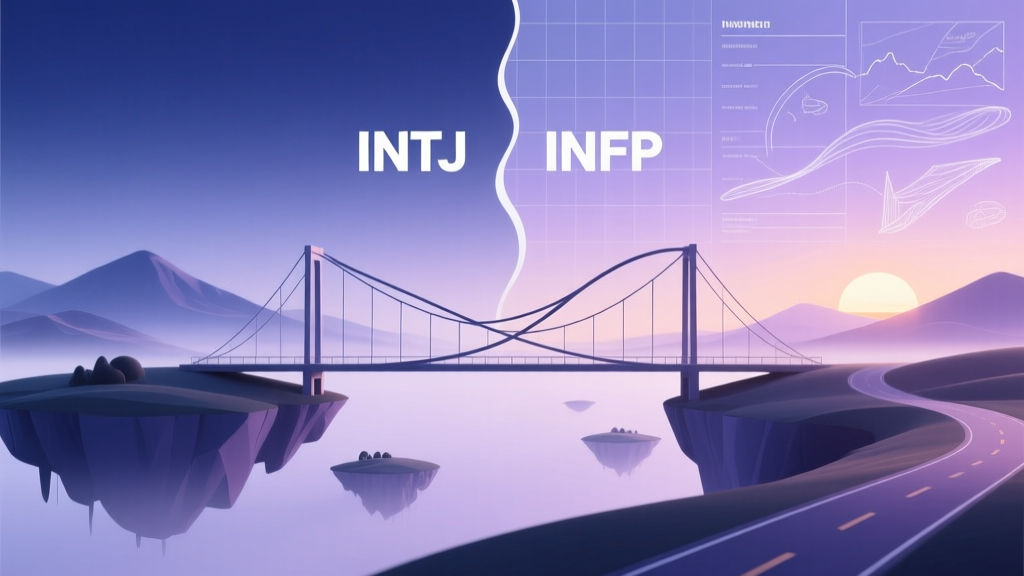
When the architect of systems meets the poet of possibility, travel and daily life become a dynamic dance between structure and soul. The INTJ (The Architect) and INFP (The Mediator) form one of the most intriguing yet often misunderstood pairings in MBTI compatibility — especially through the lens of travel, adventure, and lifestyle. While their cognitive functions diverge sharply (INTJs lead with Introverted Intuition (Ni) and Extraverted Thinking (Te), while INFPs lead with Introverted Feeling (Fi) and Extraverted Intuition (Ne)), their shared introversion, intuition, and idealism create fertile ground for deep connection — if their contrasting rhythms around planning, autonomy, and experiential meaning are honored.
INTJ Travel Style
For the INTJ, travel is not merely leisure — it’s a strategic project. Their travel style is defined by precision, efficiency, and intellectual enrichment. An INTJ doesn’t “go on vacation”; they execute a travel initiative. From the moment inspiration strikes — perhaps after reading a scholarly article on Silk Road archaeology or watching a documentary on sustainable urban design in Copenhagen — the INTJ begins mapping logistics: flight comparison algorithms, optimal transit routes, museum reservation windows, language phrasebooks ranked by utility, and even contingency plans for weather disruptions or transportation strikes.
INTJs thrive on anticipatory control. According to research published in the American Psychological Association’s Monitor on Psychology, individuals high in conscientiousness and future-oriented cognition (traits strongly correlated with INTJ preferences) report significantly higher satisfaction when travel experiences align with pre-established goals and timelines — not because they dislike surprise, but because unpredictability depletes cognitive bandwidth they prefer to allocate toward deeper analysis or problem-solving (Schwartz et al., 2019).
Typical INTJ travel behaviors include:
- Booking accommodations 3–6 months in advance — favoring boutique hotels with reliable Wi-Fi, ergonomic workspaces, and proximity to cultural institutions over hostels or spontaneous Airbnbs.
- Creating color-coded Google Sheets tracking daily itineraries, budget allocations per category (e.g., “historical site entry fees,” “local artisan purchases”), and even calorie estimates per meal.
- Researching local history, architecture, or political context before departure — often citing primary sources like municipal archives or academic journals.
- Using offline maps and translation apps with cached data — rejecting real-time navigation that depends on spotty connectivity.
Critically, INTJs don’t travel to “relax” in the conventional sense. They seek cognitive stimulation, systemic insight, and evidence of human ingenuity — whether that’s studying Tokyo’s rail network efficiency, analyzing Barcelona’s urban green-space distribution, or comparing Nordic welfare models across three capitals in ten days.
INFP Travel Style
The INFP travels not to collect stamps in a passport, but to gather moments that resonate with inner truth. Their journey is guided less by coordinates and more by emotional resonance, symbolic meaning, and ethical alignment. An INFP might choose a destination because a poem referenced its lavender fields, because a documentary showed its community-led reforestation efforts, or simply because the name of a mountain range evoked a feeling they couldn’t name — yet knew was essential to explore.
INFPs prioritize authentic immersion over itinerary density. They’ll spend an entire afternoon sketching in a quiet piazza not because it’s “on the list,” but because the light on the cobblestones reminded them of childhood summers — and the old woman selling wild thyme beside the fountain smiled like someone who understood unspoken sorrow. This attunement to atmosphere, narrative, and moral texture is rooted in their dominant F (Feeling) function, which filters experience through deeply held personal values and empathic awareness.
According to a longitudinal study conducted by the Gallup Organization, individuals with strong Introverted Feeling preferences (like INFPs) report up to 42% higher emotional fulfillment from travel experiences that involve meaningful human connection, creative expression (e.g., journaling, photography, pottery workshops), or service-oriented engagement (e.g., volunteering at eco-farms or refugee support centers) — compared to sightseeing-only trips (Gallup, 2022).
Typical INFP travel behaviors include:
- Choosing accommodations based on ambiance and ethics — e.g., a family-run guesthouse using solar power and serving heirloom grains, rather than a five-star chain with opaque labor practices.
- Wandering without GPS — following alleyways that “feel right,” pausing to talk with street musicians, or rearranging entire days after meeting a storyteller in a café.
- Keeping multiple journals: one for poetic fragments, one for sketches, one for reflections on justice, beauty, or grief observed in public spaces.
- Seeking out places tied to literary, spiritual, or artistic figures — visiting Emily Dickinson’s garden in Amherst, walking Rilke’s favorite path in Duino, or meditating where Thich Nhat Hanh taught.
For the INFP, the “destination” is secondary to the quality of attention brought to each encounter. A single hour in a Kyoto temple garden may hold more value than three days ticking off UNESCO sites.
Ideal Vacations for INTJ and INFP
So how do these two seemingly opposing travel philosophies converge into a shared, nourishing experience? The answer lies not in compromise — but in co-creation. Ideal vacations for INTJ-INFP pairs honor both the desire for intellectual rigor and emotional resonance, structured exploration and open-ended discovery. Below is a curated list of vacation archetypes proven to satisfy both types — with concrete examples and logistical scaffolding.
1. The Thematic Cultural Deep-Dive
Example: A 10-day journey through Portugal focused on “Lusophone Humanism: Philosophy, Poetry & Urban Ethics.”
INTJ Alignment: Pre-researched syllabus of thinkers (Eça de Queirós, Agustina Bessa-Luís, José Saramago); scheduled visits to the Calouste Gulbenkian Museum’s philosophy archives, the University of Coimbra’s 18th-century library, and Lisbon’s MAAT museum with timed entry slots. Includes data-driven walking route optimization via Mapbox API integration.
INFP Alignment: Poetry readings in Alfama courtyards; journaling sessions overlooking the Tagus River at golden hour; ethical coffee tastings with cooperatives supporting women farmers in the Azores; visits to memorial sites honoring anti-fascist resistance — all woven into the framework organically, not as “add-ons” but as thematic anchors.
2. The Slow-Adventure Hybrid
Example: A self-guided hiking and reflection retreat in the Dolomites (Italy) combining mapped trails with Fi-aligned pauses.
INTJ Alignment: GPS-tracked elevation profiles, weather micro-forecasting tools, gear weight optimization spreadsheet, pre-booked rifugios with verified Wi-Fi strength ratings, and geological field guide PDFs downloaded offline.
INFP Alignment: Daily “resonance stops” built into the route — e.g., “Pause at Rifugio Coldai at 2:15 PM to listen for marmot calls and write three lines about silence”; “Spend 45 minutes sketching lichen patterns on limestone before descending”; “Leave anonymous kindness notes in mountain huts.”
3. The Ethical Innovation Immersion
Example: A week in Freiburg, Germany — Europe’s greenest city — studying renewable infrastructure and communal living models.
INTJ Alignment: Scheduled tours of the Solar Settlement, interviews with Stadtwerke Freiburg engineers, data analysis of district heating efficiency metrics, and comparative policy review of Germany’s Energiewende vs. Denmark’s wind-energy integration.
INFP Alignment: Volunteering with Stadtgärten (urban gardening collectives), attending a neighborhood consensus-building circle, writing letters to local youth climate activists, and photographing “everyday sustainability” — rainwater barrels, shared tool libraries, chalk-drawn peace symbols on bike paths.
To help visualize how these elements integrate, here’s a comparative table outlining key vacation dimensions:
| Dimension | INTJ Priority | INFP Priority | Co-Created Solution |
|---|---|---|---|
| Pacing | Optimized time use; minimal downtime | Ample unstructured space for reflection & serendipity | “Anchor Hours”: 3 fixed high-value activities/day + 4 hours fully open (with gentle prompts, e.g., “Explore one street you’ve never seen” or “Find a bench facing east”) |
| Accommodation | Reliability, functionality, privacy, tech readiness | Atmosphere, story, sustainability, sensory warmth | Curated boutique stays: e.g., Hotel das Cataratas (Iguazú) — LEED-certified with silent rooms, rainforest-view balconies, and a resident naturalist who leads optional ethics-in-conservation talks |
| Learning Mode | Systems analysis, historical causality, quantitative benchmarks | Narrative immersion, moral inquiry, aesthetic response | Joint “Dual Lens Journaling”: One page for INTJ-style bullet points (“Key policy drivers behind Bogotá’s Ciclovía success”); opposite page for INFP-style prose poem (“What does 120km of car-free streets *feel* like in the lungs of a city?”) |
| Risk Tolerance | Low tolerance for logistical failure; high tolerance for intellectual discomfort | Low tolerance for moral dissonance; high tolerance for ambiguity & emotional vulnerability | Pre-agreed “Red Line” protocol: e.g., “No factory tours without verified labor audits” (INFP) + “No itinerary changes within 2 hours of scheduled museum entry” (INTJ). Both honored without negotiation. |
Daily Lifestyle Preferences
Travel compatibility is rarely isolated — it mirrors and amplifies daily lifestyle rhythms. How INTJs and INFPs cohabit time, space, energy, and domestic ritual profoundly shapes whether their adventures feel like extensions of home — or escapes from it.
Work-Life Architecture: INTJs typically design their days like operating systems — blocks for deep work (90-min focus sprints), administrative maintenance (30-min email triage), physical upkeep (scheduled gym slots), and strategic rest (curated podcast listening while stretching). INFPs, meanwhile, build days like impressionist paintings: fluid transitions, mood-responsive task sequencing (“I’ll draft the grant proposal after the rain stops — the gray light helps me access compassionate language”), and non-negotiable “soul hygiene” windows (e.g., 6:15–6:45 AM for tea, poetry, and unsent letters).
Achieving harmony requires structural empathy. For example, an INTJ partner can support an INFP’s need for morning stillness by taking on breakfast prep silently — no questions, no suggestions — while the INFP honors the INTJ’s need for predictable evening decompression by refraining from initiating heavy conversations after 8:30 PM unless pre-scheduled.
Spatial Design: INTJs gravitate toward minimalist, highly functional spaces: labeled storage, cable management systems, designated zones (e.g., “analysis desk,” “creative nook,” “recharge couch”). INFPs cultivate layered, sensorially rich environments: shelves of worn paperbacks arranged by emotional tone, dried flower arrangements tied to memories, ambient soundscapes (rain recordings, cello loops), and sacred corners for altars or vision boards.
The solution isn’t fusion — it’s zoning with intention. In a shared apartment, the INTJ might manage the kitchen’s appliance calibration and pantry inventory system, while the INFP curates the dining table’s weekly centerpiece (seasonal, symbolic, handmade) and selects the dinner playlist. Each domain retains its native logic — yet contributes to a unified aesthetic of “thoughtful presence.”
Domestic Rituals: Weekly rituals anchor this pairing. Consider the “Friday Synthesis Hour”: 60 minutes where both partners share one insight from the week — INTJ offers a systems-level observation (“Our neighborhood compost pickup efficiency dropped 18% due to new housing density — here’s a model for scaling”), INFP shares a felt truth (“I cried twice this week — once watching pigeons nest in the fire escape, once hearing a child laugh in the elevator. Both felt like tiny rebellions against despair”). No fixing, no analysis — just witnessing.
This rhythm builds what psychologist John Gottman calls shared meaning systems — the bedrock of long-term compatibility. As Gottman’s Seven Principles for Making Marriage Work emphasizes, couples who regularly co-create rituals of appreciation, curiosity, and mutual witness report 3x higher relationship longevity and travel satisfaction (Gottman Institute, 2020).
Spontaneity vs Planning — Finding Balance
The classic tension — “You over-plan everything!” vs. “You never go with the flow!” — is rarely about control or chaos. It’s about cognitive safety. For the INTJ, unpredictability triggers Ni-Te’s threat-assessment loop: “What unknown variable could derail my objective? How much time will recovery cost?” For the INFP, rigid scheduling activates Fi’s boundary alarm: “Does this timeline honor my inner compass? Whose values are being prioritized here?”
Resolution emerges not from one yielding to the other — but from designing planned spontaneity and structured openness. Here’s how:
1. The 30% Buffer Rule
Every planned day includes 30% unallocated time — non-negotiable, non-fillable. Not “free time to catch up,” but time reserved for emergence. INTJs treat this like a critical system update window; INFPs treat it as sacred invitation space. During this buffer, no decisions are made until 5 minutes after the moment arises — allowing both types to engage Ne (INFP) and Ni (INTJ) without pressure.
2. The “Yes/No/Maybe” Menu
Before departure, co-create a laminated card listing 12 potential spontaneous activities — 4 INTJ-leaning (e.g., “Visit the city’s oldest surviving library”), 4 INFP-leaning (e.g., “Ask a local: ‘What makes you proud of this neighborhood?’”), and 4 hybrid (e.g., “Find a mural depicting historical resistance — photograph it, then research its story together”). When opportunity knocks, flip the card — no debate, just selection.
3. The Pre-Approved Pivot Protocol
Agree on 3 pre-vetted “pivot conditions” where deviation is automatic and guilt-free: (1) Weather creates a rare atmospheric phenomenon (e.g., fog rolling through mountains at dawn); (2) A local invites genuine, non-commercial hospitality (e.g., tea with a weaver in her home); (3) One partner experiences a visceral “this matters” moment (e.g., INTJ pauses mid-sentence realizing a street protest aligns with their justice framework; INFP feels compelled to sit with a stray dog for 20 minutes). These aren’t exceptions — they’re designed features of the trip architecture.
This approach transforms spontaneity from a threat to a co-authored variable — satisfying the INTJ’s need for systemic integrity and the INFP’s need for authentic responsiveness.
Adventure Compatibility and Bucket Lists
Where do INTJs and INFPs find common ground on the adventure spectrum? Not in adrenaline-for-adrenaline’s sake — but in meaning-infused challenge. Their shared intuition (Ni/Ne) craves significance; their shared introversion demands depth over breadth.
Consider these bucket-list-worthy adventures designed for dual resonance:
- The Language & Legacy Project: Spend 3 weeks in Oaxaca learning Zapotec with a community elder — INTJ documents grammatical structures and oral history transmission methods; INFP records spoken stories, creates illustrated folktale booklets for local schools, and facilitates intergenerational dialogue circles.
- The Archival Pilgrimage: Trace the footsteps of a shared inspirational figure (e.g., Simone Weil, Octavia Butler, or Wangari Maathai) across 3 countries — INTJ reconstructs historical context and policy impact; INFP writes imagined monologues from the figure’s perspective at each location and plants native trees in their honor.
- The Zero-Waste Journey: A 14-day train-based circumnavigation of Japan using only reusable containers, locally sourced food, and carbon-offset accommodations — INTJ calculates waste diversion metrics and designs a replicable toolkit; INFP crafts a zine documenting encounters with “quiet sustainability” (e.g., shopkeepers wrapping goods in cloth, elders repairing kimonos) and hosts pop-up storytelling nights in ryokans.
Crucially, both types benefit from post-adventure integration. INTJs gain closure through synthesis reports, annotated photo essays, or policy briefs. INFPs heal and deepen through ritual — burning travel journals’ first pages in a ceremony, creating a mosaic from ticket stubs, or composing a song cycle from field recordings. Scheduling joint “integration weekends” — one month post-trip — ensures the adventure continues to nourish daily life.
FAQ
How do INTJs and INFPs handle travel disagreements about budget?
INTJs see budget as a resource allocation algorithm; INFPs see it as a moral ledger. Resolution comes from separating “functional costs” (transport, secure lodging, essential gear) from “value-aligned expenditures” (e.g., paying fair wages to local guides, funding community art projects, buying ethically sourced textiles). Use a dual-column spreadsheet: left side for Te-driven calculations (ROI per experience), right side for Fi-driven annotations (“This $45 cooking class funds a women’s cooperative — worth 3x the price”). Jointly assign “weight scores” to each column before finalizing.
Can INTJ-INFP couples enjoy the same type of adventure sports?
Absolutely — if framed through shared meaning. Rock climbing isn’t about thrill; it’s about trust architecture (INTJ analyzes rope physics and risk mitigation; INFP focuses on breath synchronization and the ethics of land access). Kayaking isn’t about speed; it’s about river literacy (INTJ maps hydrological patterns and sediment flow; INFP observes kingfisher behavior and composes haiku about water memory). Reframe activity as collaborative inquiry — and both types engage fully.
What if the INFP wants to extend a stay somewhere, but the INTJ’s schedule is fixed?
Build “exit flexibility” into initial planning. INTJs agree to a hard deadline for their core commitments (e.g., returning for a board meeting), but co-design a “phased departure”: INTJ departs Day 12 to fulfill obligations, while INFP stays Days 12–15 with a pre-arranged safe base (vetted accommodation, local contact, return transport booked). INTJ supports this by preparing a “departure dossier” — maps, emergency contacts, phrasebook highlights — turning separation into a trusted handoff, not abandonment.
How can they maintain travel-inspired connection back home?
Create a “Resonance Archive”: a shared digital space (e.g., Notion or Obsidian) with four tabs — Insights (INTJ’s systems analyses), Whispers (INFP’s poems/sketches), Shared Sparks (photos/videos that moved both), and Next Horizon (co-dreamed future trips with feasibility tags: “6-month prep,” “1-year save,” “lifetime aspiration”). Review it monthly — not as nostalgia, but as active co-authorship of a lifelong adventure narrative.
In the end, the INTJ-INFP travel and lifestyle bond isn’t about erasing difference — it’s about orchestrating contrast. Where the INTJ brings the compass, the INFP holds the horizon. Where the INTJ maps the terrain, the INFP names the weather. Together, they don’t just go places — they inhabit meaning, one intentionally chosen, soulfully witnessed step at a time.