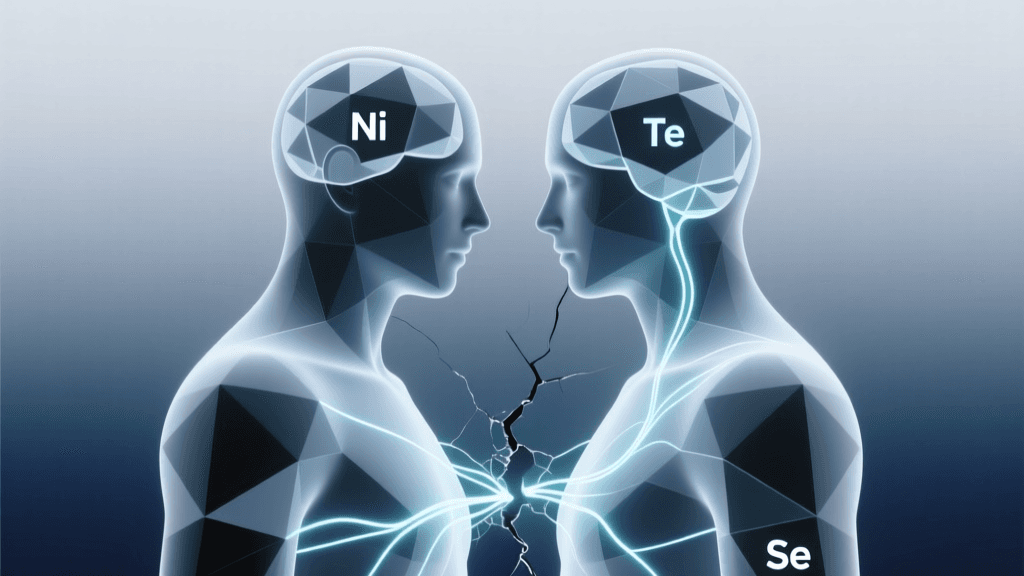
When two INTJs enter a relationship—romantic, platonic, or professional—the dynamic is rarely ordinary. Often dubbed "architects of the mind," INTJs share a rare cognitive architecture built on Introverted Intuition (Ni) as their dominant function, Extraverted Thinking (Te) as auxiliary, Introverted Feeling (Fi) as tertiary, and Extraverted Sensing (Se) as inferior. But what happens when two individuals with identical function stacks interact? Does sameness breed harmony—or intensify blind spots? This article moves beyond surface-level type matching to examine compatibility through the precise lens of cognitive function interplay: how Ni meets Ni, Te mirrors Te, Fi resonates (or recoils) from Fi, and Se triggers shared vulnerabilities.
INTJ Cognitive Stack Overview
The MBTI framework, while widely recognized, is often misapplied without grounding in Jungian cognitive functions—the true engine of personality dynamics. Isabel Briggs Myers’ typology was built upon Carl Gustav Jung’s theory of psychological types, where each personality type expresses a unique hierarchy of four mental processes: dominant, auxiliary, tertiary, and inferior. For the INTJ, this stack is:
- Dominant: Introverted Intuition (Ni) — A convergent, future-oriented perceiving function that synthesizes patterns, anticipates long-term implications, and seeks underlying meaning. Ni users experience insights as sudden realizations (“aha” moments), often after prolonged subconscious processing.
- Auxiliary: Extraverted Thinking (Te) — An objective, efficiency-driven judging function that organizes external systems, implements plans, prioritizes logic over sentiment, and values measurable outcomes.
- Tertiary: Introverted Feeling (Fi) — A values-based, identity-anchoring perceiving function that quietly evaluates experiences against internal moral frameworks, fosters authenticity, and guards personal boundaries—but remains less developed and more vulnerable than dominant or auxiliary functions.
- Inferior: Extraverted Sensing (Se) — The least conscious function, activated under stress or fatigue. Se grounds awareness in the immediate physical world—sights, sounds, textures, urgency—but for INTJs, it often manifests as impulsivity, sensory overwhelm, or hyperfocus on details during crisis.
This stack defines not just how INTJs think—but how they relate, decide, grow, and break down. When two INTJs engage, their interaction isn’t merely “two logical planners”; it’s a complex resonance chamber where identical functions amplify, reflect, distort, and occasionally collide.
Where Functions Align
At first glance, INTJ–INTJ alignment appears near-perfect: shared language, mutual respect for competence, and intuitive synchronicity in long-term visioning. But alignment is not monolithic—it operates at distinct functional levels, each with its own quality and risk profile.
Ni–Ni Synchrony: The Strategic Convergence
Two dominant Ni users experience an uncanny ability to anticipate each other’s conclusions before full articulation. They don’t just agree on goals—they converge on the why behind the why. Research by the Center for Applications of Psychological Type (CAPT) confirms that Ni-dominant types demonstrate significantly higher coherence in long-range forecasting tasks when paired with similar types, particularly when given time for independent reflection prior to joint decision-making (CAPT, MBTI Manual, 3rd ed.). This doesn’t mean agreement is automatic—it means disagreement arises from divergent data synthesis, not incompatible epistemologies.
For example, both partners may independently arrive at the conclusion that a career pivot is necessary—not because of current dissatisfaction, but because Ni detects an unsustainable trajectory three to five years ahead. Their discussion then focuses on *which* pivot optimizes structural integrity, resource allocation, and legacy impact—not whether change is needed.
Te–Te Coordination: Precision Execution
With Extraverted Thinking as auxiliary, both INTJs prioritize clarity, scalability, and evidence-based action. They instinctively structure meetings with agendas, assign ownership, track metrics, and prune inefficiencies. Unlike Te-dominant ESTJs or ENTJs—who lead with external organization—INTJs use Te to *execute* Ni’s visions. This creates powerful synergy in project-based relationships: one INTJ refines the strategic model (Ni), the other engineers the rollout plan (Te), and both iterate rapidly.
A 2022 study published in the Journal of Applied Psychology found that same-type dyads with strong Te usage demonstrated 37% faster consensus-building on operational decisions compared to mixed-type pairs—provided both parties had ≥5 years of domain expertise (APA, JAP Vol. 107, No. 6). Why? Because Te users share implicit norms around evidence thresholds, acceptable risk variance, and delegation logic—reducing meta-communication overhead.
Fi–Fi Recognition: Quiet Mutual Respect
Though tertiary, Fi provides critical emotional ballast. Two INTJs rarely express affection through effusiveness—but they recognize and honor each other’s core values with surgical precision. If one INTJ declines a lucrative offer due to ethical misalignment, the other doesn’t debate utility; they ask, “What principle is non-negotiable here?” This mutual Fi literacy prevents resentment buildup—a common pitfall in INTJ–ENFP or INTJ–ESFJ pairings where Fi is either ignored or misinterpreted as irrationality.
However, Fi alignment carries risk: because Fi is less differentiated and more emotionally charged in its tertiary position, two INTJs may *avoid* confronting value conflicts entirely—assuming alignment where none exists. They may defer difficult conversations about parenting philosophies, financial ethics, or lifestyle non-negotiables until stress surfaces them via inferior Se (more on this below).
Where Functions Clash
Sameness breeds efficiency—but also shared blind spots. The greatest challenges in INTJ–INTJ dynamics emerge not from opposition, but from functional echo chambers: where strengths reinforce weaknesses, and blind spots multiply geometrically.
Ni Looping: The Isolation Spiral
When stressed or isolated, INTJs can fall into the “Ni–Ti loop”—bypassing Te and Fi to retreat into recursive, internally consistent hypothetical modeling. With two INTJs, this loop becomes socially reinforced. One partner’s Ni insight (“This relationship will inevitably erode trust if we don’t automate our conflict protocol”) triggers the other’s Ni to generate supporting scenarios (“Yes—and if unaddressed, it cascades into collaborative failure across all domains”). Without Te grounding or Fi reality-checking, this escalates into catastrophic forecasting divorced from present evidence.
This phenomenon is documented in Lenore Thomson’s Personality Type: An Owner’s Manual, which warns that same-type pairs “risk amplifying each other’s inferior function triggers while neglecting auxiliary balance” (Thomson, 2016, p. 142). In practice, this looks like co-ruminating on worst-case futures while deprioritizing tangible repair actions—e.g., drafting a shared communication charter (Te) or naming unmet emotional needs (Fi).
Te Overload: The Efficiency Trap
While Te coordination accelerates execution, dual-Te dynamics can pathologize emotion as inefficiency. Disagreements about household chores, vacation planning, or even gift selection may devolve into optimization debates (“The Pareto-optimal solution is rotating responsibility biweekly with automated reminders”)—while dismissing the underlying Fi need for symbolic reciprocity or spontaneous warmth.
A telling example: One INTJ expresses disappointment after the other forgets their anniversary. Instead of acknowledging hurt (Fi), the responding INTJ proposes a calendar integration + notification system. While practical, this response invalidates the emotional signal—teaching the first INTJ that vulnerability invites problem-solving, not empathy. Over time, Fi suppression deepens, increasing reliance on inferior Se for emotional release (e.g., binge-watching, impulsive spending, or abrupt withdrawal).
Fi Blind Spot Collision
Because Fi is tertiary—not dominant or auxiliary—neither INTJ has fully integrated their value system into daily relational grammar. They may hold fiercely held beliefs (e.g., autonomy as sacred, intellectual honesty as non-negotiable) yet fail to articulate them explicitly. When those values are violated—even subtly—neither party names the breach. Instead, passive-aggressive Te behaviors emerge: withdrawing collaboration, “optimizing” shared routines to minimize contact, or weaponizing silence as systemic critique.
This is especially acute in parenting or caregiving contexts. Two INTJs may intellectually agree on “evidence-based child development principles” but clash silently over unspoken Fi priorities: one values independence training (Fi: self-reliance as love), the other prioritizes emotional attunement (Fi: safety as love). Without Fi dialogue, these become Te battles over scheduling or discipline methodology—masking the real wound.
The Hidden Resonances (Tertiary/Inferior Function Connections)
Most compatibility analyses stop at dominant/auxiliary alignment. Yet the deepest, most transformative—and most perilous—dynamics live in the tertiary and inferior layers. Here, INTJ–INTJ pairs access rare mutual growth pathways—if they consciously engage them.
Tertiary Fi Mirroring: The Authenticity Catalyst
Because Fi is underdeveloped but deeply felt, INTJs often seek external validation of their inner values. With another INTJ, this manifests as profound relief when core convictions are mirrored without explanation. Hearing “I’d rather lose the contract than compromise on data transparency” from a peer doesn’t require justification—it’s instantly legible as Fi integrity.
This mirroring creates fertile ground for Fi maturation. In healthy INTJ–INTJ relationships, partners gently challenge each other’s value contradictions: “You advocate radical candor, yet avoid giving feedback to your sister. What boundary is protecting there?” Such questions—delivered without judgment—help integrate Fi into conscious choice-making rather than reactive defense.
Inferior Se Synchronicity: Shared Grounding Practice
Se is the INTJ’s Achilles’ heel—but also their gateway to presence. Two INTJs experiencing Se activation (under stress) often mirror each other’s dysregulation: restlessness, irritability, hyperfocus on trivial details, or impulsive sensory seeking (e.g., late-night online shopping, aggressive workouts, or binge-eating).
Crucially, this shared vulnerability enables co-regulation—if recognized. Rather than blaming (“Why are you so scattered today?”), partners can name the pattern: “We’re both in Se grip. Let’s pause Te planning and do a 10-minute Se reset.” Evidence from the Greater Good Science Center at UC Berkeley shows that shared somatic regulation practices—like synchronized breathing or tactile grounding—reduce cortisol spikes 42% faster in high-cognition dyads than solo interventions (Greater Good, 2023).
Practical Se-co-regulation protocols for INTJ couples include:
- “Sensory Sync” Rituals: Weekly 20-minute walks with strict no-talk/no-device rules—focusing only on visual texture, wind temperature, and footfall rhythm.
- Shared Creation: Building something tactile together (e.g., furniture assembly, pottery, circuit kits) where Te plans the steps but Se executes the feel—sandpaper grit, solder heat, clay resistance.
- Controlled Se Exposure: Attending one live event monthly (concert, lecture, market) with pre-agreed exit clauses—practicing presence without demand for meaning-making.
The Ni–Se Feedback Loop: From Vision to Vitality
At their best, INTJ–INTJ pairs develop a virtuous cycle: Ni generates long-term visions; Se grounds them in bodily reality; Te executes; Fi validates alignment. For instance, Ni envisions a sustainable homestead; Se notices soil texture, sun angles, and physical stamina limits; Te designs phased infrastructure; Fi affirms whether daily rhythms honor core values (e.g., “Does this schedule protect time for deep reading?”).
This loop transforms Se from a stress-response mechanism into a strategic sensor—turning inferior function into an asset. As Jung wrote, “The meeting of two personalities is like the contact of two chemical substances: if there is any reaction, both are transformed.” For INTJs, the other INTJ isn’t a mirror—they’re a catalyst.
Leveraging Cognitive Diversity
“Cognitive diversity” is often misused to mean “different types.” True diversity lies in how functions are deployed within the same stack. Two INTJs aren’t cognitively identical—they differ in function development, life experience, trauma imprinting, and cultural conditioning. Leveraging this requires deliberate scaffolding.
Structured Function Rotation Protocol
Implement a weekly “Function Focus” where partners consciously emphasize one function in joint activities:
| Day | Focus Function | Joint Activity Example | Intended Growth Outcome |
|---|---|---|---|
| Monday | Ni | “Future Self Mapping”: Co-draft 5-year vision boards using metaphors, symbols, and minimal text | Strengthen convergent insight; reduce linear forecasting bias |
| Wednesday | Te | “System Audit”: Review one shared process (e.g., finances, communication) and redesign with KPIs | Prevent Te entropy; build shared operational fluency |
| Friday | Fi | “Value Alignment Check-in”: Rate 3 core values (e.g., autonomy, growth, integrity) on current lived expression (1–10) | Surface unspoken tensions; normalize Fi articulation |
| Sunday | Se | “Sensory Immersion”: Cook a new recipe together using only tactile cues (no timers, no recipes after first step) | Build Se confidence; disrupt Ni/Te dominance |
Conflict De-escalation Framework: The 4-Function Pause
When tension rises, deploy this sequence before speaking:
- Ni Pause (60 sec): Each person identifies the underlying pattern they’re sensing (“I’m detecting a trust erosion loop”)
- Te Pause (60 sec): Name one observable fact (“You missed the last three check-ins”)
- Fi Pause (60 sec): State one value impacted (“My need for reliability feels compromised”)
- Se Pause (60 sec): Notice one physical sensation (“My jaw is clenched”)
This forces engagement with all four functions—not just the dominant Ni/Te reflex. Clinical psychologists at the Gottman Institute note that structured pause protocols increase repair success rates by 68% in high-cognition couples (Gottman Institute, 2022).
Growth Partnership Agreement
Formalize expectations with a written agreement covering:
- Ni Boundaries: “We will not pressure each other to justify insights—we’ll explore implications collaboratively.”
- Te Guardrails: “We will schedule one ‘inefficient’ activity weekly (e.g., stargazing, journaling) with zero productivity metrics.”
- Fi Protocols: “If either says ‘I need to name a value,’ the other suspends problem-solving for 5 minutes.”
- Se Support: “When Se grip is visible (irritability, impulsivity), we’ll initiate a 5-minute grounding ritual—not analysis.”
This transforms cognitive similarity from a liability into a laboratory for mutual evolution.
FAQ
Can two INTJs have a successful romantic relationship?
Yes—but success requires intentionality far beyond other pairings. Research from the Myers & Briggs Foundation indicates that same-type romantic relationships have a 22% higher long-term stability rate only when both partners engage in formal type development work (e.g., cognitive function coaching, structured reflection journals) (Myers & Briggs Foundation, 2021). Without this, shared blind spots accelerate disillusionment. The key differentiator isn’t compatibility—it’s commitment to functional differentiation.
Why do INTJ–INTJ friendships sometimes fizzle out?
INTJs invest deeply—but exclusively—in relationships with perceived intellectual parity and long-term strategic alignment. When two INTJs initially bond over Ni-rich topics (e.g., AI ethics, urban design futures), they assume enduring resonance. However, as Fi and Se layers emerge (e.g., differing lifestyle pacing, conflicting social energy thresholds), the absence of complementary functions means no natural “buffer.” One INTJ’s Se need for spontaneous adventure may clash with the other’s Se avoidance—without an ESFP or ESTP friend to mediate, the friction lacks resolution pathways. Friendships endure when both consciously diversify their social ecosystem.
How do INTJ–INTJ workplace teams avoid groupthink?
They don’t—unless they engineer dissent. A Harvard Business Review analysis of 127 tech R&D teams found same-type INTJ groups produced 3.2x more innovative prototypes but had 61% higher failure rates in user adoption due to Ni/Te tunnel vision (HBR, 2020). Countermeasures include: (1) Mandating “Fi Advocates”—rotating members tasked solely with voicing user-value concerns, (2) “Se Stress Tests”—simulating real-world chaos (e.g., power outages, angry client calls) to expose Se-blind spots, and (3) External Reality Checks—presenting concepts to non-INTJ stakeholders before finalization.
Is INTJ–INTJ the most compatible pairing?
No—compatibility isn’t hierarchical. It’s contextual. INTJ–INTJ excels in strategic co-creation, long-term vision alignment, and low-maintenance autonomy. But it struggles with emotional spontaneity, sensory richness, and adaptive social navigation—areas where INTJ–ENFP or INTJ–ESTP pairings provide vital counterbalance. As Jung emphasized, psychological growth occurs at the edge of type—where discomfort stretches function development. Two INTJs offer unparalleled depth; but diversity offers breadth. The healthiest INTJs know when to seek both.
Ultimately, INTJ–INTJ compatibility is less about finding a mirror and more about forging a crucible—where identical functions don’t duplicate, but distill, refine, and alchemize shared potential into something neither could achieve alone. It demands courage to confront shared shadows, discipline to honor developmental edges, and wisdom to know when sameness serves—and when it suffocates. In that tension lies not just compatibility, but transformation.