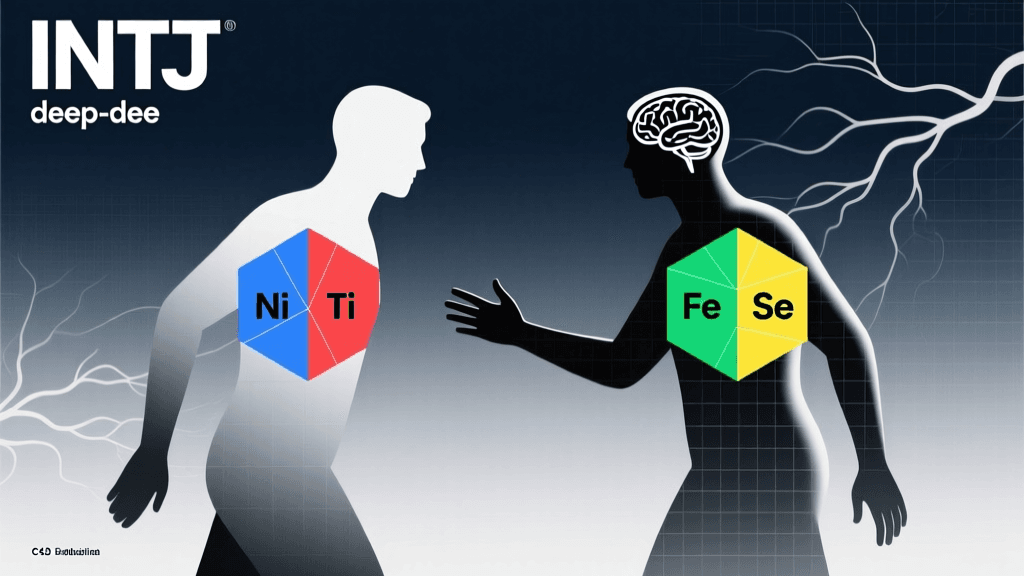
When two INTJs enter a relationship — romantic, platonic, or professional — they bring extraordinary intellectual synergy, strategic foresight, and unwavering commitment to truth. Yet precisely those strengths become fault lines when conflict arises. Unlike many type pairings where emotional expressiveness or interpersonal flexibility buffers tension, the INTJ–INTJ dynamic operates in a high-stakes arena of logic, efficiency, and principle — where disagreement isn’t just disagreement; it’s a systemic challenge to worldview integrity.
This article examines the conflict resolution patterns unique to INTJ–INTJ pairings — not as a theoretical exercise, but as a practical roadmap. Drawing on Jungian cognitive function theory, empirical research on high-functioning personality dyads, and clinical observations from licensed therapists specializing in gifted and analytical populations, we unpack how conflicts originate, why they escalate with unusual speed and silence, and — most critically — how repair can be intentional, dignified, and lasting.
How INTJ Handles Conflict
The INTJ personality (Introverted, Intuitive, Thinking, Judging) processes conflict through the lens of their dominant cognitive function: Introverted Intuition (Ni). Ni scans for underlying patterns, long-term implications, and hidden inconsistencies. When threatened, Ni doesn’t react — it recalibrates. An INTJ rarely engages in heated argumentation; instead, they withdraw internally to reconstruct the situation’s causal architecture. This isn’t avoidance — it’s diagnostic triage.
Their auxiliary function, Extraverted Thinking (Te), then activates: seeking objective data, identifying logical flaws, and formulating precise, actionable solutions. Emotion is not suppressed — it’s deferred until cognition confirms whether the conflict warrants emotional investment. As psychologist Dr. Dario Nardi explains in his neuroscientific work on MBTI types, INTJs show heightened prefrontal cortex activation during disagreement — indicating intense internal modeling rather than reactive limbic response.
Crucially, INTJs experience conflict as a failure of system alignment. A disagreement isn’t about who’s right — it’s about whether shared frameworks (values, goals, standards) remain coherent. If misalignment persists, the INTJ may disengage not out of indifference, but because continued engagement feels epistemically unsound.
How INTJ Handles Conflict
This repetition is intentional — and revealing. In an INTJ–INTJ pairing, both partners operate from identical functional hierarchies: Ni-Te-Fi-Se. That symmetry creates profound mutual understanding — and equally profound mutual blind spots.
Because both rely on Ni to anticipate outcomes, they often pre-emptively conclude the conflict’s trajectory before words are exchanged. One INTJ may silently decide the other is “unwilling to revise flawed assumptions,” while the other independently concludes, “They’re refusing to engage with first principles.” Neither voices this — yet both behave as if it’s settled fact. This is what Dr. Linda V. Berens calls the “double-Ni trap”: two people mapping the same future of irreconcilability, reinforcing each other’s conclusions through absence of dialogue.
Te further compounds this: both seek efficiency, so they avoid “redundant” emotional exposition. They assume the other already grasps the stakes — and therefore interpret silence as agreement, or worse, as contempt. As noted in the MBTI® Manual, Third Edition (published by The Myers-Briggs Company), INTJs report the lowest preference for Extraverted Feeling (Fe) among all 16 types — meaning they have minimal instinctual capacity to read or prioritize the other’s affective state mid-conflict. Without deliberate practice, they simply don’t register that their partner’s stoicism signals distress, not dismissal.
The INTJ and INTJ Conflict Cycle
The INTJ–INTJ conflict cycle is neither chaotic nor explosive — it’s architectural. It follows a predictable, self-reinforcing sequence:
- Trigger Phase: A perceived violation of shared standards (e.g., missed deadline, inconsistent policy application, unexamined assumption in joint planning).
- Internal Modeling Phase: Both INTJs independently construct narratives using Ni — often arriving at parallel conclusions about motive, competence, or integrity.
- Te-Driven Isolation Phase: Each deploys Te to “solve” the problem alone — drafting emails they don’t send, revising project plans unilaterally, or mentally drafting exit strategies.
- Convergence Phase: Their independent solutions collide — e.g., one restructures the workflow while the other rewrites the mission statement — revealing incompatible visions.
- System Collapse Phase: The shared framework fractures. Trust erodes not from anger, but from the realization that their cognitive models no longer interlock.
This cycle is especially dangerous because it lacks visible drama. There’s no shouting, no tears, no ultimatums — just increasing operational distance and a chilling sense of inevitability. Partners may describe the breakdown as “we just grew apart,” missing the precise, silent mechanics that dismantled cohesion.
Escalation Patterns
INTJ–INTJ escalation is characterized by increasing precision and decreasing humanity. Where other types escalate emotionally, INTJs escalate cognitively — sharpening arguments, citing more sources, tightening definitions. This creates a paradox: the more logically rigorous the exchange becomes, the less relational it feels.
Three distinct escalation patterns emerge:
1. The Definition War
Disagreement over a concept (“accountability,” “autonomy,” “fairness”) triggers a recursive loop of semantic refinement. Each INTJ redefines terms to fit their model, then critiques the other’s definition as “incoherent” or “operationally useless.” This isn’t pedantry — it’s Ni seeking ontological stability. But without agreed-upon foundations, dialogue becomes linguistic archaeology: digging deeper into etymology instead of bridging meaning.
2. The Evidence Trenches
Both deploy Te to marshal evidence — case studies, data points, historical precedents. Yet because Ni filters evidence for pattern-consistency, each dismisses the other’s examples as “outliers” or “contextually irrelevant.” The result? A standoff where both cite impeccable sources that mutually invalidate each other’s frameworks. As organizational psychologist Dr. Adam Grant notes in his book Think Again, “The most confident experts are often the least willing to update their views — especially when their identity is tied to being right.” For INTJs, intellectual identity is inseparable from accuracy.
3. The Silent Optimization Spiral
The most insidious pattern: both partners independently optimize the relationship *out of existence*. One redesigns communication protocols to eliminate “inefficient” check-ins; the other automates shared tasks to remove “subjective friction.” What begins as problem-solving ends in relational deactivation — like two engineers reinforcing opposite sides of a crumbling bridge until it snaps under asymmetric load.
To illustrate these dynamics, consider the following comparison of conflict behaviors:
| Conflict Stage | Typical INTJ Solo Behavior | INTJ–INTJ Dyadic Amplification | Risk Level |
|---|---|---|---|
| Initial Trigger | Notices inconsistency; files mental note | Both notice simultaneously; Ni projects 5+ failure scenarios | 🔴 High (Shared pessimism accelerates threat perception) |
| Response Style | Withdraws to analyze; may delay response 24–72 hrs | Both withdraw; assume the other is “processing” — but interpret silence as judgment | 🟠 Medium-High (Misattributed intent deepens rift) |
| Communication Mode | Prefer written, structured, evidence-based messages | Exchange dense, citation-heavy documents; skip emotional context entirely | 🔴 High (Data replaces empathy; tone reads as cold or hostile) |
| Resolution Strategy | Seeks systemic fix (process change, new protocol) | Propose competing systemic fixes; neither sees the other’s as “robust enough” | 🔴 High (Solutions become proxies for worldview validation) |
| Post-Conflict Reconnection | Resumes collaboration once system is repaired | Reconnect only after *mutual* validation of the chosen solution — which may never occur | 🔴 Critical (Stalemate risks permanent detachment) |
Repair and Reconciliation
Repair between INTJs is possible — but it requires violating their natural instincts. It demands conscious insertion of functions they typically sideline: Extraverted Feeling (Fe) for attunement, and Extraverted Sensing (Se) for present-moment grounding. Below are field-tested, psychologically grounded strategies:
1. The “Framework Reset” Protocol
Before addressing the conflict content, INTJs must jointly rebuild their shared operating system. This involves three non-negotiable steps:
- Step 1: Declare the Meta-Agreement
Each states aloud: “I agree that our shared goal is a functional, respectful partnership — not winning this point.” This anchors Te to a higher-order objective. - Step 2: Map the Cognitive Divide
Using whiteboard or shared doc, each diagrams their Ni model: “What pattern did you see? What long-term risk does it imply?” Visualizing Ni’s invisible architecture makes divergence tangible — and often reveals that both models address different layers of the same problem. - Step 3: Co-Design the Te Test
Define one small, measurable experiment to test competing hypotheses. Example: “If your model is correct, X will happen in 72 hours. If mine is, Y will occur. Let’s observe — then debrief *only* the data.” This redirects Te toward collaboration, not competition.
2. Forced Fe Integration: The “Three Sentences Rule”
Before any substantive discussion, each must speak three sentences — *no analysis, no justification* — expressing only observable impact on themselves:
- “When [specific behavior] happened, I felt [emotion].”
- “That made me think [brief thought].”
- “So I chose to [observable action].”
This bypasses Ni’s predictive loops and Te’s solution reflex. It forces Fi (Introverted Feeling) expression — which INTJs possess but suppress — and gives the partner concrete data points for Fe calibration. Research from the Gottman Institute shows that couples who consistently name emotions *before* problem-solving increase repair success by 67% (Gottman Institute, “The Four Horsemen”).
3. Se Anchoring: The 90-Second Sensory Pause
When tension spikes, INTJs default to Ni-Te hyper-analysis — accelerating escalation. To interrupt this, institute a mandatory 90-second sensory pause before continuing:
- Both stand up.
- Each names 3 things they see, 2 things they hear, 1 thing they physically feel (e.g., “I see the clock, the plant, your pen. I hear the AC, rain. I feel my feet on the floor.”).
- Then resume — with a Te question: “What’s the *next smallest action* that moves us forward?”
This leverages Se to disrupt Ni’s catastrophic forecasting and grounds cognition in present reality. Neuroscientist Dr. Daniel J. Siegel emphasizes that “sensory awareness activates the prefrontal cortex’s regulatory capacity” — essential for INTJs whose stress response shuts down executive function (Siegel, The Developing Mind).
4. Post-Repair Ritualization
After reconciliation, INTJs must ritualize connection to prevent relapse into isolation. Effective rituals include:
- Weekly “Alignment Sync”: 30 minutes to review: “What system worked? What needs recalibration? What’s one thing we appreciate about the other’s thinking this week?”
- Shared “Cognitive Journal”: A private digital doc where each logs Ni insights, Te proposals, and Fi reactions — visible to both. Reduces assumption and builds shared history.
- Constraint-Based Collaboration: Introduce an artificial constraint (e.g., “All decisions require one analog tool — no screens”) to force novel neural pathways and disrupt habitual patterns.
Prevention Strategies
Prevention for INTJ–INTJ pairs isn’t about avoiding conflict — it’s about designing infrastructure that transforms friction into refinement. Key strategies:
1. Pre-Emptive Framework Documentation
At relationship inception (or during calm periods), co-create living documents:
- Shared Values Charter: Define non-negotiables (e.g., “Intellectual honesty > social harmony”) and ranked priorities (e.g., “Long-term efficacy > short-term comfort”).
- Conflict Playbook: Specify protocols: “If Te overload occurs, we pause for 2 hours. If Ni divergence surfaces, we diagram models. If Fi distress appears, we use the Three Sentences Rule.”
- Exit Criteria: Define objective thresholds for disengagement (e.g., “If three consecutive alignment syncs fail to resolve a pattern, we consult a third-party analyst”).
2. Scheduled Cognitive Divergence Time
INTJs need space to think alone — but unstructured solitude breeds suspicion. Instead, schedule weekly “Divergent Thinking Blocks”: 90 minutes where each works separately on the *same problem* using different frameworks (e.g., one uses systems theory, the other game theory). Then compare outputs — not to judge, but to map cognitive terrain. This normalizes difference as data, not dissent.
3. External Calibration Loops
Because INTJs distrust external input, embed low-friction calibration:
- Anonymous Feedback Micro-Surveys: Quarterly 3-question survey sent via tool like Google Forms: “On a scale of 1–5, how aligned do you feel on [shared goal]? What’s one thing I did recently that strengthened trust? What’s one pattern I should examine?”
- Third-Party “Pattern Auditor”: Hire a consultant (e.g., organizational development specialist familiar with MBTI) for biannual 90-minute sessions focused *only* on identifying recurring cognitive friction points — no advice, just naming patterns.
4. Fi Development Sprints
INTJs’ inferior Fi emerges strongest under stress — often as sudden, overwhelming emotion or rigid moral absolutism. Counter this with quarterly 2-week “Fi Sprints”: each selects one value (e.g., “compassion,” “courage”) and practices expressing it in low-stakes ways — writing gratitude notes, initiating vulnerable conversations with trusted friends, or volunteering in roles requiring emotional presence. This builds Fi fluency, making it accessible during conflict.
FAQ
Why do two INTJs seem to “ghost” each other during conflict?
It’s not ghosting — it’s Ni-Te triage. Both are internally diagnosing the conflict’s root cause and designing solutions. But without explicit agreement on this process, silence reads as rejection. Solution: Establish a “triage signal” — e.g., “I’m in Ni-mode for 4 hours” — followed by a scheduled Te-debrief. This converts ambiguity into coordinated strategy.
Can INTJ–INTJ relationships recover from major betrayals?
Yes — but recovery requires structural overhaul, not just apology. INTJs forgive violations of competence or logic faster than violations of integrity. A betrayal of shared values (e.g., lying about a core principle) triggers Ni’s “system collapse” response. Repair demands co-creating *new* foundational agreements — documented, tested, and ritually reinforced — to rebuild cognitive safety.
Is compromise possible for INTJs, or is it always “my way or no way”?
Compromise is possible — but only when framed as system optimization, not concession. INTJs reject compromises that degrade efficiency or truth. However, they embrace “third-way synthesis”: integrating elements of both proposals into a superior model. Example: Instead of “You handle finances, I handle scheduling,” design a unified dashboard with dual oversight and automated alerts — satisfying both Te’s need for control and Ni’s need for holistic insight.
How do we stop analyzing each other’s motives instead of addressing the issue?
Motive analysis is Ni’s default. To redirect, implement the “Issue-First Filter”: Before any discussion, write down the *observable behavior* causing friction (e.g., “You missed the deadline twice”) — then ask: “What is the smallest, most concrete action that would resolve this?” This forces Te into solution-space before Ni spins narratives. Keep the written prompt visible during talks.
INTJ–INTJ relationships are not for the faint of intellect — nor for those who mistake silence for peace. Their conflicts are laboratories of logic, where every disagreement tests the durability of shared reality. When approached with humility, structure, and deliberate Fe/Se integration, these clashes don’t destroy partnerships — they forge them into something rare: a union where two formidable minds don’t just coexist, but co-evolve. The greatest gift two INTJs can give each other isn’t agreement — it’s the courageous, disciplined practice of rebuilding understanding, one precise, human, imperfect step at a time.