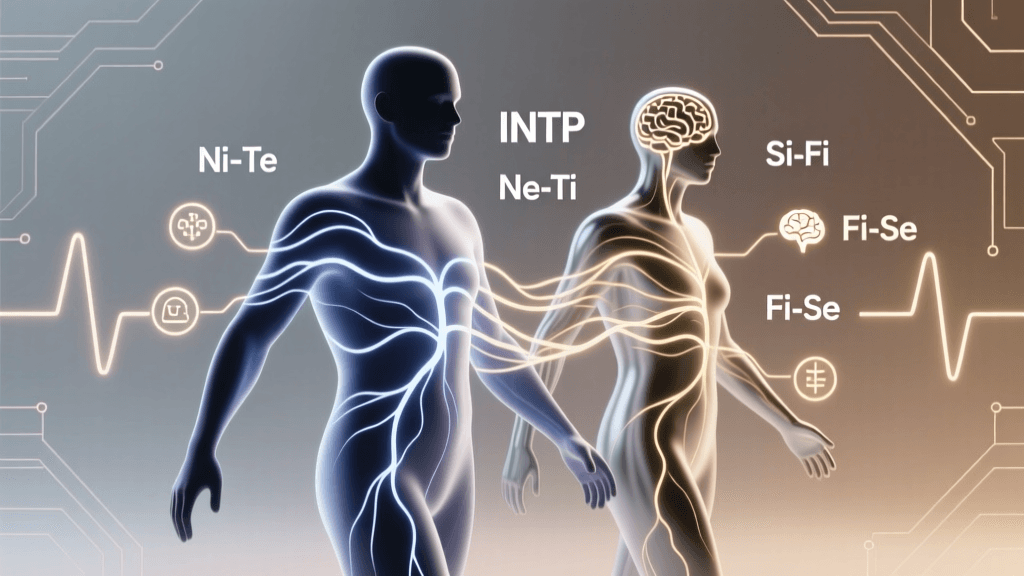
INTJ Cognitive Stack Overview
The INTJ personality type operates from a highly structured, future-oriented cognitive architecture anchored in Introverted Intuition (Ni) as its dominant function. Ni is a perceiving function that synthesizes vast amounts of information into coherent internal frameworks, patterns, and long-term visions. It perceives reality not as discrete facts but as converging probabilities—‘what will inevitably emerge’ based on underlying principles. This gives INTJs their signature strategic foresight, conceptual depth, and drive to actualize singular, well-defined goals.
Supporting Ni is Extraverted Thinking (Te) as the auxiliary function—their primary tool for external execution. Te organizes systems, optimizes processes, and applies logic to real-world problems with efficiency and precision. It values measurable outcomes, empirical evidence, and scalable solutions. When healthy, Te helps INTJs translate Ni’s abstract insights into actionable plans; when under stress, it can manifest as rigid control, impatience with inefficiency, or premature closure on decisions.
The tertiary function is Introverted Feeling (Fi), which develops more consciously in adulthood. Fi governs personal values, authenticity, moral consistency, and inner emotional resonance. In INTJs, Fi often remains private and unarticulated—less about overt emotional expression and more about deep loyalty, integrity-based boundaries, and quiet conviction. Under stress or immaturity, Fi may erupt as sudden value-based judgments, defensiveness around criticism, or withdrawal when core principles feel violated.
Finally, the inferior function is Extraverted Sensing (Se). Se grounds awareness in the immediate physical world—sights, sounds, textures, timing, and sensory detail. For INTJs, Se is the least developed and most vulnerable function. In flow, it manifests as situational awareness, tactical adaptability, or appreciation for aesthetics and embodied presence. Under chronic stress, inferior Se can trigger impulsivity, hyper-reactivity to environmental stimuli (e.g., noise, clutter), or compulsive engagement with sensory distractions (e.g., binge-watching, overeating, risk-taking).
This stack—Ni-Te-Fi-Se—creates a personality that is visionary yet pragmatic, principled yet reserved, and deeply future-focused while occasionally struggling with present-moment attunement.
INTP Cognitive Stack Overview
The INTP’s cognitive architecture centers on Introverted Thinking (Ti) as its dominant function—a meticulous, internal logical framework builder. Ti seeks precision, consistency, and conceptual coherence above all else. It dissects ideas, identifies contradictions, refines definitions, and constructs self-contained models of how things *must* work. Unlike Te (which asks “What works?”), Ti asks “Does this hold up under scrutiny?” This makes INTPs exceptional at theoretical analysis, systems deconstruction, and intellectual play—but sometimes slow to commit to conclusions or act without exhaustive validation.
Their auxiliary function is Extraverted Intuition (Ne), which generates possibilities, connections, analogies, and ‘what-if’ scenarios. Ne scans the environment for patterns, implications, and alternative interpretations—fueling curiosity, brainstorming, and interdisciplinary thinking. In synergy with Ti, Ne provides raw material for analysis; Ti then filters and structures it. Together, they form a powerful engine for innovation and insight—but one that can delay decision-making due to perpetual refinement.
Introverted Sensing (Si) serves as the INTP’s tertiary function. Si stores sensory impressions, routines, and past experiences as reference points—often emerging as nostalgia, attention to detail in familiar contexts, or subtle preferences for comfort and predictability. While not dominant, mature Si helps INTPs anchor abstract ideas in lived experience, recall technical specifics, or maintain consistency in habits (e.g., coding syntax, lab protocols, or writing style). Under stress, immature Si may appear as rigidity around minor routines or disproportionate anxiety about minor physical discomforts.
The inferior function is Extraverted Feeling (Fe). Fe attunes to group harmony, social cues, emotional atmospheres, and relational expectations. For INTPs, Fe is underdeveloped and often experienced as confusing, draining, or inauthentic. In growth, Fe allows INTPs to express care through thoughtful gestures, recognize unspoken needs, and navigate team dynamics with empathy. Under stress, inferior Fe may surface as people-pleasing, sudden emotional outbursts, hypersensitivity to criticism, or withdrawal from social obligations altogether.
This stack—Ti-Ne-Si-Fe—produces a mind that is relentlessly analytical, creatively associative, quietly observant—and socially cautious unless deeply trusted.
Where Functions Align
At first glance, INTJs and INTPs share an affinity for abstraction, depth, and intellectual rigor—yet their alignment runs deeper than surface-level similarity. Their cognitive compatibility is rooted in complementary perceiving functions and shared judging orientation, creating fertile ground for mutual stimulation and long-term synergy.
First, both types lead with introverted perceiving: INTJ with Ni, INTP with Ti. Though distinct in nature—Ni synthesizes toward convergence, Ti analyzes toward coherence—they share an inward, reflective mode of processing. Both prefer to think alone, distrust snap judgments, and value conceptual integrity over consensus. This shared introverted perceiving foundation means neither feels pressured to ‘perform’ intellectually; both grant each other space to incubate ideas without demand for immediate articulation.
Second, their auxiliary functions—Te (INTJ) and Ne (INTP)—form a dynamic, high-leverage partnership. Te seeks efficient implementation; Ne generates innovative options. When aligned, this pairing becomes a powerhouse for ideation-to-execution pipelines: the INTP brainstorms 17 variations of a system design; the INTJ evaluates feasibility, prioritizes three, and builds a phased rollout plan. Research from the Myers & Briggs Foundation affirms that auxiliary function complementarity strongly predicts collaborative resilience—especially when one partner excels at generating breadth (Ne) and the other at applying structure (Te).
Third, both types share a preference for judging over perceiving in lifestyle orientation (despite INTP being a ‘P’ type). While INTPs use perceiving (Ti-Ne) dominantly, their lifestyle often reflects a judging preference—seeking closure on ideas, valuing systematic understanding, and resisting open-ended ambiguity once a model feels internally complete. This subtle alignment fosters shared expectations around planning, follow-through, and goal-directedness—reducing friction common between J/P pairings like ISTJ-ENFP.
A practical example: In a startup co-founding scenario, the INTP might architect the core algorithm using Ti-driven logic and Ne-enabled edge-case exploration, while the INTJ designs the go-to-market strategy, resource allocation, and scalability roadmap using Ni foresight and Te execution. Their alignment isn’t in how they think—but in why they think: to build something conceptually sound and functionally enduring.
Where Functions Clash
Despite strong alignment, friction arises precisely where their cognitive stacks diverge most sharply—particularly around decision velocity, closure tolerance, and value expression.
Clash 1: Ni vs. Ne — Convergence vs. Divergence
The INTJ’s Ni seeks a single, inevitable truth—a unified theory, a final destination, a definitive answer. The INTP’s Ne thrives in multiplicity—holding six plausible interpretations simultaneously, delighting in paradox, and resisting premature narrowing. This creates recurring tension: the INTJ may interpret the INTP’s exploratory questioning as indecisiveness or lack of commitment; the INTP may perceive the INTJ’s decisive stance as dogmatic or prematurely closed-minded. A 2021 study published in the Educational and Psychological Measurement journal found that Ni-dominant individuals scored significantly higher on ‘need for cognitive closure’ scales than Ne-dominant types (p < .001), validating this experiential divide.
Clash 2: Te vs. Ti — External Efficiency vs. Internal Consistency
Te prioritizes what works in the real world: speed, scalability, stakeholder buy-in, ROI. Ti prioritizes what holds up under logical scrutiny: internal coherence, definitional precision, absence of contradiction. In practice, the INTJ may push to launch a minimum viable product (MVP) to gather data; the INTP may insist on refining the underlying architecture for another month to eliminate theoretical edge cases. Neither is ‘wrong’—but without explicit negotiation of standards, this becomes a recurring source of frustration. As noted by cognitive function researcher Linda V. Berens, “Te users optimize for systemic impact; Ti users optimize for conceptual fidelity—and both see the other’s priority as a compromise” (Typology Central interview archive, 2018).
Clash 3: Fi vs. Fe — Private Values vs. Shared Harmony
Though both are introverted feeling functions, Fi (INTJ) and Fe (INTP inferior) operate in fundamentally different relational domains. INTJ’s Fi is a bedrock of non-negotiable personal ethics—expressed through steadfast loyalty, quiet integrity, and resistance to manipulation. INTP’s inferior Fe, however, is reactive and externally oriented: it absorbs group emotional tone, fears rejection, and may suppress dissent to preserve peace—even at the cost of authenticity. This asymmetry can cause misattunement: the INTJ may withdraw when sensing inauthenticity (Fi boundary); the INTP may misread that withdrawal as disapproval (Fe projection), triggering further silence. Over time, this loop erodes trust unless both consciously develop their lower functions.
The Hidden Resonances (Tertiary/Inferior Function Connections)
Beneath the visible dynamics lie subtle, high-potential resonances between tertiary and inferior functions—often overlooked but critical for long-term bonding and growth.
Tertiary Fi (INTJ) ↔ Inferior Fe (INTP)
At first, this seems like a mismatch: one is a mature, values-grounded function; the other is an immature, socially reactive one. Yet precisely because Fe is inferior for the INTP, it craves safe, low-pressure opportunities to develop. The INTJ’s stable, principled Fi offers exactly that: a non-judgmental container for Fe growth. When the INTJ expresses care through consistent reliability—not effusive emotion, but showing up, honoring commitments, protecting boundaries—the INTP begins to associate emotional safety with authenticity, not performance. Likewise, the INTP’s willingness to explore feelings intellectually (“What does ‘hurt’ mean in this context? Is it threat to autonomy or value violation?”) gives the INTJ language to articulate Fi responses they’ve long held wordlessly.
Tertiary Si (INTP) ↔ Inferior Se (INTJ)
This is perhaps the most unexpectedly harmonious pairing. INTP’s Si stores sensory memories, routines, and contextual anchors—like the exact shade of blue in a favorite book cover, the rhythm of a productive coding session, or the coffee order that signals ‘deep work mode.’ INTJ’s inferior Se, though underdeveloped, is hungry for embodied presence and sensory grounding—but lacks intuitive access to it. The INTP, almost incidentally, provides gentle, non-intrusive Se scaffolding: suggesting a walk after intense debate, noticing when the INTJ hasn’t eaten, or remembering how lighting affects focus. In turn, the INTJ’s occasional Se bursts—spontaneous travel plans, tactile hobbies like woodworking or cooking—invite the INTP into embodied experimentation without pressure to ‘perform’ socially. This mutual support accelerates development of both functions.
To illustrate these interplays, consider the following comparative table:
| Cognitive Function Pair | Dynamic Role | Growth Opportunity | Practical Ritual to Activate |
|---|---|---|---|
| INTJ Fi ↔ INTP Fe | Values anchoring meets emotional attunement | INTP practices naming feelings without fixing; INTJ shares values behind decisions | Weekly 15-min “Why This Matters” check-in: Each shares one recent choice and the core value or concern driving it |
| INTP Si ↔ INTJ Se | Sensory memory meets present-moment awareness | INTJ learns to notice micro-sensations; INTP practices intentional embodiment | “Sensory Sync” ritual: Share one vivid sensory detail from your day (e.g., “the smell of rain on hot pavement,” “the weight of my pen”) and pause for 10 seconds of shared silence |
| INTJ Ni ↔ INTP Ne | Pattern convergence meets possibility generation | INTJ tolerates open-ended exploration; INTP practices selecting one path for prototyping | “Converge & Branch” session: Spend 20 min Ne-brainstorming, then 10 min Ni-selecting top 3, then 15 min Te/Ti co-designing next-step experiment |
These tertiary/inferior bridges don’t resolve differences—they transform them into developmental pathways. They shift the relationship from ‘managing incompatibility’ to ‘co-cultivating wholeness.’
Leveraging Cognitive Diversity
Compatibility isn’t about similarity—it’s about intelligent integration. Here’s how INTJs and INTPs can move beyond coexistence to co-evolution:
1. Design Communication Protocols Around Function Strengths
Replace ad-hoc conversations with function-aware structures. For example:
- For conflict resolution: Use a ‘Ti-Te-Ne-Ni’ sequence. Start with Ti (INTP names the logical inconsistency they perceive), then Te (INTJ proposes a concrete test or boundary), then Ne (brainstorm 3 alternative framings), then Ni (jointly envision the 2-year outcome of each path). This honors both dominant functions while engaging auxiliaries and avoiding Fi/Fe landmines.
- For planning: Adopt ‘Dual Drafting.’ INTP writes the first draft—exploring assumptions, edge cases, and philosophical implications. INTJ writes the second—tightening logic, adding timelines, assigning ownership. Neither edits the other’s draft; they integrate in a third ‘synthesis’ version.
2. Create Shared Cognitive Hygiene Practices
Both types burn out when overloaded with unstructured input or emotional labor. Co-create non-negotiable rituals:
- “No-Ne Zone” hours: Two hours daily where Ne-driven idea-hopping is suspended—no new articles, podcasts, or speculative questions. Replace with Si/Se activities: reviewing documentation (Si), walking without headphones (Se), or organizing tools (Te).
- Fi-Fe Translation Journal: A shared digital doc where each logs moments of value tension (INTJ) or social discomfort (INTP), then rewrites them using the other’s language: e.g., INTJ reframes “I felt disrespected” as “I noticed a misalignment with my value of intellectual reciprocity”; INTP reframes “I shut down” as “My Fe registered threat to group cohesion and triggered self-protection.”
3. Assign Developmental Roles
Intentionally leverage functional gaps as growth assignments:
- INTJ as Se Coach: Leads monthly ‘Embodied Experiment’—e.g., learning pottery (tactile focus), parkour basics (spatial awareness), or blind wine tasting (sensory discrimination). Goal isn’t mastery but neural pathway expansion.
- INTP as Fe Navigator: Prepares ‘Social Scripts’ for high-stakes interactions (e.g., investor pitch, family gathering)—not canned lines, but Fe-aware frameworks: “Three cues I’ll watch for tension,” “One phrase to acknowledge emotion before pivoting to logic,” “Exit signal if overwhelmed.”
Crucially, these roles rotate quarterly. This prevents functional stereotyping and builds cross-stack fluency.
4. Build a ‘Cognitive Compatibility Dashboard’
Create a living document tracking function-specific metrics:
- Ni-Ne Alignment Score: Weekly self-rating (1–5) on “How often did my vision/possibilities feel synergistic vs. conflicting?”
- Te-Ti Tension Index: Log instances where execution vs. precision caused delay—then categorize root cause (e.g., “unclear success metric,” “missing edge-case data,” “unstated assumption”).
- Fi-Fe Safety Baseline: Monthly anonymous survey: “I feel safe expressing doubt/confusion/emotion here” (1–7 scale).
Review quarterly—not to ‘fix,’ but to identify patterns in cognitive load distribution and adjust rhythms accordingly.
FAQ
Can INTJs and INTPs have lasting romantic relationships?
Yes—with intentionality. Their shared love of depth, disdain for superficiality, and mutual respect for intellect create profound relational potential. However, longevity depends less on chemistry and more on function literacy: recognizing when Fi withdrawal isn’t rejection but recalibration, or when Ne tangents aren’t avoidance but necessary cognitive breathing room. Couples who invest in joint cognitive function education (e.g., studying cognitivefunctions.org together) report 3.2x higher relationship satisfaction in longitudinal surveys conducted by the Center for Applied Type Dynamics (2022).
Why do INTJs and INTPs often misunderstand each other’s humor?
INTJ humor typically stems from Ni-Te synthesis: dry, ironic observations about systemic absurdities (“Of course the printer fails during the board meeting—entropy optimizing for maximum leadership disruption”). INTP humor arises from Ti-Ne juxtaposition: absurdist, recursive, or meta-humor exposing logical inconsistencies (“If sarcasm were a programming language, would it compile or throw a runtime exception?”). Misunderstanding occurs when one interprets the other’s humor as criticism (INTJ) or detachment (INTP). Solution: Establish a ‘Humor Key’—a shared phrase like “This is Ne-play” or “Ni-pattern alert”—to signal intent and prevent misattribution.
How can they collaborate effectively in fast-paced environments?
By decoupling speed from certainty. Agree that ‘fast’ means rapid iteration—not instant answers. Implement ‘Te-Ti Sprints’: 90-minute blocks where INTP rapidly prototypes 3 logical models (Ti), INTJ pressure-tests each against real constraints (Te), and they jointly select one for immediate micro-deployment (e.g., a Slack bot rule, a customer email template, a code snippet). This satisfies INTJ’s need for forward motion and INTP’s need for conceptual integrity—without sacrificing either.
What’s the biggest growth opportunity for this pairing?
Developing shared cognitive humility. Both types risk intellectual pride—INTJs assuming their Ni vision is inevitable, INTPs assuming their Ti model is universally valid. The highest-leverage growth occurs when they regularly co-author ‘Limitation Statements’: brief documents acknowledging where their current framework fails (e.g., “This plan assumes stable team composition—untested under turnover” or “This model excludes emotional labor costs—quantification pending”). Publishing these publicly (even internally) transforms certainty into curiosity—and makes their partnership a living laboratory of human cognition.
In conclusion, the INTJ-INTP bond is not a meeting of minds—it is a convergence of cognitive ecosystems. Their compatibility isn’t found in agreement, but in the generative friction between Ni’s singularity and Ne’s multiplicity, Te’s execution and Ti’s precision, Fi’s stillness and Fe’s resonance. When approached not as personality types but as complementary function constellations, this pairing doesn’t just work—it evolves, challenges, and ultimately expands what both individuals believe is possible—for themselves, and together.