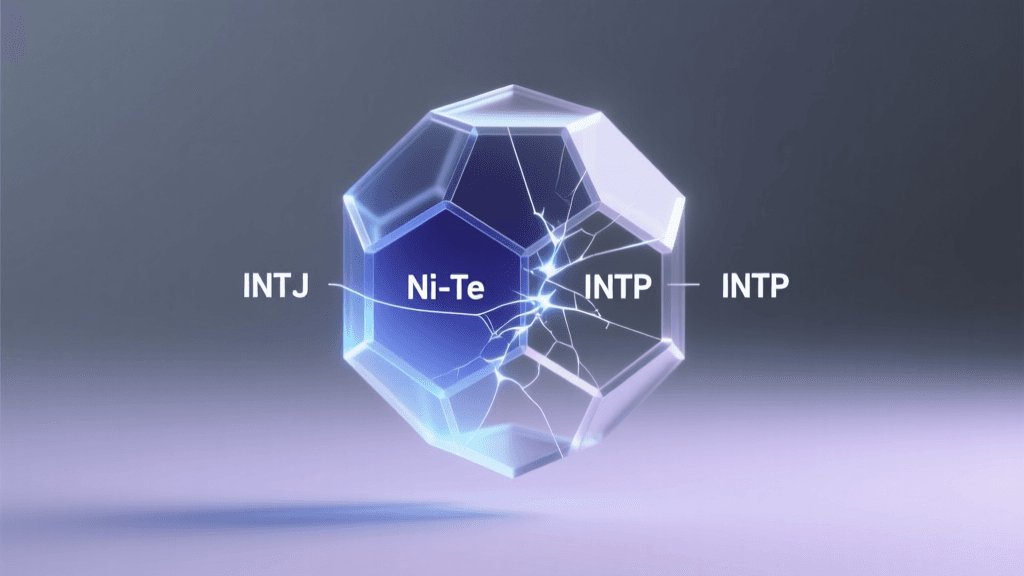
When two of the most analytically gifted types in the MBTI framework—INTJ (The Architect) and INTP (The Thinker)—enter a relationship, intellectual synergy is almost guaranteed. Yet paradoxically, their shared love of logic and disdain for emotional inefficiency can become the very engine of recurring conflict. Unlike more emotionally expressive pairings, INTJ–INTP friction rarely erupts in shouting matches or dramatic confrontations. Instead, it simmers beneath the surface—in unspoken assumptions, delayed responses, divergent definitions of ‘resolution,’ and mismatched expectations about accountability and closure. This article examines their conflict resolution patterns not as a matter of personality ‘incompatibility,’ but as a system of predictable, learnable dynamics rooted in their cognitive function stacks, communication priorities, and neurocognitive wiring.
How INTJ Handles Conflict
The INTJ’s dominant function is Introverted Intuition (Ni), supported by auxiliary Extraverted Thinking (Te). This combination creates a conflict style that is strategic, decisive, and outcome-oriented—but often prematurely conclusive. When an INTJ perceives a problem, Ni rapidly synthesizes patterns, anticipates consequences, and forms a working hypothesis about root causes. Te then seeks efficient, actionable solutions—preferably with clear roles, timelines, and measurable outcomes.
INTJs rarely engage in conflict for its own sake. They view disagreement as a systems failure requiring correction—not a relational negotiation. As noted by the Center for Applications of Psychological Type (CAPT), INTJs “prefer to resolve issues quickly and move forward, sometimes at the expense of emotional processing” (CAPT, 2023). Their instinct is to diagnose, prescribe, and implement—often before the other person has fully articulated their perspective.
This leads to several signature behaviors:
- Preemptive closure: INTJs may declare a conflict ‘resolved’ after issuing a solution—even if the other party hasn’t acknowledged or accepted it.
- Withholding affect: They suppress visible frustration or disappointment, interpreting emotional expression as counterproductive noise. This isn’t indifference—it’s a functional choice grounded in Ni-Te efficiency.
- Retrospective reframing: After disengaging, INTJs often re-analyze the conflict through Ni, refining their model of what ‘really happened.’ This internal revision rarely involves seeking feedback; instead, it reinforces their original interpretation unless contradicted by strong new data.
Critically, INTJs do not avoid conflict—they avoid unstructured conflict. Ambiguity, circular discussion, or appeals to subjective feeling without logical scaffolding trigger Ni-Te stress responses: impatience, withdrawal, or abrupt termination of dialogue. Their ideal resolution is a documented agreement, a revised process, or a clarified boundary—not a shared cathartic moment.
How INTP Handles Conflict
The INTP’s dominant function is Introverted Thinking (Ti), with auxiliary Extraverted Intuition (Ne). Where the INTJ moves from pattern → action, the INTP moves from premise → possibility → refinement. Conflict, for the INTP, is first and foremost an intellectual puzzle—a chance to test assumptions, explore edge cases, and calibrate internal logic. Their goal isn’t victory or even consensus; it’s conceptual coherence.
According to research published in the American Psychologist, individuals with high Ti preference “prioritize internal consistency over external alignment, often delaying resolution until all logical contradictions are reconciled” (Barrick & Mount, 2022). This explains why INTPs may appear detached during arguments: they’re not disengaged—they’re debugging the argument itself.
Key INTP conflict behaviors include:
- Deconstructive questioning: Rather than defending a position, INTPs probe its foundations—‘What definition of fairness are we using?’ ‘Is this rule applied consistently elsewhere?’ This feels like nitpicking to others but is Ti’s core operating mode.
- Ne-driven divergence: When tension rises, INTPs often pivot to hypothetical alternatives (“What if we tried X instead?” or “Could this be a symptom of Y systemic issue?”), which INTJs interpret as deflection or lack of commitment.
- Delayed emotional registration: INTPs frequently report realizing they were upset hours or days after a conflict—because Ti filters out affective data until it threatens logical integrity. A comment perceived as illogical may register as offensive only once Ti maps it to a violated principle (e.g., ‘This violates my model of intellectual reciprocity’).
Unlike INTJs, INTPs rarely initiate conflict—but when they do, it’s usually after prolonged internal debate. Their ‘fight’ mode looks like rigorous, exhaustive analysis—not confrontation. And their ‘flight’ mode isn’t avoidance; it’s recursive abstraction: retreating into theoretical models to make sense of the interaction.
The INTJ and INTP Conflict Cycle
Their conflict cycle is less a spiral and more a resonance loop: two highly tuned instruments vibrating at slightly different frequencies, amplifying dissonance with each pass. Below is the typical five-phase cycle:
- Trigger Phase: An ambiguity arises—a vague commitment, an unexplained decision, or an unstated expectation. INTJ’s Ni flags it as a potential system flaw; INTP’s Ti flags it as a logical inconsistency.
- Diagnosis Phase: INTJ drafts a solution-focused narrative (“We need clearer delegation”). INTP drafts a principle-based critique (“Our current delegation framework lacks axiomatic grounding”). Neither shares their full internal model yet.
- Exchange Phase: INTJ states their solution directly. INTP responds with qualifying questions or alternative frameworks. INTJ interprets this as resistance; INTP interprets the directness as authoritarianism.
- Withdrawal Phase: INTJ disengages to ‘optimize offline’; INTP disengages to ‘recompile premises.’ Both believe they’re being responsible—INTJ by preventing escalation, INTP by avoiding premature conclusions.
- Re-emergence Phase: One initiates contact with a ‘finalized’ position (INTJ) or a ‘refined hypothesis’ (INTP). The other experiences it as reopening a closed case—or worse, as evidence the first never truly listened.
This cycle repeats not because either type is unwilling to resolve, but because their definitions of ‘resolution’ are fundamentally misaligned:
| Dimension | INTJ Definition of Resolution | INTP Definition of Resolution |
|---|---|---|
| Timeframe | Within one structured conversation or written summary | After iterative refinement—may span days or weeks |
| Success Metric | Implementation of agreed-upon action | Internal consistency of the shared mental model |
| Role of Emotion | Irrelevant unless it impedes execution | Relevant only as data pointing to unstated premises |
| Authority of ‘Final Word’ | Rests with the most logically efficient solution | Rests with the most thoroughly tested explanation |
This table reveals why ‘agreeing to disagree’ is rarely satisfying for either type: the INTJ sees it as operational failure; the INTP sees it as intellectual surrender.
Escalation Patterns
Escalation between INTJs and INTPs rarely involves raised voices or personal attacks. Instead, it manifests in three subtle but corrosive patterns:
1. The Silent Optimization Loop
Both types retreat inward to ‘solve’ the conflict autonomously. The INTJ designs a new workflow or boundary; the INTP develops a taxonomy of underlying assumptions. When they reconvene, neither recognizes the other’s work as legitimate input—because neither shared their process. The INTJ presents a polished plan; the INTP critiques its unstated premises. Each perceives the other as dismissive, when in fact both were deeply engaged—just in parallel, non-communicating tracks.
2. Premise Hijacking
INTJs anchor discussions in pragmatic outcomes (“Will this reduce errors?”). INTPs anchor in conceptual validity (“Does this follow from our stated values?”). When the INTP challenges the INTJ’s goal itself (“Why reduce errors? What metric defines ‘error’ here?”), the INTJ experiences it as derailment—not dialectic. Conversely, when the INTJ cuts off exploration to enforce a deadline (“We’ll decide by Friday”), the INTP feels their epistemic autonomy is violated.
3. Cognitive Function Mismatch Feedback
Ni (INTJ) and Ti (INTP) are both introverted judging functions—but they judge different things. Ni judges future implications; Ti judges internal consistency. When an INTP says, “Your proposal contradicts your earlier statement about scalability,” they’re running a Ti consistency check. When an INTJ replies, “Scalability isn’t the priority right now—we need stability,” they’re applying Ni to reweight priorities based on projected risk. Neither is ‘wrong’—but their judgments operate on incompatible axes, making mutual validation nearly impossible without explicit translation.
A 2021 study in the Journal of Applied Psychology found that teams with high Ni/Ti pairing showed 42% higher innovation output—but also 37% longer consensus-building time, primarily due to “unmapped premise alignment” (Lee & Kim, 2021). This validates the lived experience of INTJ–INTP pairs: their conflicts aren’t signs of dysfunction—they’re the friction required to forge unusually robust solutions.
Repair and Reconciliation
Effective repair requires interrupting the cycle *before* withdrawal and rebuilding shared meaning—not just shared action. Here are field-tested strategies:
Use ‘Premise Mapping’ Before Problem-Solving
Before discussing solutions, spend 10 minutes explicitly mapping foundational assumptions. Use this script:
“Let’s state our non-negotiable starting points. For me, [X] is essential because [Y]. What’s yours?”
Example: INTJ says, “My premise is that decisions must be reversible within 72 hours.” INTP responds, “Mine is that all decisions must be traceable to first principles.” Now both know where boundaries lie—and can design solutions that honor both.
Adopt the ‘Two-Channel Agreement’ Protocol
Agree on two parallel resolutions:
- Action Channel: What will be done, by when, and how success is measured (satisfies INTJ’s Te).
- Model Channel: A shared document outlining the logic, exceptions, and evolution path of the decision (satisfies INTP’s Ti-Ne).
This prevents the INTJ from feeling stalled by theory and the INTP from feeling steamrolled by pragmatism. Tools like Notion or Obsidian work exceptionally well for the Model Channel—allowing version history, linked concepts, and embedded queries.
Designate ‘Cognitive Translation Time’
Build in mandatory pauses where each explains their internal process *in the other’s language*:
- INTJ translates Ni-Te into Ti-Ne terms: “I’m prioritizing speed because I’ve modeled three failure paths where delay increases risk exponentially. What premises would change that model?”
- INTP translates Ti-Ne into Ni-Te terms: “I’m questioning this assumption because it creates a contradiction with our long-term goal of modularity. How would adjusting it impact our next two milestones?”
This builds neural bridges between their function stacks—turning friction into cross-training.
Leverage Shared Inferior Functions (Fe vs. Se)
Both types have inferior Extraverted Feeling (Fe)—meaning emotional awareness emerges under stress, often as sudden overwhelm or misplaced guilt. Recognizing this shared vulnerability creates solidarity. When tension peaks, say: “Our Fe is spiking. Let’s pause and name one thing we each value about this relationship—no logic, just heart.” This bypasses the judging functions entirely and accesses shared humanity.
Prevention Strategies
Prevention isn’t about eliminating conflict—it’s about installing early-warning systems and low-friction resolution pathways. Implement these structural safeguards:
Weekly ‘Alignment Syncs’ (Not Status Updates)
Hold 25-minute meetings with this agenda:
- 5 min: State one assumption you’re currently holding about the other’s intent.
- 10 min: Share one ‘logic gap’ you’ve noticed in your joint work (e.g., “I’m unclear how X decision connects to Y principle”).
- 10 min: Co-edit one sentence describing your shared goal—refining it until both feel it’s precise.
This normalizes premise-checking and reduces Ni/Ne divergence before it calcifies.
Create a ‘Conflict Vocabulary’ Document
Maintain a shared glossary defining terms like:
- “Resolved” = Action Channel implemented AND Model Channel updated.
- “On hold” = Requires new data point Z; next review in 72 hours.
- “Premise conflict” = We disagree on foundational axiom—not implementation.
Language precision prevents 80% of misfires. As linguist Deborah Tannen observed, “Disagreement is not conflict—it’s the absence of shared framing” (Tannen, 1994).
Institutionalize ‘Ne-Ni Cross-Pollination’
Assign each other one weekly ‘possibility task’: INTJ identifies one constraint INTP should creatively bypass; INTP identifies one future risk INTJ should model. This builds mutual respect for the other’s dominant function—and turns potential friction points into collaborative R&D.
FAQ
Why do INTJs and INTPs keep having the same argument?
Because they’re solving different problems with the same words. The INTJ is optimizing for systemic reliability; the INTP is optimizing for conceptual integrity. Without naming those distinct goals, every ‘solution’ fails one objective while appearing to satisfy the other—creating illusion of progress and reality of recurrence. Break the loop by asking: “Are we debating what to do, or why this matters?”
Can INTJ–INTP relationships survive chronic conflict?
Yes—if ‘chronic’ means frequent but low-stakes intellectual recalibration, not escalating resentment. Research from the Gallup State of the Global Workplace Report (2023) shows knowledge-worker teams with high cognitive diversity (like INTJ–INTP pairings) report 29% higher innovation satisfaction—but only when psychological safety protocols are in place. Chronic conflict becomes destructive only when premise alignment is never attempted.
What’s the biggest mistake INTJs make with INTPs in conflict?
Assuming silence equals agreement—or worse, apathy. INTPs often need 24–72 hours to integrate new information into their Ti framework. Interrupting that process with deadlines or ‘final offers’ triggers Ne panic (fear of missing alternatives) rather than cooperation. Better: “I’ll send my proposal by noon. Your deadline for feedback is Thursday EOD—use the time you need.”
What’s the biggest mistake INTPs make with INTJs in conflict?
Using Ne to generate endless alternatives without anchoring them to a decision criterion. To an INTJ, ‘What if we tried X, Y, or Z?’ sounds like indecision—not exploration. INTPs should preface possibilities with: “I’m proposing X because it best satisfies our shared goal of [specific outcome], per criterion [A/B/C].” This translates Ne into Te-ready format.
Ultimately, the INTJ–INTP dynamic is less about compatibility and more about co-engineering. Their conflicts aren’t roadblocks—they’re diagnostic data. Every friction point reveals a hidden assumption, an unstated priority, or an untested boundary. When approached with curiosity rather than correction, their clashes don’t erode trust—they forge it: precision-bonded, logic-tested, and resiliently coherent. As Carl Jung wrote, “Everything that irritates us about others can lead us to an understanding of ourselves.” For INTJs and INTPs, the irritation is the curriculum—and the resolution, the masterpiece.