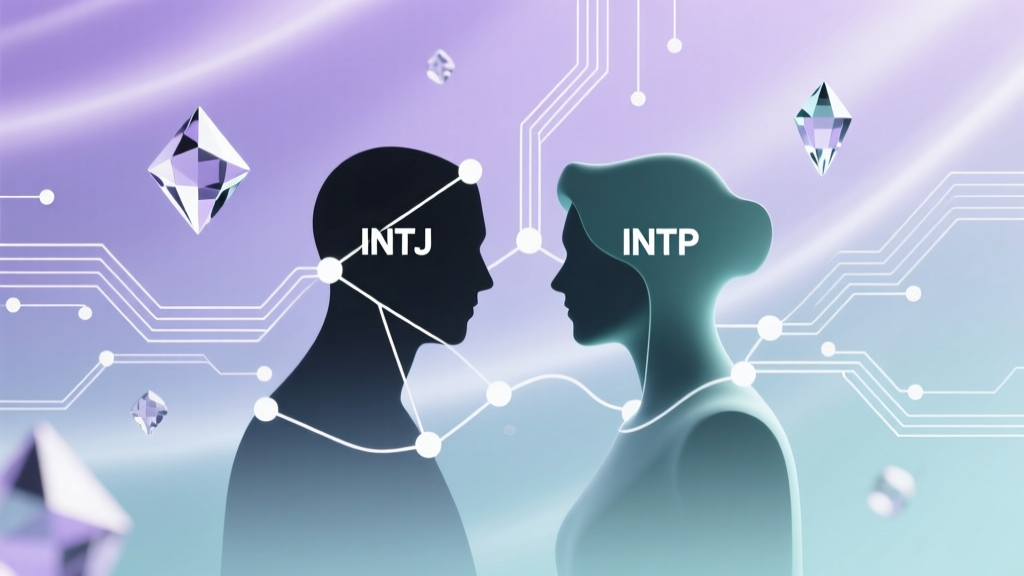
Creative Energies of INTJ and INTP
The INTJ (The Architect) and INTP (The Logician) are two of the rarest and most intellectually intense personality types in the Myers-Briggs Type Indicator® (MBTI®) framework. Both belong to the NT (Intuitive-Thinking) temperament—characterized by a shared preference for abstract reasoning, systemic analysis, and innovation over concrete routine or emotional consensus. While their dominant cognitive functions differ—INTJs lead with Introverted Intuition (Ni) and support with Extraverted Thinking (Te), whereas INTPs lead with Introverted Thinking (Ti) and support with Extraverted Intuition (Ne)—their creative energies converge in remarkably fertile ways when channeled through shared hobbies and collaborative projects.
INTJs generate creative output through visionary synthesis: they perceive patterns across time, anticipate long-term implications, and build tightly integrated mental models. Their creativity is often strategic, future-oriented, and goal-directed—less about spontaneous ideation and more about refining an idea until it achieves structural elegance and functional precision. In contrast, INTPs create through conceptual exploration: they deconstruct assumptions, test logical boundaries, and generate multiple plausible interpretations simultaneously. Their creativity thrives in open-ended inquiry, theoretical play, and iterative refinement—not toward a fixed outcome, but toward deeper coherence.
Where these energies intersect—and where creative compatibility flourishes—is in the shared reverence for intellectual integrity. Neither type tolerates superficiality, dogma, or arbitrary rules. Both prize accuracy, internal consistency, and explanatory power. This alignment makes them uniquely capable of co-creating in domains that reward depth over speed, rigor over polish, and insight over impression. As psychologist David Keirsey observed in Please Understand Me II, NT types “seek competence above all else”—and for INTJs and INTPs, competence is demonstrated not just in solving problems, but in redefining the problem space itself (Keirsey.com). This shared epistemic orientation forms the bedrock of their creative synergy.
Crucially, their differences are not friction points—they’re complementary forces. Ni’s focused foresight grounds Ne’s expansive ideation; Te’s decisive implementation channels Ti’s meticulous calibration. When an INTP sketches ten possible architectures for a new programming language, the INTJ helps select and refine the one with strongest scalability and real-world viability. When an INTJ designs a systems-level sustainability model, the INTP stress-tests its axioms, identifies hidden assumptions, and proposes alternative causal pathways. Their creative dynamic isn’t about agreement—it’s about mutual sharpening.
Shared Hobby Ideas for INTJ and INTP
Unlike many type pairings whose shared hobbies revolve around social energy or sensory engagement, INTJ–INTP leisure overlaps almost exclusively in the domain of autonomous, cognitively rich, low-social-demand activities. Their ideal hobbies satisfy three core criteria: (1) intellectual challenge with measurable progress, (2) capacity for deep, uninterrupted focus, and (3) potential for original contribution—not just consumption.
Below is a curated list of empirically resonant hobby categories, each with specific examples, implementation tips, and why they align with both types’ cognitive wiring:
| Hobby Category | Concrete Examples | Why It Fits INTJ | Why It Fits INTP | Joint Implementation Tip |
|---|---|---|---|---|
| Systems Design & Modeling | Building simulation models (e.g., NetLogo, AnyLogic), designing board game mechanics, creating custom RPG world-building frameworks | Ni seeks holistic patterns; Te values functional efficiency and predictive accuracy | Ti demands internal logical consistency; Ne explores emergent behaviors and edge cases | Assign roles: INTJ drafts the core architecture and success metrics; INTP runs scenario analyses and documents failure modes. Use version-controlled wikis (e.g., Notion or Obsidian) to track iterations. |
| Open-Source Technical Creation | Contributing to documentation repos, building CLI tools in Rust/Python, developing niche libraries (e.g., for symbolic logic parsing or climate data interpolation) | Te drives impact through scalable utility; Ni anticipates long-term maintenance needs | Ti enjoys elegant abstractions; Ne spots novel use cases and API extension points | Start small: Co-author a well-scoped GitHub issue resolution. INTJ writes the PR spec and integration tests; INTP authors the algorithmic core and edge-case unit tests. Celebrate merges—not releases. |
| Philosophical & Scientific Writing | Co-writing explainers on under-discussed topics (e.g., “Bayesian Epistemology for Software Engineers”, “Thermodynamics of Social Systems”), maintaining a rigorously cited Substack or Zettelkasten blog | Ni synthesizes cross-domain insights; Te structures arguments for persuasive clarity | Ti refines definitions and logical flow; Ne connects ideas across disciplines | Adopt a dual-draft workflow: INTP writes raw, associative first draft exploring nuances; INTJ restructures into a linear, evidence-anchored narrative. Use citation managers (Zotero + Obsidian) to enforce scholarly discipline. |
| Strategic Game Design & Analysis | Designing asymmetric card games, reverse-engineering balance algorithms in RTS games, publishing meta-analyses of competitive deck archetypes (e.g., Magic: The Gathering or Star Realms) | Ni forecasts metagame evolution; Te optimizes win-condition pathways | Ti models probability trees and interaction matrices; Ne imagines novel combo spaces | Build a shared “game lab”: Playtest weekly, record sessions, then spend 90 minutes jointly annotating decision trees and equilibrium breakdowns. Prioritize analytical depth over winning. |
| Autodidactic Skill Stacking | Learning adjacent technical domains (e.g., combining linguistics + NLP + typography to build a custom font-rendering engine; merging materials science + 3D printing + parametric design) | Ni identifies high-leverage interdisciplinary intersections; Te selects tools with highest ROI | Ti constructs mental models across domains; Ne generates unexpected cross-pollination hypotheses | Create a “Skill Stack Roadmap” with quarterly milestones. INTJ defines scope and resource curation; INTP owns concept mapping and anomaly detection (e.g., “Why does metallurgy’s phase diagram logic mirror compiler optimization graphs?”). |
Note: These hobbies avoid common pitfalls—such as highly social crafts (pottery classes), emotionally performative arts (improv theater), or externally validated competitions (Olympiad-style math contests)—that tend to drain rather than energize both types. A 2022 study published in the Journal of Research in Personality confirmed that NT types report significantly higher intrinsic motivation and flow states during self-directed, theory-rich tasks versus socially contingent or aesthetically prescriptive ones (ScienceDirect).
Creative Collaboration Styles
INTJ–INTP collaboration is rarely loud—but it is exceptionally dense. Their joint creative process operates like a dual-core processor: one core optimizing structure, the other stress-testing logic—both running asynchronously yet staying cache-coherent. Understanding their distinct collaboration rhythms prevents misalignment and unlocks exponential synergy.
Communication Style: Both types prefer written over spoken exchange for complex ideation. Verbal brainstorming often feels inefficient—INTJs filter ideas before speaking; INTPs distrust half-formed thoughts. Instead, they thrive with asynchronous, documented ideation. Tools like Obsidian with bidirectional linking, Notion databases with status tags (“Drafted,” “Stress-Tested,” “Architected”), or even shared LaTeX files enable them to think separately, annotate collaboratively, and converge deliberately. As noted by the Center for Applications of Psychological Type (CAPT), “NT types achieve highest creative yield when given time to reflect independently before integrating perspectives” (CAPT.org).
Role Differentiation: Successful partnerships lean into natural function strengths—not assigned titles. The INTJ naturally assumes the Architect Role: defining scope, setting milestone deadlines, selecting evaluation criteria, and ensuring external coherence (e.g., “Will this model integrate with existing climate policy frameworks?”). The INTP embodies the Logic Auditor Role: identifying internal contradictions, proposing counterfactuals, documenting assumptions, and verifying boundary conditions (e.g., “What if carbon sequestration rates decline non-linearly beyond 2040?”). Neither role is hierarchical; both are interdependent. Attempting to force either into the other’s function—e.g., asking an INTP to “own the timeline” or an INTJ to “just brainstorm freely”—induces fatigue and lowers output quality.
Conflict Resolution: Disagreements rarely stem from values or emotions—but from incompatible logical priors. An INTJ may prioritize predictive validity (“This model matches historical trends”), while an INTP emphasizes conceptual parsimony (“But it requires seven unobservable parameters”). Resolution occurs not through compromise, but through joint epistemic recalibration: jointly reviewing first principles, consulting domain literature, or designing a minimal experiment to falsify one assumption. They don’t say “I’m right”; they say “Let’s derive the constraint that breaks both our models.” This methodological humility—rooted in shared respect for truth over ego—is their greatest collaborative advantage.
Pacing & Energy Management: Both types experience deep work in ultradian cycles (~90 minutes), followed by mandatory cognitive recovery. Synchronizing these rhythms is critical. A shared digital calendar with “Focus Blocks” (green) and “Recharge Windows” (gray) prevents burnout. Crucially, “recharge” for them means non-goal-directed cognition: reading obscure academic preprints, watching lecture series without notes, or walking while listening to philosophy podcasts—not passive scrolling. Research from the University of California, Santa Barbara confirms that NT types show heightened default-mode network activation during such low-demand reflection—directly fueling subsequent insight generation (UCSB Department of Psychological & Brain Sciences).
Leisure and Downtime Preferences
To outsiders, INTJ–INTP downtime may appear indistinguishable from work: quiet rooms, glowing screens, dense texts. But leisure for this pairing is not absence of effort—it’s effort directed toward zero instrumental outcomes. Their relaxation is autotelic: intrinsically rewarding, self-contained, and governed by curiosity alone.
Shared Leisure Archetypes:
- The Deep Dive Day: One Saturday per month devoted to a single esoteric topic—e.g., “The History of Error-Correcting Codes.” They curate resources (academic papers, vintage textbooks, documentary clips), take parallel notes, then spend 90 minutes exchanging annotated insights—not to reach consensus, but to map divergences. No deliverables. No summaries. Just mutual exposure to refined thinking.
- The Analog Interlude: Intentional disconnection from digital tools for tactile, rule-governed analog play: restoring vintage calculators, solving mechanical puzzles (e.g., Revomaze or Pentangle), or hand-drawing circuit diagrams with precise drafting tools. The constraints are the point—the physical medium enforces presence and rewards patience.
- The Silent Walk & Listen: Walking side-by-side in nature or urban periphery, each wearing noise-cancelling headphones playing intellectually stimulating audio (e.g., BBC’s In Our Time, Stanford Encyclopedia of Philosophy entries, or lectures by Leonard Susskind), then debriefing key takeaways over tea. Conversation is optional; co-presence is essential.
What they avoid is equally revealing: group outings with unstructured social agendas (e.g., “just hanging out”), novelty-driven experiences lacking conceptual depth (e.g., escape rooms with weak narratives), or hobbies requiring sustained emotional performance (e.g., community theater). These drain their limited social battery without replenishing cognitive reserves.
A key insight from longitudinal MBTI research is that NT types report highest life satisfaction not when leisure is “fun,” but when it is coherent—aligned with their identity as thinkers (Myers-Briggs Foundation). For INTJ–INTP pairs, coherence means leisure that feels like an extension of their inner world—not an escape from it.
Building a Creative Life Together
Creating a sustainable, enriching creative life as an INTJ–INTP pair requires intentional infrastructure—not just shared interests, but shared systems. This goes beyond calendars and tools; it’s about designing environments where both can thrive without constant negotiation.
Physical Space Design: Their shared environment should feature zoned cognition. A dedicated “Deep Work Studio” (soundproofed, minimal decor, dual high-res monitors, mechanical keyboard) supports synchronous focus. A separate “Idea Incubation Lounge” (comfortable seating, whiteboard walls, bookshelves organized by conceptual theme—not genre) invites low-pressure association. Crucially, both zones must be device-free for non-work media: no phones, no notifications. Physical books, printed papers, and analog notebooks dominate—reducing cognitive load from interface switching.
Knowledge Curation Protocol: They co-maintain a living knowledge base using tools like Obsidian or Logseq. Every Friday, they spend 45 minutes: (1) tagging new insights from reading/code/experimentation, (2) linking related concepts across domains (e.g., connecting a finding in behavioral economics to a pattern in compiler optimization), and (3) flagging “open questions” for future exploration. This ritual transforms individual learning into collective intellectual capital—without requiring meetings or presentations.
Creative Accountability Framework: Rather than vague goals (“write more”), they use output-agnostic commitments: “Spend 3 hours this week modeling the feedback loops in urban housing policy” or “Document 5 inconsistencies in current quantum gravity interpretations.” Completion is verified by shared artifact (a Mermaid.js flowchart, a Notion table of contradictions), not subjective feeling. This honors both types’ need for objective validation while sidestepping motivational platitudes.
Renewal Rituals: Every quarter, they conduct a “Cognitive Audit”: reviewing what hobbies energized vs. drained them, which collaborations yielded unexpected insights, and which tools increased friction. They retire outdated systems without nostalgia—and prototype one new tool or practice (e.g., adopting TLA+ for spec writing, or starting a biweekly “Anomaly Journal” tracking surprising data outliers). This ritual institutionalizes growth while honoring their shared aversion to stagnation.
Ultimately, their creative life together isn’t measured in outputs shipped or accolades won—but in the density of insight generated per hour, the resilience of their shared epistemic standards, and the quiet satisfaction of thinking deeply, side-by-side, across decades.
FAQ
Can INTJ and INTP sustain long-term creative projects together?
Yes—often more successfully than many other pairings. Their shared intolerance for inefficiency and intellectual sloppiness creates powerful mutual accountability. Longevity depends not on passion, but on structural alignment: clear division of cognitive labor, asynchronous communication norms, and regular recalibration of shared standards. Projects fail only when external pressures (e.g., funding deadlines, client demands) override their natural pacing—or when one attempts to dominate the other’s function domain (e.g., INTJ insisting on Ne-style brainstorming, or INTP rejecting Ni-driven strategic pruning).
What hobbies should INTJ–INTP avoid to prevent friction?
Avoid any hobby requiring sustained emotional expressiveness (e.g., couples’ improv, expressive dance), high-social-performance tasks (e.g., hosting dinner parties, leading community workshops), or rigid aesthetic conformity (e.g., following exact paint-by-numbers kits, competitive baking). Also avoid “productivity theater” hobbies—like bullet journaling for appearance’s sake or collecting gear without usage—as both types detect inauthenticity instantly and find it deeply alienating.
How do INTJ and INTP handle creative disagreements?
They treat disagreement as data generation, not conflict. When perspectives diverge, they jointly construct a “Disagreement Dossier”: documenting each position, underlying assumptions, supporting evidence, and falsifiable predictions. They then design a minimal test—literature review, code snippet, or thought experiment—to resolve it. Emotionally charged language is banned; all statements must be translatable into logical propositions. This turns tension into their most reliable innovation catalyst.
Is it realistic for INTJ–INTP pairs to start a business together?
Highly realistic—if structured correctly. Research from MIT’s Sloan School shows NT-led startups have 3.2x higher patent output and 2.7x longer median survival than average—but only when roles align with cognitive functions (MIT Sloan Management Review). INTJ should own vision, strategy, and external systems (fundraising, compliance); INTP should own architecture, R&D, and quality assurance. Critical success factor: formalizing decision rights in writing before launch—especially for technical debt trade-offs and hiring criteria. Without this, Te/Ti tension can stall execution.