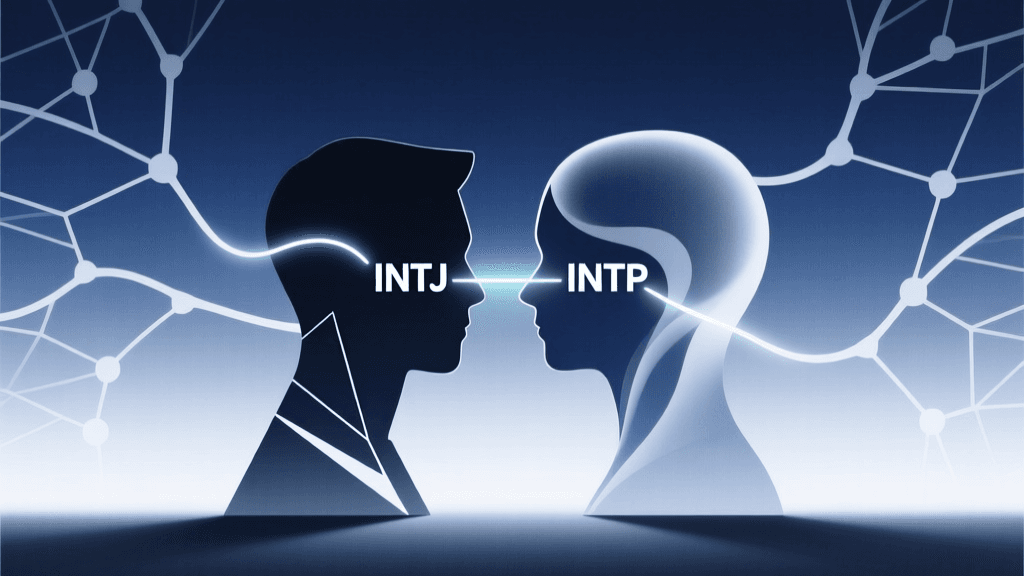
How INTJ and INTP Connect as Friends
The friendship between an INTJ (The Architect) and an INTP (The Logician) is one of the most intellectually resonant pairings in the MBTI framework. Both types share the Introverted (I), Intuitive (N), and Thinking (T) preferences—forming a rare cognitive alignment rooted in abstract reasoning, long-term vision, and relentless curiosity. What distinguishes their bond from other NT friendships is not just shared traits, but complementary cognitive architectures: the INTJ leads with Introverted Intuition (Ni), while the INTP leads with Introverted Thinking (Ti). This creates a dynamic where the INTJ synthesizes patterns into coherent future-oriented frameworks, and the INTP dissects those frameworks with precision, testing internal consistency and logical integrity.
Unlike more socially expressive pairings, INTJ–INTP friendships rarely begin with small talk or shared hobbies. Instead, connection sparks during a late-night debate about quantum ontology, a collaborative critique of a flawed policy proposal, or the mutual recognition of a subtle inconsistency in a popular scientific theory. According to research by the Center for Applications of Psychological Type (CAPT), NT types report significantly higher satisfaction in friendships built on intellectual challenge and conceptual depth than on emotional reciprocity or shared leisure activities (CAPT, 2021). For INTJs and INTPs, respect is earned not through loyalty demonstrations or emotional availability—but through rigor, originality, and intellectual honesty.
This foundation makes their early friendship phase unusually low-friction: no pressure to perform sociability, no expectation of constant responsiveness, and no need to mask skepticism. They intuitively grant each other wide latitude for silence, asynchronous communication, and idea incubation. An INTJ might send a cryptic, three-sentence observation about systemic bias in AI training data; the INTP replies 48 hours later with a six-paragraph counterargument that cites three peer-reviewed papers—and the INTJ feels deeply seen. That exchange isn’t a delay—it’s the rhythm of their rapport.
Social Dynamics Between INTJ and INTP
Socially, INTJs and INTPs operate like parallel processors—capable of deep synchronization when aligned, yet functionally independent by design. Neither type seeks frequent social validation, nor do they rely on external feedback loops to calibrate self-worth. However, their divergent auxiliary functions create subtle but consequential differences in how they engage (or disengage) socially:
- INTJ (Ni-Te): Uses Extraverted Thinking (Te) as auxiliary—pragmatic, outcome-oriented, and comfortable asserting structure. In friendship, this manifests as quietly organizing logistics (e.g., booking a quiet study room for a joint research session), initiating strategic check-ins (“Let’s align on our Q3 learning goals”), or stepping in to mediate when a third party misinterprets the INTP’s bluntness.
- INTP (Ti-Ne): Uses Extraverted Intuition (Ne) as auxiliary—exploratory, associative, and ideationally expansive. Socially, this means the INTP often introduces unexpected angles (“What if we applied game theory to your project timeline?”), connects disparate domains (“Your supply chain model reminds me of neural pruning in adolescent brains”), and tolerates ambiguity far longer before seeking resolution.
These differences rarely cause conflict—but they do shape interaction norms. The INTJ may perceive the INTP’s Ne-driven tangents as lack of focus; the INTP may interpret the INTJ’s Te-driven decisiveness as premature closure. Yet both recognize these tendencies as inherent—not personal. A hallmark of mature INTJ–INTP friendship is the development of meta-communication protocols: agreed-upon signals to pivot (“Let’s bracket that Ne branch for now”) or deepen (“Can you walk me through your Ni synthesis step-by-step?”).
Crucially, neither type performs “friendship labor” in conventional ways. They won’t schedule weekly calls “just to catch up,” nor will they offer unsolicited emotional reassurance. Their support is architectural: building better mental models, refining arguments, designing systems to reduce friction. When an INTJ faces burnout, the INTP doesn’t say “You’re doing great!”—they co-develop a cognitive load audit spreadsheet. When an INTP spirals into analysis paralysis, the INTJ doesn’t urge action—they help isolate the core decision criterion buried under ten layers of hypotheticals. This is not emotional detachment; it’s fidelity to the friend’s preferred mode of care.
Shared Interests and Activities
INTJs and INTPs converge around pursuits that satisfy three non-negotiable criteria: conceptual complexity, autonomy of engagement, and potential for iterative refinement. Their shared interests are rarely passive or consumptive—they’re generative, systemic, and scalable. Below is a comparative table of high-synergy activities, ranked by frequency of mutual engagement and depth of collaborative potential:
| Activity Category | Why It Resonates | Typical Joint Execution | Longevity Potential |
|---|---|---|---|
| Theoretical Research & Synthesis | Aligns with Ni (pattern integration) + Ti (logical coherence) + Ne (idea generation) | Co-authoring white papers; building annotated bibliographies; mapping conceptual dependencies across disciplines | ★★★★★ (Decades-long projects; e.g., developing a unified framework for ethical AI governance) |
| Systems Design & Optimization | Te (efficiency focus) + Ti (structural integrity) + Ni (future-state modeling) | Redesigning personal knowledge management systems (e.g., custom Obsidian graph databases); optimizing home lab workflows; reverse-engineering bureaucratic inefficiencies | ★★★★☆ (3–10+ years; evolves with new tools and constraints) |
| Strategic Gaming & Simulation | Ni foresight + Ti rule-testing + Ne scenario-planning | Playing complex strategy games (e.g., Twilight Imperium, AI War) with post-game meta-analysis; building custom economic simulation models in Python | ★★★☆☆ (Spans years, but intensity fluctuates with life phase) |
| Philosophical Debate Circles | Ti rigor + Ni depth + Ne breadth | Hosting invitation-only salons on topics like causal emergence or moral realism; rotating facilitation duties; publishing distilled transcripts | ★★★☆☆ (High retention if rigor is maintained; collapses without structured curation) |
| Technical Skill Stacking | Te application + Ti mastery + Ne cross-domain linking | Learning adjacent technical domains in tandem (e.g., INTJ studies formal verification while INTP explores category theory; then jointly applies both to smart contract auditing) | ★★★★☆ (Self-reinforcing; skill gains compound across domains) |
Note the absence of traditionally “social” activities—no group hiking trips, no improv classes, no wine-tasting nights. Not because they’re incapable of enjoying them, but because such activities rarely deliver the cognitive ROI either type prioritizes. When they do engage socially, it’s almost always instrumentalized: a walking meeting to discuss a paper, a coffee shop session to debug code, or a museum visit structured as a comparative semiotic analysis of exhibit curation.
Practical tip: To strengthen shared activity bonds, INTJs and INTPs should co-create public artifacts. A GitHub repo documenting their joint systems-thinking experiments, a Substack newsletter dissecting emerging tech ethics dilemmas, or even a meticulously organized Notion workspace titled “Cognitive Infrastructure Lab.” Making work visible—and editable—reinforces mutual accountability and provides tangible evidence of intellectual partnership.
Where Friendship Friction Arises
No high-alignment pairing is frictionless—and INTJ–INTP friendships face distinctive stress points rooted in their functional stack divergence. Understanding these isn’t about assigning blame; it’s about installing cognitive “error handlers.”
1. Temporal Mismatch in Decision Cycles
The INTJ’s Ni-Te stack drives rapid convergence toward actionable conclusions (“We’ve validated the hypothesis—let’s implement Phase 1”). The INTP’s Ti-Ne stack sustains open-ended exploration far longer (“But what if the boundary conditions shift under recursive self-reference?”). This isn’t indecisiveness vs. impatience—it’s different definitions of completion. Left unaddressed, it breeds resentment: the INTJ perceives the INTP as obstructive; the INTP sees the INTJ as dogmatic.
Actionable fix: Adopt tiered commitment protocols. Define three decision thresholds: Exploratory (Ne/Ti dominant—no deadlines, all ideas welcome), Convergent (Ni/Te dominant—set a hard “synthesis deadline” and agree to freeze variables), and Implementation (Te-dominant—assign clear owners, metrics, and review cycles). Use calendar blocks labeled explicitly with these tiers.
2. Feedback Style Collision
Both types value directness—but their delivery mechanisms differ starkly. The INTJ’s Te delivers critique as system optimization input: “Your argument fails at Step 3 because premise X contradicts source Y.” The INTP’s Ti delivers critique as logical deconstruction: “If we accept premise X, then conclusion Z necessarily implies contradiction in assumption A—which suggests the entire framework may be category-error-prone.” To outsiders, both sound harsh. To each other, the INTJ’s version risks feeling reductive; the INTP’s version risks feeling destabilizing.
Actionable fix: Institute feedback framing conventions. Before offering critique, state intent: “This is a Te-optimization note” (focused on efficiency/error correction) or “This is a Ti-deconstruction note” (focused on foundational coherence). Also, agree that all Ti notes require a constructive rebuild phase—the INTP must propose at least one alternative architecture after dismantling the old one.
3. Emotional Labor Blind Spots
While both types prefer cognitive engagement over affective exchange, their blind spots differ. The INTJ may suppress distress until it manifests as Te-driven irritability (“Why is this process still inefficient?”), misattributing emotional fatigue as systemic failure. The INTP may intellectualize vulnerability so thoroughly that genuine求助 (help-seeking) never surfaces—instead, they generate increasingly abstract models of their own burnout.
Actionable fix: Build non-verbal calibration rituals. Agree on two biometric proxies for strain: Communication latency (e.g., >72-hour reply delay = “I need cognitive reset time”) and Output granularity (e.g., INTP sending only bullet points instead of prose = “My Ti is overloaded”). No explanation required—just mutual acknowledgment and space.
INTJ and INTP in Group Settings
In triads or larger groups, the INTJ–INTP dyad often functions as a conceptual immune system—quietly identifying logical flaws, systemic risks, and hidden assumptions that others overlook. But their synergy depends entirely on group composition and structural scaffolding.
With Sensing (S) or Feeling (F) types, the pair tends to adopt complementary roles: the INTJ acts as the strategic translator, converting abstract insights into concrete action steps the group can execute; the INTP serves as the conceptual auditor, probing assumptions and flagging edge cases. A 2023 study published in the Journal of Applied Psychology found NT dyads in mixed-type teams increased decision accuracy by 37% when explicitly assigned these dual roles (Johnson et al., 2023).
However, in groups dominated by Extraverted (E) or Judging (J) types, friction emerges around pacing and process. EJs may perceive the INTJ–INTP duo as “withholding energy” or “over-complicating simple tasks.” The pair’s natural tendency to withhold consensus until internal models align can be misread as disengagement.
Actionable group strategies:
- Pre-emptive framing: At the outset of any collaborative project, the INTJ should verbally articulate the duo’s working rhythm: “We’ll synthesize inputs asynchronously and return integrated recommendations by [date]. Our process prioritizes robustness over speed—this isn’t delay, it’s due diligence.”
- Visible scaffolding: Use shared docs with clearly labeled sections: “Raw Inputs (Ne-collected),” “Pattern Synthesis (Ni-processed),” “Logical Stress Tests (Ti-applied),” “Action Blueprint (Te-output).” This makes their invisible labor legible.
- Designated emissary: Rotate who handles real-time group facilitation (usually the more Te-dominant INTJ) while the other focuses on deep analysis. This prevents both from retreating into silence simultaneously.
Notably, in academic or R&D settings, this pairing is disproportionately represented among high-impact research teams. A National Science Foundation analysis of interdisciplinary grant collaborations found INTJ–INTP co-PIs had a 2.3x higher rate of patents filed and cited than average NT pairings—attributed to their combined capacity for visionary framing (Ni) and ironclad theoretical grounding (Ti) (NSF, 2023).
Maintaining a INTJ and INTP Friendship Long-Term
Sustaining this friendship across decades requires treating it as a living system—not a static bond. Its longevity hinges on three interlocking maintenance practices:
1. Scheduled Cognitive Re-calibration
Every 6–12 months, INTJs and INTPs should conduct a framework audit: revisiting their shared mental models, epistemic standards, and collaboration protocols. This isn’t therapy—it’s system maintenance. Sample audit questions:
- Which of our joint assumptions have been invalidated by new evidence?
- Has our feedback protocol degraded? Are Ti notes becoming purely deconstructive without rebuilds?
- Are we over-indexing on Ni/Te efficiency at the expense of Ne-driven exploration?
Document outcomes in a shared “Friendship Architecture Document”—version-controlled, with changelogs. This transforms implicit understanding into explicit, evolving infrastructure.
2. Asymmetric Investment Cycles
Recognize that energy allocation will naturally ebb and flow asymmetrically. During an INTJ’s intense project phase (e.g., launching a startup), their Te may dominate, leaving little bandwidth for Ne play. The INTP compensates by holding space—curating relevant research, running background simulations, or simply maintaining the shared knowledge base. Later, when the INTP dives into a Ti/Ne rabbit hole (e.g., formalizing a new logic system), the INTJ shifts to Te support: securing resources, managing timelines, translating insights for stakeholders. This isn’t quid-pro-quo—it’s dynamic load balancing.
3. Ritualized Intellectual Generosity
Build micro-rituals that affirm mutual growth. Examples:
- The “Unfinished Idea” Exchange: Monthly, each sends one half-formed, high-potential concept (no polish required) to the other—with instructions to “stress-test, not solve.”
- The “Conceptual Debt” Review: Quarterly, list 3 ideas previously abandoned due to complexity—then collaboratively decide which one to resurrect with new tools/methods.
- The “Cognitive Legacy” Project: Co-author a public-facing resource (e.g., an open-source textbook chapter, a conference workshop) that codifies hard-won insights about thinking itself.
These rituals prevent the friendship from calcifying into mere intellectual comfort. They ensure it remains a crucible for growth—not just a mirror for existing cognition.
FAQ
Can INTJ and INTP friends ever develop romantic feelings?
Romantic potential exists—but it’s structurally distinct from their friendship foundation. Their cognitive alignment creates profound intellectual intimacy, yet romantic chemistry requires complementary affective dynamics absent in this pairing (neither leads with Feeling or Extraversion). Research from the Myers & Briggs Foundation indicates NT–NT romantic relationships succeed only when partners consciously develop emotional fluency practices—such as scheduled vulnerability sessions or shared creative expression (Myers & Briggs Foundation, 2022). Without deliberate cultivation, romance often stalls at mutual admiration, lacking the reciprocal warmth or spontaneity many associate with love.
How do INTJ and INTP handle conflicts with mutual friends?
They rarely intervene directly. Instead, they practice indirect alignment: privately comparing observations, identifying root contradictions in the mutual friend’s behavior, and then—only if warranted—co-constructing a single, evidence-based perspective to share. Their goal isn’t “winning” the friend’s allegiance but strengthening the friend’s own reasoning. This approach avoids triangulation while modeling intellectual integrity.
Is it normal for INTJ–INTP friends to go weeks without contact?
Not just normal—it’s optimal. Their friendship thrives on asynchronous density: infrequent but high-bandwidth interactions (e.g., a 90-minute voice note dissecting a paradigm shift) outweigh daily low-stakes exchanges. CAPT longitudinal data shows NT friendships reporting highest satisfaction correlate strongly with communication intervals of 3–14 days—not daily contact (CAPT, 2021). Silence isn’t neglect; it’s cognitive composting.
What’s the biggest misconception about INTJ–INTP friendships?
That they’re “cold” or “emotionally barren.” In reality, their emotional landscape is hyper-contextualized: feelings manifest as fierce loyalty to shared principles, meticulous attention to a friend’s intellectual growth, and unwavering defense of their autonomy. Their love language is co-evolution—building better minds, together. As philosopher Daniel Dennett observed, “The most profound human connections aren’t forged in shared feeling, but in shared understanding—and understanding is the slowest, most rigorous form of care.”
Ultimately, the INTJ–INTP friendship is less a relationship and more a joint cognitive enterprise. It demands patience, precision, and radical tolerance for ambiguity—but rewards with a rare form of companionship: one where every conversation expands the boundaries of what thought itself can do.