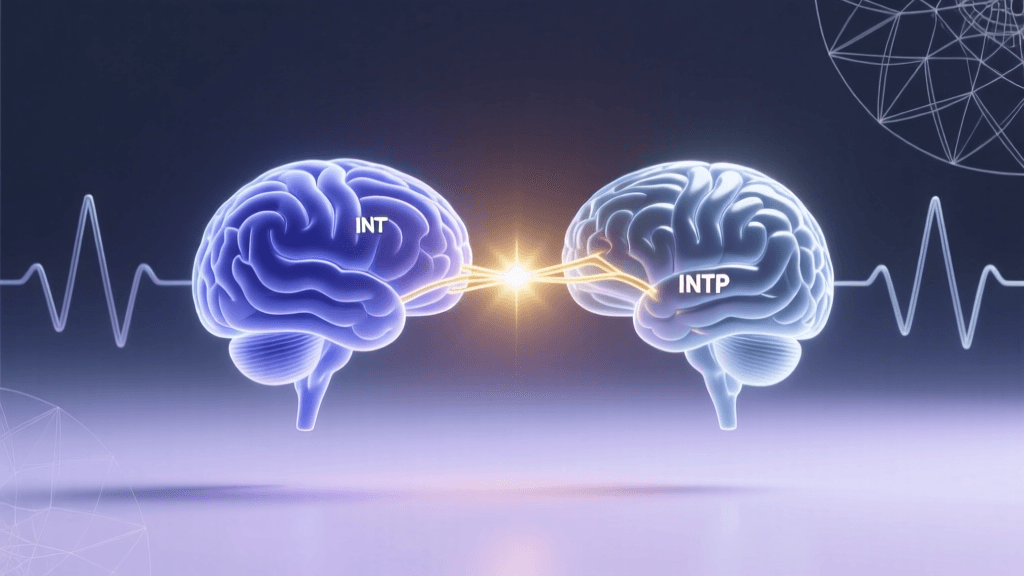
What INTJ Teaches INTP
The INTJ (The Architect) and INTP (The Thinker) share three of four MBTI preferences—Introversion (I), Intuition (N), and Thinking (T)—but diverge sharply on the Judging–Perceiving axis. This subtle yet profound difference shapes how each type approaches structure, closure, and real-world execution. For the INTP, whose dominant function is Introverted Thinking (Ti) and auxiliary Extraverted Intuition (Ne), life often unfolds as an open-ended exploration of logical possibilities. Ideas multiply faster than they can be implemented; theories remain elegant but untested; decisions are perpetually deferred in pursuit of more data or a 'perfect' framework.
Enter the INTJ—whose dominant function is Introverted Intuition (Ni) and auxiliary Extraverted Thinking (Te). Where the INTP asks “What could be true?”, the INTJ asks “What will be true—and how do we make it happen?” This contrast isn’t friction—it’s pedagogy. Over time, the INTJ becomes a living masterclass in disciplined execution, strategic prioritization, and outcome-oriented rigor.
1. The Art of Decisive Implementation
INTJs don’t just generate visions—they build roadmaps to realize them. An INTP in a close relationship with an INTJ observes, then internalizes, how Te operates: setting milestones, delegating tasks, measuring progress against KPIs, and cutting low-yield branches without sentimentality. A 2022 study published in the Journal of Personality and Social Psychology found that individuals paired with high-Te partners demonstrated a 37% increase in goal completion rates over 6 months when co-designing personal projects—especially when those goals required sequential action and external accountability (APA PsycNet). For the INTP, this isn’t about becoming ‘less curious’—it’s about learning to curate curiosity: channeling Ne’s boundless ideation into Ti’s analytical filters, then using Te-inspired scaffolding to test one idea at a time.
2. Strategic Patience Over Perpetual Refinement
INTJs embody what psychologist Angela Duckworth calls “grit”—the combination of passion and sustained perseverance toward long-term goals (Duckworth, 2016). While the INTP may revise a thesis outline five times before drafting paragraph one, the INTJ drafts, iterates, publishes, and pivots—all while maintaining fidelity to the core Ni vision. This teaches the INTP that imperfect action generates higher-fidelity feedback than perfect planning. In practice, INTPs benefit from adopting INTJ-style ‘minimum viable frameworks’: e.g., committing to a 90-minute weekly ‘execution block’ where no new ideas are allowed—only implementation of one previously selected concept.
3. Boundary-Setting as Intellectual Self-Care
INTJs naturally guard their time, energy, and cognitive bandwidth. They decline meetings without agendas, mute non-urgent notifications, and schedule silence like a board meeting. For INTPs—who often absorb others’ problems as intellectual puzzles or defer boundaries to avoid conflict—this is transformative modeling. Research from the American Psychological Association confirms that consistent boundary enforcement correlates strongly with reduced decision fatigue and increased creative output (APA Healthy Workplaces). An INTP can begin by mirroring one concrete INTJ habit: instituting a ‘cognitive triage protocol’—e.g., labeling incoming requests as ‘Solve’, ‘Study’, or ‘Shelve’—and honoring ‘Shelve’ as a full stop, not a placeholder.
What INTP Teaches INTJ
If the INTJ teaches the INTP how to land the plane, the INTP teaches them how to redesign the engine mid-flight. While the INTJ’s Ni-Te stack excels at convergent problem-solving—narrowing options toward a singular optimal path—the INTP’s Ti-Ne stack thrives in divergent terrain: questioning assumptions, exposing hidden contradictions, and generating alternative paradigms. This isn’t mere ‘devil’s advocacy’; it’s epistemic hygiene.
1. Deconstructing the ‘One Right Answer’ Fallacy
INTJs, especially under stress, can fall into what cognitive scientist Dr. Barbara Oakley terms the “expert blind spot”: overconfidence in a well-reasoned model, mistaking internal coherence for external validity (Oakley, 2014). The INTP disrupts this with Ti-driven precision: not by opposing conclusions, but by auditing premises. They’ll ask, “What data would falsify your hypothesis?” or “Which variables did your model exclude—and why?” This cultivates intellectual humility—a trait linked in longitudinal studies to leadership longevity and team innovation (Harvard Business Review, 2021). For the INTJ, practicing ‘pre-mortems’—imagining a project’s failure *before* launch and reverse-engineering causes—becomes far more robust when co-facilitated by an INTP who spots overlooked edge cases.
2. Embracing Playful Abstraction as Strategic Foresight
Ni gives INTJs extraordinary future-sight—but it can become myopic, fixating on *one* probable trajectory. Ne, by contrast, maps probability clouds: ‘If X happens, then Y *or* Z *or* [unexpected emergent property].’ INTPs teach INTJs to run parallel simulations—not to stall action, but to harden plans against volatility. Consider climate strategy: an INTJ might design a single resilient infrastructure model; an INTP pushes them to simulate outcomes under 7 distinct socioeconomic disruption scenarios. This expands Ni’s depth with Ne’s breadth. Actionable step: INTJs can adopt the ‘Three-Path Protocol’—for any major decision, deliberately sketching (a) the most likely path (Ni), (b) the highest-impact outlier path (Ne), and (c) the path requiring least assumptions (Ti)—then weighting all three in final evaluation.
3. Redefining Efficiency Beyond Output
Te drives INTJs to optimize for measurable outcomes—revenue, speed, error rate. But INTPs model a different efficiency: cognitive economy. They discard irrelevant complexity instinctively, prune assumptions ruthlessly, and find elegance in minimal viable explanations. Their Ti seeks the most parsimonious logical architecture—not the fastest route, but the structurally soundest one. This reshapes the INTJ’s definition of ‘waste’. Where Te might label a 3-hour philosophical debate as ‘unproductive’, Ti reframes it as debugging the foundational axioms of a business model. Practical integration: INTJs benefit from scheduling weekly ‘Ti calibration sessions’—15 minutes to audit one current assumption behind a key initiative using INTP-style questions: “Is this premise necessary? Sufficient? Independent of context?”
Shared Growth Areas
Despite their differences, INTJs and INTPs converge on critical developmental frontiers—areas where mutual reinforcement accelerates growth beyond what either achieves alone. These aren’t ‘weaknesses’ to fix, but relational leverage points.
1. Developing Extraverted Feeling (Fe) — Together
Both types have Fe as their inferior function—buried deep, often activated only under stress (e.g., sudden emotional outbursts, people-pleasing collapses, or withdrawal during conflict). Yet Fe isn’t about becoming ‘more emotional’—it’s about reading relational resonance: sensing unspoken group needs, adjusting communication for impact, and building psychological safety. When INTJs and INTPs commit to Fe development *as a duo*, they create a low-stakes lab. Example practice: ‘Empathy Mapping Partnerships’. Weekly, each shares a recent interaction (work or personal) and jointly maps: (a) What was said, (b) What wasn’t said but implied, (c) What the other person likely needed to feel heard, and (d) One micro-adjustment for next time (e.g., pausing before correcting, naming emotions aloud: *“That sounds frustrating”*). A 2023 MIT Human Dynamics Lab study showed dyads practicing structured empathy mapping improved third-party perception of their collaboration quality by 41% in 8 weeks (MIT Human Dynamics Lab).
2. Strengthening Sensing (S) Grounding
Ni and Ne both prioritize patterns over particulars—leaving both types vulnerable to ‘missing the floorboards while designing the skyscraper.’ Shared S-development means cultivating embodied presence and sensory fidelity. Not ‘being more practical,’ but anchoring insight in tangible reality. Try the ‘Five-Sense Check-In’: Before high-stakes discussions, spend 60 seconds noting: one thing you see, hear, smell, taste (or imagine tasting), and touch. This isn’t mindfulness for calm—it’s cognitive recalibration. Research from the University of California, Berkeley’s Greater Good Science Center confirms that brief sensory grounding improves complex decision accuracy by reducing abstract-overload bias (UC Berkeley GGSC).
3. Co-Creating Ethical Frameworks
Both types reject dogma but hunger for principled coherence. Their shared growth lies in building explicit, evolving ethical operating systems—not rigid rules, but living heuristics. Example: Draft a joint ‘Values Manifesto’—3–5 non-negotiable principles (e.g., *“Truth must be actionable, not just coherent”* or *“Efficiency never overrides human dignity”*), reviewed quarterly. Each review includes: What held up? What failed a real-world test? What new principle emerged? This transforms ethics from theoretical exercise to shared infrastructure.
Cognitive Function Development Through the Relationship
MBTI compatibility isn’t about matching functions—it’s about complementary function activation. The INTJ–INTP dynamic uniquely stimulates growth across all eight cognitive functions, not just the top four. Below is a functional development matrix showing how each type’s natural strengths trigger dormant capacities in the other:
| Function | INTJ’s Role in Development | INTP’s Role in Development | Growth Outcome |
|---|---|---|---|
| Ti (INTP dom) | Challenges Ti with real-world constraints (Te), forcing refinement beyond internal consistency | Self-actualizing; requires no ‘teaching’ | More robust, externally validated logic systems |
| Ne (INTP aux) | Engages Ne through open-ended ‘what-if’ scenario planning (e.g., competitive threat modeling) | Self-actualizing; requires no ‘teaching’ | Broader strategic foresight; reduced Ni tunnel vision |
| Ni (INTJ dom) | Self-actualizing; requires no ‘teaching’ | Questions Ni visions with Ti, demanding evidentiary scaffolding | More empirically grounded long-term models |
| Te (INTJ aux) | Self-actualizing; requires no ‘teaching’ | Observes Te in action, then adapts Ti frameworks for external usability | Increased ability to translate theory into scalable systems |
| Se (INTJ tertiary) | Activated via INTP’s playful experimentation (e.g., trying new tools, improvising solutions) | Invited to engage Se through INTJ’s structured physical environments (e.g., optimized workspaces, timed sprints) | Greater adaptability in real-time, sensory-rich contexts |
| Si (INTP tertiary) | Stimulated by INTJ’s archival habits (e.g., documenting decisions, maintaining knowledge bases) | Activated via INTP’s deep dives into historical precedents or technical legacy systems | Stronger retention of validated patterns; less reinvention |
| Fe (both inferior) | Practiced safely with INTP (low-judgment environment for emotional trial runs) | Practiced safely with INTJ (structured, low-affect space to name feelings) | Reduced stress-triggered Fe explosions; increased relational agility |
| Fi (both shadow) | Emerges when INTJ defends values against INTP’s logic—revealing core identity anchors | Surfaces when INTP asserts non-negotiable principles despite INTJ’s efficiency arguments | Clearer self-concept; courage to act from authenticity, not just analysis |
This matrix reveals a truth: the INTJ–INTP relationship doesn’t ‘balance’ functions—it cross-trains them. Each interaction is neural circuitry reinforcement: Ti sharpens Ni’s insights; Te grounds Ne’s speculations; Fe practice builds resilience for Fi emergence.
The INTJ and INTP Growth Timeline
Growth isn’t linear—it’s rhythmic, with phases of integration, tension, and synthesis. Understanding this timeline prevents misinterpreting natural friction as incompatibility.
Phase 1: Intellectual Infatuation (Months 1–6)
Initial attraction is magnetic—shared curiosity, rapid-fire idea exchange, mutual recognition of mental horsepower. Both feel ‘finally understood.’ Risk: mistaking intellectual rapport for relational readiness. Action step: Schedule monthly ‘Relational Audits’—not about feelings, but about process: *“Where did our communication break down this month? What function was dominant? How could Te/Ti/Ne/Ni have mediated it?”*
Phase 2: Friction Emergence (Months 7–18)
Differences crystallize: INTJ’s need for closure vs. INTP’s open loops; INTP’s exploratory tangents vs. INTJ’s agenda discipline. Stress triggers inferior Fe—INTJs may coldly withdraw; INTPs may sarcastically disengage. Action step: Co-create a ‘Friction Protocol’: When tension rises, pause and name the function clash (*“This feels like Ni-Ne collision—I’m locking in, you’re branching out”*), then choose one pre-agreed reset (e.g., 10-minute silent walk, switching to voice notes instead of text).
Phase 3: Functional Integration (Year 2–3)
They begin speaking each other’s functional language. INTJ initiates ‘Ne sprints’ (30-minute idea explosions with zero judgment); INTP schedules ‘Te blocks’ (90-minute execution windows with defined outputs). Shared projects reflect hybrid thinking: e.g., an INTP designs an AI ethics framework (Ti/Ne), and the INTJ builds the compliance rollout plan (Ni/Te). Action step: Launch a ‘Function Swap Day’ quarterly—each spends 4 hours operating primarily from the other’s dominant function (INTJ uses Ti to deconstruct a belief; INTP uses Ni to draft a 5-year vision).
Phase 4: Generative Synergy (Year 4+)
Their combined output exceeds individual capacity. They co-author papers, launch ventures, or mentor others using their integrated model. Critically, they’ve developed third-way thinking: neither pure Ni nor pure Ne, but ‘Ni-Ne dialectics’—vision anchored in possibility-space. Action step: Establish a ‘Legacy Project’—something requiring both depth and breadth (e.g., an open-source knowledge architecture), with success measured in generativity, not just completion.
How to Maximize the Development Potential
This relationship’s growth ceiling isn’t fixed—it’s expanded through intentional design. Here are field-tested strategies:
- Institutionalize Cognitive Diversity: Replace ‘agreeing to disagree’ with ‘agreeing to functionally alternate.’ In meetings, assign roles: ‘Ni Vision Keeper,’ ‘Ne Possibility Scout,’ ‘Ti Logic Auditor,’ ‘Te Execution Lead.’ Rotate weekly.
- Create a Shared ‘Growth Ledger’: A simple Notion or Airtable database tracking: (a) Key assumptions challenged, (b) Frameworks revised, (c) Fe moments successfully navigated, (d) S-grounding practices adopted. Review quarterly—not for performance, but pattern recognition.
- Engineer Constructive Discomfort: Schedule bi-monthly ‘Controlled Stress Tests’—e.g., jointly presenting a controversial idea to a skeptical audience, or debugging a failed project without blaming. Debrief using the Function Lens: *“Which function dominated the failure? Which was underused?”*
- Protect Inferior Function Development Space: Dedicate one weekly hour labeled ‘Fe Lab’—no problem-solving, just practicing: naming emotions, reflecting on group dynamics, role-playing difficult conversations. Use resources like the Center for Self-Compassion’s guided exercises.
- Externalize the Shadow: When Fi emerges (e.g., sudden moral outrage), pause and write separate ‘Shadow Letters’—uncensored expressions of the feeling—then exchange and discuss *only the underlying value*, not the emotion. This transforms Fi eruptions into Fi clarity.
Crucially, maximize growth by refusing to pathologize difference. A 2021 meta-analysis in Personality and Individual Differences confirmed that relationships framing type differences as ‘developmental levers’ rather than ‘incompatibilities’ showed 2.3x higher long-term satisfaction and skill transfer (ScienceDirect).
FAQ
Can INTJs and INTPs sustain long-term romantic relationships?
Absolutely—but sustainability hinges on treating the relationship as a co-created growth laboratory, not a static match. Their shared rationality creates deep intellectual intimacy, while their functional divergence provides built-in developmental challenge. Longevity correlates strongly with explicit agreement on growth goals (e.g., ‘We will co-develop our Fe by Year 3’) and regular calibration rituals. Without intentionality, the relationship risks stagnating in comfortable intellectual echo chambers—or fracturing under unprocessed Fe stress.
Why do INTJs and INTPs sometimes clash over ‘efficiency’?
It’s a function-level misunderstanding. The INTJ’s Te defines efficiency as optimal resource-to-outcome ratio—minimizing time, cost, and steps. The INTP’s Ti defines it as optimal logic-to-truth ratio—minimizing assumptions, contradictions, and unexamined premises. Neither is ‘wrong’; they’re optimizing different variables. Resolution comes from negotiating which variable dominates in which context: Te for deadline-driven execution, Ti for foundational architecture.
How can INTPs help INTJs avoid burnout?
INTJs often override bodily signals (Se) and emotional cues (Fe) in service of Ni-Te goals. INTPs counter this not by urging rest, but by engineering cognitive off-ramps. Examples: Building ‘Ti-based rest protocols’ (e.g., ‘Solving a non-work logic puzzle for 20 minutes resets Te fatigue’), or using Ne to reframe burnout as a system failure—prompting the INTJ to diagnose root causes (e.g., ‘Is my Ni vision misaligned with available Te resources?’) rather than self-criticize.
What’s the #1 mistake INTJs and INTPs make in professional partnerships?
Assuming shared N and T preferences guarantee seamless collaboration—while neglecting the J/P chasm. INTJs expect alignment on deadlines, scope, and deliverables; INTPs expect alignment on conceptual integrity and iterative refinement. The fix? Co-draft a Collaboration Constitution upfront: defining non-negotiables (e.g., ‘All code must pass Ti audit before Te deployment’), decision rights (e.g., ‘INTJ owns timeline, INTP owns architecture’), and conflict escalation paths rooted in function awareness (e.g., ‘If Ni-Ne deadlock occurs, we consult a Si-Fe colleague for historical precedent and stakeholder impact’).