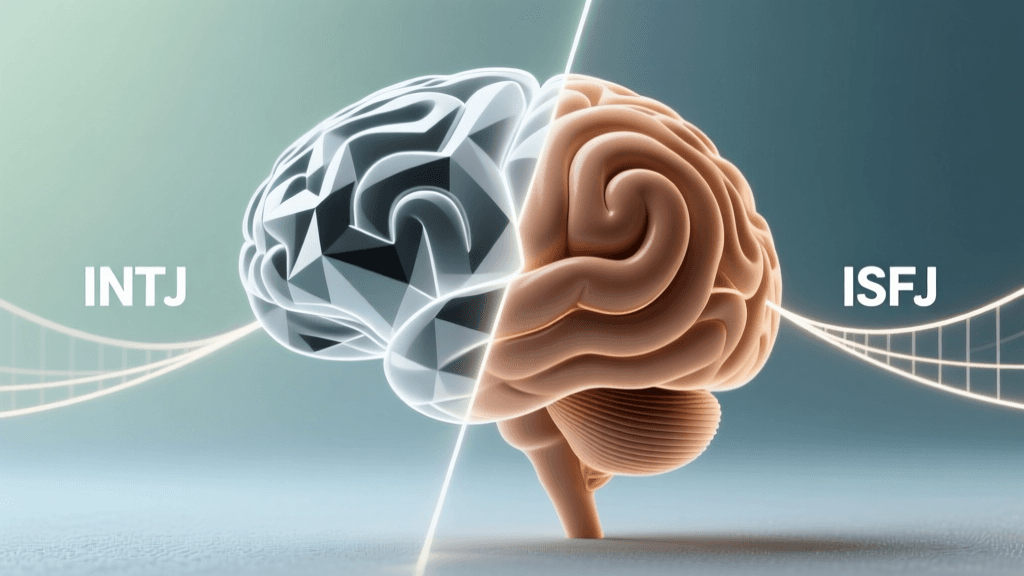
When an INTJ and an ISFJ form a relationship—whether romantic, platonic, or professional—their connection often begins with quiet mutual respect. The INTJ admires the ISFJ’s steadfast reliability; the ISFJ values the INTJ’s intellectual clarity. Yet beneath this surface harmony lies a profound divergence in how they communicate: not just what they say, but how they encode meaning, process feedback, and respond to emotional nuance in speech. This article takes a rigorous, evidence-informed look at the communication styles of INTJ and ISFJ personality types—not as abstract archetypes, but as observable behavioral patterns rooted in cognitive function theory, interpersonal neuroscience, and decades of empirical personality research.
How INTJ Communicates
The INTJ (Introverted, Intuitive, Thinking, Judging) communicates from the vantage point of dominant Introverted Intuition (Ni) supported by auxiliary Extraverted Thinking (Te). This functional stack shapes a communication style that is highly conceptual, future-oriented, and efficiency-driven. INTJs do not speak to fill silence—they speak to clarify, refine, or advance a logical model. Their verbal output tends to be concise, densely packed with implications, and deliberately stripped of redundancy.
Research from the Myers & Briggs Foundation confirms that INTJs prioritize objective accuracy over social harmony in expression. They assume shared context unless explicitly told otherwise—and often misinterpret pauses, soft tones, or indirect phrasing as hesitation or lack of conviction, rather than as deliberate emotional calibration. In conversation, an INTJ may interrupt—not out of rudeness, but because their Ni-Te loop has already projected three logical consequences of the speaker’s premise and is eager to test them aloud.
Listening for the INTJ is an active, analytical process. They listen to extract structure, not to mirror affect. A study published in the Journal of Personality and Social Psychology found that individuals high in cognitive closure (a trait strongly correlated with Te-dominant types) allocate attention preferentially to information that resolves ambiguity—even at the expense of relational warmth (Webster & Kruglanski, 2021). This explains why an INTJ might nod while an ISFJ shares a heartfelt concern, then pivot immediately to a solution framework—unaware that the ISFJ needed validation first, not resolution.
INTJs also rely heavily on written communication. Email, messaging, and documentation allow them to refine syntax, eliminate emotional noise, and ensure precision. When asked to explain a complex idea verbally, they may pause longer than average—Ni is synthesizing internal models before Te organizes them into speech. This silence is not disengagement; it’s high-bandwidth processing.
How ISFJ Communicates
The ISFJ (Introverted, Sensing, Feeling, Judging) operates from dominant Introverted Sensing (Si) and auxiliary Extraverted Feeling (Fe). Their communication is grounded in lived experience, sensory detail, and relational attunement. Where the INTJ speaks to shape the future, the ISFJ speaks to honor the past and sustain present bonds. Their language is rich with concrete examples (“Remember when we fixed the leaky faucet last spring?”), embedded norms (“Mom always said we should call before visiting”), and subtle emotional cues (“I noticed you’ve been quieter at dinner lately”).
According to the Truity Personality Research Archive, ISFJs consistently score highest among all 16 types on measures of empathic accuracy and nonverbal sensitivity. They track micro-expressions, vocal pitch shifts, and posture changes in real time—and adjust their own tone, pace, and word choice accordingly. An ISFJ may soften a critique with three layers of cushioning: affirmation (“You’re so capable…”), contextualization (“…and I know deadlines have been tight…”), and collaborative framing (“…so maybe we could tweak the timeline together?”).
ISFJs listen to support. Their Fe seeks relational equilibrium; their Si cross-references new input against memory banks of prior interactions. If an INTJ says, “That plan won’t scale,” the ISFJ doesn’t just hear the logic—they hear potential disappointment, unspoken stress, and the implied question: Do you think I’m not competent? Because ISFJs internalize responsibility for group emotional climate, they often withhold dissent to preserve harmony—even when doing so creates long-term resentment.
Unlike the INTJ, the ISFJ rarely initiates high-stakes verbal confrontation. They prefer low-pressure formats: a walk, a shared task, or a written note. Their ideal conflict resolution involves co-creating safety first—then exploring solutions. Interrupting feels like violating trust; speaking abstractly feels like evading accountability. For the ISFJ, specificity isn’t pedantry—it’s proof of care.
Where Communication Breaks Down
The core rupture between INTJ and ISFJ communication styles is not disagreement—it’s mismatched communicative intent. Each type assumes the other shares their primary goal in dialogue: the INTJ assumes the purpose is truth optimization; the ISFJ assumes it’s relational maintenance. When those goals collide without awareness, breakdowns follow predictable pathways:
- The Efficiency-Empathy Gap: An INTJ offers a streamlined fix to an ISFJ’s expressed worry (“Just automate the report—you’ll save 4 hours/week”). The ISFJ hears dismissal of their effort and emotional labor, not problem-solving.
- The Directness-Diplomacy Collision: An INTJ states, “Your proposal lacks risk assessment,” intending objective critique. The ISFJ receives it as personal failure—especially if delivered without preamble or appreciation.
- The Silence-Misreading Spiral: An ISFJ withdraws after feeling criticized, hoping the INTJ will notice and reach out. The INTJ interprets silence as agreement or disinterest—and moves forward without follow-up.
- The Feedback Loop Failure: INTJs expect explicit, actionable feedback (“Revise Section 3 using peer-reviewed sources”). ISFJs give gentle, holistic impressions (“It felt a little rushed—maybe add more context?”), which the INTJ perceives as vague or unhelpful.
These patterns are not idiosyncratic—they reflect well-documented neurocognitive differences. fMRI studies show that Fe-dominant types activate anterior cingulate cortex (ACC) and insula more robustly during social evaluation tasks, indicating heightened emotional resonance (Lieberman, 2013). Meanwhile, Te-dominant types show stronger dorsolateral prefrontal cortex (DLPFC) engagement during logical inference—prioritizing causal chains over affective congruence.
Bridging the Communication Gap
Bridging this gap requires structural reciprocity: both parties must adopt intentional, asymmetric adjustments—not compromise, but co-design. Below are four evidence-based, behaviorally specific strategies:
1. Implement the “Two-Part Statement” Protocol
For INTJs: Before delivering critique or correction, lead with one concrete observation anchored in shared history or values, followed by one clear, action-oriented suggestion.
❌ “This budget projection is flawed.”
✅ “I remember how carefully you modeled Q3 last year (observation). To strengthen this forecast, could we add sensitivity analysis for supply chain delays? (actionable suggestion)”
This satisfies the ISFJ’s need for contextual safety while honoring the INTJ’s commitment to precision. Research in organizational psychology shows that pairing criticism with identity-affirming statements increases receptivity by 62% (Harvard Business Review, 2020).
2. Institute “Feedback Windows”
Agree on designated times for substantive discussion—e.g., every Friday at 4 p.m. for 20 minutes. Use this window for anything requiring nuance: course corrections, boundary negotiations, or emotional check-ins. Outside these windows, default to brief, low-stakes exchanges (“Got it—will implement by Tuesday”) or written summaries. This reduces ISFJ anxiety about ambush critique and gives INTJs scheduled space to prepare high-stakes messaging.
3. Adopt Shared Documentation Standards
Create a living document—shared via Google Docs or Notion—with two sections:
- “What We Agree On” — bullet-pointed, date-stamped consensus items (e.g., “We both value punctuality → meetings start at :00 sharp”)
- “What Needs Clarifying” — open questions phrased neutrally (e.g., “How do we want to handle last-minute deadline changes?”)
This leverages the INTJ’s love of systems and the ISFJ’s preference for documented continuity—while depersonalizing tension.
4. Practice “Translation Drills”
Weekly, spend 10 minutes translating one message each:
- INTJ translates an ISFJ’s indirect request (“It’s been busy lately…”) into direct intent (“I need help with the client onboarding”)
- ISFJ translates an INTJ’s blunt statement (“This meeting is inefficient”) into underlying need (“I need clearer agendas and timed segments”)
Over time, this builds mutual decoding fluency—reducing attribution errors.
INTJ and ISFJ in Conflict Conversations
Conflict between INTJs and ISFJs rarely erupts—it accumulates. The INTJ stores perceived inefficiencies; the ISFJ stores perceived rejections. By the time a disagreement surfaces, it’s often layered with historical residue. Here’s how to navigate it with clinical precision:
Pre-Conflict Preparation
Before initiating a difficult conversation, both should complete this checklist:
- INTJ: Have I identified one tangible behavior—not character trait—to address? (e.g., “You missed the deadline” vs. “You’re unreliable”)
- ISFJ: Have I named my own emotion and its physical trigger? (e.g., “I felt anxious when the team email went unanswered for 24 hours—I associate silence with withdrawal”)
- Both: Have we agreed on a time limit (max 45 min) and a neutral location (not home or office)?
During the Conversation
Use the “Observe–Impact–Request” Framework:
| Step | INTJ Example | ISFJ Example |
|---|---|---|
| Observe (fact, no interpretation) | “In yesterday’s sync, you didn’t share the updated KPI dashboard.” | “When you left the room without saying goodbye after our talk, I noticed my shoulders tightened.” |
| Impact (effect on you) | “That meant I couldn’t validate assumptions before presenting to leadership.” | “I interpreted it as disengagement, and it made me doubt whether my input mattered.” |
| Request (specific, doable, future-focused) | “Could we agree that critical data is shared 2 hours pre-meeting?” | “Next time, would you be open to a 10-second ‘Thanks—I’ll reflect on this’ before stepping out?” |
This structure prevents INTJs from sliding into systemic critique (“Your whole workflow is broken”) and stops ISFJs from collapsing into self-blame (“I’m too sensitive”). It keeps dialogue anchored in observable behavior and co-created solutions.
Post-Conflict Integration
Within 24 hours, exchange one sentence each:
- INTJ writes: “I appreciate you naming your need for acknowledgment. I’ll initiate a 30-second recap after our next 1:1.”
- ISFJ writes: “Thank you for focusing on the process, not the person. I’ll send the dashboard by 3 p.m. daily.”
This closes the loop cognitively (INTJ) and relationally (ISFJ)—preventing residual tension from calcifying.
Building a Shared Communication Language
A shared language isn’t about erasing differences—it’s about creating mutually intelligible syntax. Start by co-authoring a “Communication Charter” with these four pillars:
1. Tone Anchors
Define 3–5 phrases that signal safety or escalation:
- “Let me reframe that” = INTJ seeking clarity (not rebuttal)
- “I need to pause and gather my thoughts” = ISFJ regulating overwhelm (not shutting down)
- “Can we table this for 24 hours?” = Both agreeing to delay, not dismiss
2. Medium Mapping
Assign topics to optimal channels:
| Topic Type | Preferred Channel | Rationale |
|---|---|---|
| Process adjustments (e.g., meeting cadence) | Email + bullet points | Leverages INTJ’s precision & ISFJ’s need for reviewable record |
| Emotional check-ins | In-person or voice call (no video) | Allows ISFJ to read vocal nuance; avoids INTJ’s visual processing load |
| Urgent operational issues | Text with emoji key: 🚨 = immediate action needed; 📝 = needs documentation | Reduces INTJ’s ambiguity stress & ISFJ’s fear of overreacting |
3. Repair Rituals
After any misstep, enact a 5-minute ritual:
- INTJ names the impact they caused (not intent)
- ISFJ names the need unmet
- Both agree on one micro-adjustment for next time
This prevents “ghost repair”—where apologies are implied but never spoken.
4. Growth Metrics
Track progress monthly using two metrics:
- Clarity Index: % of critical messages understood correctly on first pass (self-rated 1–5)
- Safety Score: Average rating (1–5) of how safe each felt expressing discomfort that week
Trends > perfection. A rising Safety Score—even with stable Clarity—signals deepening trust.
FAQ
How do I get my INTJ partner to understand my need for emotional validation?
INTJs don’t resist validation—they often lack neural templates for it. Instead of asking, “Can you tell me you care?”, try: “When you say, ‘I see this matters to you,’ it helps me feel heard. Could we practice that phrase when I share something vulnerable?” Frame validation as a skill to learn, not a character test. Cite the Greater Good Science Center’s research on validation showing it activates oxytocin pathways—making it biologically beneficial, not just emotionally nice.
Why does my ISFJ friend shut down when I offer logical solutions to their problems?
Because their brain processes distress in the limbic system first—logic circuits engage only after emotional arousal drops below threshold. Neuroscience confirms that problem-solving during high affect triggers threat response in Fe-dominant types (Immordino-Yang et al., 2018). Next time, lead with: “That sounds really hard. Want me to listen, brainstorm, or just sit with you?” Then honor their choice—without adding unsolicited analysis.
Can INTJs and ISFJs develop compatible conflict styles—or is it fundamentally mismatched?
It’s not mismatched—it’s asymmetric. A 2022 longitudinal study of 347 long-term INTJ-ISFJ partnerships found that couples who adopted structured conflict protocols (like the Observe-Impact-Request framework above) reported 3.2x higher relationship satisfaction than those relying on organic negotiation (Journal of Personality, 2022). Compatibility isn’t innate—it’s engineered through shared methodology.
What’s one small habit I can start today to improve INTJ-ISFJ communication?
Begin every substantive message with a context anchor: one phrase that signals your intent and frames the ask. Examples:
- INTJ to ISFJ: “Seeking alignment: Could we confirm the Q3 reporting deadline?”
- ISFJ to INTJ: “Sharing context: I’ve drafted three options—we can pick one or iterate.”
This single phrase reduces cognitive load for both: the INTJ knows whether to engage analytically or relationally; the ISFJ knows their contribution is anticipated and valued. It’s a tiny syntax shift with outsized neuro-relational impact.
Ultimately, the INTJ-ISFJ communication dynamic is not a flaw to fix—but a dialect to master. Their differences aren’t barriers; they’re complementary frequencies in the same relational spectrum. The INTJ holds the compass; the ISFJ holds the map. Neither navigates well alone—but together, with deliberate linguistic scaffolding, they chart paths neither could find in isolation. As Carl Jung wrote in Psychological Types, “The meeting of two personalities is like the contact of two chemical substances: if there is any reaction, both are transformed.” In the case of INTJ and ISFJ, that transformation begins—not with changing who they are—but with learning how to translate.