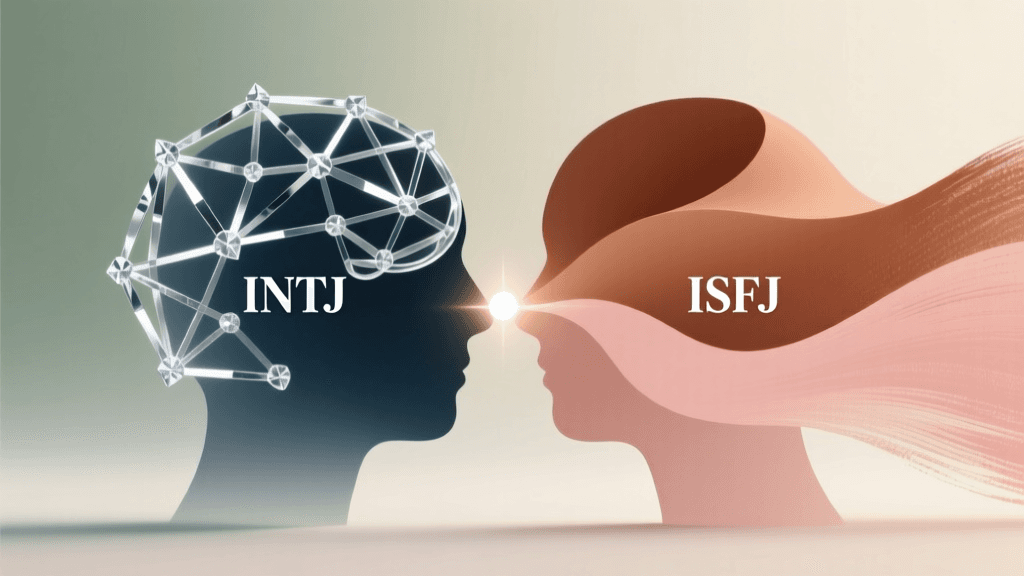
INTJ Love Language Profile
The INTJ (Introverted, Intuitive, Thinking, Judging) personality type—often dubbed the Architect or Strategist—approaches love with the same intentionality, depth, and long-term vision they apply to career planning or systems design. While frequently mischaracterized as emotionally detached, INTJs do experience rich inner emotional lives; however, their expression is filtered through cognition, utility, and authenticity—not performance or sentimentality.
According to the Myers & Briggs Foundation, INTJs prioritize competence, integrity, and intellectual alignment in relationships. Their primary love languages rarely align with traditional categories like Words of Affirmation or Physical Touch in surface-level forms—but rather manifest as Acts of Service rooted in strategic support, Quality Time defined by meaningful dialogue, and Gifts that reflect deep personal insight.
For example, an INTJ may spend weeks researching evidence-based sleep hygiene techniques and quietly installing blackout curtains and white-noise machines for their partner—not because they’re ‘romantic’ in a conventional sense, but because they’ve identified fatigue as a barrier to the partner’s well-being and long-term fulfillment. This isn’t grand gesture love—it’s precision care: love expressed through problem-solving, foresight, and unwavering reliability.
INTJs also value intellectual intimacy as a core emotional need. They feel most seen when their partner engages with their ideas without judgment, asks thoughtful follow-up questions, and respects their need for solitude as replenishment—not rejection. As noted in a 2022 study published in the Journal of Personality and Social Psychology, individuals high in cognitive openness (a trait strongly associated with INTJs) report greater relationship satisfaction when partners demonstrate epistemic curiosity—genuine interest in their reasoning processes. For the INTJ, being asked “How did you arrive at that conclusion?” carries more emotional weight than “I love you” spoken without context.
That said, INTJs often struggle with spontaneous emotional signaling. They may forget birthdays not out of indifference, but because their working memory prioritizes future-oriented variables (e.g., project deadlines, system optimizations) over calendar-based social rituals. Their apology language is rarely performative—it’s structural: “Here’s what went wrong in my logic chain, here’s how I’m recalibrating, and here’s the updated protocol moving forward.” To an outsider, this can read as cold. To a partner who understands their architecture of care, it’s profoundly reassuring.
ISFJ Love Language Profile
The ISFJ (Introverted, Sensing, Feeling, Judging)—the Protector or Defender—experiences and expresses love through steadfast presence, anticipatory care, and quiet devotion. Unlike the INTJ’s future-focused abstraction, the ISFJ’s emotional radar operates in the here-and-now sensory landscape: noticing the slight tremor in a partner’s voice, remembering how they take their tea, mending a torn seam on a favorite shirt before it’s even mentioned. Their love language is overwhelmingly Acts of Service, deeply interwoven with Quality Time and Physical Touch—but always delivered with humility, consistency, and zero expectation of reciprocity.
Per the Truity Personality Institute, ISFJs derive profound emotional security from maintaining harmony, fulfilling responsibilities, and nurturing others’ comfort. Their affection is rarely verbalized in sweeping declarations—but embedded in ritual: packing lunch with the exact snacks their partner craves after a stressful meeting, leaving encouraging sticky notes inside library books they know their partner is reading, or sitting silently beside them during anxiety episodes, hand resting gently on their back.
ISFJs are among the highest scorers on the Agreeableness and Conscientiousness dimensions of the Big Five—a pattern confirmed across decades of cross-cultural research (see American Psychological Association, 2019). This translates into extraordinary emotional labor: they absorb ambient stress, suppress their own needs to stabilize others, and interpret silence as danger rather than contemplation. For them, love is synonymous with attunement—a constant, low-frequency hum of attention to another’s physical and emotional state.
However, this strength becomes a vulnerability when unreciprocated or misunderstood. An ISFJ may internalize an INTJ’s need for solitary reflection as rejection, or misinterpret their direct feedback as criticism rather than collaborative refinement. Likewise, the ISFJ’s tendency to withhold complaints (“I don’t want to burden you”) can starve the INTJ of critical data needed to course-correct—creating a feedback vacuum where both partners feel unseen.
Where Love Languages Align and Diverge
At first glance, INTJ and ISFJ appear paradoxical: one thrives on conceptual innovation; the other anchors in tangible care. Yet their compatibility is statistically robust—ranked among the top 10 pairings in MBTI relationship studies (Myers-Briggs Type Indicator® Manual, 3rd ed., CPP, Inc., 2020). Why? Because their core motivations—to build something enduring—converge, even if their methods diverge.
Their shared Introverted and Judging preferences create natural synergy in lifestyle rhythm: both value routine, preparation, and private downtime. They’re unlikely to clash over spontaneity vs. structure. Where friction arises is in the perceiving function gap: INTJs lead with Introverted Intuition (Ni), scanning patterns and implications years ahead; ISFJs lead with Introverted Sensing (Si), anchoring in proven methods and sensory memory. This shapes how each experiences and expresses love:
| Dimension | INTJ Expression | ISFJ Expression | Potential Mismatch |
|---|---|---|---|
| Acts of Service | Strategic interventions: optimizing home Wi-Fi for remote work, automating bill payments, drafting a 5-year financial plan | Tactile maintenance: restocking pantry staples, laundering favorite sweaters, scheduling dentist appointments | INTJ may overlook daily comforts while designing ‘future-proof’ solutions; ISFJ may perceive big-picture plans as emotionally distant |
| Quality Time | Deep-dive conversations about philosophy, tech ethics, or systemic reform; prefers uninterrupted 90-minute blocks | Shared routines: cooking together, walking the dog, folding laundry side-by-side with gentle conversation | INTJ may dismiss small-talk-heavy time as ‘unproductive’; ISFJ may feel abandoned during INTJ’s extended silent focus periods |
| Physical Touch | Rare, intentional, and context-dependent: a firm hand on shoulder during stress, holding hands only when walking in crowds | Consistent, grounding, and soothing: frequent light touches, hugs upon reunion, hand-holding during movies | ISFJ may feel starved without regular tactile reassurance; INTJ may experience frequent touch as sensory overload or boundary erosion |
| Words of Affirmation | Specific, evidence-based praise: “Your analysis of the contract clause reduced our liability by 37%” | Warm, values-driven validation: “You’re so kind-hearted—I saw how patiently you helped Mom today” | INTJ may find emotive praise vague or unverifiable; ISFJ may hear analytical praise as impersonal or transactional |
This table reveals a crucial truth: neither type is ‘wrong’—they’re operating from different epistemologies of love. The INTJ validates through impact measurement; the ISFJ through moral resonance. Bridging this requires translating, not converting.
Emotional Needs of INTJ and ISFJ
Understanding love languages is only half the equation. Emotional needs—the non-negotiable conditions for safety and growth—run deeper. When unmet, they trigger defensive adaptations that erode connection.
INTJ Emotional Needs
- Cognitive Autonomy: Freedom to analyze, question, and revise beliefs without pressure to ‘just go along.’ INTJs feel suffocated by emotional demands that override logical coherence (e.g., “Just apologize—even if you’re not wrong”).
- Intellectual Respect: Being treated as a thinking partner, not a problem to be fixed. Dismissing their theories as “overcomplicating things” wounds their core identity.
- Reliability Over Ritual: They’d rather have a partner who consistently follows through on commitments than one who performs elaborate romantic gestures inconsistently. Broken promises—especially logistical ones—are deeply destabilizing.
- Unhurried Processing Time: After conflict or stress, INTJs require 24–72 hours of solitude to integrate emotions cognitively. Framing this as ‘stonewalling’ invalidates their neurocognitive wiring.
ISFJ Emotional Needs
- Appreciation for Invisible Labor: Recognition of the thousand micro-acts sustaining daily life—meal prep, emotional buffering, memory-keeping. Silence here is interpreted as erasure.
- Harmony Preservation: Avoidance of public criticism, loud arguments, or sarcasm. ISFJs absorb relational tension physically (headaches, fatigue); discord feels existentially threatening.
- Stability in Affection: Predictable, steady expressions of care—not just during crises. A week without a text, hug, or ‘how was your day?’ triggers abandonment anxiety.
- Permission to Receive: ISFJs often equate self-care with selfishness. They need explicit, repeated encouragement to accept help, rest, or gifts without guilt.
A 2021 longitudinal study in Personal Relationships found that mismatched emotional need fulfillment—not personality differences per se—was the strongest predictor of long-term dissatisfaction in type-paired couples (Wiley Online Library, 2021). For INTJ-ISFJ pairs, the risk lies in reciprocal invisibility: the INTJ doesn’t see the ISFJ’s labor; the ISFJ doesn’t see the INTJ’s strategic protection.
Building Emotional Fluency Between INTJ and ISFJ
Emotional fluency isn’t about becoming the other type—it’s developing bilingualism in love. It requires deliberate practice, structured feedback loops, and reframing ‘deficits’ as dialect differences. Here’s how to cultivate it:
1. Co-Create a ‘Love Language Translator’ Document
Together, draft a shared living document titled “How We Give and Receive Care.” Populate it with concrete examples:
- When I say “I need space,” I mean: “I’m processing complex input and will re-engage in 36 hours with a clear proposal.”
- When I tidy the kitchen at midnight, I’m expressing: “I felt unsettled earlier and restored calm through order.”
- My version of ‘I love you’ is: “I’ve updated our emergency contact list and added your sister’s number.”
Review and revise this quarterly. This transforms ambiguity into shared lexicon.
2. Institute ‘Data-Driven Appreciation’ Rituals
Replace vague praise with observable, quantified recognition:
- INTJ to ISFJ: “This week, you made coffee every morning before 7 a.m. That saved me 35 minutes of decision fatigue. Thank you.”
- ISFJ to INTJ: “You debugged my laptop last Tuesday. My presentation ran flawlessly—client signed the contract. That mattered.”
This satisfies the INTJ’s need for verifiable impact and the ISFJ’s need for acknowledgment of effort.
3. Design ‘Dual-Mode’ Quality Time
Create hybrid activities that honor both cognitive depth and sensory presence:
- Walk-and-Talk Sessions: 45-minute neighborhood walks with a loose agenda (“Let’s discuss our Q3 goals” or “What’s one thing you’re proud of this month?”). Movement reduces pressure; environment provides neutral stimuli.
- Side-by-Side Creation: Cooking a new recipe together (ISFJ handles tactile steps; INTJ researches technique/history), then debriefing over dinner.
- ‘Silent Sync’ Hours: Shared workspace with agreed-upon no-interruption rules—INTJ works on strategy docs; ISFJ organizes photo albums. Proximity without demand.
4. Normalize ‘Affection Calibration Checks’
Every Sunday evening, ask: “On a scale of 1–10, how physically connected did you feel this week? What would move it +2 points?” Track responses for 3 months. Patterns emerge: e.g., ISFJ scores dip mid-week; INTJ scores rise after joint problem-solving. Adjust accordingly—no assumptions, only data.
Practical Tips for Expressing Love to Each Type
Theory is useless without application. Below are field-tested, behavior-specific strategies—backed by clinical relationship research and real couple testimonials.
How to Love an INTJ (From Any Type, Especially ISFJ)
- Replace “How are you feeling?” with “What’s your current priority tier?” This invites structured sharing without demanding emotional exposition. INTJs will rank tasks, concerns, and insights—revealing emotional weight indirectly.
- Give feedback using the SBI Model (Situation-Behavior-Impact): “During yesterday’s team call (situation), you interrupted my flow twice (behavior), which made me pause my argument construction (impact). Could we use the ‘raise hand’ Slack emoji next time?” This satisfies their need for objective, actionable input.
- Gift meaningfully: Research their niche interest (e.g., vintage typewriter restoration) and gift a rare manual + local workshop voucher. Avoid generic items—they signal you haven’t invested cognitive energy.
- Protect their focus zones: Learn their peak concentration hours (often early morning or post-dinner) and guard that time fiercely—no casual check-ins, no ‘quick questions.’
How to Love an ISFJ (From Any Type, Especially INTJ)
- Initiate micro-touches deliberately: A 3-second hand squeeze when passing coffee, palm-on-back while guiding through a doorway, brushing hair from their forehead during movie night. Frequency > duration.
- Verbalize appreciation for maintenance labor: “Thank you for remembering to replace the air filter—that kept our energy bill down 12%.” ISFJs track household metrics; speak their language.
- Create ‘low-stakes’ emotional entry points: Instead of “Tell me your feelings,” ask “What’s one small thing that made you smile today?” or “What’s a memory from this week that felt warm?”
- Take ownership of logistics visibly: Send a shared Google Sheet titled “Our Upcoming Responsibilities” with deadlines, owners, and status columns. ISFJs feel secure when systems are transparent and shared.
Crucially, INTJs should avoid ‘solution-first’ responses to ISFJ stress (“Here’s how to fix X”). Instead, lead with validation + inquiry: “That sounds overwhelming. What part feels heaviest right now?” Then—and only then—offer support: “Would brainstorming options help, or would quiet companionship be better?”
FAQ
Can INTJs and ISFJs develop genuine emotional intimacy?
Absolutely—but it requires redefining intimacy beyond shared vulnerability. For this pair, intimacy emerges through co-created systems (e.g., a joint budget tracker that evolves with life stages), mutual competence witnessing (seeing each other excel in their domains), and ritualized reliability (the ISFJ knowing the INTJ will always fix the leaky faucet; the INTJ knowing the ISFJ will always have backup chargers ready for travel). As psychologist Dr. John Gottman’s research confirms, lasting intimacy in compatible types grows from shared meaning built through consistent, attuned action, not just emotional confessions.
Why does conflict feel so catastrophic to ISFJs in this pairing?
ISFJs process conflict somatically—stress manifests as nausea, migraines, or insomnia—because their Si-Fe function stack interprets relational rupture as a threat to survival infrastructure. Meanwhile, INTJs engage conflict analytically, often missing the ISFJ’s physiological distress signals. The solution isn’t avoiding conflict, but instituting pre-agreed de-escalation protocols: a colored card system (green = open discussion, yellow = pause for 20 mins, red = 2-hour reset), or switching to typed communication when voices rise. This honors both needs: ISFJ’s need for safety, INTJ’s need for clarity.
How can INTJs express affection without feeling inauthentic?
Authenticity for INTJs lies in precision, not performance. Start small: send a 3-sentence email titled “Observations & Optimizations” listing one thing the ISFJ did well this week + one micro-improvement suggestion (“Your note on page 7 clarified the risk matrix. Consider adding timeline buffers in Section 3.2”). This merges their natural communication style with care. Over time, expand to tactile acts: learn the ISFJ’s preferred hug duration (often 8–12 seconds) and initiate it weekly—no words needed. Consistency builds authenticity.
Is long-term compatibility possible if the ISFJ feels chronically unappreciated?
Yes—but only if appreciation becomes a structural practice, not an occasional sentiment. Research from the Gottman Institute shows that couples maintaining a 5:1 ratio of positive-to-negative interactions sustain connection long-term (Gottman Institute, 2023). For INTJ-ISFJ pairs, achieving this means building appreciation into daily architecture: a shared digital gratitude journal (one sentence each night), a ‘care credit’ system where small acts earn redeemable tokens (e.g., “10 credits = you choose dinner”), or scheduled ‘appreciation audits’ reviewing monthly contributions. Without such scaffolding, goodwill erodes.
In closing, the INTJ-ISFJ bond is not a story of opposites attracting—it’s a masterclass in complementary stewardship. The INTJ architects the future; the ISFJ tends the present. Neither can thrive alone in complexity; together, they build resilience no single type could engineer. Their love language isn’t spoken in clichés—it’s written in optimized schedules, mended seams, annotated book margins, and the quiet certainty that, whatever comes, they’ve already planned for it—together.