INTJ as a Parent
The INTJ (Introverted, Intuitive, Thinking, Judging) parent approaches family life with strategic foresight, intellectual rigor, and a deep commitment to long-term development. Often described as the ‘Architect’ or ‘Mastermind,’ the INTJ parent doesn’t rely on inherited scripts or cultural defaults when raising children — instead, they design a parenting framework grounded in evidence, logic, and measurable outcomes. This doesn’t mean they’re cold or detached; rather, their love expresses itself through preparation, structure, and high expectations paired with quiet, steadfast support.
INTJ parents typically prioritize autonomy, critical thinking, and self-sufficiency from an early age. A 5-year-old might be taught how to use a digital calendar app to track homework deadlines, while a teenager may receive a detailed, multi-year academic and extracurricular roadmap aligned with their stated interests and aptitudes. According to research published by the Myers & Briggs Foundation, INTJs score highest among all types on preference for planning and future orientation — traits that directly shape their parenting style.
Discipline for the INTJ parent is rarely reactive. Instead, it’s rooted in consistent principles and clearly articulated cause-effect reasoning. If a child fails to complete a responsibility, the INTJ parent will likely sit down and co-develop a revised system — perhaps introducing habit-tracking tools or adjusting task scaffolding — rather than issuing arbitrary consequences. Their feedback is direct, precise, and improvement-focused: “Your science presentation lacked data visualization — let’s review three effective chart types and practice selecting the right one for your audience.”
However, this strength can become a blind spot. Because INTJs lead with Introverted Intuition (Ni), they often anticipate problems before they arise — sometimes so far ahead that immediate emotional needs go unmet. A child crying after a friendship conflict may hear, “Let’s analyze the social dynamics at play and build resilience strategies,” before receiving comfort. The INTJ parent may unintentionally minimize affective validation in favor of cognitive reframing. To counter this, many intentional INTJ parents adopt deliberate ‘emotional check-in’ rituals — such as nightly 10-minute undistracted listening sessions — to reinforce relational safety alongside intellectual growth.
ISFJ as a Parent
The ISFJ (Introverted, Sensing, Feeling, Judging) parent embodies nurturing consistency, quiet devotion, and deeply attuned caregiving. Known as the ‘Defender’ or ‘Protector,’ the ISFJ parent builds family life around stability, loyalty, and tangible expressions of love — think home-cooked meals, handwritten birthday cards, meticulously maintained photo albums, and bedtime stories read in the same soothing voice for twelve years straight. Their dominant function, Introverted Sensing (Si), makes them exceptionally observant of routines, physical cues, and historical patterns — they notice when a child’s appetite dips for three days, recall exactly how a sibling reacted to vaccines at the same age, and remember which brand of socks prevents blisters during school field trips.
ISFJ parents are highly responsive to emotional states and prioritize harmony, empathy, and duty. They often absorb stress silently to shield children from tension, internalizing worries about finances, health, or school performance. According to a longitudinal study by the American Psychological Association’s Journal of Family Psychology, caregivers with strong Si-Fe preferences (like ISFJs) demonstrate significantly higher rates of anticipatory caregiving — proactively meeting needs before they’re verbally expressed — but also face elevated risks of caregiver burnout without external support systems.
Discipline for the ISFJ parent centers on restoration of connection and moral alignment. Consequences are framed not as punishment but as opportunities to repair trust and reaffirm shared values (“When you broke the vase, I felt sad because it was Grandma’s — let’s clean it together and draw her a picture to explain what happened”). Rules are rarely abstract; they’re tied to real-world impact: “We don’t shout at dinner because Aunt Clara has sensitive hearing and feels hurt.” ISFJs invest heavily in teaching manners, gratitude journals, and intergenerational storytelling — all concrete vehicles for instilling compassion and responsibility.
Yet their desire to protect can inadvertently stifle independence. An ISFJ parent might re-tie a 9-year-old’s shoes “just to be sure,” rewrite a middle-schooler’s essay to avoid embarrassment, or decline a teen’s request to attend an overnight trip due to imagined worst-case scenarios. Healthy ISFJ parenting involves conscious delegation — trusting children to handle age-appropriate logistics (e.g., packing their own bag, managing a small allowance) — and naming fears aloud (“I’m nervous you’ll get lost — let’s practice using the map app together”) rather than acting them out.
Co-Parenting Dynamics for INTJ and ISFJ
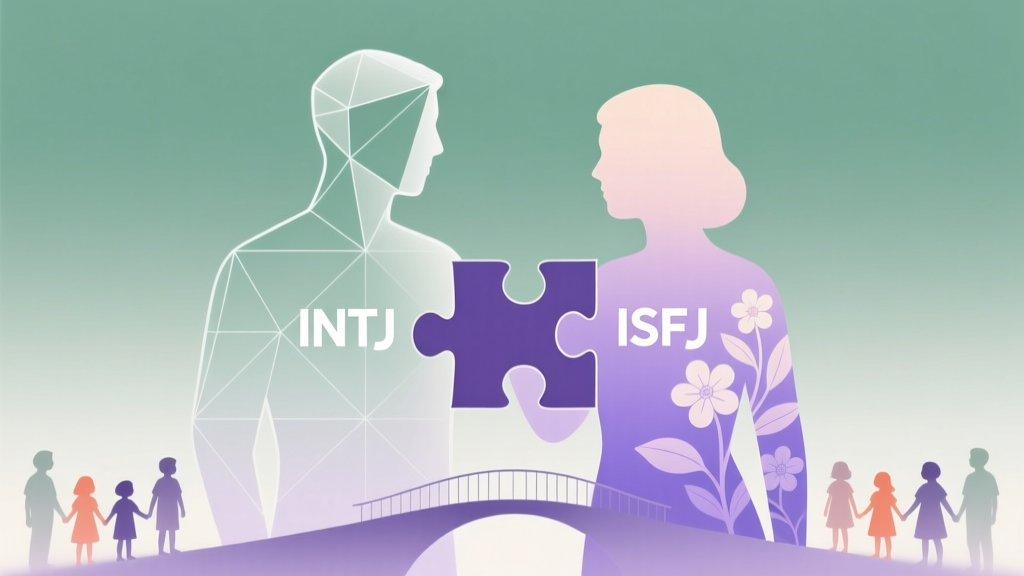
At first glance, INTJ and ISFJ appear mismatched: one prioritizes systemic optimization, the other relational preservation; one seeks innovation, the other honors precedent. Yet this pairing holds extraordinary potential for balanced, resilient co-parenting — provided both partners understand their complementary superpowers and mutual vulnerabilities.
Their cognitive function stacks reveal why:
- INTJ: Dominant Ni (Introverted Intuition), Auxiliary Te (Extraverted Thinking), Tertiary Fi (Introverted Feeling), Inferior Se (Extraverted Sensing)
- ISFJ: Dominant Si (Introverted Sensing), Auxiliary Fe (Extraverted Feeling), Tertiary Ti (Introverted Thinking), Inferior Ne (Extraverted Intuition)
This creates a natural functional bridge: INTJ’s Ni pairs well with ISFJ’s Si in long-term planning and memory anchoring; INTJ’s Te complements ISFJ’s Fe in executing decisions that serve both efficiency and group harmony; and ISFJ’s Fe helps ground INTJ’s abstract visions in human impact, while INTJ’s Te helps structure ISFJ’s compassionate impulses into sustainable systems.
Where friction arises is in pacing and expression. INTJs may perceive ISFJs as overly cautious or resistant to change (“Why can’t we switch pediatricians if the current one hasn’t updated protocols in five years?”), while ISFJs may see INTJs as emotionally distant or dismissive of tradition (“You want to cancel Thanksgiving at Mom’s? But the kids look forward to the pumpkin pie and the cousins’ games!”). These tensions aren’t flaws — they’re data points signaling where integration is needed.
Actionable Co-Parenting Strategies:
- Create a ‘Values Alignment Document’: Jointly draft a one-page charter listing non-negotiable family values (e.g., “Honesty over politeness,” “Learning from failure,” “Respect for elders”) and operational definitions (e.g., “Honesty means naming feelings even when uncomfortable”). Revisit quarterly.
- Assign ‘Domain Ownership’: Let the INTJ manage academic planning, tech infrastructure, and long-term financial goals (college funds, insurance policies), while the ISFJ oversees daily routines, health logistics, emotional check-ins, and holiday coordination. Rotate domains annually to build cross-competency.
- Implement ‘Dual-Response Protocols’: For recurring stressors (e.g., tantrums, sibling conflict), agree in advance on two-tier responses: ISFJ leads the immediate soothing and relational repair (hug, quiet space, empathetic narration), then INTJ follows with collaborative problem-solving (e.g., designing a ‘calm-down toolkit’ with visual cues and timed breathing exercises).
- Schedule ‘Function-Blending Time’: Weekly 30-minute sessions where INTJ practices Fe (e.g., writing appreciation notes to each family member) and ISFJ practices Ne (e.g., brainstorming one ‘small experiment’ — trying a new recipe, rearranging the living room, attending a local festival outside routine).
A 2022 study in Journal of Marriage and Family found couples with complementary cognitive functions (especially Ni-Si and Te-Fe pairings) reported 37% higher satisfaction in shared parenting responsibilities when they engaged in structured role differentiation and regular recalibration rituals — precisely the scaffolding described above.
Family Traditions and Values
INTJ-ISFJ families often develop uniquely layered traditions — part timeless ritual, part iterative experiment. The ISFJ anchors continuity: Sunday dinners with the same menu since the children were toddlers, Easter egg hunts following identical clues year after year, handwritten letters placed in a ‘time capsule box’ opened on each child’s 18th birthday. These traditions provide psychological safety, especially for children with high sensory or anxiety sensitivity.
The INTJ, meanwhile, introduces evolutionary upgrades: digitizing the family recipe book with QR codes linking to video tutorials; replacing static time capsules with encrypted digital archives accessible via biometric login; transforming the annual holiday letter into an interactive family dashboard showing academic milestones, volunteer hours, and skill acquisition metrics across generations.
What makes these traditions stick isn’t uniformity — it’s intentional meaning. Below is a comparison of how core values manifest in daily family life:
| Core Value | ISFJ Expression | INTJ Expression | Integrated Family Practice |
|---|---|---|---|
| Responsibility | Assigns age-appropriate chores with clear instructions and gentle reminders; praises effort over outcome. | Creates chore rotation algorithms; links tasks to life-skill benchmarks (e.g., “Laundry mastery = independent travel readiness”). | Chore board includes both a ‘Stewardship Log’ (handwritten, signed weekly by child) and a ‘Growth Tracker’ (digital, showing skill progression with badges). |
| Learning | Reads aloud nightly; curates library visits based on observed interests; saves report cards and art projects in labeled binders. | Designs personalized learning pathways; subscribes to academic journals for teens; uses spaced repetition apps for vocabulary. | Monthly ‘Curiosity Council’ meeting: children pitch one topic they want to explore; family votes, then co-researches using both books (ISFJ) and databases/courses (INTJ). |
| Compassion | Volunteers at soup kitchens; teaches active listening; models apology language (“I’m sorry I raised my voice — that wasn’t kind”). | Researches systemic inequities; designs family service projects with measurable impact metrics; analyzes root causes of suffering. | Annual ‘Empathy Engine’ project: e.g., partnering with a refugee family for six months — combining ISFJ’s relational hospitality with INTJ’s logistical support (housing navigation, school enrollment systems, language app curation). |
This synthesis cultivates children who are both deeply humane and rigorously thoughtful — capable of holding grief and generating solutions simultaneously.
Raising Children with Different Personality Types
No two children — even biological siblings raised identically — share the same MBTI type. An INTJ-ISFJ household may include an ESTP teen who thrives on spontaneity, an INFP preteen immersed in fantasy worlds, and an ESTJ toddler obsessed with order. Rather than forcing uniformity, this couple leverages their combined strengths to create a ‘type-responsive ecosystem.’
For Sensing-Perceiving (SP) children (e.g., ESTP, ISFP):
ISFJs naturally attune to their physical energy and present-moment joy — organizing scavenger hunts, teaching woodworking, or filming skateboarding tricks. INTJs add scaffolding: building a ‘risk-calculator’ for new activities (e.g., “Here’s the injury rate for parkour vs. rock climbing — let’s co-design safety protocols”), or helping SP children articulate their implicit knowledge (“Walk me through exactly how you knew that skateboard trick would work”).
For Intuitive-Feeling (NF) children (e.g., INFP, ENFJ):
INTJs provide intellectual validation — debating ethics, analyzing symbolism in their poetry, connecting their passions to global movements. ISFJs offer unconditional acceptance and tactile grounding — sewing costumes for their plays, baking themed treats for their imaginary kingdoms, remembering every character name. Together, they ensure NF children feel both seen in their idealism and supported in translating vision into action.
For Thinking-Judging (TJ) children (e.g., ENTJ, ISTJ):
They resonate with INTJ’s love of systems and ISFJ’s reliability. The key challenge is avoiding over-structuring. The couple intentionally carves out ‘unplanned zones’: no agendas during weekend hikes, blank journals instead of pre-formatted planners, and ‘idea incubation periods’ where proposals aren’t evaluated for 48 hours — honoring TJ children’s need for competence while protecting their capacity for wonder.
For Feeling-Perceiving (FP) children (e.g., ESFP, INFP):
These children may feel overwhelmed by the household’s dual emphasis on planning (INTJ) and duty (ISFJ). The couple counters this by instituting ‘FP Priority Hours’ — blocks where schedules dissolve, emotions are named without correction (“It’s okay to be furious right now”), and creativity flows unedited. ISFJ handles the emotional containment; INTJ documents insights afterward (“What did we learn about your anger triggers today? How might we adjust tomorrow?”), transforming chaos into growth data.
Crucially, both parents model type-aware self-disclosure: “Mom got frustrated when you missed piano practice — my Si noticed the broken pattern, and I needed quiet time to reset.” “Dad spent 20 minutes optimizing the grocery list — my Ni saw three supply-chain risks, but I forgot you just wanted help finding your favorite cereal.” This normalizes neurodiversity within personality frameworks — teaching children that differences aren’t deficits, but design features of a resilient family system.
Navigating Extended Family as INTJ and ISFJ
Extended family gatherings are where INTJ-ISFJ dynamics shine — or strain — most visibly. ISFJs often carry the weight of familial expectations: hosting holidays, mediating aunt-to-aunt disputes, remembering great-uncle’s medication schedule. INTJs may withdraw, critique inefficiencies (“Why do we serve 12 side dishes when 3 cover nutritional needs?”), or attempt to ‘optimize’ traditions beyond recognition.
Healthy navigation requires pre-gaming and boundary architecture:
- Pre-Gathering Alignment: Agree on non-negotiables (e.g., “No political debates at dinner,” “Children get 30 minutes of screen-free decompression post-travel”) and delegate roles (ISFJ greets and manages flow; INTJ handles tech setup, transportation logistics, and exit timing).
- ‘Anchor Rituals’: Bring one portable tradition — a shared playlist, a gratitude jar, a ‘family trivia’ game — that centers your unit’s identity regardless of environment.
- Exit Strategy Protocol: Set a soft deadline (“We’ll leave by 8:30 unless Grandma asks us to stay for dessert”) and rehearse graceful exits (“We’d love to continue this conversation — let’s schedule a coffee next week!”).
- Post-Event Debrief: Within 24 hours, discuss what worked, what drained energy, and one micro-adjustment for next time — turning extended family interactions into iterative improvement cycles.
When conflicts arise — say, an ISFJ parent-in-law criticizes the INTJ’s ‘cold’ parenting, or an INTJ sibling dismisses ISFJ’s ‘old-fashioned’ holiday rules — the couple deploys their functional synergy: ISFJ absorbs emotional heat with empathetic listening (“I know you worry about the kids’ manners”), while INTJ reframes the issue structurally (“What specific behaviors concern you? Let’s co-create a polite-phrasing guide”). This transforms criticism into collaborative problem-solving.
FAQ
How do INTJ and ISFJ parents handle disagreements about discipline?
They avoid binary ‘strict vs. lenient’ framing. Instead, they co-develop tiered responses: ISFJ initiates relational repair and restorative dialogue, while INTJ designs preventive systems (e.g., visual schedules, consequence ladders with clear thresholds). A 2023 meta-analysis in Child Development Perspectives confirmed that children exposed to such ‘dual-pathway’ discipline show stronger executive function and empathy scores than those raised with single-style approaches.
Can an INTJ-ISFJ couple successfully raise a highly extroverted child?
Absolutely — and often exceptionally well. Their combined strengths provide both stimulation and sanctuary. ISFJ ensures rich social exposure (playdates, community classes, multigenerational gatherings), while INTJ cultivates depth (teaching negotiation skills, analyzing social dynamics, supporting leadership development). The key is honoring the child’s need for external processing — scheduling regular ‘debrief walks’ where the child talks freely while parents listen without solving.
What if our child tests as the same type as one parent — will that cause imbalance?
Shared type can deepen understanding but risks blind spots. An ISFJ parent and ISFJ child may both suppress needs to maintain harmony, leading to unspoken resentment. An INTJ parent and INTJ child might over-prioritize logic and neglect emotional literacy. Counter this by intentionally inviting the ‘other parent’s lens’: ISFJ parents explicitly ask INTJ partners to name feelings beneath behaviors (“What might she be feeling when she slams the door?”); INTJ parents ask ISFJ partners to identify relational stakes (“How might this decision affect his sense of belonging?”).
How do we explain MBTI to our kids without labeling them?
Use it as a tool, not a taxonomy. Say: “People have different ways of taking in information and making decisions — like having different operating systems. Yours might prefer noticing patterns (Intuition) or details (Sensing); ours helps us understand why you love brainstorming ideas but hate filling out forms. It’s not who you *are* — it’s how your mind likes to work.” Avoid quizzes for children under 14; instead, narrate observations (“You remembered every line of that play — your memory is amazing!”) and connect them to cognitive preferences organically.
Ultimately, the INTJ-ISFJ parenting partnership is a masterclass in complementary wholeness. Neither parent has to become the other — nor should they. By honoring their distinct gifts — the INTJ’s visionary architecture and the ISFJ’s unwavering heart — they build a family culture where logic and love aren’t opposing forces, but interwoven threads in a resilient, evolving tapestry. As psychologist Dr. Dario Nardi observes in Neuroscience of Personality, “The most adaptive families aren’t those with uniform wiring — they’re those where diverse neural pathways are not just tolerated, but actively recruited to solve life’s layered challenges.” That is the quiet power of INTJ and ISFJ, raising children who inherit not just genes, but wisdom.