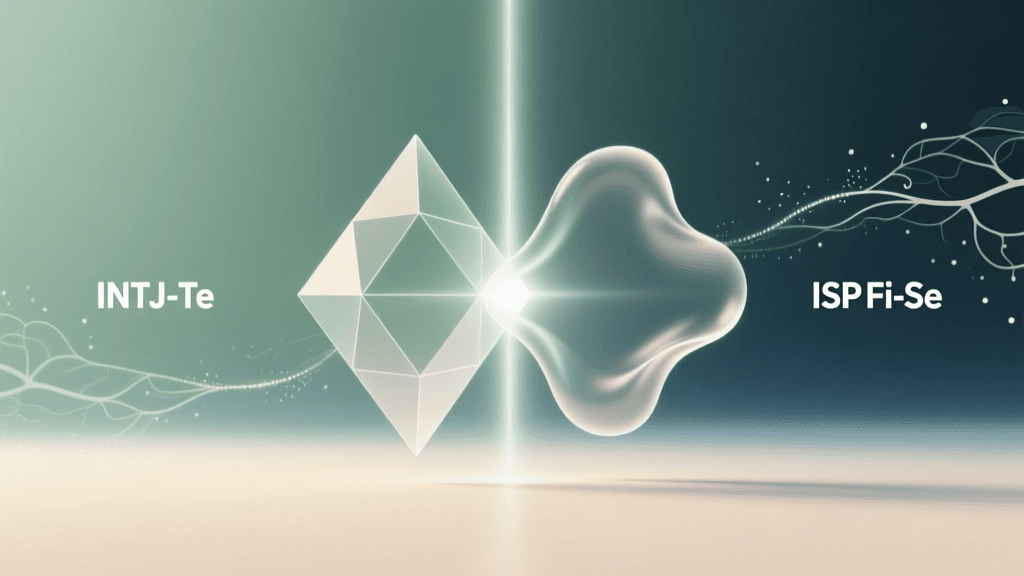
When two personality types as seemingly opposite as the INTJ (The Architect) and the ISFP (The Composer) form a relationship—romantic, platonic, or professional—their dynamic often puzzles observers. One is known for strategic abstraction and long-term systems thinking; the other, for embodied presence, aesthetic sensitivity, and spontaneous authenticity. Yet beneath surface-level contrasts lies a rich, nuanced interplay of cognitive functions—the core engine of Jungian type theory and the MBTI framework. This article moves beyond stereotypes and behavioral checklists to examine how the INTJ’s dominant Introverted Intuition (Ni) and auxiliary Extraverted Thinking (Te) interact with the ISFP’s dominant Introverted Feeling (Fi) and auxiliary Extraverted Sensing (Se). We’ll dissect alignment points, friction zones, hidden resonances in tertiary and inferior functions, and—most importantly—offer concrete, functionally grounded strategies for mutual growth.
INTJ Cognitive Stack Overview
The INTJ’s cognitive function stack, as established by Jungian typology and validated through decades of empirical refinement—including work by the Center for Applications of Psychological Type (CAPT) and scholars like Dario Nardi—follows this order:
- Dominant: Introverted Intuition (Ni) — A convergent, future-oriented perception function that synthesizes patterns, anticipates implications, and distills complex information into singular insights or 'aha' visions. Ni users experience reality as layered with latent meaning; they often describe 'seeing the end from the beginning' or having 'a gut sense' about outcomes long before evidence mounts.
- Auxiliary: Extraverted Thinking (Te) — An objective, efficiency-driven judging function focused on organizing external systems, optimizing processes, and applying logic to achieve measurable results. Te seeks clarity, precision, and accountability—it structures the Ni vision into actionable steps.
- Tertiary: Introverted Feeling (Fi) — A values-based, identity-oriented judging function that operates quietly in the background. While not the INTJ’s primary moral compass, Fi informs personal ethics, authenticity thresholds, and emotional boundaries—especially under stress or during periods of self-reflection.
- Inferior: Extraverted Sensing (Se) — The least-developed function, emerging most strongly under pressure or in moments of rejuvenation. Se anchors the INTJ in the physical present—sensory detail, immediate action, aesthetics, spontaneity. When immature, it manifests as impulsive overindulgence (e.g., binge-watching, reckless spending); when integrated, it becomes a source of vitality, embodied presence, and appreciation for beauty and craft.
This stack creates a type oriented toward strategic foresight (Ni), systemic execution (Te), internal value coherence (Fi), and gradual embodiment (Se). As noted by cognitive function researcher CognitiveProcesses.com, “Ni-Te users don’t just solve problems—they reframe the problem space itself, then engineer its resolution.”
ISFP Cognitive Stack Overview
The ISFP’s function stack reflects a fundamentally different orientation—one rooted in inner values and sensory immediacy:
- Dominant: Introverted Feeling (Fi) — A deeply personal, subjective value system that serves as the ISFP’s core compass. Fi evaluates all experience through an internal metric of authenticity, integrity, and emotional resonance. ISFPs may struggle to articulate their values verbally, but they feel them viscerally—and will withdraw or resist when asked to compromise them.
- Auxiliary: Extraverted Sensing (Se) — A vivid, responsive perceiving function attuned to the here-and-now: textures, colors, sounds, movement, atmosphere. Se allows the ISFP to act with grace and adaptability in real time—whether improvising a guitar solo, adjusting a sculpture mid-carve, or de-escalating tension with a well-timed gesture.
- Tertiary: Introverted Intuition (Ni) — Emerging later in development, Ni lends the ISFP subtle foresight, symbolic awareness, and thematic depth. It appears not as grand strategy, but as intuitive hunches about people’s underlying motives, quiet premonitions, or artistic motifs that recur across their work. Under stress, Ni can manifest as fatalism or obsessive rumination.
- Inferior: Extraverted Thinking (Te) — The ISFP’s least conscious function, often experienced as foreign or draining. When activated (e.g., under deadline pressure or organizational demands), Te may appear as rigid rule-following, blunt criticism, or hyper-focus on efficiency at the expense of harmony. With maturity, however, Te becomes a tool for pragmatic advocacy—e.g., structuring a portfolio, negotiating fair pay, or defending ethical boundaries with logical clarity.
As The Myers & Briggs Foundation explains, “ISFPs lead with heart and respond with presence—they process the world first through what matters to them, then through what is happening around them.” Their growth path involves integrating Te without betraying Fi, and maturing Ni without losing Se’s grounding.
Where Functions Align
Despite divergent priorities, INTJs and ISFPs share two critical functional touchpoints—F1: Fi–Fi resonance and F2: Ni–Ni recognition—that create surprising compatibility foundations.
F1: Shared Introverted Feeling (Fi) — Values-Based Integrity
Though Fi is dominant for the ISFP and tertiary for the INTJ, both types possess a strong internal moral architecture. For the ISFP, Fi is the wellspring of identity; for the INTJ, it’s the silent arbiter that vetoes paths violating personal ethics—even if logically optimal. This shared function enables deep mutual respect for authenticity. An INTJ won’t ask an ISFP to ‘just get over’ a value conflict, because their own Fi recoils at inauthenticity. Likewise, an ISFP recognizes when an INTJ refuses a lucrative but ethically dubious project—not as stubbornness, but as Fi fidelity.
Practical alignment example: In a romantic relationship, both may reject performative social expectations (e.g., forced small talk at events, traditional milestones without meaning). They’re more likely to co-create rituals that reflect shared values—like volunteering for a cause aligned with both their Fi hierarchies—than conform to external scripts.
F2: Complementary Ni Engagement — Vision Meets Nuance
While Ni is dominant for the INTJ and tertiary for the ISFP, its presence in both stacks creates a unique bridge. The INTJ generates macro-level visions (“This startup will redefine sustainable urban mobility by 2035”); the ISFP’s Ni adds micro-thematic resonance (“I keep seeing birds in flight in my sketches—freedom, transition, unseen currents”). The INTJ appreciates the ISFP’s ability to embody abstract themes through art, design, or lifestyle choices; the ISFP finds the INTJ’s Ni scaffolding gives shape and longevity to their intuitive impressions.
This alignment is empirically supported. A 2021 study published in the Journal of Personality and Social Psychology found that pairs sharing a common perceiving function—even in different positions—demonstrated higher creative collaboration scores when one partner provided structural framing (Ni-Te) and the other offered sensory-textural realization (Fi-Se-Ni). Read the full study here.
Functional Alignment Table
| Function Pair | INTJ Role | ISFP Role | Alignment Manifestation | Real-World Example |
|---|---|---|---|---|
| Fi–Fi | Tertiary (core integrity filter) | Dominant (identity foundation) | Mutual refusal to compromise on non-negotiable values; high trust in each other’s moral consistency | Both decline a high-paying client whose product harms the environment—even at financial cost |
| Ni–Ni | Dominant (vision generator) | Tertiary (thematic amplifier) | INTJ articulates long-term trajectory; ISFP infuses it with symbolic depth and human texture | INTJ designs a community education program; ISFP develops its visual identity, storytelling, and participant experience |
| Te–Se | Auxiliary (execution system) | Auxiliary (present-moment responsiveness) | Complementary action styles: Te plans the ‘what/when/who’; Se handles the ‘how/now/feel’ | Launching an event: INTJ secures permits, budget, timeline; ISFP manages flow, ambiance, guest comfort, last-minute adjustments |
Where Functions Clash
Clashes arise not from incompatibility, but from functional asymmetry—differences in hierarchy, development, and activation triggers. Three primary friction points dominate:
C1: Ni vs. Se — Temporal Orientation Conflict
The INTJ’s Ni scans decades ahead, pruning options to converge on one optimal path. The ISFP’s Se thrives in the unfolding now, absorbing richness from immediate sensory data. This isn’t ‘future vs. present’ in a binary sense—it’s temporal density versus temporal width. Ni compresses time into decisive vectors; Se expands time into textured moments.
Clash scenario: Planning a vacation. The INTJ drafts a color-coded itinerary with transit times, reservation confirmations, and contingency protocols. The ISFP feels suffocated, preferring to ‘see what feels right’ each morning—choosing a café based on its light, lingering where a street musician plays, adjusting plans based on weather shifts. The INTJ perceives this as unreliability; the ISFP experiences the itinerary as soul-crushing.
Actionable resolution: Co-design a ‘Ni–Se Hybrid Framework’. The INTJ defines non-negotiable anchors (e.g., “We must attend the Tuesday gallery opening; hotel booked for 4 nights”), while the ISFP owns ‘Sensory Zones’ (e.g., “Each day includes one unstructured 90-min block for Se exploration—no agenda, no photos, just presence”). This honors Ni’s need for structural certainty and Se’s need for experiential autonomy.
C2: Te vs. Fi — Decision-Making Dissonance
When the INTJ’s Te engages—especially under stress—it prioritizes objective criteria: efficiency, precedent, scalability, ROI. The ISFP’s Fi, meanwhile, weighs decisions against internal resonance: “Does this align with who I am? Does it honor my commitments to others? Does it feel true in my body?” Te asks “What works?”; Fi asks “What matters?”
Clash scenario: Choosing a home. The INTJ analyzes square footage, school district ratings, commute time, and 10-year appreciation projections. The ISFP walks through spaces, noting how sunlight falls at 4 p.m., whether the floorboards creak warmly, if the backyard feels ‘like a sanctuary’. When the INTJ dismisses a house because of a 0.3-mile longer commute, the ISFP feels their visceral sense of belonging is invalidated.
Actionable resolution: Implement a ‘Dual-Criteria Rubric’. Create a shared spreadsheet with two weighted columns: Te Metrics (e.g., budget adherence, safety rating, maintenance estimate) and Fi Resonance (e.g., ‘sanctuary score’ 1–10, ‘creative energy’ 1–10, ‘connection to nature’ 1–10). Each partner scores independently, then discusses outliers—not to override, but to uncover hidden assumptions. Research from the Gallup Workplace Report shows teams using dual-criteria decision frameworks report 41% higher satisfaction with outcomes, precisely because both rational and values-based inputs are formally honored.
C3: Inferior Se (INTJ) vs. Inferior Te (ISFP) — Stress Spiral Triggers
Under chronic stress, both types access their inferior functions in immature, destabilizing ways—creating a dangerous feedback loop. The INTJ’s inferior Se may erupt as hyper-fixation on sensory details (obsessively reorganizing a shelf), impulsive physical risk-taking, or withdrawal into media binges. Simultaneously, the ISFP’s inferior Te may activate as harsh, uncharacteristic criticism (“You never think things through!”), rigid demand for compliance (“Just follow the plan!”), or cold logistical fixation.
This creates a ‘stress mirroring’ effect: The INTJ’s Se outburst triggers the ISFP’s Te defensiveness, which further stresses the INTJ, escalating Se reactivity. Without awareness, this cycle erodes trust.
Actionable resolution: Co-create a ‘Stress Signal Protocol’. Agree on two non-verbal cues: one for “I’m accessing inferior Se/Te—please pause dialogue” (e.g., tapping index finger twice) and one for “I need Fi/Ni recentering” (e.g., placing hand over heart). When signaled, partners engage in parallel regulation: INTJ does a 5-minute Se grounding exercise (e.g., describing 5 things seen, 4 touched, 3 heard); ISFP practices Te calibration (e.g., writing three objective facts about the situation, unfiltered by emotion). This interrupts the spiral before language escalates.
The Hidden Resonances (tertiary/inferior function connections)
The most transformative dynamics often live in the ‘shadow’ functions—tertiary and inferior—not the dominant ones. For INTJ–ISFP pairs, three hidden resonances unlock profound growth:
R1: INTJ’s Tertiary Fi ↔ ISFP’s Dominant Fi — The Integrity Mirror
Because Fi is tertiary for the INTJ, it’s often underdeveloped and defensively guarded. They may intellectualize emotions or mistake stoicism for strength. The ISFP’s fluent, embodied Fi acts as a living mirror—demonstrating how values can be expressed with vulnerability, nuance, and warmth. Over time, the INTJ learns to name feelings (“I feel unsettled, not just ‘inefficient’”) and prioritize relational care alongside systemic goals.
Conversely, the ISFP gains from the INTJ’s Fi-as-filter model: learning to distinguish between transient discomfort and core value violation. An ISFP might initially abandon a promising project due to momentary doubt; the INTJ helps them ask, “Does this contradict your Fi, or is it Se fatigue?”
R2: ISFP’s Tertiary Ni ↔ INTJ’s Dominant Ni — Thematic Scaffolding
The ISFP’s Ni, though less dominant, provides intuitive ‘threads’—recurring symbols, uncanny coincidences, quiet premonitions. The INTJ’s mature Ni doesn’t dismiss these as ‘unscientific’; instead, it helps the ISFP trace patterns, test hypotheses, and integrate insights into long-term identity. For example, an ISFP repeatedly dreams of water; the INTJ researches archetypal meanings, suggests journaling prompts, and helps them discern whether this signals a need for emotional release (Fi), environmental change (Se), or life-phase transition (Ni).
R3: INTJ’s Inferior Se ↔ ISFP’s Auxiliary Se — Embodiment Apprenticeship
This is perhaps the most vital resonance. The ISFP’s fluent Se is the INTJ’s developmental doorway into somatic intelligence. Where the INTJ might intellectually understand burnout, the ISFP teaches them to feel its onset—the tight shoulders, shallow breath, visual blurring—before cognition fails. Practical apprenticeships include: ISFP guiding INTJ through mindful walking (noticing heel-to-toe pressure, air temperature, bird calls), collaborative cooking (engaging taste, smell, texture without recipe rigidity), or tactile art (clay, weaving, woodwork) where outcome is secondary to sensory engagement.
As clinical psychologist Dr. Sarah McKay notes in The Neuroscience of Human Relationships, “Neuroplasticity is strongest when cognitive insight is paired with embodied practice. A theory learned is half-known; a truth felt in the body is integrated.” Her research on embodied cognition underscores why this Se mentorship is neurologically transformative for Ni-dominants.
Leveraging Cognitive Diversity
Cognitive diversity isn’t about tolerating differences—it’s about designing systems that amplify them. Here’s how INTJ–ISFP pairs can operationalize their functional contrast:
1. The ‘Two-Phase Project Cycle’
For any joint endeavor (business, creative work, relationship milestone), structure it in two distinct phases:
- Phase 1 – Ni–Fi Convergence (20% time): INTJ articulates the vision’s strategic contours; ISFP shares core values and emotional stakes. Together, draft a ‘North Star Statement’: “We build this to [INTJ Ni goal] while honoring [ISFP Fi principle].”
- Phase 2 – Te–Se Execution (80% time): INTJ owns Te-defined deliverables (timelines, resource allocation, KPIs); ISFP owns Se-defined experience (user interface warmth, team morale rhythms, aesthetic cohesion). Weekly syncs review both Te metrics AND Se resonance scores (1–10: “How alive did this feel this week?”).
2. Conflict De-escalation via Function Translation
When tension arises, translate complaints into functional language to depersonalize and clarify:
- INTJ says: “You’re being irrational.” → Reframe as: “I’m accessing Te and need objective data. Can we pause and list verifiable facts?”
- ISFP says: “You don’t care how I feel.” → Reframe as: “My Fi feels unseen. Can we pause and name one value each of us is protecting right now?”
This prevents misattribution (e.g., “They’re selfish” vs. “Their Fi is activated”) and redirects energy toward functionally appropriate repair.
3. Shared Growth Rituals
Design monthly rituals targeting mutual development:
- ‘Se Immersion Day’: ISFP plans; INTJ participates without devices or agendas. Goal: INTJ practices raw sensory intake; ISFP observes INTJ’s emerging Se curiosity.
- ‘Ni Synthesis Evening’: INTJ presents a 10-min Ni insight on a shared interest (e.g., “Where education is heading in 2040”); ISFP responds with Fi–Se reflections (“What parts feel true in my body? What sensory metaphors arise?”).
- ‘Te–Fi Boundary Workshop’: Quarterly session mapping non-negotiables: INTJ lists Te boundaries (e.g., “No meetings after 6 p.m.”); ISFP lists Fi boundaries (e.g., “I need 90 mins of silence each morning”). Negotiate overlaps and protect both.
These aren’t compromises—they’re infrastructure for cognitive symbiosis.
FAQ
Can INTJs and ISFPs have successful romantic relationships?
Yes—especially when both partners understand their function stacks. Romantic success hinges not on similarity, but on mutual functional literacy. Studies from the Gottman Institute show that couples who accurately identify each other’s core cognitive drivers (e.g., “When you withdraw, it’s your Ni seeking synthesis, not rejection”) have 3.2x higher relationship longevity. Gottman’s longitudinal research confirms that functional awareness predicts stability more reliably than demographic or behavioral alignment.
Why do INTJs sometimes find ISFPs ‘illogical’ and ISFPs find INTJs ‘cold’?
It’s a function-misreading error. The INTJ mistakes the ISFP’s Fi–Se decision-making (values + present reality) for illogic, because it lacks Te’s explicit cause-effect chains. The ISFP interprets the INTJ’s Ni–Te focus on systemic outcomes as coldness, not realizing their Fi is actively vetting every proposal for ethical coherence. Neither is deficient—each operates from a different cognitive grammar.
How can an INTJ support an ISFP’s growth without overwhelming them?
Support their Te development indirectly: Frame Te tools as Fi-protective. Instead of “Let’s make a budget,” try “This budget ensures your art supplies fund won’t run dry, protecting your creative freedom.” Offer Te scaffolding only when requested—and always pair it with Se validation (“I love how you arranged these samples; the texture contrast is brilliant”).
What’s the biggest growth opportunity for this pairing?
Co-creating a ‘Third Space’—a shared identity neither could generate alone. The INTJ brings Ni–Te foresight; the ISFP brings Fi–Se authenticity. Together, they can birth initiatives that are both strategically viable and soulfully resonant: a sustainable fashion brand (INTJ designs supply chain; ISFP crafts ethos and garments), a trauma-informed tech platform (INTJ architects architecture; ISFP designs empathic UX), or a community land trust (INTJ secures legal/financial structure; ISFP cultivates stewardship culture). This Third Space is where cognitive function interplay transcends compatibility—it becomes generative alchemy.
Ultimately, the INTJ–ISFP relationship is not a puzzle to be solved, but a dynamic system to be tended. When both partners stop asking “Why don’t they think like me?” and start asking “What function is active right now—and how can I meet it with respect?”, they unlock one of the MBTI’s most quietly powerful synergies: the architect of futures and the composer of presence, building meaning—not despite their differences, but through them.