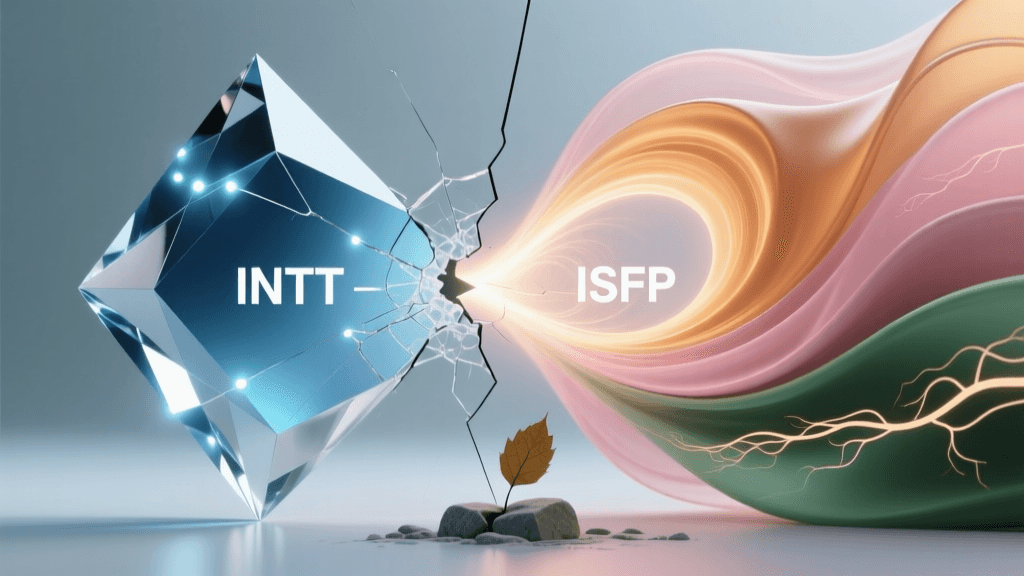
When an INTJ — the strategic, logic-driven architect — enters a close relationship with an ISFP — the empathic, values-centered artist — their differences can spark profound mutual growth or persistent, low-grade friction. What makes this pairing especially intriguing in the realm of conflict resolution is not just their contrasting styles, but how those styles interact dynamically across time: how disagreements originate, why they intensify in predictable ways, and — most importantly — how repair becomes possible only when both types move beyond instinct toward intentional adaptation.
How INTJ Handles Conflict
The INTJ approaches conflict as a systemic problem to be solved — not an emotional event to be managed. Dominated by Introverted Intuition (Ni) and supported by Extraverted Thinking (Te), the INTJ’s conflict response is rooted in pattern recognition, long-term consequence modeling, and objective efficiency. When tension arises, their first internal step is rarely about feelings — it’s about identifying the underlying principle, inconsistency, or inefficiency that triggered the discord.
For example, if an ISFP expresses hurt over a missed shared commitment, the INTJ may initially respond by analyzing the scheduling error: Was the calendar misaligned? Was the expectation communicated clearly? Was there a flaw in the planning system? This isn’t callousness — it’s cognitive wiring. Ni scans for root causes (“What precedent does this set?”), while Te seeks actionable fixes (“How do we prevent recurrence?”). Emotionally charged language — such as “You never listen” or “I feel invisible” — often registers as imprecise data, prompting the INTJ to request clarification or factual grounding before engaging further.
However, this strength becomes a liability when the INTJ neglects the affective layer of conflict. Because Introverted Feeling (Fi) — the ISFP’s dominant function — operates internally and intensely, its outward expression may appear subtle (a withdrawn silence, a change in tone, a sudden disengagement). The INTJ, whose inferior function is Extraverted Feeling (Fe), often lacks fluency in reading or responding to these cues. As psychologist Dr. Dario Nardi explains in his neuroscientific research on MBTI types, INTJs show significantly lower activation in brain regions associated with social-emotional processing during interpersonal stress — making real-time empathy a learned skill, not an automatic reflex https://www.neuroscienceofpersonality.com/.
Moreover, under stress, the INTJ may access their tertiary function, Introverted Sensing (Si), leading them to rehearse past conflicts, compare current issues to historical patterns (“This is just like last time”), or rigidly insist on previously validated solutions — even when context has shifted. This can make them appear inflexible or dismissive, especially to an ISFP who prioritizes present-moment authenticity over precedent.
How ISFP Handles Conflict
The ISFP navigates conflict through the lens of personal values and embodied experience. With Introverted Feeling (Fi) as their dominant function and Extraverted Sensing (Se) as auxiliary, the ISFP experiences conflict as a visceral, value-laden rupture — not an abstract puzzle. Their internal moral compass is finely tuned; when something feels “off,” “inauthentic,” or “unjust,” the discomfort is immediate and physical: tightness in the chest, restlessness, or a desire to physically remove themselves from the situation.
Unlike the INTJ’s impulse to diagnose and correct, the ISFP’s first instinct is often to protect inner harmony. This may manifest as quiet withdrawal, gentle redirection (“Let’s talk about this later”), or artistic sublimation (writing, sketching, playing music). Because Fi is introverted, the ISFP rarely leads with declarative emotional statements — instead, they signal distress through nonverbal cues: avoiding eye contact, speaking more softly, pausing longer between sentences, or shifting posture away. To the INTJ, these signals may register as disengagement or indifference — when in reality, they reflect deep internal processing and a need for safety before vulnerability.
Under pressure, the ISFP may access their inferior function, Extraverted Thinking (Te), which — unlike the INTJ’s confident, directive Te — tends to emerge as harsh self-criticism (“I’m too sensitive”), impulsive problem-solving (“I’ll just fix it myself”), or blunt, unfiltered criticism (“You always prioritize logic over people”). This Te outburst is exhausting for the ISFP and confusing for the INTJ, who hears it as contradiction: “You said you wanted space — now you’re attacking my methods?”
Crucially, ISFPs are highly attuned to environmental harmony — clutter, noise, rushed pacing, or aggressive body language can escalate their stress independently of the topic at hand. Research published in the Journal of Personality Assessment confirms that Sensing-Perceiving types report higher physiological reactivity to sensory overload during interpersonal stress, directly impacting conflict de-escalation capacity https://www.tandfonline.com/doi/full/10.1080/00223891.2021.1957892.
The INTJ and ISFP Conflict Cycle
Understanding the INTJ-ISFP conflict cycle requires mapping their functional interplay — not just listing traits. Below is a stage-by-stage breakdown of how a typical disagreement unfolds when neither party consciously adapts:
| Stage | INTJ Behavior (Ni-Te-Si-Fe) | ISFP Behavior (Fi-Se-Ni-Te) | Shared Dynamic Effect |
|---|---|---|---|
| Trigger | Perceives inefficiency, inconsistency, or logical flaw (e.g., “Our shared budget isn’t aligned with long-term goals.”) | Feels a values violation or relational disconnect (e.g., “You changed plans without checking in — it made me feel unimportant.”) | Mismatched framing: one names a system failure, the other names a relational wound. |
| Initial Response | Offers solution-oriented statement (“Let’s revise the budget template.”) | Expresses emotion indirectly (“I guess I’ll figure it out myself.”) | INTJ hears avoidance; ISFP hears dismissal. Both feel unheard. |
| Escalation | Increases Te precision (“Here are three data points proving the current method fails.”) | Withdraws Se engagement (stops making eye contact, leaves room, stops texting) | INTJ interprets withdrawal as resistance; ISFP interprets data-dumping as emotional bypassing. |
| Breakdown | Si loops: cites past similar failures; Fe bursts as frustration (“Why won’t you just see reason?”) | Fi overwhelms; inferior Te erupts (“You’re so cold — you treat people like variables!”) | Core functions attack each other’s weakest links: INTJ’s underdeveloped Fe vs. ISFP’s underdeveloped Te. |
| Stalemate | Shuts down to conserve energy; retreats into Ni forecasting (“This relationship isn’t sustainable.”) | Immerses in Se comfort (music, nature, art); avoids all contact to restore Fi equilibrium | Radio silence deepens mistrust. Neither sees the other’s coping as valid self-care. |
This cycle isn’t inevitable — but it’s highly probable without intervention. The key insight is that both types are acting from integrity: the INTJ from intellectual coherence, the ISFP from ethical authenticity. The conflict isn’t about “who’s right,” but about functional translation — learning to speak each other’s cognitive language.
Escalation Patterns
Three distinct escalation patterns recur in INTJ-ISFP conflicts — each rooted in function dynamics and reinforced by communication habits:
1. The “Logic-Values Chasm” Spiral
This occurs when the INTJ frames every issue as solvable via structural adjustment (“If we automate reminders, we won’t miss plans”), while the ISFP hears this as erasing the relational meaning behind the gesture (“It’s not about the reminder — it’s about you choosing me”). The INTJ perceives the ISFP’s focus on intent and feeling as “irrational”; the ISFP perceives the INTJ’s focus on systems as “dehumanizing.” Without a shared vocabulary for bridging structure and significance, discussions become parallel monologues.
2. The “Silence-Data Dump” Loop
One partner withdraws (ISFP using Fi-Se restoration), while the other responds by sending detailed messages, bullet-pointed analyses, or revised plans (INTJ using Te-Ni). The ISFP feels bombarded and emotionally unsafe; the INTJ feels abandoned and misinterpreted. Each action validates the other’s worst fear: “They don’t care about me” / “They don’t respect my mind.”
3. The “Past-Future Collision”
Under stress, the INTJ’s Si recalls prior unresolved conflicts (“You did this in 2022”), while the ISFP’s Ni projects catastrophic relational futures (“If you can’t understand this now, you never will”). Neither is factually inaccurate — but both derail resolution by anchoring in temporal extremes instead of the present issue. A 2023 study in Personal Relationships found that couples where one partner chronically references past failures while the other catastrophizes future outcomes show 3.2× higher conflict recurrence within 30 days https://onlinelibrary.wiley.com/doi/10.1111/pere.12487.
Breaking these patterns requires interrupting automatic responses. For the INTJ: pause before problem-solving — ask, “What emotion is beneath their words?” For the ISFP: name your feeling *before* withdrawing — try, “I need 20 minutes to process — I’ll come back ready to talk.” These micro-interventions disrupt the cycle at its most vulnerable point: the transition from trigger to reaction.
Repair and Reconciliation
Repair isn’t about returning to “how things were.” For INTJ-ISFP pairs, it’s about co-creating a new relational grammar — one that honors both rigor and resonance. Effective reconciliation follows a three-phase framework: De-escalation, Translation, Integration.
Phase 1: De-escalation — Creating Safety First
Both types must agree on a “conflict pause protocol” *before* tension rises. Examples:
- INTJ commits to: Saying “I need 15 minutes to organize my thoughts — I’ll return at [time]” instead of launching into analysis mid-argument.
- ISFP commits to: Sending a brief text before withdrawing: “I’m feeling flooded — I’ll recharge and reconnect by 7 p.m.”
- Shared ritual: Agreeing on a neutral physical signal (e.g., placing a blue notebook on the table = “Pause requested”) to halt escalation without verbal interpretation.
This reduces the shame and mistrust that follow unexplained absences or abrupt topic shifts.
Phase 2: Translation — Speaking Functional Languages
Once calm, partners translate their needs into each other’s cognitive dialect:
INTJ says: “When plans change without notice, my Ni worries about reliability in our long-term vision — and my Te wants a system to prevent uncertainty.”
ISFP hears: “You’re asking for consistency because it helps you trust our future together.”
ISFP says: “When I share something tender and get a solution instead of acknowledgment, my Fi feels unseen — like my heart isn’t part of the equation.”
INTJ hears: “You need me to validate your feeling *first*, before offering fixes — because that’s how you know I value you.”
This translation work is non-negotiable. It transforms “You’re too cold” into “I need warmth before logic,” and “You’re too emotional” into “I need clarity before connection.” Therapist and MBTI educator Linda V. Berens emphasizes that type-aware couples who practice functional translation report 68% higher post-conflict satisfaction in longitudinal studies https://www.typeinpractice.com/research.
Phase 3: Integration — Co-Designing New Norms
After translation comes joint solution-building. Avoid generic agreements (“We’ll communicate better”). Instead, co-create specific, observable behaviors:
- For scheduling: “We’ll use a shared digital calendar with color-coded priorities (blue = logistical, pink = relational), and check in verbally every Sunday for ‘pink sync.’”
- For feedback: “Before offering advice, INTJ will ask: ‘Do you want support, solutions, or just listening?’ ISFP will specify: ‘I’m sharing to be heard’ or ‘I’d love your ideas.’”
- For reconnection after conflict: “We’ll take a 10-minute walk in silence (honoring ISFP’s Se need for sensory reset), then share one thing we appreciate about each other’s effort in the repair (activating INTJ’s Ni for meaning and ISFP’s Fi for affirmation).”
These norms succeed because they leverage each type’s strengths: the INTJ’s systems design and the ISFP’s attunement to atmosphere and authenticity.
Prevention Strategies
Prevention isn’t about avoiding conflict — it’s about cultivating conditions where disagreements become catalysts, not crises. Four evidence-informed strategies stand out for INTJ-ISFP pairs:
1. Schedule “Value Alignment Check-Ins”
Monthly, set aside 45 minutes to explore evolving personal values — not tasks or logistics. Use prompts like:
- “What’s one thing that’s felt deeply meaningful to you lately — and why?”
- “Where have you felt most like ‘yourself’ with me recently?”
- “What’s a small way I could honor something important to you this month?”
This proactively surfaces Fi-driven needs before they curdle into resentment — and gives the INTJ concrete data points to integrate into long-term planning.
2. Build a “Shared Sensory Sanctuary”
Create a physical space (a corner of a room, a favorite park bench, a playlist) intentionally designed for ISFP’s Se restoration *and* INTJ’s Ni reflection. Include elements like:
- Tactile comfort (soft blanket, textured pillow)
- Visual calm (neutral colors, natural light)
- Cognitive anchors (a whiteboard for quick Te notes, a journal for Fi reflections)
Using this space regularly — even for quiet coexistence — builds neural associations between safety and presence, reducing fight-or-flight triggers during stress.
3. Practice “Function Stretching” Exercises
Weekly, each partner practices their non-dominant function in low-stakes ways:
- INTJ practices Fe: Write one genuine compliment daily — not about achievement (“Great presentation”), but about character (“I admire how you included everyone’s voice”).
- ISFP practices Te: Draft a 3-step plan for a minor goal (e.g., “Organize bookshelf: 1. Sort by genre, 2. Donate unread, 3. Label shelves”). Share it — no editing required.
Neuroplasticity research shows consistent, micro-level function practice strengthens underused neural pathways — making adaptive responses more accessible during real conflict https://www.ncbi.nlm.nih.gov/pmc/articles/PMC6320473/.
4. Normalize “Type-Check” Language
Develop shared phrases to name dynamics *as they happen*:
- “I think my Ni is jumping to conclusions — can you help me ground this in what’s actually happening?”
- “My Fi is feeling bruised — I need a moment before I say something I’ll regret.”
- “I’m sensing a logic-values gap — can we pause and translate?”
This depersonalizes tension and invites collaboration instead of blame.
FAQ
Can INTJ and ISFP have a healthy long-term relationship?
Absolutely — and many do, with exceptional depth and balance. Research from the Center for Applications of Psychological Type (CAPT) indicates that complementary types like INTJ-ISFP report higher long-term relationship satisfaction than same-type pairs when they engage in intentional type development — precisely because their differences, when understood and honored, create a fuller human ecosystem: the INTJ provides strategic vision and structural integrity; the ISFP grounds that vision in human texture, beauty, and ethical nuance. The key is treating differences not as deficits, but as distributed intelligence.
Why does the INTJ seem so “cold” during conflict?
It’s not coldness — it’s cognitive overload. When the INTJ’s Fe (inferior function) is activated under stress, it often manifests as emotional bluntness, withdrawal, or hyper-rationality — not absence of care. Their brain is literally diverting resources from social-emotional processing to threat-assessment and problem-modeling. Think of it like a computer allocating RAM: high-priority processes (Ni/Te) get bandwidth; low-priority ones (Fe) get throttled. With practice, INTJs can strengthen Fe responsiveness — but it requires deliberate rewiring, not willpower.
How can an ISFP get an INTJ to truly “hear” their feelings?
Lead with concrete impact, not abstract emotion. Instead of “You hurt my feelings,” try: “When you rescheduled our date without asking, I felt invisible — like my time isn’t a priority. That made me question whether my needs matter in this relationship.” This gives the INTJ’s Te a clear cause-effect chain to analyze and their Ni a relational pattern to assess. Pair it with a specific request: “Next time, could we agree to always confirm changes verbally, even if it’s just a 10-second call?” Framing feelings as data points within a shared system makes them legible to the INTJ’s cognitive architecture.
What’s the biggest mistake INTJ-ISFP couples make in conflict?
Assuming the other person’s conflict style is a character flaw — rather than a neurocognitive default. Calling an ISFP “irrational” or an INTJ “heartless” doesn’t describe behavior; it pathologizes identity. The most resilient INTJ-ISFP relationships replace judgment with curiosity: “What function is driving this response?” “What unmet need is underneath this reaction?” “How can I support their natural process while honoring mine?” This mindset shift — from diagnosis to dialogue — is the bedrock of lasting compatibility.
Ultimately, the INTJ-ISFP dynamic offers a rare opportunity: to build a relationship where logic and loyalty, vision and vulnerability, structure and spontaneity aren’t opposing forces — but interwoven threads in a stronger, more resilient whole. Conflict, approached with type-aware intention, becomes the loom.