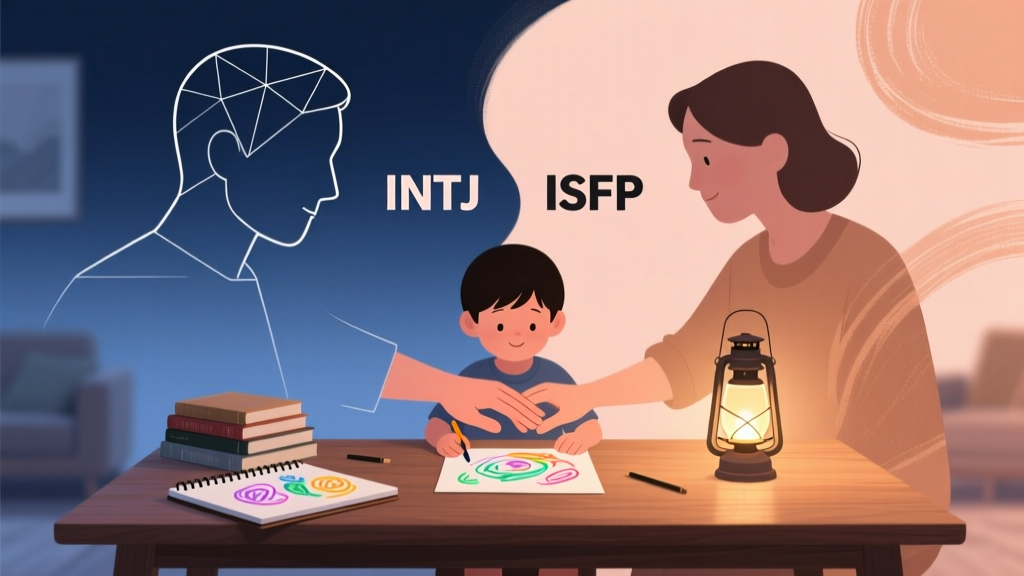
INTJ as a Parent
The INTJ (Introverted, Intuitive, Thinking, Judging) parent approaches family life with strategic intentionality. Often described as the 'Architect' or 'Mastermind,' the INTJ parent operates from a deeply internalized vision of long-term development—both for themselves and their children. Their parenting style is rooted in high standards, intellectual curiosity, and a strong belief in self-reliance. Rather than relying on tradition or emotional intuition alone, INTJs design parenting systems: structured routines, personalized learning plans, and clear cause-and-effect consequences.
For example, an INTJ parent may create a color-coded weekly chart mapping academic goals, extracurricular commitments, and independent skill-building milestones (e.g., cooking one new recipe per month, managing a small allowance budget). They prioritize teaching critical thinking over rote compliance—asking open-ended questions like, “What evidence supports your conclusion?” or “How might this decision affect others five years from now?” This emphasis on logic and foresight helps children develop analytical resilience—but can unintentionally sideline emotional validation if not consciously balanced.
INTJ parents often struggle with spontaneous affection or unstructured play. Hugs may be infrequent but deeply meaningful when offered; praise tends to be specific and merit-based (“Your hypothesis about plant growth was exceptionally well-designed”) rather than general (“Good job!”). Research by the Myers & Briggs Foundation confirms that Judging types—including INTJs—report higher satisfaction with predictable home environments and express greater stress when routines are disrupted without rationale (Myers & Briggs Foundation, 2023). This preference shapes how they manage household logistics, discipline, and even bedtime transitions—with minimal negotiation and maximal consistency.
However, their strength in long-range planning can become a blind spot when it comes to developmental nuance. An INTJ parent might overlook a child’s need for sensory downtime after school—mistaking restlessness for defiance—because the child’s behavior doesn’t align with the planned schedule. Similarly, their aversion to inefficiency may lead them to streamline emotional conversations (“Let’s identify the problem and solve it”) before the child feels fully heard. Without conscious calibration, the INTJ’s clarity and competence can feel cold or overly demanding to sensitive or feeling-oriented children.
ISFP as a Parent
In stark contrast, the ISFP (Introverted, Sensing, Feeling, Perceiving) parent—the 'Composer' or 'Adventurer'—leads with presence, empathy, and aesthetic attunement. ISFPs parent through gentle observation and responsive warmth. They notice subtle shifts in mood, texture, and atmosphere: the way light falls across a child’s face during storytime, the particular shade of blue in a crayon drawing that signals sadness, or the hesitation before entering a crowded room. Their parenting philosophy centers on nurturing authenticity—not molding children into idealized outcomes, but helping them discover and honor their innate rhythms, values, and creative expressions.
An ISFP parent is likely to keep a basket of natural materials—pinecones, smooth stones, watercolor paper—by the kitchen table, inviting spontaneous art-making. They may establish 'quiet rituals' instead of rigid schedules: ten minutes of shared silence with sketchbooks after dinner, or walking barefoot in the grass every Sunday morning. Discipline, for the ISFP, leans toward restorative connection rather than rule enforcement. If a child breaks a vase, the ISFP might say, “I see you’re feeling upset. Let’s clean it up together—and then maybe paint what that feeling looks like.” This approach fosters emotional literacy and self-compassion but may appear inconsistent to more structure-oriented observers.
ISFPs deeply value harmony and avoid confrontation—even when boundaries need reinforcing. They may delay addressing behavioral issues until tension peaks, then resolve them quietly and privately, often sacrificing their own needs to preserve peace. According to a 2022 study published in the Journal of Personality Assessment, Perceiving types (especially those with dominant Sensing-Feeling functions like ISFP) demonstrate significantly higher responsiveness to nonverbal emotional cues in parent-child interactions—yet report lower confidence in setting firm limits without guilt (Garcia et al., 2022). This creates a tender paradox: ISFPs are often the first to sense distress—but the last to name it directly.
Because ISFPs process internally and prefer to act in response to immediate reality—not abstract forecasts—they may resist long-term academic pressure or standardized benchmarks. They’ll champion a child who prefers building forts over flashcards, or composing songs instead of memorizing multiplication tables—sometimes to the concern of teachers or extended family. Their gift lies in affirming identity before achievement—a vital counterbalance in achievement-driven cultures.
Co-Parenting Dynamics for INTJ and ISFP
At first glance, INTJ and ISFP seem temperamentally mismatched: one maps futures in spreadsheets; the other savors the scent of rain on warm pavement. Yet this pairing holds profound complementary potential—if both partners recognize their differences as assets, not deficits. Their co-parenting synergy emerges most powerfully when the INTJ provides scaffolding and the ISFP supplies soul.
Consider homework support: The INTJ designs a semester-long study calendar with spaced repetition intervals and resource links; the ISFP sits beside the child during study blocks, offering quiet companionship, herbal tea, and encouragement that focuses on effort (“I love how carefully you erased and tried again”) rather than outcome. Or in conflict resolution: When siblings argue, the INTJ drafts a fair, step-by-step mediation framework (“State your need → Name the impact → Propose one solution”); the ISFP observes body language, validates feelings aloud (“Your arms are crossed and your voice is tight—that tells me you feel disrespected”), and models de-escalation through breath and tone.
However, friction arises predictably around three axes:
- Planning vs. Presence: INTJs initiate family calendars six months ahead; ISFPs prefer to decide weekend activities Friday evening based on weather, energy levels, and current interests.
- Feedback Style: INTJs offer constructive criticism framed as optimization (“This essay would be stronger with clearer thesis signaling”); ISFPs soften critique with affirmation and sensory grounding (“I loved the description of the forest—you made me smell the moss! Would you like help sharpening the main idea?”).
- Conflict Avoidance vs. Conflict Resolution: ISFPs may withdraw during disagreements to restore inner equilibrium; INTJs interpret withdrawal as disengagement or resistance—and escalate with logical rebuttals, inadvertently intensifying distress.
A practical co-parenting agreement can transform these tensions into alignment. We recommend the following Shared Parenting Framework:
| Domain | INTJ Contribution | ISFP Contribution | Shared Ritual |
|---|---|---|---|
| Routine Design | Creates master weekly template (meals, chores, learning blocks) | Selects 2–3 flexible “anchor moments” (e.g., candlelight reading at 7:30 pm, Saturday morning nature walk) | Every Sunday evening: 15-minute “Rhythm Check-In”—review what worked/didn’t, adjust 1 element collaboratively |
| Discipline Approach | Defines consistent, values-aligned consequences (e.g., tech time reduced by 15 min per unmet chore) | Leads restorative conversations using art, movement, or storytelling | “Repair Jar”: After any correction, child chooses one reparative action from options co-created by both parents (e.g., write a note, bake cookies, draw a comic strip apology) |
| Child Development Tracking | Maintains digital portfolio: academic progress, skill mastery, goal completion | Curates physical memory box: sketches, pressed flowers, voice memos, handmade gifts | Quarterly “Growth Gallery”: Combine digital highlights + tactile artifacts into a family exhibition with simple captions (“This is when Maya learned to tie her shoes—and also painted her first self-portrait”) |
This framework honors both cognitive preferences while anchoring collaboration in tangible, recurring practices. It prevents either parent from defaulting to unilateral decision-making—and gives children the security of consistency *and* the freedom of spontaneity.
Family Traditions and Values
INTJ and ISFP families rarely adopt traditions wholesale from cultural templates. Instead, they co-create rituals that reflect their shared commitment to integrity, beauty, and growth—expressed through distinct yet harmonizing lenses.
For instance, holiday celebrations may include both a meticulously researched historical context session (led by the INTJ: “Did you know the Yule log originated as a Norse symbol of cyclical renewal?”) and a sensory-rich craft circle (led by the ISFP: arranging dried citrus, cinnamon sticks, and beeswax candles on a hand-thrown ceramic tray). The INTJ ensures the tradition has meaning anchored in principle; the ISFP ensures it has texture anchored in experience.
Core family values often crystallize around three pillars:
- Autonomy with Accountability: Children are granted increasing independence (choosing electives, managing allowances, planning solo outings)—but must articulate their reasoning and anticipate impacts. The INTJ structures the 'accountability' system; the ISFP ensures the 'autonomy' feels emotionally safe.
- Truth-Telling with Tenderness: Honesty is non-negotiable—but delivery is curated. Hard truths are preceded by connection (“I love you deeply, and because I do, I need to talk about something important”). The ISFP models compassionate framing; the INTJ ensures factual accuracy and follow-through.
- Excellence Rooted in Authenticity: High standards apply—not to conformity, but to personal expression. A child’s science fair project is evaluated for rigor *and* originality; their piano recital for technical precision *and* emotional resonance. Neither parent sacrifices depth for polish—or vice versa.
One powerful tradition many INTJ-ISFP families adopt is the “Dual Journal”: A bound notebook passed between parent and child monthly. The INTJ writes a reflective letter analyzing patterns, growth, and future opportunities (“I’ve noticed your debate club participation increased 40% this term—what internal shift supported that?”). The ISFP contributes watercolor margins, pressed leaves, or short poetic fragments responding to the same themes (“Your words reminded me of the oak tree outside your window—strong roots, surprising new branches”). This practice bridges abstraction and embodiment, logic and lyricism—modeling integration for the whole family.
Raising Children with Different Personality Types
No two children share identical MBTI types—and in an INTJ-ISFP household, this diversity becomes both a laboratory and a litmus test for adaptive parenting. Because the parents themselves represent opposite ends of key spectrums (Judging/Perceiving, Thinking/Feeling, Intuition/Sensing), they possess an unusually rich toolkit for meeting varied temperaments.
Consider how they might support four common child types:
- ESTJ Child: Thrives on structure and fairness. The INTJ parent mentors in systems-thinking and civic responsibility; the ISFP parent softens rigidity with humor and embodied joy (e.g., turning chore charts into a backyard scavenger hunt). Together, they teach that rules serve people—not the reverse.
- INFP Child: Deeply idealistic and sensitive. The ISFP parent offers unconditional acceptance and creative sanctuary; the INTJ parent helps translate values into actionable projects (“If justice matters to you, let’s research local food banks and design a donation drive”). They jointly protect the child’s inner world while equipping them to engage the outer one.
- ESTP Child: Energetic, pragmatic, and socially agile. The ISFP parent joins impromptu adventures and celebrates quick wit; the INTJ parent introduces strategic reflection (“What did that skateboard trick teach you about risk assessment?”). They balance thrill with insight—without stifling spontaneity.
- INFJ Child: Insightful, principled, and quietly intense. Both parents recognize this type’s need for depth and meaning. The INTJ engages in philosophical dialogue about ethics and futurism; the ISFP provides sanctuary through music, nature immersion, and silent companionship. Their united reverence for inner complexity helps the INFJ child feel profoundly seen.
A key insight from clinical family therapist Dr. Susan S. Baudry, whose work with neurodiverse and temperamentally diverse families is cited by the American Psychological Association, is that “children flourish not when parents mirror them—but when parents complement them in ways that expand their capacity without erasing their essence” (APA Monitor, 2021). For INTJ-ISFP couples, this means resisting the urge to ‘correct’ a child’s type (e.g., pushing a Perceiving child into rigid scheduling, or discouraging an Intuitive child’s abstract questions). Instead, they scaffold development: helping a Sensing child appreciate metaphor through concrete analogies, or guiding a Thinking child to name emotions using physiological cues (“Where do you feel that frustration in your body?”).
Practical tip: Implement a “Type-Responsive Learning Menu” for homework and enrichment. Each child selects weekly options aligned with their preferences:
- For Sensors: Hands-on experiments, field notes, photo journals
- For Intuitives: Hypothesis trees, future-scenario writing, concept mapping
- For Thinkers: Debate prompts, logic puzzles, comparative analysis
- For Feelers: Empathy interviews, value-based storytelling, collaborative art
- For Judgers: Structured timelines, checklist rubrics, goal ladders
- For Perceivers: Choice boards, open-ended challenges, iterative prototyping
This approach communicates: Your mind works beautifully as it is—and we’ll meet you where you are.
Navigating Extended Family as INTJ and ISFP
Extended family gatherings often magnify the INTJ-ISFP dynamic. Grandparents may misinterpret the INTJ’s quiet analysis as aloofness, or mistake the ISFP’s gentle reserve for passivity. Cousins may overwhelm the ISFP with noise while challenging the INTJ with illogical arguments. Navigating these settings demands pre-planning, mutual advocacy, and boundary clarity.
Before events, the couple should co-draft a Family Interaction Protocol:
- Pre-Event Briefing: INTJ outlines logistical expectations (travel time, duration, dietary accommodations); ISFP shares emotional readiness cues (“I’ll wear my blue sweater—it means I’m grounded and open to conversation”).
- On-Site Roles: INTJ serves as ‘logistics anchor’—managing transportation, medication, nap schedules—while ISFP acts as ‘emotional barometer’, scanning for overload in children or themselves and initiating micro-breaks (stepping outside for air, finding a quiet corner with sketchbook).
- Boundary Scripts: Rehearse polite but firm responses: To unsolicited advice, INTJ says, “We’ve researched several approaches and landed on what fits our family’s values”; ISFP says, “That’s an interesting perspective—I’ll hold it gently as we continue learning what works for us.”
- Exit Strategy: Agree on a non-verbal signal (e.g., tapping wedding ring twice) indicating it’s time to leave—no explanation required. Honor it immediately, without apology.
When relatives question parenting choices (“Why don’t you just make him sit still?” or “Shouldn’t she be in advanced math by now?”), the couple responds as a unit—not competitively, but chorally. One begins, the other completes: “We believe every child unfolds at their own pace…” (ISFP) “…guided by evidence, values, and ongoing observation.” (INTJ). This models unity without uniformity.
Over time, extended family often comes to appreciate the couple’s complementary strengths: the INTJ’s calm authority during crises, the ISFP’s soothing presence during emotional ruptures. Their very differences become a testament to intentional, values-driven family life—inviting others to reflect on their own assumptions.
FAQ
How do INTJ and ISFP parents handle discipline differently—and how can they unify their approach?
INTJs emphasize consistency, logic, and long-term consequence; ISFPs prioritize relational repair, emotional safety, and contextual flexibility. Unification begins with agreeing on 3 non-negotiable family values (e.g., respect, honesty, kindness) and co-designing one consequence protocol per value—e.g., for disrespect: INTJ defines the boundary (“No raised voices during conflict”); ISFP designs the reconnection ritual (“After cooling down, share one thing you appreciate about each other”). Review quarterly and adjust collaboratively.
What if our child is an ESTJ or ENTJ—will they clash with the ISFP parent?
Not inherently—but friction may arise from differing pacing and communication styles. ESTJ/ENTJ children often seek clear directives and measurable outcomes, which can exhaust the ISFP’s preference for organic exploration. Mitigate this by giving the child structured leadership roles within ISFP-led activities: e.g., the child times the nature walk, logs observations in a journal, or presents findings to the family. This satisfies their need for order while honoring the ISFP’s experiential focus.
How can an INTJ parent better connect with an ISFP child?
Shift from verbal analysis to shared doing: build furniture together, restore old tools, garden side-by-side. Speak less; observe more. Ask sensory questions (“What’s the most satisfying part of sanding that wood?”) rather than evaluative ones (“Is this project meeting your standards?”). Gift experiences—not reports: a pottery class, stargazing kit, or visit to a textile museum. Your presence, not your insights, is the bridge.
Are there resources specifically designed for INTJ-ISFP parenting teams?
Yes. The Center for Applications of Psychological Type (CAPT) offers a free downloadable guide titled “Temperament Partnerships in Parenting,” which includes exercises for J-P and T-F dyads. Additionally, the book Raising Your Spirited Child by Mary Sheedy Kurcinka—though not MBTI-specific—provides adaptable frameworks for high-structure + high-empathy co-parenting, validated across temperament research (SpiritedChild.com, 2023).
Ultimately, the INTJ-ISFP parenting partnership is not about compromise—but about composition. Like bass and violin in a string quartet, their contrasting timbres generate resonance no single instrument could achieve alone. When the INTJ’s vision meets the ISFP’s grace, children don’t just grow up—they grow *whole*: equipped with both the map and the compass, the blueprint and the breath, the why and the wonder.