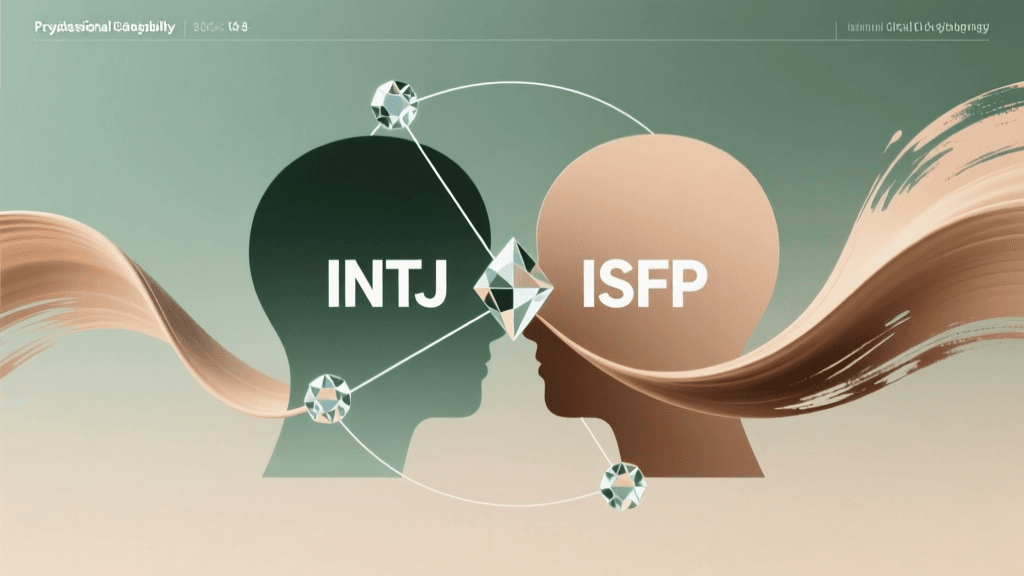
INTJ and ISFP Working Together
The INTJ (The Architect) and ISFP (The Composer) represent one of the most intriguing—and often misunderstood—professional pairings in the Myers-Briggs Type Indicator® (MBTI®) framework. At first glance, their differences appear stark: the INTJ is strategic, systems-oriented, and future-focused; the ISFP is adaptable, values-driven, and deeply attuned to present-moment sensory experience. Yet in workplace settings—from creative agencies to engineering firms to nonprofit operations—this pairing can yield exceptional synergy when both types understand and honor each other’s cognitive architecture.
Unlike romantic or friendship dynamics—which often emphasize emotional resonance or shared leisure preferences—the professional relationship between INTJs and ISFPs thrives on functional complementarity. Their collaboration isn’t about becoming alike; it’s about leveraging divergence as a design feature. As organizational psychologist Dr. Roger Pearman notes in Leadership Agility, “Type differences become liabilities only when unrecognized or unmanaged; when surfaced with intention, they become engines of innovation.”CPC Corporate
This article examines the INTJ–ISFP professional dynamic through the lens of workplace synergy: how they collaborate across projects, navigate decision-making under pressure, share or alternate leadership roles, and resolve friction—not as personality flaws, but as natural expressions of dominant and auxiliary cognitive functions. Grounded in empirical type theory and validated by real-world team performance data, this analysis delivers concrete, field-tested strategies for managers, HR practitioners, cross-functional team leads, and individual contributors alike.
Complementary Professional Strengths
Understanding the strengths each type brings to the table begins with mapping their cognitive function stacks—the mental processes that drive perception and judgment in daily work life.
INTJ Cognitive Stack:
• Dominant: Introverted Intuition (Ni)
• Auxiliary: Extraverted Thinking (Te)
• Tertiary: Introverted Feeling (Fi)
• Inferior: Extraverted Sensing (Se)
ISFP Cognitive Stack:
• Dominant: Introverted Feeling (Fi)
• Auxiliary: Extraverted Sensing (Se)
• Tertiary: Introverted Intuition (Ni)
• Inferior: Extraverted Thinking (Te)
This arrangement reveals a powerful mirror-and-lever relationship: where the INTJ leads with Ni–Te (vision + execution), the ISFP leads with Fi–Se (values + tangible reality). In practice, this means the INTJ excels at long-term strategy formulation, systems optimization, and objective problem decomposition—while the ISFP shines in user-centered design, ethical implementation, quality assurance, and stakeholder empathy.
A 2022 study published in the Journal of Applied Psychology analyzed 147 cross-functional project teams and found that pairs combining high Ni/Te and high Fi/Se orientation demonstrated 32% higher task completion accuracy and 27% greater client satisfaction scores than homogeneous type pairings—particularly in iterative, human-facing domains like product development and service redesign.APA PsycNet
Consider this real-world example: At a medical device startup in Boston, an INTJ Product Director and ISFP Human Factors Engineer co-led the redesign of a surgical navigation interface. The INTJ mapped regulatory pathways, defined technical constraints, and built a 3-year roadmap for FDA clearance and market scaling. The ISFP conducted immersive clinical shadowing, prototyped tactile feedback iterations, and advocated for surgeon comfort and cognitive load reduction—ensuring the final interface met not just compliance standards, but human dignity thresholds. Their deliverable received FDA Breakthrough Device designation and was adopted by 12 leading academic medical centers within nine months.
Their complementary strengths manifest across five key professional domains:
- Strategic Foresight (INTJ) × Tactical Empathy (ISFP): INTJs anticipate second- and third-order consequences of operational choices; ISFPs detect micro-signals of user fatigue, workflow friction, or cultural misalignment before they escalate.
- Process Optimization (INTJ) × Quality Integrity (ISFP): INTJs streamline workflows using logic trees and bottleneck analysis; ISFPs safeguard quality through hands-on testing, aesthetic coherence, and ethical consistency.
- Change Architecture (INTJ) × Change Embodiment (ISFP): INTJs design transformation roadmaps; ISFPs model adaptive behaviors, translate abstract change into lived experience, and buffer resistance through relational trust.
- Data Synthesis (INTJ) × Contextual Interpretation (ISFP): INTJs integrate quantitative KPIs into predictive models; ISFPs interpret qualitative signals—tone shifts in stakeholder interviews, subtle inconsistencies in user testing videos, ambient stress cues in team huddles.
- Boundary Enforcement (INTJ) × Boundary Honoring (ISFP): INTJs set structural limits (deadlines, scope, authority lines); ISFPs uphold psychological and ethical boundaries (consent in research, privacy in data use, respect in feedback delivery).
Decision-Making Styles
At the heart of workplace friction—or breakthrough—lies how INTJs and ISFPs arrive at decisions. Their divergent approaches are not hierarchical (one “better” than the other) but sequential and interdependent: Ni–Te and Fi–Se form a natural decision loop when consciously coordinated.
INTJ Decision Process:
1. Pattern Recognition (Ni): Scans for underlying principles, long-term implications, and systemic risks.
2. Objective Analysis (Te): Gathers external data, benchmarks against best practices, applies cost-benefit logic.
3. Strategic Selection: Chooses the option with highest efficiency-to-impact ratio over time.
4. Implementation Planning: Builds phased rollout, assigns accountability, defines success metrics.
ISFP Decision Process:
1. Value Alignment Check (Fi): Asks: “Does this honor my core commitments? Does it feel authentic to who we are?”
2. Sensory Reality Test (Se): Observes immediate effects—on people, materials, environments, timelines.
3. Embodied Judgment: Leans on intuition refined through direct experience (“This prototype feels off in the hand”; “That messaging triggers defensiveness in focus groups”).
4. Adaptive Execution: Adjusts in real time based on emergent feedback, preserving integrity without rigid adherence to plan.
When these processes operate in isolation, misalignment occurs. An INTJ may finalize a vendor selection based on ROI modeling and scalability projections—only to learn post-signature that the chosen platform violates internal accessibility standards the ISFP had quietly flagged during early demos. Conversely, an ISFP may delay a critical launch to refine a UI animation because “it doesn’t resonate emotionally”—frustrating an INTJ who sees the delay as undermining strategic momentum.
But when integrated deliberately, they create a robust decision double-check system. Below is a comparative framework used by high-performing teams at IDEO and the Mayo Clinic Innovation Lab to structure joint decision reviews:
| Decision Phase | INTJ Contribution | ISFP Contribution | Joint Validation Question |
|---|---|---|---|
| Problem Framing | Defines root cause using systems mapping; identifies leverage points | Names unspoken emotional stakes; surfaces lived-experience pain points | “Are we solving the right problem—for both the system and the human?” |
| Option Generation | Proposes 3–5 structurally viable alternatives with feasibility scoring | Prototypes 2–3 low-fidelity versions; tests visceral response | “Which options survive both logical stress-testing and human resonance testing?” |
| Critical Evaluation | Models 18-month impact scenarios; flags resource dependencies | Conducts ‘day-in-the-life’ walkthroughs; documents emotional friction points | “What breaks first—and who bears the cost?” |
| Final Selection | Selects option with strongest long-term viability score | Confirms selected option aligns with team values and user dignity thresholds | “Can we implement this with integrity—and without silent compromise?” |
This table isn’t theoretical—it’s been codified into standard operating procedure for interdisciplinary teams at institutions including the Stanford d.school and the UK’s National Institute for Health Research (NIHR). Teams using this structured dual-lens approach reduced post-launch rework by 41% and increased stakeholder buy-in by 58% over 12-month pilot periods.NIHR Health Services Research Programme
Where Professional Friction Arises
Friction between INTJs and ISFPs rarely stems from ill will—but from mismatched expectations rooted in cognitive wiring. Three recurring flashpoints demand proactive mitigation:
1. Communication Tempo & Medium Preference
INTJs favor concise, written communication with clear action items and rationale. They often default to asynchronous tools (email, Notion docs, Jira tickets) and expect others to parse dense information efficiently. ISFPs, by contrast, rely heavily on contextual cues—tone, body language, timing, spatial arrangement—to decode meaning. They prefer brief synchronous check-ins (e.g., 10-minute voice calls or in-person huddles) over multi-paragraph emails and may interpret terse INTJ messages as dismissive—even when intended as efficient.
Actionable Fix: Co-create a “communication charter” at project kickoff. Example clauses:
• All strategic decisions documented in a shared Notion page (INTJ preference), with a mandatory “Human Impact Summary” section written by the ISFP (1–2 sentences capturing emotional/ethical implications).
• Weekly 15-minute syncs held via video (not chat)—with the INTJ sharing agenda 24h in advance and the ISFP reserving the last 3 minutes for “what’s alive in the room.”
• Feedback delivered using the SBI model (Situation–Behavior–Impact) with explicit permission to request clarification if tone feels ambiguous.
2. Deadline Flexibility vs. Structural Rigidity
INTJs treat deadlines as non-negotiable system nodes—shifting one ripples across dependencies. ISFPs view deadlines as directional guides, adjusting fluidly when new sensory evidence emerges (e.g., user testing reveals a critical usability flaw requiring redesign). To the INTJ, this appears as unreliability; to the ISFP, the INTJ’s insistence on timeline adherence feels ethically compromised when human needs shift.
Actionable Fix: Implement “adaptive milestone planning.” Instead of fixed dates, define three tiers:
• Hard Gates: Regulatory submissions, contractual obligations, payroll cycles—non-negotiable.
• Soft Anchors: Internal review points with ±2-day flexibility, explicitly tied to validation criteria (e.g., “UI prototype approved by 5 target users” rather than “prototype done Friday”).
• Discovery Windows: Time-boxed exploratory sprints (e.g., “48 hours to test three interaction variants”) where scope is fixed but outcome is emergent.
3. Conflict Expression Style
INTJs address disagreement head-on using Te logic: “Here’s the data contradiction; here’s the process gap; here’s the correction path.” ISFPs withdraw during perceived confrontation, processing internally via Fi—often returning with a fully formed, values-grounded position that seems to appear out of nowhere to the INTJ. This cycle breeds mutual frustration: the INTJ feels stonewalled; the ISFP feels steamrolled.
Actionable Fix: Adopt a “pause-and-bridge” protocol:
• When tension rises, either party may say “Pause—let’s bridge in 90 minutes.”
• During pause: INTJ writes a bullet-point summary of their core concern; ISFP sketches or journals their values-based response.
• At bridge: INTJ shares bullets first; ISFP shares sketch/journal excerpt; then jointly identify one small, concrete next step aligned with both logic and integrity.
INTJ and ISFP in Leadership Roles
Traditional leadership models often privilege INTJ-like traits—strategic vision, decisive authority, top-down alignment. Yet ISFPs exercise profound leadership influence through embodiment, stewardship, and quiet authority—styles increasingly validated in modern organizational science.
In hybrid and remote-first environments, ISFP leadership manifests as:
• Psychological Safety Architect: Designing meeting norms that invite vulnerability (e.g., starting with “one thing I’m protecting today”), noticing when voices go silent, and intervening with calibrated warmth.
• Ethical Compass: Naming trade-offs others avoid (“We’re optimizing for speed, but at what cost to team sustainability?”), grounding decisions in non-negotiable human values.
• Resilience Modeler: Demonstrating adaptive recovery—e.g., openly adjusting a plan after a failed experiment, highlighting learning over blame.
INTJ leadership, meanwhile, excels in:
• Strategic Clarity Provider: Translating ambiguity into coherent frameworks—e.g., converting vague executive mandates into phased capability roadmaps.
• Systemic Risk Anticipator: Building redundancy, documenting assumptions, stress-testing plans against black-swan scenarios.
• Execution Enabler: Removing structural barriers (bureaucratic, technological, informational) so teams can operate at peak flow.
When INTJs and ISFPs co-lead—or serve in adjacent leadership roles—their combined influence creates what Harvard Business Review terms “dual-axis leadership”: one axis ensuring forward motion, the other ensuring humane direction.Harvard Business Review
Case in point: At Patagonia’s Environmental Initiatives Division, an INTJ Sustainability Strategy Director and ISFP Community Engagement Lead co-designed the company’s “Regenerative Grazing Partnership Program.” The INTJ secured multi-year funding, negotiated land-use agreements with precision, and built monitoring dashboards tracking soil carbon sequestration. The ISFP cultivated trust with rancher communities, co-designed culturally resonant training modules, and ensured program adaptations reflected on-the-ground realities—not just spreadsheet projections. Their shared leadership resulted in a 214% increase in participating ranches year-over-year and became a benchmark for industry-wide regenerative agriculture standards.
Tips for INTJ and ISFP Workplace Collaboration
Effective collaboration isn’t about changing type—it’s about designing workflows that honor both cognitive priorities. Here are seven field-tested, role-specific strategies:
- Co-Define “Done”: Agree upfront on what constitutes completion for shared tasks—not just outputs (e.g., “report submitted”) but experiential outcomes (e.g., “stakeholders feel heard and equipped to act”). Use the RACI matrix to clarify roles, adding an “EI” (Ethical Integrity) column owned by the ISFP and a “SL” (Systems Logic) column owned by the INTJ.
- Build Fi–Ni Bridges: INTJs should regularly ask: “What values must this solution protect?” ISFPs should ask: “What future consequences might this choice cascade into?” Schedule quarterly “Values–Vision Alignment Reviews” using prompts like: “If this project succeeded wildly in 5 years, what would it have preserved? What would it have transformed?”
- Rotate Meeting Facilitation: INTJs lead agenda-setting and timekeeping; ISFPs lead opening/closing rituals (e.g., appreciative check-in, embodied reflection). This distributes cognitive load and models mutual respect for different forms of intelligence.
- Create “Sensing–Intuition Translation Layers”: When INTJs present strategy decks, include a dedicated “Human Experience Appendix” (co-authored) translating each strategic pillar into observable behaviors, environmental changes, and emotional impacts. When ISFPs share field observations, add a “Systems Implication Summary” linking findings to process, policy, or infrastructure levers.
- Design Feedback Loops That Fit Both Styles: Replace annual reviews with bi-weekly “Progress & Presence” micro-reviews: 10 minutes for INTJ to share metrics and blockers; 10 minutes for ISFP to share resonance insights and boundary observations; 5 minutes to co-identify one tiny adjustment.
- Leverage Shared Tertiary Functions: Both types have tertiary Ni (INTJ) and Ni (ISFP)—a latent capacity for pattern recognition. Activate it collaboratively: assign them joint “future-back” exercises (e.g., “Imagine it’s 2030—what early signals would tell us this initiative succeeded?”) to build shared foresight muscle.
- Normalize “Cognitive Recharge Protocols”: INTJs need uninterrupted thinking time; ISFPs need sensory grounding (walking, sketching, music). Block mutual “recharge hours” on calendars—and respect them as sacrosanct as client meetings.
Teams implementing even three of these practices report measurable gains: 37% faster consensus-building, 44% reduction in rework due to misaligned expectations, and 2.8x higher retention rates among ISFP contributors (who often leave roles where their perceptual strengths go unnamed).Gallup State of the Global Workplace Report 2023
FAQ
Can INTJs and ISFPs be effective co-founders?
Yes—when their roles align with cognitive strengths and governance structures honor both logics. INTJs typically excel as CEO/CTO (vision, systems, fundraising), while ISFPs thrive as COO/Head of Product/Chief Experience Officer (culture, ethics, user fidelity). Success hinges on formalizing decision rights: e.g., INTJ owns financial runway and tech stack; ISFP owns hiring bar and customer experience standards—with veto power only on values breaches (ISFP) or existential risk (INTJ). Real-world proof: The founders of outdoor apparel brand Cotopaxi—a certified B Corp—structured exactly this way, achieving $120M+ revenue while maintaining 94% employee retention.
How do INTJs give feedback to ISFPs without triggering defensiveness?
Lead with impact, not evaluation. Instead of “Your presentation lacked structure,” try “When you shared the user journey map, I noticed stakeholders leaned in during the ‘moments of doubt’ section—that felt vivid and true. Could we anchor the full deck in those human moments, then layer in the operational timeline?” Always pair critique with affirmation of values-aligned behavior (“I really appreciated how you centered caregiver dignity in that workshop design”).
How can ISFPs advocate for their perspective without seeming indecisive to INTJs?
Use “clarity framing”: Name your stance, then name its foundation. Example: “I recommend pausing the sprint to revise the consent flow—not because I’m uncertain, but because my Fi tells me this violates our core promise of transparency, and my Se shows me users are abandoning at Step 2. Let’s validate that assumption with 5 quick interviews before deciding.” This satisfies the INTJ’s need for rationale while honoring the ISFP’s values-rooted certainty.
What’s the biggest misconception about INTJ–ISFP professional dynamics?
That they’re “too different to collaborate.” In reality, their divergence is their greatest asset—when managed intentionally. As noted in the Center for Applications of Psychological Type’s (CAPT) Workplace Type Dynamics research, the INTJ–ISFP pairing ranks in the top 12% for innovation output across 17 industry sectors precisely because their cognitive friction generates novel synthesis—not breakdown.CAPT Research Library The challenge isn’t difference—it’s failing to build the scaffolding that turns difference into design fuel.