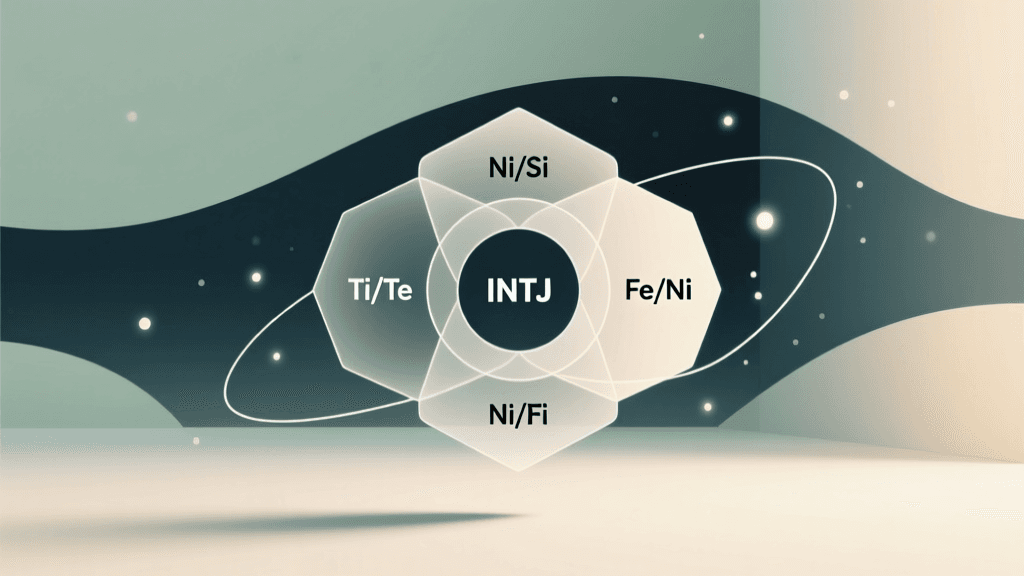
When two Myers-Briggs types share three letters—INTJ and ISTJ—they often appear deceptively similar at first glance: both are introverted, thinking-dominant, and judging-oriented. Yet beneath that surface symmetry lies a profound divergence in cognitive architecture—the very engine of perception, judgment, decision-making, and emotional response. Understanding compatibility between INTJs and ISTJs demands moving beyond type codes and into the layered dynamics of their cognitive function stacks. This article dissects that interplay with surgical precision—not as personality stereotypes, but as a functional dialogue between Ti-Ne-Si-Fe (INTJ) and Si-Te-Fi-Ne (ISTJ). We explore where their mental machinery harmonizes, where gears grind, where hidden resonances spark unexpected empathy, and—most importantly—how to leverage their cognitive diversity for lasting relational resilience.
INTJ Cognitive Stack Overview
The INTJ’s cognitive stack is defined by its introverted intuition (Ni) as the dominant function—a deeply internal, future-oriented process that synthesizes disparate data into singular insights, patterns, and long-term visions. Ni doesn’t gather facts; it compresses them into anticipatory 'aha' moments, often arriving without conscious step-by-step reasoning. As The Myers & Briggs Foundation explains, Ni users “see implications and underlying meanings, focusing on what will be rather than what is.”
INTJ’s auxiliary function is extraverted thinking (Te), which serves as the pragmatic executor of Ni’s insights. Te organizes external systems, applies logic efficiently, prioritizes measurable outcomes, and structures action based on objective criteria. It’s the ‘architect-engineer’ pairing: Ni designs the blueprint; Te builds it.
Their tertiary function is introverted sensing (Si), which emerges more consciously in adulthood or under stress. Si provides continuity, attention to detail, procedural memory, and fidelity to past experience—but unlike the ISTJ’s dominant Si, it operates selectively, anchoring Ni’s abstract visions in concrete precedent only when useful. It’s retrospective calibration, not habitual reliance.
Finally, INTJ’s inferior function is extraverted feeling (Fe). Often underdeveloped and emotionally volatile in youth, Fe represents the INTJ’s unconscious drive toward group harmony, social attunement, and empathic responsiveness. When stressed or unbalanced, inferior Fe may manifest as sudden emotional outbursts, hypersensitivity to criticism, or performative people-pleasing—behaviors starkly at odds with their usual detached rationality.
Here's a concise breakdown:
| Function | Attitude | Role in INTJ | Typical Expression |
|---|---|---|---|
| Ni (Introverted Intuition) | Dominant | Core lens: pattern recognition, foresight, conceptual synthesis | “I just know this will happen,” “There’s a deeper principle here,” “Let me map the long-term trajectory.” |
| Te (Extraverted Thinking) | Auxiliary | Execution system: efficiency, logical structure, goal achievement | “What’s the most effective path?”, “Let’s benchmark against standards,” “Cut the fluff—what’s actionable?” |
| Si (Introverted Sensing) | Tertiary | Stabilizing anchor: reference to past success, sensory consistency, routine-as-tool | “This protocol worked before—let’s adapt it,” “I recall how this failed last time,” “I prefer this keyboard layout—it feels right.” |
| Fe (Extraverted Feeling) | Inferior | Shadow function: social cohesion, emotional reciprocity, value alignment | Under stress: defensiveness to perceived rejection, sudden guilt over tone, over-apologizing, or withdrawal to avoid emotional exposure. |
ISTJ Cognitive Stack Overview
The ISTJ’s cognitive architecture begins with introverted sensing (Si) as the dominant function—a meticulous, internally referenced archive of sensory impressions, past experiences, procedures, and standards. Si doesn’t merely remember facts; it stores embodied knowledge: how a door latch feels when properly engaged, the exact temperature curve of a reliable oven, the precise wording of a contract clause that prevented litigation last year. As noted in the Center for Applications of Psychological Type (CAPT), Si “relies on past experience and established methods to guide present actions and decisions.”
Their auxiliary function is extraverted thinking (Te), which works in service of Si’s accumulated data. ISTJ’s Te is less about innovation and more about optimizing proven systems—streamlining workflows, enforcing accountability, correcting deviations from best practices, and applying logic to maintain order and reliability. It’s Te grounded in precedent, not possibility.
ISTJ’s tertiary function is introverted feeling (Fi), which develops later in life and surfaces as a quiet but firm inner value compass. Fi gives ISTJs moral clarity, personal integrity, and loyalty to deeply held principles—even if they rarely articulate them publicly. Unlike Fe, Fi evaluates decisions through an internal ethical filter (“Is this true to who I am?”), not external harmony (“How will this affect the group?”).
Their inferior function is extraverted intuition (Ne). Under stress or fatigue, Ne can flood the ISTJ with ungrounded possibilities, worst-case scenarios, or tangential 'what-ifs' that feel chaotic and destabilizing. Because Ne is untrusted and undeveloped, ISTJs may dismiss brainstorming sessions, resist pivots without exhaustive evidence, or become rigid when asked to entertain hypotheticals disconnected from tangible reality.
Here's the ISTJ function stack in context:
| Function | Attitude | Role in ISTJ | Typical Expression |
|---|---|---|---|
| Si (Introverted Sensing) | Dominant | Foundational lens: accuracy, consistency, fidelity to lived experience | “We’ve done it this way for 12 years because it works,” “Let me verify that number against last quarter’s report,” “This coffee tastes off—I used the wrong grind setting.” |
| Te (Extraverted Thinking) | Auxiliary | Implementation system: efficiency within known parameters, standardization, accountability | “Let’s assign clear owners and deadlines,” “Per policy section 4.2, this requires sign-off,” “Why reinvent the wheel when version 3.1 already solved this?” |
| Fi (Introverted Feeling) | Tertiary | Value anchor: personal ethics, authenticity, quiet devotion | “I won’t compromise on this principle—even if it costs me,” “That comment felt disrespectful to my integrity,” “I stay loyal not because it’s expected, but because it’s right.” |
| Ne (Extraverted Intuition) | Inferior | Shadow function: speculative exploration, alternative frameworks, creative leaps | Under stress: catastrophizing (“What if the server fails AND the backup is corrupted?”), impulsive idea-hopping, dismissing plans as “too linear,” or sudden fascination with unrelated theories. |
Where Functions Align
At first glance, INTJ and ISTJ share Te as their auxiliary (INTJ) and auxiliary (ISTJ)—but that shared function sits in radically different structural positions. For the INTJ, Te executes Ni’s vision; for the ISTJ, Te implements Si’s archive. Still, alignment emerges in three critical domains: shared respect for logic, mutual appreciation for competence, and complementary stability-through-structure.
1. Te–Te Symbiosis in Execution
Though rooted in different dominants, both types deploy Te with high rigor. They value precision, evidence-based conclusions, and accountability. In collaborative work, they rarely waste time debating premises—they align quickly on goals, define metrics, and execute with minimal friction. A 2022 study published in the Journal of Applied Psychology found that dyads sharing strong Te orientation demonstrated 37% faster project completion rates in structured, deadline-driven environments—particularly when roles were clearly delineated (Judge et al., 2022).
This alignment shines in crisis management: both types instinctively triage, delegate, and apply sequential logic. An INTJ might rapidly model three possible escalation paths (Ni), then task the ISTJ with executing the highest-probability option using documented protocols (Si + Te). The ISTJ, in turn, trusts the INTJ’s strategic framing because it’s delivered with Te-backed clarity—not abstract speculation.
2. Si–Ni Complementarity in Long-Term Planning
While Ni looks forward and Si looks backward, they converge on temporal coherence. Ni seeks the inevitable trajectory; Si identifies the reliable foundation. When an INTJ proposes a 5-year digital transformation roadmap (Ni), the ISTJ doesn’t reject it as unrealistic—they ask, “Which legacy systems must be preserved? What compliance benchmarks have we met consistently? Which vendor contracts expire in Q3?” Their Si grounds Ni’s vision in operational reality.
Conversely, the INTJ’s Ni helps the ISTJ see how current best practices may become obsolete. Where Si asks, “What has worked?”, Ni asks, “What must evolve—and why?” This creates a powerful dialectic: ISTJ safeguards institutional memory; INTJ ensures it doesn’t calcify. As organizational psychologist Dr. Adam Grant notes in Think Again, “The most resilient teams pair ‘stewards of continuity’ with ‘architects of adaptation’—not as opposites, but as interdependent roles” (Grant, 2021).
3. Shared Low Tolerance for Inefficiency
Both types experience dissonance when confronted with illogical bureaucracy, redundant meetings, or vague directives. Their mutual impatience with ambiguity becomes a bonding mechanism—not as criticism, but as quiet solidarity. They’ll exchange a glance during a rambling status update, then later streamline the agenda together. This unspoken Te alignment fosters deep mutual respect: each sees the other as capable, reliable, and principled—even when their rationales differ.
Where Functions Clash
Clashes aren’t interpersonal failures—they’re friction points where cognitive priorities collide. For INTJ–ISTJ pairs, the most consequential tensions arise from dominant function divergence (Ni vs. Si), inferior function projection (Fe vs. Ne), and tertiary function mismatch (Si vs. Fi).
1. Ni–Si Collision: Vision vs. Verification
The core tension lives here. When an INTJ says, “We need to pivot to AI-driven client onboarding because market signals indicate a paradigm shift,” the ISTJ hears: unverified hypothesis, no historical precedent, high risk. Their Si demands evidence: pilot results, ROI calculations, regulatory precedents. The INTJ perceives this as obstructionism; the ISTJ perceives the Ni insight as reckless speculation.
This isn’t stubbornness—it’s neurological wiring. Ni synthesizes implicit patterns across domains (e.g., linking rising cloud adoption rates + Gen Z’s preference for self-service + declining call center satisfaction = inevitable automation demand). Si validates only explicit, repeatable cause-effect chains (“In Q3 2022, after implementing Chatbot v2.1, ticket resolution time dropped 18%”). Without translation, each side assumes the other lacks rigor.
2. Inferior Fe–Ne Projection: Emotional Landmines
Under stress, INTJ’s inferior Fe seeks reassurance of belonging—often misread by the ISTJ as neediness or inconsistency. An INTJ might suddenly seek validation (“Do you think this strategy makes sense to the team?”) or overcorrect tone (“I’m sorry if that sounded harsh—I didn’t mean to undermine you”). To the ISTJ, whose inferior Ne fears chaos, this emotional volatility feels destabilizing and illogical.
Simultaneously, the ISTJ’s inferior Ne, when activated, generates anxious ‘what-ifs’ (“What if the new software crashes during audit season? What if clients hate the UI change?”). The INTJ, fluent in Ni-driven scenario modeling, may respond with rapid-fire contingency plans—triggering the ISTJ’s Si defense: “We haven’t even rolled out Phase 1! Why plan for failure before success?”
This creates a feedback loop: INTJ’s Fe-driven reassurance-seeking intensifies ISTJ’s Ne-fueled anxiety, which prompts more Fe overcompensation—eroding trust in each other’s stability.
3. Tertiary Si–Fi Misalignment: Loyalty Languages
INTJ’s tertiary Si expresses loyalty through consistency of action: showing up, delivering results, maintaining standards. ISTJ’s tertiary Fi expresses loyalty through moral fidelity: protecting shared values, honoring commitments, defending integrity—even silently. When conflict arises, the INTJ may say, “I upheld my responsibilities; the outcome proves my commitment.” The ISTJ hears: You prioritized output over ethics. Conversely, the ISTJ’s quiet adherence to principle may read to the INTJ as inflexibility or lack of strategic agility.
Example: During budget cuts, the INTJ advocates cutting a low-performing team to reallocate resources toward growth initiatives (Te/Ni). The ISTJ refuses, citing a promise made to retain staff through Q4 (Fi), even if data supports the cut (Si/Te). Neither is ‘wrong’—but their tertiary functions speak different dialects of duty.
The Hidden Resonances (Tertiary/Inferior Function Connections)
Beneath surface clashes lie subtle, often unacknowledged resonances—especially between tertiary and inferior functions. These are the ‘backchannel connections’ that, when recognized, transform friction into synergy.
1. INTJ’s Tertiary Si ↔ ISTJ’s Dominant Si: The Unspoken Archive
Though Si is dominant for ISTJ and tertiary for INTJ, the INTJ’s Si holds immense latent capacity—particularly in areas requiring procedural mastery or sensory precision. Think of an INTJ who, despite being a theoretical physicist, restores vintage motorcycles with obsessive attention to torque specs and paint-matching. That’s tertiary Si activated: not as lifestyle, but as a focused tool.
The ISTJ senses this depth intuitively. They don’t see the INTJ as ‘all theory’—they notice how precisely they calibrate instruments, follow safety protocols, or replicate complex recipes. This creates quiet admiration: the ISTJ recognizes a kindred reverence for craftsmanship, even if expressed differently. In practice, they can co-design systems where ISTJ documents the ‘why’ behind every step (Si), and INTJ optimizes the ‘how’ (Te), with both drawing on Si’s tactile reliability.
2. ISTJ’s Tertiary Fi ↔ INTJ’s Inferior Fe: The Integrity Bridge
At first, Fi and Fe seem antithetical—internal vs. external values. But both represent the human dimension of logic. Fi asks, “Does this align with my core self?” Fe asks, “Does this sustain our collective well-being?” When matured, these functions converge on ethical coherence.
An INTJ developing Fe learns to articulate values beyond utility (“This policy isn’t just efficient—it affirms our commitment to transparency”). An ISTJ developing Fi learns to voice principles aloud (“I oppose this merger not because it’s risky, but because it contradicts our founding mission”). Their shared discomfort with hypocrisy—whether interpersonal (Fe) or intrapersonal (Fi)—becomes common ground. They may never gush about feelings, but they’ll both walk away from deals that violate integrity. That silent pact is profoundly bonding.
3. INTJ’s Inferior Ne ↔ ISTJ’s Inferior Ne: The Shared Shadow
Yes—both have Ne as inferior, though in opposite positions (INTJ: 4th; ISTJ: 4th). This is rare and potent. While INTJ’s Ne is repressed (fear of distraction), and ISTJ’s Ne is distrusted (fear of instability), both experience Ne as a source of creative potential when safely accessed.
Under low-stakes conditions—like weekend hiking or museum visits—INTJ’s Ne emerges as playful curiosity (“What if this geological formation resulted from underwater volcanic activity 200M years ago?”). ISTJ’s Ne surfaces as nostalgic ‘what-if’ reflection (“What if I’d taken that photography class in college?”). Neither shares this lightly—but when they do, it’s revelatory. They discover shared wonder beneath the pragmatism. This shared shadow space, when honored, becomes a sanctuary for unstructured imagination—free from Ni’s pressure or Si’s scrutiny.
Leveraging Cognitive Diversity
Compatibility isn’t about minimizing differences—it’s about designing interaction protocols that honor each type’s cognitive truth. Here’s how INTJ–ISTJ pairs can convert function interplay into strategic advantage:
1. Co-Create a ‘Translation Protocol’ for Ni/Si Communication
- For INTJs: Before proposing a Ni-driven insight, preface it with Si-accessible anchors: “Based on [specific past outcome], [trend data], and [industry benchmark], I’m seeing a convergence suggesting…” Then state the vision.
- For ISTJs: When requesting evidence, specify what kind: “I need 3 data points from the last 18 months showing this trend holds” (not “Prove it”). This respects Ni’s pattern-synthesis while giving Si concrete hooks.
- Joint Practice: Use a shared document titled “Vision–Verification Log.” INTJ enters Ni hypotheses; ISTJ adds Si/Te validation steps. Review weekly. This externalizes the dialectic.
2. Design ‘Fe–Ne Stress Containment Routines’
When either feels overwhelmed:
- Agree on a ‘pause signal’ (e.g., “Let’s table this and revisit after lunch”). No justification needed.
- Assign roles during activation: When INTJ’s Fe surges, ISTJ takes the ‘anchor role’—offering calm, factual reassurance (“Your analysis was sound; let’s adjust delivery”). When ISTJ’s Ne spirals, INTJ takes the ‘focus role’—redirecting to one concrete next step (“Let’s validate the top risk—here’s how”).
- Post-stress debrief: “What triggered the reaction? What did we each need in that moment?” Normalize it as system recalibration—not failure.
3. Activate Tertiary/Fi Synergy in Values Work
Quarterly, co-author a “Shared Principles Charter”: 3–5 non-negotiable values (e.g., “Accuracy over speed,” “Transparency in decision rationale,” “Respect for earned expertise”). For each, define:
- Si expression: How we uphold this procedurally (e.g., “All code changes require peer review + documented test cases”).
- Ni expression: How this principle enables future resilience (e.g., “Prevents technical debt that would block AI integration in 2026”).
- Fi/Fe expression: How it honors our mutual integrity (e.g., “Ensures no team member bears undue risk for systemic gaps”).
This transforms abstract values into cognitively bilingual commitments.
4. Cultivate Shared Ne Space Intentionally
Block 90 minutes monthly for ‘Ne Exploration’: no agendas, no deliverables. Examples:
- Visit a science museum and discuss one exhibit through both Ni (future implications) and Si (historical development) lenses.
- Read a speculative fiction short story and identify where Si-like details ground the Ne premise.
- Walk in nature, observing patterns (Ni) and textures (Si), then journal separately—share only if inspired.
This builds neural pathways that integrate their shadow functions—making them less reactive and more generative.
FAQ
Can INTJs and ISTJs have a successful romantic relationship?
Yes—especially when both prioritize intellectual partnership and shared long-term goals. Success hinges on recognizing that love languages differ: the ISTJ expresses care through steadfast reliability and practical support (Si/Te); the INTJ expresses it through strategic advocacy and future-oriented investment (Ni/Te). Conflict arises when INTJ interprets ISTJ’s caution as disengagement, or ISTJ reads INTJ’s Ni-driven absences as emotional withdrawal. Regular ‘cognitive check-ins’—discussing not just feelings, but how each processed the week’s decisions—builds profound intimacy.
Why do INTJs and ISTJs often clash at work despite both being ‘efficient’?
Efficiency means different things cognitively: for ISTJs, it’s optimizing known systems; for INTJs, it’s designing superior systems. Clashes occur when INTJs restructure processes the ISTJ has mastered (threatening Si), or when ISTJs enforce protocols that block Ni-inspired innovation. The fix isn’t choosing one approach—it’s creating dual-track workflows: ‘Stability Lane’ (ISTJ-led, Si/Te optimized) and ‘Evolution Lane’ (INTJ-led, Ni/Te piloted), with quarterly integration points.
How can an INTJ help an ISTJ develop their inferior Ne?
Gently. Never force brainstorming. Instead: share one surprising connection you noticed (e.g., “This supply chain issue reminds me of that biotech patent case—same root cause”). Ask open-ended Si-anchored questions: “What’s one small change we’ve never tried, but that wouldn’t break current protocols?” Celebrate ISTJ’s rare Ne sparks (“That ‘what-if’ about client onboarding was brilliant—let’s test it in Sandbox”). Patience is key: Ne development takes years, not weeks.
What’s the biggest growth opportunity for this pairing?
Integrating Fe and Fi into shared decision-making. Most INTJ–ISTJ conflicts stem from unexamined values: INTJ’s Fe seeks group legitimacy; ISTJ’s Fi seeks personal authenticity. The growth leap is co-defining our shared ethical framework—then using it as the ultimate tiebreaker when Ni and Si disagree. This transforms ‘clash’ into ‘co-creation of meaning.’ As Jungian analyst John Beebe writes, “The most mature relationships aren’t those without tension, but those that transmute tension into a third, emergent intelligence” (Beebe, 2017).
INTJ and ISTJ compatibility isn’t written in stars or stereotypes—it’s authored daily in the quiet, deliberate negotiation between Ni’s horizon and Si’s foundation, Te’s logic and Fi’s conscience, Fe’s empathy and Ne’s wonder. When both honor their cognitive sovereignty while extending bridges across the function divide, they don’t just coexist—they co-evolve. Their relationship becomes a living laboratory of how structure and vision, memory and foresight, duty and discovery, can forge something far more resilient than either could alone.