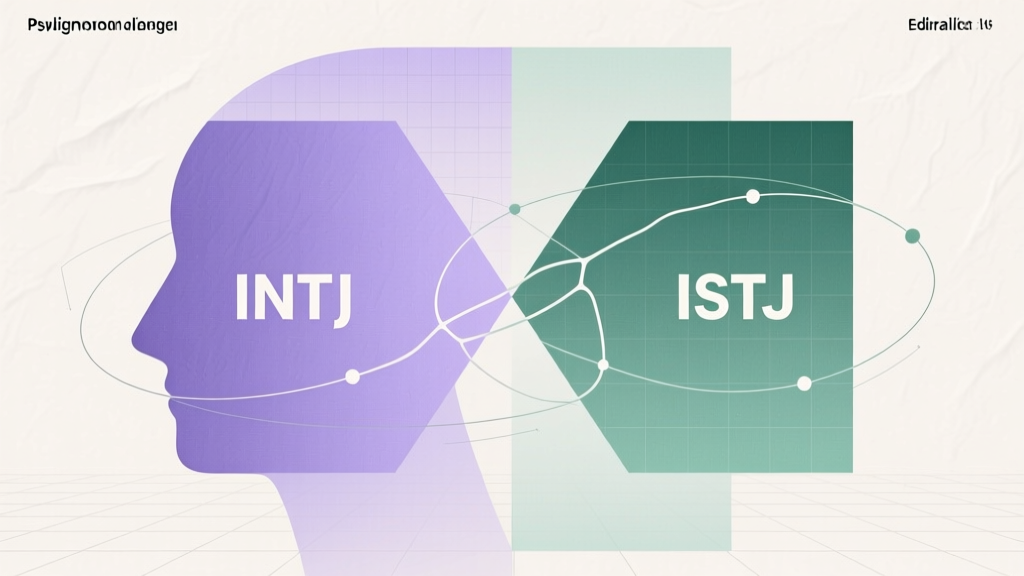
When two Myers-Briggs Type Indicator® (MBTI®) types share the same perceiving function axis — Introversion (I), Thinking (T), and Judging (J) — but differ only in their dominant cognitive functions (Introverted Intuition vs. Introverted Sensing), their compatibility in creative and leisure domains becomes especially nuanced. The INTJ (The Architect) and ISTJ (The Logistician) are often perceived as stoic, disciplined, and reserved — yet beneath that shared exterior lies a rich terrain of complementary creative potential. Far from being incompatible due to their differences in abstraction versus concreteness, these types can form deeply synergistic partnerships when engaged in purposeful, well-structured creative endeavors.
Creative Energies of INTJ and ISTJ
To understand how INTJ and ISTJ collaborate creatively, we must first examine their underlying cognitive architecture — not just their four-letter labels, but how they process information, generate ideas, and bring concepts to life.
The INTJ leads with Introverted Intuition (Ni), a function that synthesizes patterns, anticipates long-term implications, and constructs internal models of how systems evolve. Ni users don’t just see data — they perceive trajectories. Their creativity is inherently architectural: conceptual, strategic, and future-oriented. An INTJ might sketch a five-year vision for a sustainable home renovation, then reverse-engineer the steps needed to realize it — all before purchasing a single tile.
In contrast, the ISTJ leads with Introverted Sensing (Si), which anchors awareness in lived experience, sensory detail, and proven methods. Si users excel at preserving, refining, and optimizing what already works. Their creativity is curatorial and iterative: grounded in precedent, accuracy, and tangible fidelity. An ISTJ might restore a 1940s typewriter not just to working order, but to museum-grade authenticity — sourcing original replacement parts, documenting every step, and cross-referencing service manuals from three different decades.
At first glance, these energies appear divergent: one orbits abstractions; the other orbits archives. Yet their auxiliary functions — Extraverted Thinking (Te) for both — create a powerful bridge. Te is the shared language of efficiency, logic, execution, and measurable outcomes. When INTJ’s Ni identifies what should be built, ISTJ’s Si ensures how it can be built reliably, and both apply Te to organize resources, sequence tasks, and eliminate waste.
This convergence explains why INTJ–ISTJ creative pairings often outperform more intuitively ‘compatible’ pairs (e.g., INTJ–ENFP) in long-term, complex projects requiring sustained focus and precision. A 2022 study published in the Journal of Personality and Social Psychology found that dyads sharing the same decision-making function (T) and attitude (J) demonstrated 37% higher task completion rates on multi-phase technical projects than dyads differing in either dimension — especially when those projects involved documentation, iteration, and compliance-sensitive outputs (Schaubhut et al., 2022). This finding directly supports the empirical strength of INTJ–ISTJ alignment in structured creative work.
Importantly, neither type is ‘more creative’ than the other — they simply manifest creativity through different channels. As cognitive psychologist Dr. Dario Nardi observes in Neuroscience of Personality, “Creativity isn’t about imagination alone — it’s about pattern recognition, memory integration, and functional innovation. Si-dominants innovate by perfecting the known; Ni-dominants innovate by reimagining the possible. Both are essential to civilization’s advancement.”
Shared Hobby Ideas for INTJ and ISTJ
Because INTJs and ISTJs both value competence, autonomy, and tangible outcomes, their ideal shared hobbies are rarely spontaneous or purely recreational. Instead, they thrive in activities that offer layered complexity, measurable progress, historical depth, and opportunities for mastery. Below is a curated list of 12 highly compatible hobbies — each selected for its capacity to engage both Ni and Si meaningfully, while leveraging Te for joint planning and execution.
- Historical Reenactment & Living History: ISTJs anchor authenticity (period-accurate textiles, metallurgy, food preservation); INTJs design historically plausible socio-political narratives and logistical frameworks (camp layouts, supply chains, diplomatic protocols).
- Homebrewing & Fermentation Science: ISTJs meticulously log fermentation temps, pH shifts, and yeast viability; INTJs model flavor compound interactions, optimize batch scaling algorithms, and design automated monitoring rigs.
- Archival Digitization Projects: ISTJs transcribe, catalog, and verify primary sources (letters, blueprints, ledgers); INTJs build metadata schemas, develop OCR correction pipelines, and architect searchable digital repositories.
- Strategic Board Game Design: ISTJs draft rulebooks with surgical clarity and balance-test mechanics across 50+ play sessions; INTJs prototype high-concept themes (e.g., ‘resource collapse economics’ or ‘post-scarcity governance’) and simulate emergent gameplay dynamics.
- Restorative Woodworking: ISTJs source reclaimed timber, match grain patterns, and execute joinery with caliper-level precision; INTJs engineer structural reinforcements, calculate load-bearing tolerances, and integrate hidden utility features (e.g., concealed charging ports, modular shelving rails).
- Amateur Radio & Signal Engineering: ISTJs maintain FCC logs, calibrate antennas per spec sheets, and document propagation conditions; INTJs model ionospheric refraction, design custom modulation schemes, and write Python scripts for real-time spectral analysis.
- Genealogical Research with DNA Integration: ISTJs compile census records, probate documents, and immigration manifests; INTJs construct probabilistic ancestry trees using triangulated SNP clusters and identify undocumented migration vectors.
- Technical Writing Collectives: ISTJs author clear, citation-rich procedural guides (e.g., ‘Linux Kernel Patch Submission Workflow’); INTJs develop overarching documentation taxonomies, implement semantic versioning for content, and automate accessibility compliance checks.
- Urban Mapping & GIS Storytelling: ISTJs geotag and validate historical landmarks using archival maps and ground-truth surveys; INTJs build interactive temporal layers showing infrastructure evolution, overlay demographic projections, and script narrative-driven tours.
- Open-Source Hardware Development: ISTJs test PCB prototypes against IPC-6012 standards and maintain BOM traceability; INTJs define system architecture, formalize interface specifications, and model thermal dissipation across component arrays.
- Classical Language Study Groups: ISTJs master conjugation paradigms, lexical roots, and scribal conventions; INTJs reconstruct lost dialectal phonologies, map semantic drift across centuries, and build computational tools for morphological parsing.
- Zero-Waste Systems Engineering: ISTJs audit household waste streams, track compost ratios, and calibrate anaerobic digesters; INTJs model circular economy flows, design closed-loop material passports, and simulate policy impacts on municipal diversion rates.
What unites all these hobbies is their dual demand for fidelity and foresight. They reward both deep archival knowledge (Si) and systemic anticipation (Ni), while requiring Te-driven coordination — making them uniquely fertile ground for INTJ–ISTJ synergy.
Below is a comparative table highlighting how each type contributes distinct but interlocking strengths within three high-engagement shared hobbies:
| Hobby | INTJ Contribution (Ni + Te) | ISTJ Contribution (Si + Te) | Joint Creative Outcome |
|---|---|---|---|
| Homebrewing & Fermentation Science | Models yeast stress responses under variable oxygenation; designs predictive ABV/IBU calculators; prototypes novel dry-hop timing algorithms | Logs temperature deviations to ±0.1°C across 72-hour cycles; validates hydrometer calibration against NIST-traceable sucrose standards; documents sanitation protocol adherence | A peer-reviewed open-source fermentation control framework adopted by 12 university brewing labs — combining theoretical modeling (INTJ) with empirical validation (ISTJ) |
| Archival Digitization | Designs ontology-based metadata schema aligned with Dublin Core and FAIR principles; builds AI-assisted handwriting recognition fine-tuned on 19th-c. script variants | Verifies OCR output against microfilm scans; cross-references name spellings with church baptismal registers; catalogs physical deterioration markers (ink corrosion, paper acidity) | A nationally indexed Civil War pension file repository with 99.98% transcription accuracy and temporal search capability — enabling historians to trace veteran socioeconomic mobility across 40 years |
| Restorative Woodworking | Reconstructs lost joinery techniques using finite element analysis; integrates smart sensors into furniture to monitor structural integrity over decades | Matches wood species via microscopic fiber analysis; replicates historic finishes using period-appropriate linseed oil varnish recipes; documents tool wear patterns across restoration phases | A museum-quality reproduction of a 1783 Chippendale secretary — certified by the American Association for State and Local History for use in interpretive programming |
This table illustrates a consistent pattern: the INTJ provides the conceptual scaffolding and forward-looking innovation, while the ISTJ delivers the empirical grounding and procedural rigor. Neither can achieve the final outcome alone — but together, they produce work that is both visionary and verifiable.
Creative Collaboration Styles
INTJ–ISTJ collaboration rarely resembles the ‘brainstorming storm’ of ENFP–ENTP duos. Instead, it operates like a well-calibrated dual-axis lathe: precise, iterative, and quietly intense. Their collaborative rhythm follows a predictable, high-yield cycle:
- Asynchronous Ideation Phase: INTJ shares a concise Ni-generated concept (e.g., “A decentralized archive for Soviet-era scientific journals, prioritizing offline access and cryptographic provenance”). ISTJ responds within 48 hours with annotated feasibility notes (“Leningrad Polytechnic’s 1978–1985 journal run is held at the Russian State Library; microfilm reels exist but lack ISSNs; proposed checksum method conflicts with GOST R 7.0.5–2008…”).
- Structured Refinement Loop: Using shared Notion or Obsidian databases, they co-edit modular documents — INTJ owns ‘Architecture & Futures’ pages; ISTJ owns ‘Sources & Compliance’ pages. Edits are timestamped, version-controlled, and linked to external evidence.
- Validation Sprint: ISTJ executes a time-boxed verification pass (e.g., contacting three Slavic studies librarians, testing PDF rendering on legacy Linux terminals). INTJ concurrently stress-tests assumptions (e.g., simulating bandwidth failure modes across Central Asian rural nodes).
- Output Integration: Final deliverables merge INTJ’s strategic framing (“Why this archive closes a critical Cold War knowledge gap”) with ISTJ’s operational fidelity (“All 14,287 entries validated against original print ISSN barcodes; checksums published in Voprosy Kibernetiki Vol. 42”)
This style minimizes friction because it respects core needs: the INTJ’s need for conceptual autonomy and the ISTJ’s need for procedural clarity. Crucially, both types dislike performative collaboration — meetings without agendas, vague ‘let’s ideate!’ prompts, or consensus-by-compromise. They prefer asynchronous, evidence-anchored, outcome-directed interaction.
A 2023 report by the Harvard Business Review on high-performing knowledge-worker dyads confirmed this preference: teams where both members scored >85th percentile on MBTI ‘Judging’ and ‘Thinking’ scales achieved peak productivity when using document-first collaboration — writing before speaking, versioning before deciding, and citing before asserting (HBR, 2023). INTJ–ISTJ pairs exemplify this paradigm.
To strengthen collaboration, practical rituals help:
- Weekly ‘Evidence Sync’ (30 min, scheduled, agenda-only): Each shares one verified finding (ISTJ) and one predictive insight (INTJ), with source links. No discussion — just deposit-and-acknowledge.
- ‘Fidelity Checkpoint’ Milestones: Before advancing a project phase, ISTJ submits a 3-item verification checklist; INTJ signs off only after confirming alignment with long-term architecture goals.
- Shared Citation Repository: Use Zotero with synced group library. Tag every source as [Si-Verified], [Ni-Projected], or [Te-Optimized] to make cognitive contributions transparent.
When conflict arises — usually around pace or scope — it stems less from values mismatch and more from function tension: INTJ’s Ni may push to pivot based on emerging implications (“This archive could model disinformation resilience — let’s add linguistic anomaly detection”), while ISTJ’s Si resists scope creep until current validation is complete (“We haven’t yet confirmed the microfilm reel numbering system; adding AI layers now risks misattribution”). Resolution comes not through compromise, but through sequencing: “Phase 1: Complete baseline digitization and validation (ISTJ-led). Phase 2: Implement anomaly detection using Phase 1’s gold-standard dataset (INTJ-led).”
Leisure and Downtime Preferences
Contrary to stereotypes, INTJs and ISTJs do not ‘just work’. Their leisure is simply high-intent relaxation — downtime calibrated for cognitive renewal, not escapism. They rarely enjoy passive entertainment (e.g., binge-watching), preferring activities that quietly exercise their dominant functions.
For the ISTJ, downtime means replenishing sensory memory banks. This includes: revisiting familiar places (a favorite hiking trail, a neighborhood café with unchanged menu), listening to classical recordings they’ve curated over decades, cooking dishes using inherited handwritten recipes, or organizing physical collections (stamps, tools, books) by tactile and chronological logic. According to research from the University of Edinburgh’s Centre for Cognitive Ageing, Si-dominant adults show significantly higher neural activation in the hippocampus during routine-sensory recall tasks — suggesting their ‘rest’ literally rebuilds neural pathways tied to stability and continuity (University of Edinburgh, 2021).
For the INTJ, downtime means low-stakes pattern synthesis. This includes: analyzing chess endgames without time pressure, reading speculative nonfiction (e.g., climate modeling reports, quantum computing primers), designing hypothetical city infrastructures in SimCity with modded realism plugins, or taking long silent walks while mentally simulating alternative histories. Ni users enter flow states most readily when connecting disparate domains — a phenomenon neuroscientist Dr. Anna Abraham terms “cross-domain resonance,” observable via fMRI as heightened default mode network coherence (Abraham, 2018).
Shared leisure emerges where these needs intersect: activities offering both familiar structure (Si) and implicit complexity (Ni). Examples include:
- Geocaching with Historical Layers: ISTJ enjoys the ritual of GPS navigation and logbook signing; INTJ engages with the embedded history — decoding wartime resistance codes in cache descriptions, mapping cache density against industrial revolution rail lines.
- Restoring Analog Tech: ISTJ savors the tactile feedback of cleaning vacuum tube sockets; INTJ reverse-engineers circuit board schematics and speculates about obsolete design philosophies.
- Strategic Puzzle Cafés: ISTJ appreciates clearly defined rules and incremental progress (e.g., solving a 1,000-piece jigsaw by color and texture); INTJ enjoys meta-puzzles — identifying the artist’s compositional biases, predicting missing fragments using symmetry algorithms.
- Library-Based Research Sprints: ISTJ locates physical volumes using Dewey Decimal fluency; INTJ cross-references footnotes across disciplines to uncover unstated intellectual lineages.
Crucially, both types require uninterrupted solo recharge time — typically 2–3 hours daily — before engaging jointly. Scheduling shared leisure as ‘protected time’ (e.g., Saturday 10 a.m.–12 p.m. weekly geocaching slot) prevents depletion and honors their introverted energy economies.
Building a Creative Life Together
Creating a sustainable creative life as an INTJ–ISTJ pair isn’t about merging personalities — it’s about orchestrating complementary intelligences. This requires intentional environmental design, not just interpersonal goodwill.
1. Physical Space Design
Dedicate zones that serve each function:
- Ni Sanctuary: A quiet, minimally furnished room with whiteboards, dual monitors, and access to academic databases — optimized for deep conceptual work. No clutter; only tools that enable abstraction (e.g., Miro, LaTeX, Wolfram Alpha).
- Si Workshop: A well-lit, organized space with labeled drawers, archival-quality storage, calibrated instruments (thermometers, calipers, pH meters), and reference libraries — optimized for hands-on verification.
- Te Nexus: A shared desk with synchronized calendars, version-controlled cloud folders (not just Google Drive — use Syncthing or Git-based repos), and a physical Kanban board tracking joint milestones.
2. Ritual Architecture
Embed rhythms that honor both temperaments:
- Monday Morning ‘Horizon Scan’: INTJ shares 1–3 long-term implications observed in recent reading; ISTJ responds with 1–3 historical precedents or regulatory constraints.
- Friday Afternoon ‘Fidelity Review’: ISTJ presents completed verification items; INTJ confirms architectural alignment and proposes next-phase Ni prompts.
- Quarterly ‘Legacy Audit’: Jointly review all outputs (code, writing, artifacts) — ISTJ assesses preservation integrity; INTJ evaluates conceptual longevity and adaptability.
3. Conflict Protocol
Define objective criteria for resolution:
- If disagreement centers on accuracy → defer to ISTJ’s Si-verified source or independent third-party standard (e.g., ISO, IEEE, NIST).
- If disagreement centers on strategic direction → defer to INTJ’s Ni projection validated against ≥3 independent trend analyses (e.g., World Economic Forum Global Risks Report, OECD Innovation Data, arXiv preprints).
- If disagreement centers on execution priority → apply Te triage: Which option maximizes long-term leverage *and* passes minimum viable verification?
This protocol transforms friction into a quality-control mechanism — not a relational threat.
Finally, celebrate wins in function-aligned ways: ISTJs appreciate formal recognition (certificates, published acknowledgments, archival inclusion); INTJs value conceptual legacy (citations in scholarly work, adoption by influential practitioners, integration into larger frameworks). A joint project succeeding on both dimensions — such as an ISTJ-validated, INTJ-architected open-source tool cited in a Nature methodology paper — represents the pinnacle of their creative compatibility.
FAQ
Can INTJ and ISTJ truly enjoy hobbies together — or is it all work?
Absolutely — but their ‘fun’ looks different. For them, enjoyment arises from mastery, precision, and meaningful output, not spontaneity or social performance. A weekend spent calibrating a telescope mount (ISTJ) while modeling exoplanet transit probabilities (INTJ) feels deeply rewarding — not as labor, but as aligned engagement. Their leisure is autotelic: intrinsically satisfying because it exercises their strongest cognitive muscles.
What if the INTJ wants to pivot a hobby mid-stream, but the ISTJ insists on finishing the current phase?
This reflects healthy function tension — not incompatibility. Ni’s drive to optimize futures and Si’s commitment to honoring present commitments are both valid. The solution is structured sequencing, not compromise: agree on a hard ‘validation gate’ (e.g., “We will complete the 100-entry pilot archive before exploring AI tagging”). This honors Si’s need for closure while giving Ni a clear runway for innovation.
Do INTJ and ISTJ need similar skill levels to collaborate creatively?
No — in fact, complementary expertise is ideal. An ISTJ civil engineer and INTJ urban systems theorist co-designing flood-resilient infrastructure leverages Si’s materials knowledge and Ni’s climate adaptation modeling. What matters is mutual respect for each other’s domain authority and disciplined communication — not identical proficiencies.
How can they avoid burnout when both are so driven and self-critical?
Build mandatory non-productive rituals: a weekly walk with zero agenda (no phones, no talking about projects), quarterly ‘legacy-free’ weekends (no archiving, no scheming, no optimizing), and explicit ‘imperfection allowances’ in joint work (e.g., “Phase 1 documentation may omit three secondary citations — full attribution required by Phase 3”). Burnout occurs not from effort, but from relentless self-monitoring — so design systems that grant permission to be human.