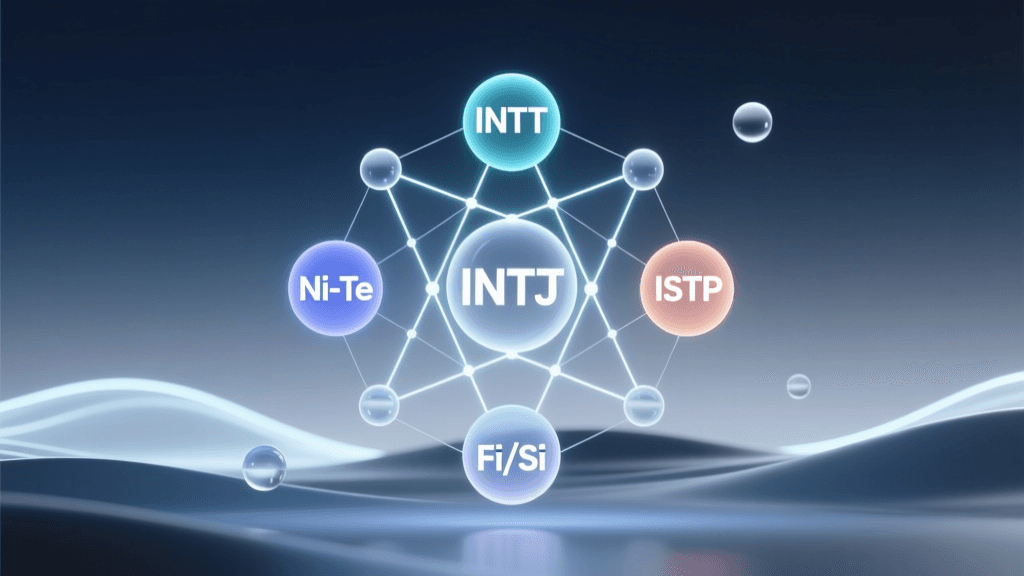
INTJ Cognitive Stack Overview
The INTJ personality type operates from a highly structured, future-oriented cognitive architecture rooted in Introverted Intuition (Ni) as its dominant function. Ni is the engine of pattern recognition, strategic foresight, and conceptual synthesis—it perceives reality not as isolated facts but as converging threads of meaning pointing toward inevitable outcomes. As Carl G. Jung originally described intuition, it is 'a perception via the unconscious' that grasps possibilities and underlying principles without linear reasoning (Jungian Analysts Association). For the INTJ, Ni manifests as an internal 'vision board'—a constantly refining mental model of how systems evolve, what’s truly important, and where things are headed.
Supporting Ni is Extraverted Thinking (Te), the INTJ’s auxiliary function. Te serves as the executive arm: organizing external reality, optimizing processes, applying logic to achieve goals, and enforcing standards of efficiency and objectivity. It grounds Ni’s abstract insights in actionable plans, data-driven decisions, and measurable outcomes. When healthy, Te allows INTJs to build scalable systems, delegate with precision, and communicate conclusions with clarity—even if their delivery lacks emotional softness.
The tertiary function is Introverted Feeling (Fi). Often underdeveloped in younger or less self-aware INTJs, Fi represents internal values, authenticity, moral consistency, and deeply held personal convictions. While not outwardly expressive, Fi shapes what the INTJ *refuses* to compromise on—integrity over convenience, truth over harmony, long-term alignment over short-term approval. Its emergence in midlife or under stress adds depth and ethical grounding to otherwise pragmatic decision-making.
Finally, the inferior function is Extraverted Sensing (Se). This is the INTJ’s Achilles’ heel—and also their growth frontier. Se governs presence, sensory immediacy, physical awareness, aesthetic responsiveness, and spontaneous action. Under stress, INTJs may overindulge in Se—binge-watching, impulsive spending, hyper-fixation on bodily sensations, or reckless risk-taking. But when integrated healthily, Se brings vitality, embodied confidence, adaptability in real-time, and appreciation for beauty, craft, and tactile mastery.
ISTP Cognitive Stack Overview
The ISTP type is anchored by Introverted Thinking (Ti) as its dominant function—a precise, internal framework-building process focused on logical consistency, structural integrity, and causal accuracy. Ti doesn’t seek external validation; instead, it deconstructs ideas, tests hypotheses against first principles, and refines mental models until they ‘click’ into coherence. As psychologist Dario Nardi explains in Neuroscience of Personality, Ti-dominant individuals show distinct EEG patterns during problem-solving, marked by intense localized activity in the prefrontal cortex associated with analytical calibration and error correction.
ISTPs pair Ti with Extraverted Sensing (Se) as their auxiliary function—their most socially visible trait. Se grants ISTPs extraordinary environmental awareness: rapid response to changing conditions, keen observation of physical detail, comfort with tools and mechanics, and effortless embodiment in the present moment. Whether disassembling an engine, navigating dense traffic, or improvising in a crisis, Se gives ISTPs fluid, grounded competence. It’s why many ISTPs excel in fields like emergency medicine, aviation, tactical operations, and skilled trades.
Their tertiary function is Introverted Intuition (Ni). Unlike the INTJ’s dominant Ni, the ISTP’s Ni is subtle, intermittent, and often emerges retrospectively—‘aha’ moments after prolonged Ti-Se analysis. It surfaces as gut-level hunches about long-term consequences, sudden insights into hidden motives, or quiet certainty about a path forward without being able to fully articulate the reasoning. When matured, Ni helps ISTPs anticipate systemic implications and avoid short-sighted solutions—but it rarely drives their daily behavior.
The inferior function for ISTPs is Extraverted Feeling (Fe). This is the source of both vulnerability and potential growth. Fe involves attuning to group emotions, social harmony, relational reciprocity, and expressive empathy. Under stress, ISTPs may suppress Fe entirely—appearing detached, blunt, or dismissive—or swing into unhealthy Fe expression: people-pleasing, guilt-driven overcompensation, or emotional volatility. With development, however, Fe allows ISTPs to recognize unspoken needs, offer timely support, and deepen intimacy through emotional responsiveness—not performance.
Where Functions Align
At first glance, INTJs and ISTPs seem like opposites: one future-strategist, one present-tactician. Yet their cognitive stacks contain profound points of resonance—particularly between dominant and auxiliary functions across types. These alignments form the bedrock of mutual respect and functional synergy.
Ni (INTJ dom) ↔ Se (ISTP aux): This is perhaps the most dynamic and underappreciated alignment. Ni seeks convergence—patterns across time, invisible connections, ultimate outcomes. Se seeks fidelity—accurate perception of what *is*, right now, in full sensory detail. Together, they form a powerful feedback loop: Se provides raw, high-fidelity data from reality; Ni interprets it within long-term frameworks. An ISTP noticing a subtle vibration in machinery (Se) can alert an INTJ, who synthesizes that cue with historical failure logs and design schematics (Ni) to predict imminent system collapse. In collaborative projects—say, launching a hardware startup—the ISTP prototypes rapidly and iterates based on real-world feedback (Se), while the INTJ maps the product roadmap, regulatory trajectory, and scalability bottlenecks (Ni). Neither could do it alone as effectively.
Te (INTJ aux) ↔ Ti (ISTP dom): Though Te and Ti differ in orientation (external efficiency vs. internal consistency), they share a core commitment to logical rigor. Both reject dogma, demand evidence, and prize intellectual honesty. A Te-ISTP conversation might revolve around metrics and deadlines; a Ti-INTJ exchange digs into assumptions and axioms—but both end at the same destination: a conclusion that withstands scrutiny. In workplace settings, this alignment enables high-trust collaboration on technical problems. The INTJ drafts the architecture; the ISTP stress-tests each component. The ISTP identifies a flaw in the circuit design; the INTJ restructures the entire power distribution model to accommodate it. Their shared intolerance for sloppy thinking creates a rare zone of uncompromising quality control.
Fi (INTJ ter) ↔ Fe (ISTP inf): While seemingly opposite (introverted vs. extraverted feeling), these functions can form a complementary bridge—if both parties engage consciously. The INTJ’s Fi anchors them in non-negotiable values (e.g., intellectual autonomy, truthfulness, fairness); the ISTP’s developing Fe helps them recognize how those values impact others’ sense of safety or inclusion. Conversely, the ISTP’s emerging Fe sensitivity can help the INTJ notice when their Te-driven directives unintentionally undermine team morale—while the INTJ’s Fi clarity helps the ISTP discern which social expectations merit attention versus which are performative noise. This isn’t automatic harmony—it requires intention—but it’s where deep mutual growth occurs.
Where Functions Clash
Clashes between INTJs and ISTPs rarely stem from malice or incompatibility, but from fundamental differences in cognitive pacing, information processing priorities, and stress responses. Understanding *where* and *why* friction arises allows both types to preempt breakdowns.
Ni vs. Se Temporal Orientation: The INTJ lives in the future conditional (“If X continues, Y will follow by Q3”). The ISTP lives in the present imperative (“This bolt is stripped—let’s fix it *now*”). This mismatch can derail planning conversations. An INTJ outlining a five-year R&D strategy may be met with silence or a practical question like, “What’s the immediate bottleneck?” To the INTJ, this feels like dismissal of vision; to the ISTP, it feels like the INTJ is ignoring the fire in front of them to debate smoke patterns on the horizon. Without translation, both walk away frustrated—one perceiving the other as shortsighted, the other as unrealistically abstract.
Te Efficiency vs. Ti Precision: INTJs use Te to drive toward optimal outcomes—often trimming complexity for speed. ISTPs use Ti to ensure internal logical coherence—even if it slows implementation. An INTJ may say, “Let’s adopt Framework A because benchmarks show 22% faster deployment.” An ISTP may counter, “But Framework A violates Principle Z, and we’d need three workarounds that introduce latent instability.” Neither is wrong—but their definitions of ‘optimal’ diverge. Te prioritizes *effective* solutions; Ti prioritizes *correct* ones. Left unmediated, this leads to stalled decisions, passive resistance, or covert rework.
Inferior Se (INTJ) vs. Inferior Fe (ISTP) Under Stress: When overwhelmed, both types regress into their inferior functions—but in ways that escalate conflict. An INTJ under stress may become hyper-reactive to sensory stimuli—snapping at background noise, obsessing over minor physical discomforts, or impulsively abandoning long-term plans for immediate relief (e.g., quitting a job mid-crisis). Simultaneously, an ISTP under stress may over-activate Fe—seeking reassurance, interpreting neutral statements as rejection, or suppressing their own needs to ‘keep the peace.’ The result? The INTJ perceives the ISTP as emotionally volatile and illogical; the ISTP sees the INTJ as cold and abandoning. Neither recognizes the other’s behavior as a stress signal—they misattribute it to character flaws.
The Hidden Resonances (Tertiary/Inferior Function Connections)
Beyond dominant-auxiliary dynamics, the tertiary and inferior functions hold subtle but transformative bridges—especially when both individuals are psychologically mature. These resonances don’t drive daily interaction, but they anchor long-term loyalty, mutual admiration, and unexpected emotional safety.
INTJ’s Tertiary Fi ↔ ISTP’s Dominant Ti: Though Fi is introverted feeling and Ti is introverted thinking, both are internally referenced, authenticity-oriented functions. Fi asks, “Is this true to *who I am*?” Ti asks, “Is this true to *how reality works*?” When aligned, they create profound mutual respect. An ISTP won’t flatter an INTJ’s title or authority—but will deeply respect their intellectual integrity. Likewise, an INTJ may dismiss small talk but will honor an ISTP’s refusal to compromise on craftsmanship or honesty. This shared commitment to inner fidelity—over external validation—is where quiet trust forms. It’s why INTJs and ISTPs often become lifelong confidants, not because they share hobbies or social circles, but because they recognize each other’s unspoken standards.
ISTP’s Tertiary Ni ↔ INTJ’s Dominant Ni: While ISTP Ni is undeveloped relative to INTJ Ni, its emergence signals deepening maturity—and creates moments of uncanny synchronicity. An ISTP may suddenly articulate a concern the INTJ has been circling for weeks but couldn’t yet verbalize. Or, during a heated debate, the ISTP pauses and says, “Wait—if we go this route, in 18 months, Client X will pivot, and our integration becomes obsolete.” That flash of Ni resonance reassures the INTJ that their long-view isn’t lonely. For the ISTP, having their Ni hunches validated by an Ni-dominant partner reinforces its legitimacy—and encourages further development.
INTJ’s Inferior Se ↔ ISTP’s Auxiliary Se: This is perhaps the most potent growth catalyst—if approached with humility. The ISTP’s natural Se fluency can gently mentor the INTJ toward embodied presence: teaching them to notice posture tension before a presentation, to calibrate tone in video calls, to use whiteboarding physically rather than only mentally. In return, the INTJ’s Ni can help the ISTP contextualize Se observations—not just *what’s happening now*, but *why it matters downstream*. A joint home renovation project exemplifies this: the ISTP selects materials based on texture, durability, and instant visual impact (Se); the INTJ researches neighborhood zoning trends, resale analytics, and climate resilience projections (Ni). Together, they build something beautiful *and* future-proof.
Leveraging Cognitive Diversity
Compatibility isn’t about similarity—it’s about intelligently leveraging difference. Here’s how INTJs and ISTPs can transform cognitive divergence into collaborative advantage:
1. Establish a ‘Translation Protocol’ for Planning Conversations
Create a shared language for bridging Ni-Te and Se-Ti modes. Before strategic sessions, agree on two parallel tracks:
- “Now Lens” (ISTP-led): What’s observable *today*? What’s working/not working *physically or operationally*? What’s the smallest viable test?
- “Next Lens” (INTJ-led): What does this imply for Q3? What dependencies emerge at scale? What’s the irreducible principle we must preserve?
Document both lenses side-by-side. Over time, this builds mutual fluency: the ISTP learns to ask, “What’s the Ni implication here?”; the INTJ learns to ask, “What’s the Se constraint I’m overlooking?”
2. Design Conflict De-escalation Triggers
Identify early signs of inferior function activation—and agree on reset rituals:
| Stress Signal | INTJ (Inferior Se) | ISTP (Inferior Fe) | Agreed Reset Action |
|---|---|---|---|
| Verbal Cue | “I need space—this is overwhelming” | “I’m not mad—I just need to process” | 15-minute silent walk (Se grounding for both) |
| Behavioral Cue | Scrolling obsessively, snapping at minor noises | Over-apologizing, seeking repeated reassurance | Switch to hands-on task together (e.g., cooking, assembling furniture) |
| Cognitive Cue | Abandoning long-term plan for impulsive change | Withdrawing completely or performing excessive care | Re-read original shared goal statement aloud |
3. Co-Develop a ‘Function Integration Roadmap’
Every 6 months, review growth in underused functions:
- For the INTJ: Target Se integration. Commit to one sensory-rich practice weekly—e.g., pottery class (tactile focus), trail running (environmental awareness), or blind wine tasting (sensory discrimination). Track improvements in stress resilience and adaptability.
- For the ISTP: Target Fe integration. Practice naming emotions *before* acting (“I feel frustrated because…”), initiate one empathic check-in weekly (“How’s your energy holding up?”), and reflect monthly on group dynamics in shared projects.
Share reflections—not to fix each other, but to witness growth. This normalizes development as mutual, not remedial.
4. Create ‘Cognitive Cross-Training’ Rituals
Dedicate 30 minutes weekly to deliberate function-switching:
- Ti → Ni Drill: ISTP describes a current technical challenge. INTJ responds *only* with future-implication questions (“What happens if this scales 10x?” “How does this align with your 5-year craft vision?”).
- Ni → Se Drill: INTJ shares a strategic insight. ISTP responds *only* with present-moment grounding (“Show me the nearest physical example.” “What’s the first tangible step?”).
This builds neural flexibility—and makes cognitive differences feel like tools, not barriers.
FAQ
Can INTJs and ISTPs have successful romantic relationships?
Yes—with conscious effort. Their shared Thinking preference fosters intellectual respect, and complementary Se/Ni creates dynamic balance between realism and vision. Romantic success hinges on mutual commitment to developing Fe (ISTP) and Se (INTJ), and creating rituals that honor both need for autonomy (strong in both types) and desire for deep, values-aligned partnership. Research from the Gottman Institute shows that couples who prioritize shared meaning and intellectual engagement report higher long-term satisfaction—both hallmarks of healthy INTJ-ISTP bonds.
Why do INTJs and ISTPs often clash at work despite both being logical?
Because ‘logical’ isn’t monolithic. INTJs apply logic to optimize *systems and futures* (Te + Ni); ISTPs apply logic to optimize *precision and present functionality* (Ti + Se). Clashes arise when Te-driven deadlines override Ti’s need for verification, or when Ti’s iterative refinement delays Te’s rollout timeline. Resolution requires distinguishing *type of logic* in play—and assigning roles accordingly: ISTPs as quality assurance architects, INTJs as strategic integration leads.
How can an ISTP help an INTJ develop Se?
Not through lectures—but through *embodied invitation*. Instead of saying, “You should be more present,” an ISTP can: (1) Initiate a skill-based activity requiring full sensory engagement (e.g., rock climbing, woodworking, cooking a complex dish); (2) Narrate their own Se experience aloud (“I’m noticing the grain of this wood changes direction here—that’ll affect the cut”); (3) Celebrate INTJ’s Se efforts without judgment (“That presentation had great eye contact—you held the room differently today”). Modeling, not instruction, is key.
What’s the biggest misconception about INTJ-ISTP compatibility?
That their shared Introversion and Thinking make them ‘natural fits.’ In reality, their auxiliary functions (Te vs. Se) orient them toward fundamentally different realities—one structured by external metrics, the other by immediate sensory data. Assuming compatibility without addressing this divergence leads to slow-burn frustration. True compatibility emerges not from similarity, but from *structured mutual translation*—a skill both types can master, given their cognitive strengths.
Ultimately, the INTJ-ISTP pairing is less about finding common ground and more about becoming fluent in each other’s cognitive dialects. When Ni learns to speak Se, and Ti learns to listen to Ni, something rare emerges: a partnership where vision is tempered by reality, and action is guided by foresight. It’s not effortless—but for those willing to map the terrain function by function, it’s among the most resilient, innovative, and quietly profound connections MBTI has to offer.