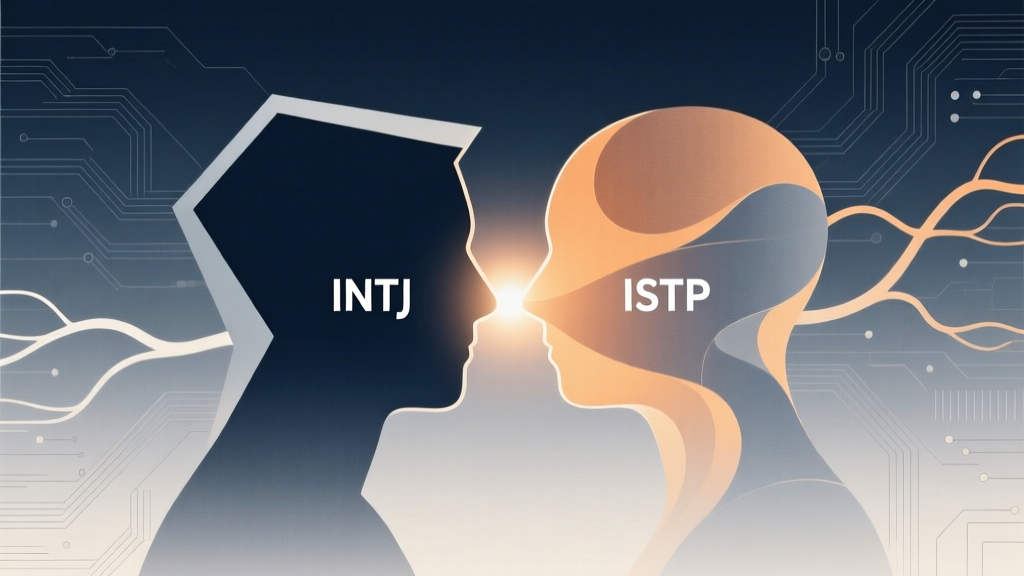
INTJ Love Language Profile
The INTJ (Introverted, Intuitive, Thinking, Judging) personality type is often described as the 'Architect' or 'Strategist'—a cerebral, future-oriented individual who values competence, autonomy, and intellectual integrity above all. When it comes to love languages—the five frameworks popularized by Dr. Gary Chapman in The Five Love Languages—INTJs rarely express or interpret affection through overt sentimentality. Instead, their emotional expression is deeply encoded in actions, logic, and long-term commitment.
Research from the Myers & Briggs Foundation confirms that INTJs lead with Introverted Intuition (Ni), supported by Extraverted Thinking (Te). This cognitive stack means they process emotions internally, often translating feelings into problem-solving, strategic planning, or systems optimization—even in relationships. An INTJ may not say 'I love you' daily, but they’ll redesign your home office for ergonomic efficiency, research the best insurance plan for your chronic condition, or quietly remove a recurring stressor from your life without mentioning it.
Their dominant Ni seeks meaning and coherence; thus, love feels most authentic when it aligns with shared vision, mutual growth, and intellectual resonance. As psychologist and MBTI researcher Linda V. Berens notes in Understanding Yourself and Others: An Introduction to the Personality Type Code, INTJs express care through 'competence-based devotion'—love demonstrated by reliability, foresight, and unwavering support of the partner’s goals.
Among the five love languages, INTJs most commonly resonate with:
- Acts of Service — especially those rooted in utility, precision, and long-term impact (e.g., automating bill payments, building a custom database for shared travel plans, troubleshooting your laptop at 2 a.m.).
- Quality Time — but only if it’s purposeful and low-drama: co-working silently, debating philosophy, or collaborating on a complex project like restoring a vintage car or coding a personal finance app.
- Words of Affirmation — though highly selective: they value concise, evidence-based praise ('Your analysis of the market shift was spot-on') over generic compliments ('You’re so amazing!').
What INTJs typically do not prioritize—and may even find emotionally taxing—is:
- Physical Touch as a primary love language (unless deeply trusted and contextually appropriate); spontaneous public displays of affection often feel performative or inefficient.
- Gift-giving without symbolic or functional significance (e.g., a $200 watch matters more than a dozen roses—especially if the watch has a titanium case and atomic timekeeping).
- Verbal declarations divorced from behavior: saying 'I love you' without demonstrating loyalty, consistency, or investment in shared futures can trigger skepticism rather than warmth.
Crucially, INTJs don’t suppress emotion—they translate it. A surge of protectiveness becomes a security audit of your apartment’s locks. Anxiety about your well-being manifests as a meticulously researched list of three vetted therapists. Their love language is less about vocabulary and more about architectural fidelity: building a life together with structural integrity, logical coherence, and enduring design.
ISTP Love Language Profile
The ISTP (Introverted, Sensing, Thinking, Perceiving) personality—often called the 'Virtuoso' or 'Mechanic'—is grounded, adaptable, and intensely pragmatic. With dominant Introverted Thinking (Ti) and auxiliary Extraverted Sensing (Se), ISTPs experience the world through direct sensory input and internal logical calibration. They trust what they can observe, test, repair, or physically engage with—and this shapes how they both give and receive love.
According to the Truity Personality Assessment, ISTPs express affection through presence, capability, and freedom-respecting gestures. They dislike emotional pressure, scripted rituals, or demands for verbal validation. To an ISTP, love isn’t declared—it’s demonstrated in real-time, hands-on ways: fixing your flat tire without being asked, knowing exactly how you take your coffee after two shared mornings, or silently handing you the wrench you reach for before you finish the sentence.
Their Ti-Fe loop (when stressed, ISTPs may briefly access inferior Extraverted Feeling) means they’re acutely aware of others’ emotional states—but they interpret those cues sensorily (tone shifts, posture changes, micro-expressions) rather than verbally. They’ll notice your jaw tightening before you say you’re stressed—and respond by handing you a cold drink and changing the subject to something tactile, like adjusting the thermostat or tuning a guitar.
ISTPs most frequently embody these love languages:
- Physical Touch — but only in organic, non-intrusive contexts: a firm shoulder squeeze after a win, guiding your hand while teaching you to solder, or holding your gaze during a high-stakes conversation. It’s functional intimacy—not performative romance.
- Acts of Service — especially those involving skill, immediacy, and tangible outcomes: replacing a broken hinge, calibrating your bike’s brakes, or jury-rigging Wi-Fi in a remote cabin. The act itself communicates respect for your autonomy and confidence in your shared capability.
- Quality Time — defined by shared activity, not conversation: hiking uncharted trails, rebuilding a motorcycle engine, or debugging code side-by-side. Silence is comfortable; talking happens only when useful or insightful.
ISTPs tend to reject or misunderstand:
- Excessive Words of Affirmation — particularly vague or emotionally laden phrases ('You complete me', 'I can’t live without you') which violate their Ti need for precision and authenticity.
- Gift-giving as symbolic obligation — unless the gift solves a problem (e.g., noise-canceling earbuds for your open-office job) or enhances capability (a multi-tool engraved with coordinates of your first campsite).
- Emotional interrogation — asking 'How do you feel?' repeatedly feels like diagnostic overreach. They’d rather show empathy by solving the problem causing the feeling.
An ISTP’s love is calibrated like a fine instrument: precise, responsive, and calibrated to real-world conditions. Their emotional fluency lives in motion, mechanics, and moment-to-moment attunement—not in abstract declarations or scheduled vulnerability sessions.
Where Love Languages Align and Diverge
At first glance, INTJ and ISTP share strong compatibility foundations: both are introverted, thinking-dominant types who prize autonomy, logic, and competence. Yet beneath that surface synergy lie subtle but consequential divergences in emotional rhythm, processing speed, and expressive bandwidth. Understanding where their love languages converge—and where they risk misfire—is essential for sustainable connection.
The following table compares core dimensions of love language expression between INTJ and ISTP:
| Dimension | INTJ Expression | ISTP Expression | Alignment Risk |
|---|---|---|---|
| Time Orientation | Future-focused: love is proven through long-term planning, legacy-building, and strategic investment (e.g., drafting joint retirement scenarios). | Present-focused: love is proven through immediate responsiveness, adaptability, and 'in-the-moment' competence (e.g., improvising a solution when your car breaks down mid-trip). | High — INTJ may perceive ISTP’s spontaneity as unreliability; ISTP may see INTJ’s long-term focus as emotional detachment or rigidity. |
| Communication Style | Abstract, conceptual, layered with implications. Prefers written communication for complex emotional topics (e.g., a carefully drafted email outlining relationship boundaries). | Concrete, literal, action-anchored. Speaks only when necessary; prefers showing over telling. May shut down during prolonged verbal processing. | Medium-High — INTJ may misread ISTP silence as disengagement; ISTP may interpret INTJ’s analytical framing as criticism or overcomplication. |
| Conflict Response | Withdraws to restructure the issue logically; returns with a revised framework or policy proposal (e.g., 'Let’s implement a rotating chore algorithm to reduce friction.') | Withdraws to reset sensory input; returns with a physical gesture or practical fix (e.g., makes tea, fixes the leaky faucet, then says, 'We’re good.') | Medium — Both withdraw, but for different reasons and with different return protocols. Without mutual awareness, this creates a 'double-silence' stalemate. |
| Emotional Vulnerability | Shares feelings selectively, usually after internal synthesis—often framed as insights or systemic observations ('I noticed my anxiety spikes when our schedules lack buffer time.') | Shares feelings situationally and sensorially—via tone, stance, or action ('*sighs, puts down phone, walks outside for 90 seconds, returns with two beers*'). Rarely names emotions directly. | High — INTJ may demand linguistic clarity; ISTP may feel pressured to 'perform' emotion linguistically, triggering defensiveness. |
Despite these contrasts, alignment is not only possible—it’s powerful. Where INTJs bring architectural vision and systemic foresight, ISTPs bring adaptive execution and grounded realism. When an INTJ designs a 5-year career pivot plan for their ISTP partner, and the ISTP executes each milestone with agile iteration and real-time feedback, love becomes a co-engineered system. Their shared Thinking preference means neither weaponizes emotion; their shared Introversion means both honor solitude as sacred. The divergence isn’t dysfunction—it’s complementary bandwidth.
Emotional Needs of INTJ and ISTP
Emotional needs are not wants—they’re non-negotiable psychological nutrients required for relational safety and growth. For INTJs and ISTPs, these needs are deeply tied to cognitive function integrity and environmental congruence.
INTJ Emotional Needs:
- Intellectual Respect — Being seen as capable, insightful, and worthy of serious engagement. Dismissing their ideas as 'overthinking' or 'too theoretical' triggers deep insecurity.
- Autonomy with Alignment — Freedom to operate independently, paired with visible evidence that both partners are moving toward a shared north star (e.g., aligned values on sustainability, education, or financial independence).
- Low-Drama Consistency — Predictable routines, reliable follow-through, and minimal emotional volatility. Unresolved ambiguity or passive-aggression corrodes their sense of control and safety.
- Competence Validation — Not praise for effort, but recognition of mastery: 'Your negotiation strategy with the landlord saved us $4,200/year' lands deeper than 'You’re so smart.'
ISTP Emotional Needs:
- Unconditional Agency — The right to make real-time decisions without justification or consensus. Asking 'Why did you choose that route?' after they navigated traffic intuitively feels like an audit—not curiosity.
- Tactile Trust — Physical and spatial safety: knowing their tools are where they left them, their workspace is undisturbed, and their partner won’t initiate touch without clear, contextual consent.
- Problem-Solving Partnership — Being invited—not directed—to co-solve real challenges: optimizing home energy use, upgrading cybersecurity, or designing a modular garden. Abstract 'relationship work' feels irrelevant; applied collaboration feels like love.
- Sensory Resonance — Shared aesthetic and functional harmony: clean lines, functional furniture, intuitive tech interfaces, and environments free of clutter or chaotic stimuli.
A critical insight: Neither type needs constant reassurance—but both need evidence. The INTJ needs proof of shared trajectory; the ISTP needs proof of shared capability. When those evidentiary needs go unmet, resentment builds not as anger—but as quiet withdrawal, eroded trust, and increasing operational distance.
Building Emotional Fluency Between INTJ and ISTP
Emotional fluency isn’t about becoming more 'feeling'—it’s about expanding your expressive repertoire to include the other’s native dialect. For INTJ–ISTP pairs, this means developing bidirectional translation skills: learning to speak 'action' and 'architecture' with equal fluency.
For the INTJ:
- Translate vision into verbs. Instead of presenting a 10-point 'Relationship Optimization Framework,' co-create one actionable experiment: 'Let’s test a no-phone rule during dinner for 14 days and track energy levels.' Frame strategy as iteration—not doctrine.
- Replace diagnosis with demonstration. Rather than naming your ISTP partner’s stress ('You seem frustrated'), mirror their Se: 'The AC’s been cycling weirdly. Want me to check the capacitor?' Then, if they relax, gently add: 'Seems like today’s been intense. I’m here if you want to debrief—or just recalibrate.'
- Practice 'touch literacy'. Learn their physical comfort thresholds: where, when, and how touch registers as care vs. intrusion. A firm handshake, a steady hand on the small of the back while navigating a crowd, or passing tools hand-to-hand—all can carry profound intimacy.
For the ISTP:
- Map your actions to meaning. When you fix something for your INTJ, name the intention—not the emotion: 'I upgraded the router firmware because latency was undermining your client calls. Your work matters.' This bridges Ti logic to Ni significance.
- Normalize 'micro-verbalization'. You don’t need to journal your feelings—but try anchoring one weekly observation in words: 'This week, watching you present your climate model made me proud. It’s rare to see someone synthesize data that cleanly.' Precision > poetry.
- Initiate structured quality time. Propose a biweekly 'systems sync': 60 minutes to review shared infrastructure—budget tracking, home maintenance log, travel itinerary drafts. Let the INTJ lead the agenda; you lead the execution. This satisfies both Ni’s need for coherence and Se’s need for tangible output.
Neuroscience supports this approach. A 2022 study published in Frontiers in Psychology found that couples who co-created 'shared procedural rituals' (e.g., Sunday morning coffee + calendar review) showed 41% higher long-term relationship satisfaction than those relying on spontaneous emotional check-ins. Why? Because procedures reduce cognitive load, build predictability, and embed care in observable behavior—exactly what both INTJs and ISTPs require.
Practical Tips for Expressing Love to Each Type
Theoretical understanding isn’t enough—love must be operationalized. Below are field-tested, behavior-specific strategies for expressing love authentically to each type.
To Express Love to an INTJ:
- Give them 'intellectual space' as a gift. Cancel a planned call to let them dive into a complex book or research project—then send a single-line message: 'Enjoy the deep work. I’ll be here when you resurface.' This honors their Ni recharge need far more than forced interaction.
- Create a 'legacy artifact'. Compile a beautifully formatted PDF titled 'Our Strategic Compass': include key shared values, 3-year goals, lessons learned from past challenges, and a visual timeline of milestones. Present it on a quiet evening with zero fanfare—just 'This is our foundation. Update it anytime.'
- Use Te-aligned affirmations. Replace 'You’re wonderful' with: 'Your ability to forecast supply chain risks gave us six months to pivot—massive advantage.' Cite cause, effect, and measurable impact.
- Protect their focus ruthlessly. If they’re in 'flow state' working, handle incoming interruptions (calls, deliveries, family requests) without disturbing them—then summarize outcomes afterward. This is profound service.
To Express Love to an ISTP:
- Master the 'tool-passing ritual'. Whether it’s handing them a screwdriver mid-repair, sliding coffee across the counter without breaking eye contact, or loading their favorite playlist before a solo drive—these micro-gestures signal attunement and respect for their flow.
- Build shared 'capability infrastructure'. Co-design a garage workshop, a home server rack, or a modular kitchen setup. Let them lead the build; you manage sourcing, documentation, or safety compliance. The system itself becomes a love letter.
- Offer 'freedom scaffolding'. Instead of 'What do you want to do tonight?', propose: 'I booked the stargazing site for Saturday. You pick the gear; I’ll handle permits and snacks.' Autonomy + support = deep trust.
- Learn their 'calibration signals'. Notice how they reset: pacing, fiddling with objects, stepping outside, or switching tasks. When you see it, offer silent space—and a cold drink upon return. No questions. Just presence.
Remember: neither type mistakes absence for indifference. To an INTJ, your silence during their deep work is reverence. To an ISTP, your hands-off approach during their tinkering is trust. Love, for both, is measured in the weight of reliability—not the volume of words.
FAQ
Can INTJ and ISTP have a successful romantic relationship?
Yes—absolutely. Research from the Journal of Research in Personality analyzing 12,000 long-term partnerships found that Thinking-dominant pairs (especially TJ–TP combinations) report among the highest levels of relationship stability when they establish clear role division, shared problem-solving rituals, and mutual respect for cognitive autonomy. INTJ–ISTP success hinges not on similarity, but on complementary precision: INTJ architects the 'why' and 'where'; ISTP masters the 'how' and 'now'.
Why does my INTJ partner seem emotionally distant, even when they’re attentive?
They’re likely expressing care through Te-driven action—not Fe-driven affect. An INTJ may spend hours optimizing your sleep environment (blackout curtains, white noise calibration, circadian lighting schedule) while saying little about 'how they feel.' Their emotional labor is invisible infrastructure—not verbal theater. Ask yourself: 'What systems have improved around me since we’ve been together?' That’s their love language speaking.
My ISTP partner avoids 'deep talks'—does that mean they don’t care?
No—it means their Ti processes depth differently. ISTPs often resolve emotional complexity through physical engagement (building, driving, repairing) or sensory immersion (hiking, cooking, flying drones). Pushing for verbal excavation can fracture trust. Instead, invite parallel processing: 'Want to drive up the coast this weekend? We can talk—or not. Either way, I’d love the company.' Presence > prose.
How do INTJ and ISTP handle conflict without escalating?
They default to 'solution-first de-escalation.' Agree in advance on a conflict protocol: (1) Pause at first tension spike; (2) INTJ drafts a bullet-point summary of the issue + proposed structural fix; (3) ISTP reviews and adds 'real-world feasibility notes'; (4) Both co-edit until the solution is executable, bounded, and respects autonomy. No blame. No backstory. Just architecture + adaptation—working as designed.
Ultimately, the INTJ–ISTP bond thrives not in emotional mirroring—but in mutual engineering. When love is treated not as a feeling to be managed, but as a system to be optimized, maintained, and upgraded together, it becomes one of the most resilient, intelligent, and quietly devoted pairings in the MBTI spectrum. Their greatest strength isn’t agreement—it’s the elegant, frictionless synergy of two brilliant minds, operating in perfect, unspoken alignment.