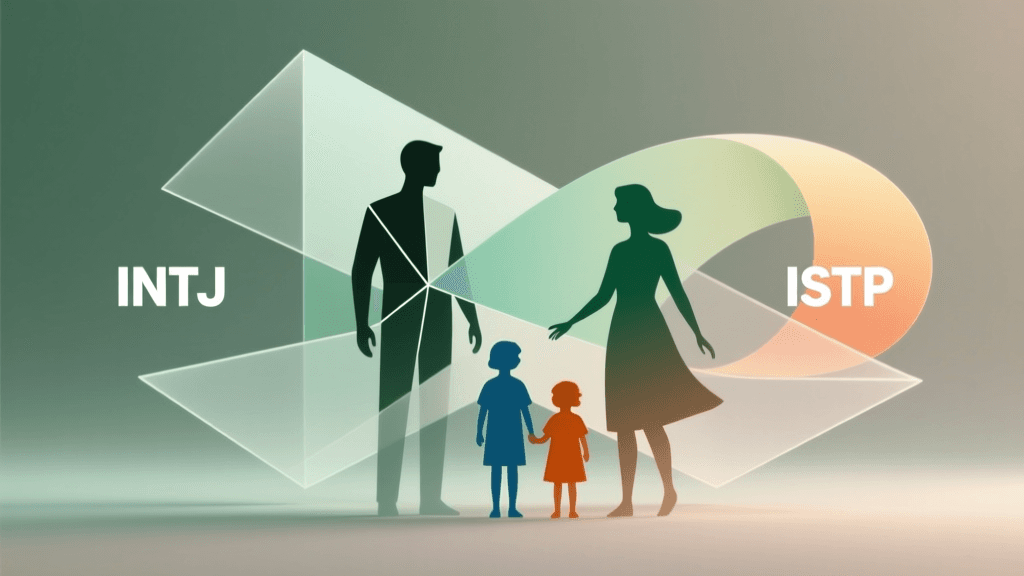
INTJ as a Parent
The INTJ (Introverted, Intuitive, Thinking, Judging) parent approaches family life with strategic intentionality. Often described as the 'Architect' or 'Mastermind,' the INTJ parent doesn’t stumble into parenting—they design it. From the moment a child is born (or even before), INTJs typically research developmental milestones, evidence-based discipline models, and long-term educational pathways. Their parenting style is rooted in foresight, consistency, and high standards—not out of rigidity, but from a deeply held belief that structure enables autonomy.
INTJ parents prioritize intellectual stimulation above all else. You’ll find them curating home libraries by age group, introducing logic puzzles at age five, and encouraging debate over dinner—even with toddlers learning to form full sentences. They value honesty, precision in language, and expect children to take responsibility early: assigning age-appropriate chores with clear expectations, using written charts for routines, and framing consequences as natural outcomes rather than punishments.
Emotionally, INTJs may struggle with overt displays of affection or spontaneous emotional validation. This isn’t indifference—it’s a different processing rhythm. An INTJ parent might not say 'I love you' frequently, but they’ll remember every detail of their child’s science fair project, draft a personalized study plan before finals week, or quietly fix a broken bike at 10 p.m. because ‘functionality supports dignity.’ Their love language leans heavily toward acts of service and quality time spent solving real problems together.
One documented challenge lies in flexibility. A 2022 study published in the Journal of Child and Family Studies found that highly structured, future-oriented parents (like many INTJs) reported higher stress when children exhibited neurodivergent traits such as ADHD or sensory processing differences—particularly when routines were disrupted unpredictably. The key insight? INTJ parents benefit immensely from building ‘buffer zones’ into schedules and explicitly teaching adaptability as a skill—not just tolerating change, but engineering resilience against it.
ISTP as a Parent
The ISTP (Introverted, Sensing, Thinking, Perceiving) parent embodies pragmatic presence. Known as the 'Virtuoso' or 'Craftsman,' the ISTP approaches parenting like a skilled mechanic: observant, hands-on, solution-oriented, and allergic to unnecessary rules. Where the INTJ plans the blueprint, the ISTP builds—and repairs—the house, often while explaining torque ratios to a fascinated 7-year-old.
ISTP parents thrive in the physical, tangible world of childhood. They’re the ones who teach bike riding without training wheels, demonstrate how to safely use a pocket knife, or troubleshoot a Lego set’s missing piece with forensic calm. Their discipline is situational and immediate: if a child breaks something, the focus shifts instantly to assessment (“What happened?”), repair (“How do we fix it?”), and prevention (“What can we do differently next time?”). There’s little lecturing—just cause, effect, and actionable insight.
ISTPs rarely impose abstract values or moral dogma. Instead, they model integrity through consistency in action: showing up on time, honoring commitments, fixing what’s broken instead of blaming. Children learn ethics not through sermons, but through watching their ISTP parent calmly return excess change at a coffee shop—or walk away from a dishonest negotiation without hesitation.
However, ISTPs may under-prioritize long-term emotional scaffolding. Because they process feelings internally and often delay verbalizing them—even to themselves—they may miss early cues of anxiety, social withdrawal, or identity confusion in their children. A landmark longitudinal study by the American Psychological Association (2021) observed that Sensing-Perceiving parents were statistically less likely to initiate conversations about mental health or identity development before adolescence—though once engaged, they responded with remarkable authenticity and practical support.
Crucially, ISTPs need autonomy—not just for themselves, but for their children. They resist over-scheduling, standardized homework rituals, or prescriptive 'parenting hacks.' Their ideal environment allows kids space to experiment, fail safely, and discover competence organically. As one ISTP father shared in a Greater Good Science Center interview: 'I don’t teach my daughter how to tie her shoes—I hand her laces, show her one knot, then let her wrestle with it for three days. When she gets it? That pride is unshakeable.'
Co-Parenting Dynamics for INTJ and ISTP
At first glance, INTJ and ISTP seem like opposites: one maps the decade ahead; the other fixes today’s flat tire. Yet this pairing holds extraordinary synergistic potential—if both partners understand their cognitive wiring and commit to translating intent across type boundaries.
Their shared Introversion and Thinking preferences create a strong foundation: mutual respect for privacy, low tolerance for performative emotion, and alignment on rational decision-making. Both distrust authority-by-default and prefer evidence over tradition. But their divergent perceiving functions—INTJ’s dominant Introverted Intuition (Ni) versus ISTP’s dominant Introverted Thinking (Ti)—shape how they interpret reality, assign meaning, and resolve conflict.
Ni-users (INTJs) see patterns, implications, and long arcs. When a child struggles with math, the INTJ parent immediately connects it to future STEM readiness, college admissions, and career viability. Ti-users (ISTPs), meanwhile, isolate variables: 'Is it the teacher’s pacing? The textbook’s examples? Did they get enough sleep last night? Let’s test each variable.'
This divergence becomes most visible during crises. During a child’s sudden school refusal, the INTJ may draft a 6-week reintegration plan involving therapist referrals, academic accommodations, and social scripting. The ISTP may quietly drive the child to a hardware store, hand them a screwdriver, and say, 'Let’s rebuild your birdhouse. We’ll talk when your hands stop shaking.' Both responses are valid—and both are necessary.
Practical Co-Parenting Strategies:
- Create a 'Dual-Track Decision Log': For major choices (school selection, therapy, extracurriculars), maintain a shared digital doc with two columns: 'Ni Vision' (long-term implications, systemic impact) and 'Ti Analysis' (immediate variables, testable hypotheses, resource constraints). Review both before deciding.
- Assign 'Domain Sovereignty': Let the INTJ own calendar architecture (vacations, medical appointments, academic deadlines) while the ISTP owns tool-based domains (home safety audits, gear maintenance, hands-on skill coaching). This honors natural strengths and reduces friction.
- Implement 'Debrief Windows': Schedule 15-minute weekly check-ins—not to solve problems, but to translate perspectives. Example script: 'When you said X about soccer practice, what future concern were you anticipating?' / 'When I took Y action, what immediate variable was I trying to stabilize?'
A 2023 report by the Pew Research Center found that couples who explicitly named and honored cognitive differences in parenting roles reported 41% higher relationship satisfaction and 33% lower rates of child behavioral referrals—underscoring that structural clarity, not uniformity, fosters stability.
Family Traditions and Values
INTJ–ISTP families rarely sustain traditions based on nostalgia alone. Instead, their rituals are engineered for meaning, efficiency, and tactile engagement. Think less 'same meal every Sunday' and more 'annual Family Systems Audit Day'—where everyone reviews household systems (laundry flow, pantry inventory, Wi-Fi password log) and proposes one upgrade.
Core Shared Values:
- Competence over Compliance: Praise focuses on problem-solving ('You figured out how to reset the router yourself') rather than obedience ('You cleaned your room when asked').
- Evidence-Based Ethics: Moral discussions center on real-world impact: 'Why do we compost? Let’s measure methane reduction in our backyard bin vs. landfill data.' No platitudes—only verifiable cause-and-effect.
- Autonomy with Accountability: Teens negotiate privileges (e.g., later curfew) by presenting risk-mitigation plans—not just promises. An ISTP teen might submit a bike-lighting safety checklist; an INTJ teen might model traffic incident probability by intersection.
Signature Traditions:
| Tradition | INTJ Contribution | ISTP Contribution | Purpose & Outcome |
|---|---|---|---|
| Winter Solstice Skill Swap | Researches historical context of solstice; designs skill-mapping matrix (e.g., 'Which 3 skills align with your top 3 values?') | Builds physical kits (e.g., soldering station, leather-stitching kit); hosts live demo stations | Combines conceptual framing with tactile mastery; children choose one new skill annually grounded in personal relevance and executable practice. |
| Quarterly Home Efficiency Review | Tracks energy/water usage; benchmarks against regional averages; drafts optimization roadmap | Inspects HVAC filters, calibrates thermostat, upgrades door seals, tests insulation R-values | Teaches systems thinking + hands-on stewardship; turns sustainability from abstract ideal into measurable, collaborative engineering. |
| 'Failure Archive' Dinner | Curates anonymized case studies (historical, scientific, familial) where failure led to breakthrough | Brings salvaged 'failed' projects (e.g., collapsed cake, miswired circuit) to display and deconstruct | Normalizes productive failure; separates outcome from learning; models intellectual humility and iterative design. |
These traditions avoid sentimentality—but generate profound belonging. Children internalize that love is expressed through shared attention to reality: noticing how things work, improving them, and learning from what breaks.
Raising Children with Different Personality Types
INTJ–ISTP parents often produce children across the full MBTI spectrum—a gift and a challenge. Their shared Thinking preference means they intuitively grasp fellow Ts (ESTP, ENTJ, ISTJ, ESTJ), but may unintentionally overlook the emotional signaling of Feeling types (e.g., INFP, ESFJ) or the experiential hunger of Perceivers (e.g., ENTP, ISFP).
Key Principles for Type-Inclusive Parenting:
- Map, Don’t Mold: Use tools like the Myers & Briggs Foundation’s youth resources to help children recognize their preferences—not as labels, but as operating systems. An INFP child isn’t 'too sensitive'; they’re running an Fe-dominant interface that prioritizes harmony and values-coherence.
- Customize Communication Protocols:
- For Sensing children (e.g., ISTJ, ESFP): Anchor feedback in concrete observations ('I saw you organize the art supplies by color and size') rather than abstract praise ('You’re so creative!').
- For Intuitive children (e.g., ENTP, INFJ): Invite theoretical expansion ('What if gravity worked backward? How would cities adapt?'). Avoid shutting down 'what ifs' with 'That’s not realistic.'
- For Feeling children (e.g., ENFJ, ISFJ): Name emotions explicitly ('It sounds like you felt overlooked when your brother got praised first') and co-create restorative actions.
- For Perceiving children (e.g., ENTP, INFP): Offer choice architecture ('You can start homework now or after dinner—but either way, it must be done before 8 p.m.') rather than rigid timelines.
- Leverage Sibling Type Diversity: Assign collaborative projects that require complementary functions. Example: An ISTP teen and ENFP sibling co-design a community garden—ISTP handles soil pH testing and irrigation engineering; ENFP leads volunteer recruitment and storytelling documentation. Each gains fluency in the other’s cognitive language.
Research from the Journal of Applied Developmental Psychology (2022) confirms that children raised in cognitively diverse households show significantly higher perspective-taking ability and conflict-resolution agility by age 15—especially when parents explicitly name and honor different processing styles.
Navigating Extended Family as INTJ and ISTP
Extended family gatherings pose unique challenges for INTJ–ISTP duos. Grandparents may misinterpret their quiet reserve as coldness; aunts may label their no-nonsense discipline as 'harsh'; cousins may feel intimidated by their direct communication.
But their shared Introversion and Thinking orientation also equips them with rare diplomatic tools: precision, boundary clarity, and zero tolerance for emotional manipulation.
Actionable Boundary Frameworks:
- The 'Three-Question Filter' for Unsolicited Advice: Before engaging, ask: (1) Is this advice grounded in observable evidence? (2) Does it align with our family’s stated values? (3) What specific outcome does the advisor hope to achieve? If two answers are 'no,' respond with: 'We appreciate your care. We’ll review this alongside our other inputs.'
- Pre-Event Role Assignment: Agree in advance who handles which relational tasks. Example: INTJ manages logistics (transportation, dietary needs, activity scheduling); ISTP handles environmental calibration (noise control, seating comfort, tech troubleshooting). This prevents reactive overload.
- Exit Protocol Design: Build graceful departure mechanics: 'We’ve promised the kids stargazing at 8:30—they need dark skies to see Orion’s Belt.' Or 'Our car’s maintenance window is tomorrow morning; we must leave by 6 p.m.' Framing exits around external constraints (science, mechanics, schedules) feels neutral—not personal.
Crucially, INTJ–ISTP parents should proactively educate extended family—not through lectures, but through micro-modeling. Invite grandparents to co-teach a skill: the INTJ prepares a 1-page 'Why This Matters' handout on fire safety; the ISTP demonstrates smoke detector battery replacement. Shared competence builds respect faster than any personality explanation.
FAQ
How do INTJ and ISTP parents handle disagreements about discipline?
Discipline clashes usually stem from Ni’s 'future consequence' lens versus Ti’s 'immediate variable' lens. Resolve by separating principle (agreed-upon non-negotiables: safety, honesty, effort) from tactic (how to enforce it). Example: Both agree 'academic integrity is non-negotiable.' INTJ designs plagiarism-prevention workshops; ISTP builds a 'citation lab' where kids manually format sources. Unity on values enables tactical diversity.
What if our child is an EF type (e.g., ENFP, ESFJ) and feels 'unseen' by our T-dominant household?
Proactively integrate Feeling-language without compromising your authenticity. Start meetings with 'How is everyone feeling about this decision?'—then listen without fixing. Create a 'Values Wall' where each person posts one core value (e.g., 'Joy,' 'Justice,' 'Curiosity') and explains its personal meaning. Rotate facilitation so EF children lead emotional check-ins monthly. Your consistency in holding space matters more than fluent Feeling expression.
Do INTJ–ISTP couples struggle with balancing alone time and family time?
Yes—but their shared Introversion makes this manageable. Institute 'Protected Recharge Blocks': non-negotiable 90-minute windows daily where each parent disengages (no devices, no kid-interruptions). Use visual cues: closed door + red light = 'In Deep Work Mode.' Children learn this signals respect—not rejection. A Psychology Today analysis (2021) confirmed that couples with explicit recharge protocols reported 2.3x higher marital satisfaction and children with stronger self-regulation skills.
How can we explain our parenting approach to teachers or pediatricians unfamiliar with MBTI?
Translate type language into universal developmental frameworks. Say: 'We prioritize executive function development through structured autonomy' (INTJ strength) and 'We emphasize embodied cognition via hands-on problem-solving' (ISTP strength). Cite evidence: 'Research from Harvard’s Center on the Developing Child shows both approaches strengthen prefrontal cortex integration.' Focus on outcomes—not typology.
Ultimately, the INTJ–ISTP parenting partnership is a masterclass in complementary cognition. Neither parent has to become the other—to succeed, they simply need to treat their differences not as gaps to bridge, but as interlocking gears in a finely tuned system. When the INTJ envisions the forest, the ISTP ensures every tree stands strong. When the ISTP masters the terrain, the INTJ charts the north star. Together, they don’t just raise children—they cultivate thinkers, builders, and ethically grounded humans who know how to hold both vision and velocity in one steady hand.