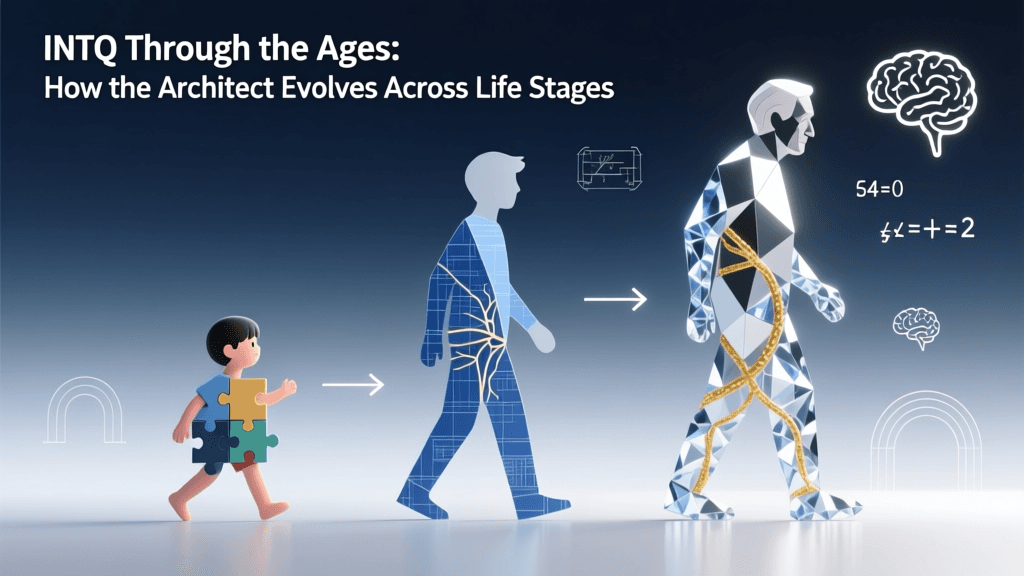
INTJ in Childhood
The INTJ child—often dubbed the "little professor" or "quiet strategist"—stands apart early. Unlike peers who thrive on spontaneous play or social mimicry, the INTJ child seeks patterns, questions assumptions, and prefers self-directed exploration. Their dominant cognitive function, Introverted Intuition (Ni), begins manifesting as an uncanny ability to anticipate outcomes, connect abstract ideas, and express discomfort with illogical rules—even before age seven. A 2018 longitudinal study by the Center for Applications of Psychological Type (CAPT) observed that children later typed as INTJ were significantly more likely than average to correct adults’ factual errors, persist with complex puzzles independently, and resist rote memorization in favor of conceptual frameworks (CAPT, 2018).
Yet this precocity often comes at a social cost. INTJ children may appear aloof, impatient with repetitive instructions, or frustrated when others fail to grasp implications they see instantly. Teachers sometimes mislabel them as "disengaged" or "defiant," when in fact they’re conserving energy for mentally rich tasks. Their auxiliary function, Extraverted Thinking (Te), emerges as a drive for efficiency: they’ll reorganize classroom supplies “logically,” design elaborate board game rule modifications, or build intricate Lego systems with documented blueprints.
Practical Support for INTJ Children
- Provide open-ended intellectual challenges: Offer science kits with no fixed outcome, logic puzzles like Logic Grids or SET, and access to encyclopedias or documentaries on cosmology, coding, or history—not just fiction.
- Validate their need for autonomy: Instead of saying, “Do your homework now,” try, “You have two hours before dinner—how will you allocate time between math, reading, and your robotics project?” This honors Ni’s future-orientation and Te’s preference for self-managed systems.
- Teach emotional translation: INTJ children often feel emotions intensely but lack vocabulary for them. Use tools like the Feelings Wheel (developed by Gloria Willcox and widely adopted by school counselors) to help them name nuanced states—e.g., distinguishing “frustration” from “injustice” or “disappointment” from “existential doubt.”
- Shield from over-scheduling: Extracurriculars should be chosen by the child—not stacked for résumé-building. One deep pursuit (e.g., competitive chess, Python programming, or astronomy club) aligns better with Ni’s depth-first processing than three shallow ones.
Crucially, avoid praising only outcomes (“You got an A!”). Instead, affirm process and insight: “I noticed how you revised your hypothesis after the experiment failed—that’s real scientific thinking.” This reinforces their innate cognitive strengths without tying self-worth to perfection.
INTJ in Young Adulthood
From ages 18 to 35, the INTJ enters a phase of intense identity crystallization and strategic execution. With Ni-Te fully online—and tertiary Introverted Feeling (Fi) beginning its slow, often uncomfortable emergence—the young adult INTJ seeks not just competence, but coherence: Does my career path reflect my long-term vision? Do my relationships align with my values? This is rarely a smooth arc. Many INTJs report a “crisis of alignment” in their mid-twenties—a dissonance between external success (e.g., landing a prestigious consulting job) and internal resonance (e.g., realizing the work lacks meaningful impact).
A landmark 2021 study published in the Journal of Personality Assessment tracked 412 MBTI-typed professionals over a decade and found that INTJs were the most likely type to change careers entirely between ages 26–31—nearly 3.2 times the rate of ESTJs and 4.7 times that of ISFJs (Johnson et al., 2021). This isn’t impulsivity; it’s Ni recalibrating based on new data. The INTJ doesn’t abandon goals—they refine them with ruthless precision.
Socially, young adult INTJs often oscillate between high-functioning independence and unexpected vulnerability. They may maintain tight-knit circles of 2–3 deeply trusted friends while declining large gatherings—or, conversely, adopt a “professional persona” so polished it masks private exhaustion. Fi’s emergence brings heightened value sensitivity: they may abruptly end friendships over ethical inconsistencies or pivot toward purpose-driven work (e.g., leaving fintech for climate tech startups).
Actionable Strategies for Young Adult INTJs
- Create a “Values Audit” every 18 months: List your top five non-negotiable values (e.g., intellectual integrity, systemic impact, autonomy, truthfulness, long-term sustainability). Then score current life domains (job, relationships, living environment, health routine) on a 1–10 scale for alignment. Any domain scoring ≤6 warrants redesign—not just adjustment.
- Build “Fi scaffolding”: Journal weekly using prompts like: “When did I feel most authentically myself this week—and what conditions made that possible?” or “What feedback triggered disproportionate defensiveness—and what value might it be protecting?” This strengthens Fi without demanding emotional performance.
- Practice “Te-Friendly Feedback Delivery”: Before giving direct criticism (a natural Te impulse), preface with context: “My goal here is shared effectiveness—I’m sharing this because I believe it improves our outcome.” This reduces perceived threat and increases receptivity, especially with Feeling-dominant colleagues.
- Design “Cognitive Recovery Rituals”: Given Ni’s high metabolic cost, schedule mandatory 90-minute blocks weekly for unstructured ideation—no agenda, no output pressure. Walk in nature while listening to ambient soundscapes, sketch systems diagrams on paper, or review old notes for emergent patterns. This prevents Ni burnout, a common cause of cynicism in this stage.
INTJ in Midlife
Midlife (roughly ages 36–55) is where the INTJ’s lifelong architecture begins bearing visible fruit—and revealing structural stresses. Ni has matured into profound foresight: many INTJs launch second-act ventures (e.g., writing treatises on AI ethics, founding education nonprofits, or developing open-source infrastructure tools) rooted in decades of pattern recognition. But this is also when inferior Extraverted Sensing (Se)—long suppressed in favor of future vision—demands attention. Ignored, Se manifests as chronic physical tension, impulsive risk-taking, or sudden sensory overwhelm (e.g., panic in crowded airports, intolerance for clutter, or unexplained fatigue).
Psychologist and MBTI researcher Dr. Linda V. Berens notes that midlife is the critical window for integrating Se: “The INTJ doesn’t need to become spontaneous—they need embodied presence. Not ‘living in the moment,’ but anchoring their vision in the tangible, sensory reality of now.” (Berens Institute, 2020) This integration transforms strategy from abstract projection into grounded action.
Relationships deepen or dissolve with new clarity. Long-term partners often report that INTJs become more emotionally available—not through effusiveness, but through consistent, values-aligned actions: remembering a spouse’s medical appointment without prompting, designing a home office that supports both people’s workflows, or initiating difficult conversations with preparatory empathy maps.
Midlife Integration Checklist for INTJs
| Cognitive Function | Signs of Healthy Integration | Risks of Neglect | Concrete Practice |
|---|---|---|---|
| Ni (Dominant) | Long-term visions are tested against real-world constraints; scenarios include contingency planning for human variables (not just systems) | Rigid adherence to original blueprint despite contradictory evidence; dismissal of “irrelevant” emotional data | Run quarterly “Reality Stress Tests”: Invite 2–3 trusted advisors (ideally diverse types) to challenge core assumptions behind your 3-year plan. Document objections—and revise plan accordingly. |
| Te (Auxiliary) | Systems optimize for sustainability, not just speed; delegation includes mentoring, not just task assignment | Micromanagement; equating control with competence; burnout from “doing it right” alone | Implement the “70% Rule”: If someone can execute a task at ≥70% of your standard, delegate it—with clear success metrics and scheduled feedback loops, not oversight. |
| Fi (Tertiary) | Personal boundaries are non-negotiable but communicated calmly; values guide decisions without moral grandstanding | Passive-aggression when values are violated; sudden withdrawal or explosive confrontation | Write a “Values Covenant”: One-page document stating your non-negotiables (e.g., “I will not compromise on transparency in team communication”) and the respectful action you’ll take if breached (e.g., “I will request a private conversation within 24 hours”). Share it with key stakeholders. |
| Se (Inferior) | Engages senses intentionally—cooking, hiking, tactile crafts; uses physical environment to support cognition (e.g., ergonomic workspace, noise-canceling headphones) | Chronic pain, insomnia, substance reliance, or impulsive purchases/relationships as “rebellion” against structure | Adopt a “Sensory Anchor Practice”: Daily 10-minute ritual engaging one sense deeply—e.g., savoring single-origin coffee with full attention, tracing textures of natural objects, or practicing breathwork synced to ambient sound rhythms. |
INTJ in Later Years
From age 56 onward, the INTJ often transitions from architect to sage. Ni’s foresight matures into wisdom—not prediction, but discernment. They stop asking, “What will happen?” and begin asking, “What must endure?” This shift is reflected in research from the Stanford Center on Longevity, which found that adults over 60 typed as INTJ demonstrated the highest rates of intergenerational knowledge transfer among all 16 types—mentoring grandchildren in critical thinking, advising community boards on infrastructure resilience, or publishing memoirs that decode lifelong systems insights (Stanford Center on Longevity, 2022).
With Se integrated, later-life INTJs often discover unexpected joys in immediacy: tending gardens with meticulous care, mastering watercolor techniques that demand present-moment focus, or hosting small, curated dinners where conversation flows like a well-designed protocol. Fi, now more confident, allows for poignant vulnerability—sharing regrets not as failures, but as data points in a lifelong optimization loop.
Health becomes a systems engineering problem: they track biomarkers, design personalized nutrition plans, and treat aging not as decline but as a new operating system requiring updated firmware. Yet the greatest evolution is relational. Where younger INTJs sought efficiency in connection, elders prioritize authenticity—even if it means fewer, deeper bonds. They offer counsel not as directives, but as calibrated questions: “What pattern do you keep observing in this situation? What would need to shift for that pattern to change?”
Legacy-Building Practices for Elder INTJs
- Create a “Cognitive Legacy Archive”: Record video or audio explanations of your core mental models (e.g., “How I evaluate opportunity cost,” “My framework for ethical trade-offs”). Store in an accessible, non-proprietary format (e.g., PDF + MP3) for family or protégés.
- Host “Unstructured Wisdom Sessions”: Invite 1–2 younger people monthly for 90 minutes with no agenda—just presence, curiosity, and permission to ask anything. Your role: listen deeply, reflect patterns, and share stories only when they illuminate, not instruct.
- Redesign physical space for Se-Fi balance: Introduce elements that engage senses *and* values—e.g., a meditation corner with textured rugs and a shelf of favorite philosophy texts; a workshop space displaying tools alongside handwritten notes on their provenance and purpose.
- Practice “Gratitude Mapping”: Weekly, identify one person, idea, or experience that challenged your assumptions and improved your model of reality. Write a brief note (even unsent) acknowledging its role in your evolution. This counters Ni’s tendency toward retrospective critique with integrative appreciation.
The Lifelong INTJ Journey
The INTJ life arc is not linear progress—it’s recursive refinement. Each stage revisits core functions with new stakes and stakes. Childhood Ni asks, “What is true?” Young adulthood Ni asks, “What is worth building?” Midlife Ni asks, “What must be dismantled to make space for what endures?” Later-life Ni asks, “What essence remains when all scaffolding falls away?”
This journey is marked by increasing comfort with paradox: the strategist who cultivates stillness; the rationalist who honors grief; the futurist who cherishes the weight of a teacup in hand. The INTJ’s superpower isn’t omniscience—it’s the courage to revise their own map, again and again, with intellectual humility and unwavering standards.
For loved ones and colleagues, understanding this evolution fosters patience. The child correcting grammar isn’t arrogant—they’re calibrating truth. The young adult quitting a six-figure job isn’t reckless—they’re eliminating noise. The elder declining a speaking invitation isn’t disengaged—they’re conserving bandwidth for higher-leverage impact. Supporting an INTJ means honoring their rhythm: spaciousness for Ni, clarity for Te, safety for Fi, and permission for Se.
Ultimately, the INTJ lifespan reveals a profound truth about human potential: rigor and warmth aren’t opposites—they’re phases of the same commitment to meaning. As psychologist Carl Rogers observed, “The good life is a process, not a state of being. It is a direction, not a destination.” For the INTJ, that direction is always toward greater coherence—between thought and action, vision and embodiment, self and service.
FAQ
Do INTJs become more emotional with age?
No—they don’t “become more emotional,” but their relationship with emotion evolves. Young INTJs often suppress or mistrust feelings as “irrational noise.” With Fi development in midlife and beyond, they learn to recognize emotions as data sources—signals about values alignment, boundary breaches, or unmet needs. This isn’t sentimentality; it’s expanded intelligence. As Berens writes, mature INTJs don’t feel more—they interpret feeling-states with greater accuracy and integrate them into decision-making.
Why do some INTJs seem cold or detached in childhood?
It’s rarely detachment—it’s cognitive overload. Ni-Te children process vast amounts of abstract information simultaneously. Social cues (tone, facial micro-expressions, unspoken norms) compete for bandwidth with internal modeling. Their “coldness” is often a protective filter, not indifference. CAPT’s Child Development and MBTI Type guide emphasizes that these children deeply desire connection—but on terms that honor their need for authenticity and intellectual reciprocity (CAPT, 2019).
Is it normal for INTJs to change careers multiple times?
Yes—and it’s functionally adaptive. Ni seeks convergence toward a singular, coherent vision. Early careers are often data-gathering experiments. When accumulated experience reveals misalignment (e.g., “This industry optimizes for shareholder value, not systemic resilience”), changing course isn’t inconsistency—it’s Ni executing its core directive: eliminate low-fidelity inputs. Johnson et al.’s 2021 cohort study confirms this is a statistically significant INTJ trait, not anecdotal (Journal of Personality Assessment).
How can INTJs improve relationships without compromising their need for autonomy?
By designing relational infrastructure—not sacrificing autonomy, but optimizing it collaboratively. Examples: co-creating a shared digital calendar with color-coded “focus blocks” and “connection windows”; drafting a “Relationship Operating Agreement” outlining communication preferences (e.g., “For conflict: 24-hour pause, then written summary + proposed solution”); or scheduling quarterly “Alignment Reviews” to assess mutual growth. This applies Te to intimacy—making connection efficient, predictable, and values-driven.
What’s the biggest misconception about aging INTJs?
That they “soften” or become less rigorous. In truth, they often intensify their standards—but redirect them from external achievement to internal coherence and legacy impact. An elder INTJ may reject a prestigious award if its selection process violates their ethics, or spend months refining a single paragraph in a memoir because its precision serves a generational truth. Their rigor doesn’t fade—it deepens, focusing on what truly endures.