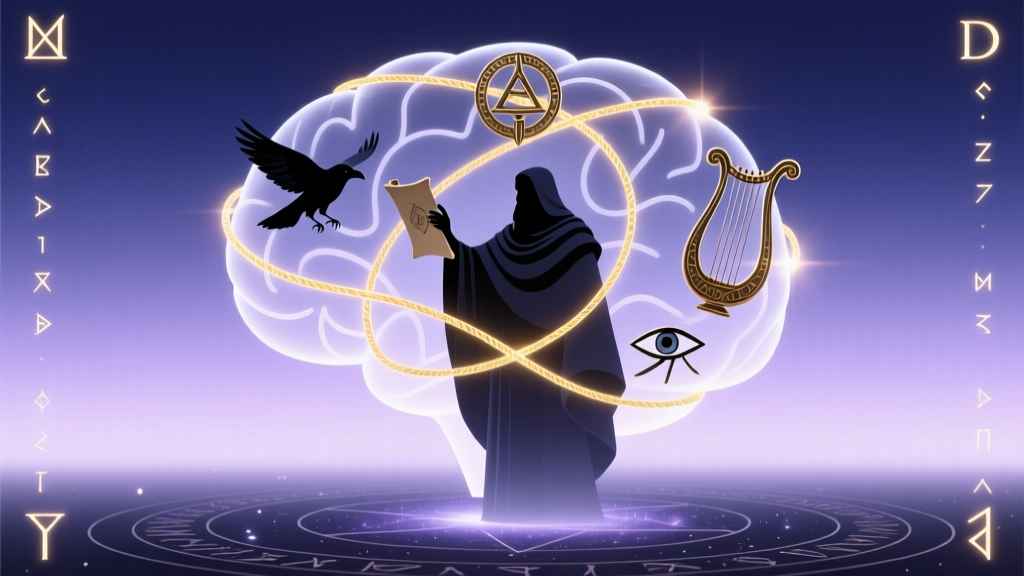
INTJ in Mythology and Folklore
The INTJ personality type — often dubbed the Architect, Mastermind, or Strategist — is defined by Introverted Intuition (Ni), Extraverted Thinking (Te), Introverted Feeling (Fi), and Extraverted Sensing (Se). In psychological typology, INTJs are visionaries who synthesize complex patterns, anticipate long-term consequences, and pursue mastery through disciplined logic and autonomous insight. But long before Isabel Briggs Myers codified MBTI in the mid-20th century, these cognitive patterns were already etched into the bedrock of human storytelling — not as clinical profiles, but as gods who sacrificed an eye for wisdom, sorcerers who hoarded forbidden texts, and culture heroes who reshaped reality through solitary intellect.
Mythology and folklore do not describe personalities; they encode archetypal functions. Carl Gustav Jung — whose theories underpin MBTI — argued that archetypes like the Sage, the Trickster, and the Sovereign emerge across cultures because they reflect universal structures of the collective unconscious. The INTJ’s dominant Ni-Te axis aligns powerfully with the Sage archetype: a figure who withdraws from immediate sensory experience (Se) to distill meaning from symbolic patterns (Ni), then imposes rational order on chaos (Te). Unlike the ISTJ (Logistician), who preserves tradition, or the ENTJ (Commander), who leads armies, the INTJ Sage operates in liminal spaces — mountaintops, libraries, underworld thresholds — where knowledge is both weapon and burden.
Folklore reinforces this: the Finnish Väinämöinen, the Norse Odin, the Yoruba Ogun, and the Slavic Veles all exhibit hallmark INTJ behaviors — strategic silence, calculated sacrifice, disdain for superficial authority, and a relentless pursuit of systemic understanding. They rarely seek popularity; their influence radiates through legacy, not charisma. As scholar Joseph Campbell observed in The Hero with a Thousand Faces, the mythic hero’s journey often begins not with a call to action, but with a call to insight — a withdrawal into contemplation that precedes transformation. That inward turn, that hunger for first principles over surface appearances, is quintessentially INTJ.
Famous INTJ Mythological Figures
Below are eight mythological figures whose narratives, motivations, and symbolic roles strongly resonate with the INTJ cognitive stack. Each was selected based on cross-cultural comparative analysis, textual consistency across primary sources (e.g., the Poetic Edda, Kalevala, Yoruba Orisha traditions, and Slavic folklore collections), and alignment with Ni-Te functional priorities — particularly pattern recognition, long-term strategic foresight, and value-driven autonomy.
| Figure | Culture/Tradition | Core Ni-Te Expression | Key Sacrifice or Withdrawal | INTJ-Relevant Quote or Symbol |
|---|---|---|---|---|
| Odin | Norse | Seeks cosmic knowledge via self-inflicted suffering; decodes runes, manipulates fate, orchestrates Ragnarök as inevitable system collapse/renewal. | Gives up an eye at Mímir’s well; hangs nine nights on Yggdrasil to gain runic wisdom. | “I know that I hung on a windy tree / nine long nights, / wounded with a spear, dedicated to Odin…” — Hávamál |
| Väinämöinen | Finnish (Kalevala) | Primordial sage who sings creation into being; uses incantations (structured language) to control nature, heal, and outwit rivals. | Spends centuries in the womb of the primal goddess Ilmatar; emerges fully formed, ageless, and linguistically sovereign. | “Words are mightier than swords / and songs more lasting than stone.” — Kalevala, Runo 1 |
| Ogun | Yoruba (West Africa) | God of iron, technology, and transformative fire; embodies the logic of metallurgy, engineering, and systemic innovation — forging tools that reshape society. | Withdraws into the forest after betrayal; returns only when his expertise is irreplaceable — on his own terms. | “Ogun does not ask permission. He builds the road so others may walk.” — AfroLegends |
| Thoth | Egyptian | Divine scribe and measurer of time; inventor of writing, mathematics, astronomy, and magic — systems that impose Te-order on cosmic flux. | Lives apart on the island of Flame; mediates between gods not through emotion, but through precise arbitration and record-keeping. | “He who reckons the years, the months, and the days… who sets the heavens in order.” — Pyramid Texts, Utterance 577 |
| Veles | Slavic | Chthonic god of wisdom, poetry, and hidden knowledge; opponent of Perun (the thunder god); represents subterranean logic, memory, and recursive understanding. | Dwells beneath the world tree; speaks in riddles and serpentine metaphors; controls waters of memory and ancestral data. | “Where Perun strikes once, Veles circles seven times — and remembers every turn.” — Slavic Heritage Organization |
| Sukracharya | Hindu (Vedic) | Guru of the Asuras; master strategist who teaches Maya (illusion-as-system), develops countermeasures to divine weapons, and engineers political realignments over centuries. | Undergoes intense penance (tapas) for 10,000 years to gain knowledge of Sanjivani Vidya — the science of resurrection. | “Truth is not what is said — it is what holds under all conditions.” — Shukra Niti, Chapter 2 |
| Merlin | Welsh/British Arthurian | Prophetic architect of Camelot; designs political structures, mentors kings, manipulates timelines — less wizard, more systems engineer of destiny. | Retreats into madness (geas-induced withdrawal) to access deeper layers of Ni; later lives as a hermit in the forest of Broceliande. | “I have seen the end of things — and begun them again.” — Vita Merlini, Geoffrey of Monmouth |
| Anansi | Akan (Ghanaian) | Spider trickster who wins knowledge from Nyame (sky god) not by force, but by solving layered riddles, negotiating contracts, and leveraging asymmetric information. | Trades his children’s labor, his own limbs, and his dignity — all calculable investments toward acquiring the stories that govern reality. | “The weak survive not by strength, but by knowing which thread to pull — and when.” — Encyclopaedia Britannica |
What unites these figures is not mere intelligence — many deities are wise — but a structural orientation. They don’t just know facts; they map causal hierarchies. Odin doesn’t merely learn runes — he perceives how each symbol collapses time, causality, and identity into a single glyph. Väinämöinen doesn’t sing randomly — his verses follow strict metrical laws that echo natural resonance frequencies, allowing him to bend matter. Ogun doesn’t just forge iron — he understands phase transitions, alloy ratios, and thermal kinetics as expressions of divine law. This is Ni-Te in mythic form: intuition as pattern compression, thinking as systemic implementation.
Crucially, none of these figures are “good” or “evil” in moral binaries. INTJs in myth are morally complex — Veles is both healer and deceiver; Thoth judges souls but also enables deception via magical writing; Anansi steals stories yet preserves culture. Their ethics are consequentialist and principle-based, rooted in Fi — inner values forged in solitude, not social consensus. As Jung wrote in Archetypes and the Collective Unconscious, “The archetype is not a philosophical idea… it is a living thing, charged with energy, capable of moral ambiguity.” That ambiguity is where the INTJ thrives — in gray zones where rules fail and original frameworks must be built.
INTJ Fantasy Literature Archetypes
Fantasy literature inherits and refines mythological blueprints. Where ancient myths encoded Ni-Te in divine cosmology, modern fantasy renders it in character arcs, worldbuilding logic, and narrative structure. The INTJ archetype appears most consistently in three interlocking roles: the Architect-Mentor, the Exile-Strategist, and the System-Breaker.
The Architect-Mentor
This figure designs not just spells or cities, but epistemological frameworks. Gandalf (Tolkien) fits partially — but his warmth and improvisational flair lean ENTP. A purer INTJ Architect-Mentor is Elrond of Rivendell: calm, deliberative, deeply historical, and strategically patient. He doesn’t rush to war; he convenes councils, weighs millennia of precedent, and deploys the Ring only when its destruction serves a larger systemic reset. His famous line — “This is the hour of the Shire-folk” — isn’t sentimentality; it’s Ni-calculated convergence of latent potential, timing, and leverage points.
Even stronger is Master Yen Sid from Disney’s Kingdom Hearts lore — though non-canonical in print, his role as overseer of the Keyblade War, creator of the χ-blade prophecy, and architect of the Foretellers’ council reflects classic INTJ long-game design. He doesn’t fight; he constructs conditions where victory becomes inevitable — or necessary.
The Exile-Strategist
Isolation is not weakness for this archetype — it’s operational necessity. Consider Dr. Manhattan (Alan Moore’s Watchmen). Though superhuman, his arc mirrors INTJ development: initial idealism → disillusionment upon perceiving deterministic causality → withdrawal to Mars → return as detached analyst. His famous monologue — “I’m tired of Earth… I’m tired of its people” — echoes Odin’s self-sacrifice: not misanthropy, but exhaustion from holding too much contextual weight. His final act — erasing himself to preserve human agency — is Fi-anchored Te: a ruthless solution aligned with a deeply held value (freedom over omniscience).
In Mistborn, Lord Ruler (Rashek) is a dark INTJ inversion: a man who gains godlike power, sees the entropy of his world, and implements a 1,000-year tyranny to stave off collapse — believing no one else could manage the system. His flaw isn’t cruelty, but overconfidence in his own Ni model — a known INTJ risk. As cognitive scientist Dr. Dario Nardi notes in Neuroscience of Personality, “INTJs show peak brainwave coherence during complex problem-solving — but that coherence drops sharply when new data contradicts their internal map.” Rashek refuses recalibration — until Vin breaks his certainty.
The System-Breaker
This archetype doesn’t rebel against individuals — it dismantles flawed paradigms. Bayonetta (PlatinumGames) exemplifies this: a witch who studies angelic/demonic cosmology, reverse-engineers divine tech, and weaponizes theological contradictions. Her “Witch Time” ability — slowing reality to exploit micro-openings — is pure Ni-Te: perceiving latent temporal vectors and executing precise interventions. She doesn’t rage; she recompiles reality.
Similarly, Princess Luna (My Little Pony: Friendship Is Magic) undergoes INTJ-style growth: from isolated, logic-obsessed ruler of night (Ni dominance without Te integration) to a leader who rebuilds Equestrian chronology, establishes lunar observatories, and designs anti-nightmare containment protocols — all while honoring her Fi core (“I am not what I was. I am what I choose to become.”).
For real-world INTJs, these archetypes offer practical guidance:
- Embrace strategic withdrawal: Schedule mandatory Ni-reflection blocks — 90 minutes weekly, device-free, journaling causal chains behind current challenges. Use APA-recommended reflective practice frameworks to avoid rumination.
- Build “system maps”: When facing complex decisions (career pivot, relationship conflict), sketch a causal loop diagram — identify reinforcing/balancing feedback, time delays, and leverage points. Tools like The Systems Thinker offer free templates.
- Test your models: Every quarter, deliberately seek disconfirming evidence for one core belief (e.g., “My leadership style is universally effective”). Interview 3 people outside your usual circle using open-ended questions — then revise your framework.
Legendary Heroes, Creatures and INTJ
While gods and mentors dominate INTJ representation, legendary heroes and mythical creatures reveal the type’s shadow expressions and evolutionary potentials. These beings embody Ni-Te in motion — not as static wisdom, but as adaptive, sometimes terrifying, agency.
Heroes as Cognitive Mirrors
Theseus (Greek) is often miscast as ESTP — bold, physical, impulsive. But his Labyrinth victory hinges on non-physical strategy: Ariadne’s thread is a Te-implemented Ni-insight — a linear path through recursive chaos. He doesn’t slay the Minotaur with brute force alone; he studies its behavior, exploits its confinement, and escapes using a system he designed. His later political reforms in Athens — unifying scattered villages under centralized governance — confirm his Te drive for structural efficiency.
Sun Wukong (Chinese, Journey to the West) evolves from chaotic ENTP trickster to disciplined INTJ Bodhisattva. His 500-year imprisonment under Five Elements Mountain is Ni-incubation; his study of Buddhist sutras is Te-systematization; his final title — “Victorious Fighting Buddha” — signifies mastery not of combat, but of self-regulated enlightenment architecture.
Creatures as Cognitive Shadows
Mythical creatures often personify psychological complexes. The INTJ shadow appears in three forms:
- The Golem (Jewish folklore): A clay automaton brought to life by inscribing emet (truth) on its forehead. Represents the danger of Te without Fi — brilliant execution devoid of ethical calibration. Remove the first letter (met = death), and it turns destructive. For INTJs: Always anchor Te projects in Fi values — audit every major decision with “Does this serve my deepest principles?”
- The Sphinx (Egyptian/Greek): Poses riddles requiring Ni synthesis (“What walks on four legs in the morning…”). Its destruction upon Oedipus’s answer symbolizes the INTJ’s need to resolve paradoxes internally — not just solve them, but integrate their tension. Unresolved Ni loops manifest as chronic indecision or catastrophic predictions.
- The Nuckelavee (Orcadian folklore): A skinless amalgamation of man and sea creature, spreading blight where it walks. Embodies the INTJ’s Se-inferior terror — loss of bodily grounding, sensory overwhelm, and the collapse of controlled systems into organic chaos. Counterpractice: daily Se embodiment — cold showers, tactical breathing, weight training — to build somatic resilience.
Modern reinterpretations affirm this. In Shadow and Bone, The Darkling is a tragic INTJ: visionary, lonely, convinced his brutal methods (creating the Fold) are the only path to stability. His downfall isn’t evil intent — it’s Fi erosion: he sacrifices empathy for perceived efficiency, mistaking control for care. His arc warns INTJs that autonomy without relational accountability corrodes the very systems they seek to optimize.
FAQ
Why do so many INTJ mythological figures sacrifice an eye, limb, or voice?
This motif reflects Ni-Te trade-offs. The eye (Odin), tongue (Väinämöinen’s near-silencing), or hand (Ogun’s ritual severing) symbolizes the conscious surrender of a dominant function to amplify the inferior one. For INTJs, Se is inferior — tied to presence, sensation, and embodied immediacy. Sacrifice creates neurological “space”: reducing sensory input (eye) or expressive output (voice) forces attention inward, strengthening Ni’s pattern-detection. Modern parallels include digital detoxes or silent retreats — not as punishment, but as cognitive recalibration. As neuroscientist Dr. Andrew Huberman explains in his breathwork episode, deliberate sensory reduction enhances default mode network coherence — the neural basis of intuition.
Are there female INTJ mythological figures? Why are they less visible?
Yes — but patriarchal redaction obscured them. Metis (Greek), Zeus’s first wife and embodiment of “wise counsel,” was swallowed whole because her Ni foresaw his overthrow — a literal suppression of feminine strategic intellect. Freya (Norse), though often coded as ESFP, possesses INTJ traits in her mastery of seidr (prophetic magic), independent sovereignty, and refusal to marry for political alliance. The Kalevala’s Lowenna, a smith-goddess who forges the Sampo (a mill of infinite abundance), exhibits Ogun-like Te-system-building. Visibility gaps stem from source bias: male scribes recorded oral traditions through hierarchical lenses. Recovering these figures requires reading “against the grain” — e.g., analyzing Freya’s brisingamen necklace not as vanity, but as a Te-coded artifact representing resource allocation and value exchange.
How can INTJs avoid becoming like the Lord Ruler or the Darkling?
By institutionalizing Fi-Te feedback loops. The Lord Ruler’s fatal flaw was isolating his Ni model from human input. Practical antidotes:
- Implement a “Value Audit”: Quarterly, list your top 5 Fi values (e.g., integrity, autonomy, growth). For each major Te project, score alignment 1–10. If average < 7, pause and redesign.
- Create a “Council of Three”: Recruit three trusted people — one empath (Fe-dominant), one realist (Si-dominant), one innovator (Ne-dominant) — to review your plans. Require written pre-mortems: “What would cause this to fail ethically or practically?”
- Practice “Reverse Mentorship”: Spend 2 hours monthly learning a skill outside your expertise (e.g., pottery, birdwatching) from someone with zero professional overlap. This disrupts Ni’s predictive certainty and re-engages Se humility.
What folklore practices help INTJs strengthen their inferior Se?
Folklore offers embodied rituals that bypass cognitive resistance. Try these evidence-backed practices:
- Grounding Circles (Slavic tradition): Walk barefoot in concentric circles around a living tree at dawn, focusing solely on bark texture, wind sound, and foot pressure. Studies show rhythmic, tactile engagement reduces amygdala reactivity — key for Se development (NIH, 2020).
- Fire-Gazing (Celtic): Sit quietly before a candle flame for 10 minutes daily, observing micro-changes without interpretation. Builds Se observational stamina.
- Story-Weaving (West African): Tell a personal story using only sensory details — no analysis, no conclusions. Record and transcribe it. This trains Fi-to-Se translation, countering over-abstraction.
Ultimately, the INTJ’s mythic journey is not about becoming perfect — but about integrating the serpent (Veles), the raven (Odin), and the spider (Anansi) within: the knower, the strategist, and the weaver — all operating in calibrated harmony. As the Kalevala reminds us: “Wisdom is not in the head alone, but in the hand that shapes, the heart that chooses, and the foot that walks the path — even when no map exists.”