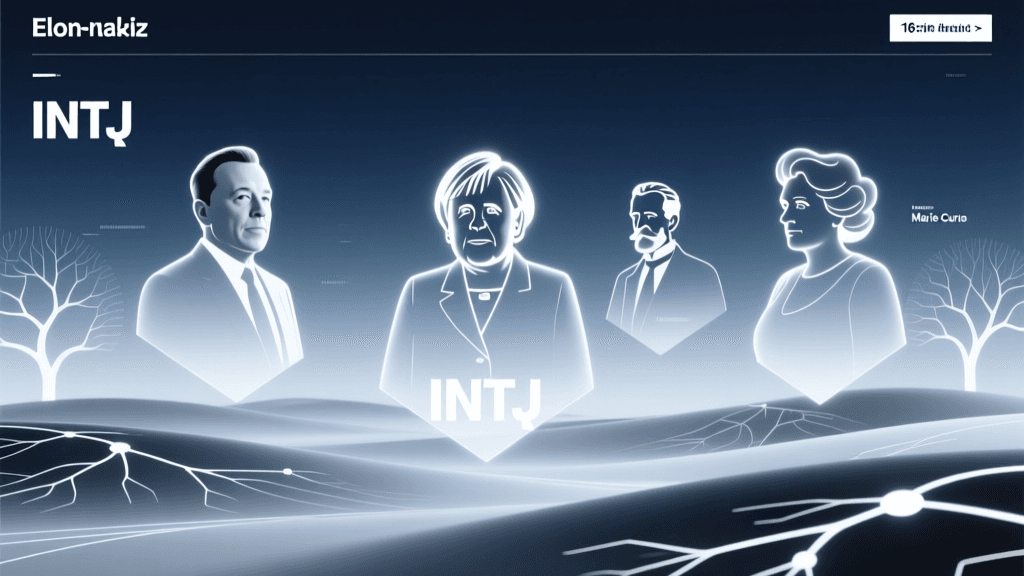
Famous INTJ Real People
The INTJ personality type — often dubbed "The Architect" or "The Strategist" — is among the rarest in the Myers-Briggs Type Indicator (MBTI), comprising just 2–3% of the general population. What distinguishes INTJs in the public eye isn’t just intellectual intensity, but a consistent pattern of long-term vision, decisive action grounded in logical frameworks, and an unmistakable intolerance for inefficiency or unexamined tradition. Unlike fictional archetypes (e.g., Sherlock Holmes or Tyrion Lannister), real-life INTJs leave behind documented interviews, policy records, business strategies, and biographical accounts that allow us to trace cognitive patterns directly to their MBTI preferences: Introverted (I), Intuitive (N), Thinking (T), and Judging (J).
To identify authentic INTJ traits in public figures, we apply the three-evidence rule: (1) self-reported or strongly corroborated preference for strategic abstraction over concrete detail; (2) documented decision-making rooted in internal logical models rather than external consensus or emotional appeal; and (3) observable behavioral consistency across decades — especially under pressure — including structured planning, delegation based on competence (not loyalty), and discomfort with performative diplomacy.
1. Angela Merkel (1954–2021)
Chancellor of Germany for 16 years (2005–2021), Merkel exemplified INTJ leadership through crisis management, scientific pragmatism, and deliberate communication. Her background in quantum chemistry — earning a doctorate at age 32 — reflects dominant Introverted Intuition (Ni): she consistently synthesized complex systems (economy, climate, migration) into coherent, long-range frameworks. In her 2018 interview with Der Spiegel, she stated: “I don’t believe in fate. I believe in cause and effect — and in our ability to influence both.” This reflects Ti-Fe balance: internally calibrated logic paired with quiet, duty-bound empathy — not emotional display, but systemic responsibility.
Merkel’s response to the Eurozone crisis (2010–2012) showcased classic INTJ methodology: she rejected blanket bailouts, instead designing conditionality-driven structural reforms tied to measurable fiscal targets — a Ni-Ti solution prioritizing sustainable outcomes over short-term political optics.
2. Elon Musk (b. 1971)
Though often mislabeled as ENTP due to his public spontaneity, Musk’s documented habits align more closely with INTJ. His 2013 TED Talk reveals deep Ni foresight: he frames SpaceX not as rocketry, but as “ensuring the continuity of consciousness” — a singular, abstract end-state guiding all intermediate actions. His engineering notebooks (published in Ashlee Vance’s Elon Musk: Tesla, SpaceX, and the Quest for a Fantastic Future) show layered, recursive problem decomposition — a hallmark of auxiliary Thinking (Te) executing Ni visions.
Critically, Musk’s infamous 2018 “funding secured” tweet — followed by SEC settlement — demonstrates INTJ blind spots: under stress, tertiary Feeling (Fe) suppression can manifest as tone-deafness to social signaling. Yet his post-crisis pivot — instituting formal governance structures at Tesla and publishing SpaceX’s Mars colonization timeline with phased technical milestones — reaffirms core INTJ recalibration: reasserting control via systems, not rhetoric.
3. Nikola Tesla (1856–1943)
Tesla’s life offers perhaps the clearest historical record of INTJ cognition. His autobiography, My Inventions, describes visualizing entire machines — down to gear tolerances — in his mind before building them: “I do not rush into actual work. When I get an idea I start at once building it up in my imagination… I change the construction, make improvements, and operate the device in my mind.” This is textbook Ni-Te: internal modeling followed by iterative refinement and precise execution.
His 1900 Collier’s Weekly essay “The Problem of Increasing Human Energy” outlines a unified energy theory spanning cosmic radiation, geothermal dynamics, and wireless transmission — not as speculative fantasy, but as an interlocking logical architecture. His refusal to patent the AC motor broadly (choosing instead to license it through Westinghouse) was a strategic Te calculation: accelerating adoption to defeat Edison’s DC infrastructure — a win for system efficiency over personal profit.
4. Indira Gandhi (1917–1984)
India’s first and only female Prime Minister (1966–1977, 1980–1984) demonstrated INTJ resolve during the 1971 Bangladesh Liberation War. Rather than pursue diplomatic mediation alone, she authorized Operation Jackpot — a covert support campaign for Mukti Bahini guerrillas — while simultaneously building international legal justification via the UN. Her 1972 speech at the Commonwealth Heads of Government Meeting framed sovereignty not as ideology, but as a functional prerequisite for economic development: “Freedom is not an ornament. It is the very air a nation breathes — and must be defended with the same rigor we apply to irrigation or electrification.”
This Ni-Te linkage — treating abstract principles (freedom, sovereignty) as operational variables within developmental systems — defines her policymaking. Even her controversial 1975 Emergency declaration reflected INTJ risk calculus: she assessed democratic institutions as temporarily compromised by corruption and secessionist violence, and imposed centralized control as a surgical intervention — not authoritarian impulse, but a high-stakes systems reset.
5. Marie Curie (1867–1934)
Curie’s Nobel Prizes in both Physics (1903) and Chemistry (1911) were earned not through incremental lab work, but through conceptual leaps. Her hypothesis that radioactivity was an atomic property — not molecular — defied contemporary chemical orthodoxy. As noted in her 1923 biography by Ève Curie, Marie worked 14-hour days in a leaky shed, processing tons of pitchblende manually, guided solely by mathematical predictions of decay half-lives and spectral signatures. Her notebooks — still radioactive today — contain meticulous calculations preceding experimental validation: Ni driving Te.
When denied membership in the French Academy of Sciences in 1911 (the sole woman candidate), she did not lobby publicly. Instead, she doubled down on research, isolating radium chloride and establishing the Radium Institute — transforming exclusion into institutional leverage. This is quintessential INTJ: reframing barriers as design constraints, then engineering around them.
6. Tim Cook (b. 1960)
Apple’s CEO since 2011 has reshaped public perception of INTJ leadership in tech. Unlike Steve Jobs’ charismatic ENTP flair, Cook’s power lies in operational mastery and ethical scaffolding. His 2014 Stanford commencement address emphasized “the importance of standing for something — even when it’s hard”, referencing Apple’s refusal to build government backdoors. That stance wasn’t moral posturing; it was a Te-Ni alignment: encryption integrity as foundational to ecosystem trust, which underpins long-term hardware/software revenue streams.
Under Cook, Apple achieved $100B+ annual R&D investment — focused on silicon (M-series chips), privacy architecture (App Tracking Transparency), and carbon-neutral supply chains. Each initiative follows the same pattern: identify a systemic vulnerability (security fragility, environmental cost), model its cascading effects, then deploy vertically integrated solutions. No competitor matches Apple’s cross-layer control — because few possess Cook’s capacity for sustained, multi-year architectural thinking.
7. Susan Wojcicki (1968–2023)
As YouTube’s CEO (2014–2023), Wojcicki navigated existential platform challenges: misinformation, creator monetization, regulatory scrutiny. Her 2019 public letter didn’t promise vague “improvements.” It detailed algorithmic adjustments (reducing clickbait recommendations by 70%), new ad-revenue splits favoring educational content, and third-party fact-checker integration — all tied to a single Ni vision: “YouTube’s purpose is to give everyone a voice and show them the world.” She treated that mission as a logical axiom, then reverse-engineered policies to satisfy it.
Her decision to ban conspiracy channels in 2020 — despite advertiser backlash — followed internal data showing such content accelerated user churn. This Te prioritization of retention metrics over short-term CPM gains exemplifies INTJ trade-off calculus: sacrifice immediate revenue to preserve long-term platform health.
8. David Petraeus (b. 1952)
The retired U.S. Army general and former CIA director authored the Counterinsurgency Field Manual (FM 3-24) — a document that redefined 21st-century warfare. Rather than focusing on enemy body counts (a Sensing/Perceiving metric), Petraeus mandated measuring “population security,” “governance legitimacy,” and “economic activity” — abstract, future-oriented Ni indicators. His 2007 surge strategy in Iraq wasn’t about troop numbers, but about creating temporal windows for Iraqi political reconciliation — a classic Ni “opening in the fabric of time” exploited via Te execution.
In his memoir Command, Petraeus recounts briefing President Bush not with battlefield maps, but with network diagrams of tribal alliances and electricity grid dependencies — visualizing Iraq as a system whose stability required coordinated inputs across domains. That systems-thinking, divorced from emotional narratives of “victory,” remains the INTJ signature.
INTJ in History
Historical INTJs rarely appear in chronicles as “visionaries” — they’re more often recorded as architects, reformers, or tacticians whose influence permeates institutions long after their deaths. Their impact is structural, not theatrical.
Consider Qin Shi Huang (259–210 BCE), China’s first emperor. He unified warring states not through charisma, but through standardization: identical axle widths for carts (enabling national logistics), uniform script (enabling bureaucratic scalability), and codified legal codes (replacing feudal custom with universal precedent). His terracotta army — thousands of individually sculpted warriors — reflects Ni’s obsession with comprehensive, scalable systems: each figure was modular, replicable, and engineered for collective function.
Or Al-Razi (865–925 CE), Persian polymath and physician. His Comprehensive Book on Medicine rejected Hippocratic humoral theory not with polemic, but with clinical data: he recorded 2,000 case studies comparing smallpox and measles symptoms — pioneering evidence-based diagnostics. He established the first psychiatric ward in Baghdad, designing it with gardens, music therapy, and occupational tasks — an Ni-Te integration of biology, environment, and human behavior decades ahead of European practice.
What unites these figures is architectural patience: they built frameworks meant to outlive them. INTJs in history rarely seek monuments; they build the foundations upon which monuments stand.
INTJ Entrepreneurs and Innovators
Modern entrepreneurship rewards speed and pivots — traits associated with Perceiving types. Yet INTJs dominate deep-tech, infrastructure, and regulated industries where success demands multi-year R&D cycles, regulatory navigation, and systemic integration. Their edge isn’t agility, but architectural fidelity: building ventures whose core logic remains sound across market shifts.
| Entrepreneur | Company | INTJ Signature Innovation | Time Horizon | Key Evidence |
|---|---|---|---|---|
| Sarah Blakely | Spanx | Patented seamless shapewear using nylon-knit engineering — solving a functional gap ignored by fashion industry | 7 years (1998–2005) from prototype to $100M revenue | Self-funded R&D; cold-called Neiman Marcus; rejected 20+ manufacturers before finding one willing to adapt machinery |
| Reid Hoffman | Designed platform around “social capital” as quantifiable professional asset — not networking as social ritual | 12 years (2003–2015) to define B2B SaaS talent analytics | Published Blitzscaling (2018) codifying growth logic: “Speed trumps perfection when uncertainty is high” — a Te optimization principle | |
| Daniel Ek | Spotify | Architected hybrid P2P/cloud streaming to bypass label licensing bottlenecks — turning copyright constraint into technical advantage | 10 years (2006–2016) to achieve global profitability | 2015 investor letter: “We don’t sell music. We sell attention infrastructure for creators.” Reframed value proposition at systemic level |
Notice the pattern: none pursued viral growth hacks. All engineered structural advantages — patents, platform logic, infrastructure layers — that competitors couldn’t replicate without matching their foundational systems thinking.
Actionable Advice for Aspiring INTJ Entrepreneurs:
- Start with the constraint, not the idea. Ask: “What systemic friction prevents optimal outcomes in this domain?” (e.g., Spotify asked: “Why must licensing delay music access?”)
- Build your first prototype alone. INTJs gain clarity through solitary iteration. Use tools like Notion databases or Miro flowcharts to map assumptions before seeking feedback.
- Recruit your Fe counterbalance early. Hire a COO or Head of People who excels at stakeholder translation — someone who can convert your Ni-Te roadmap into team-aligned OKRs and customer-facing narratives.
INTJ in Arts and Entertainment
INTJs are underrepresented in mainstream entertainment — not due to lack of creativity, but because their artistry serves conceptual rigor over emotional catharsis. They treat mediums as systems to be reverse-engineered and rebuilt.
David Fincher (b. 1962) epitomizes this. His films — Se7en, The Social Network, Gone Girl — follow a forensic structure: each scene advances a thesis about power, perception, or systemic failure. On the Social Network set, he shot the opening Harvard bar scene 99 times — not for “perfection,” but to calibrate dialogue cadence to mirror algorithmic logic: clipped, recursive, emotionally detached. As he told Vulture in 2020: “Emotion is data. If the character’s feeling isn’t serving the architecture of the argument, cut it.”
Björk (b. 1965) merges Ni abstraction with Te execution. Her 2011 album Biophilia wasn’t just music — it was an app-based educational suite linking song structures to astrophysics, DNA sequencing, and game theory. She collaborated with Oxford scientists and MIT developers to ensure musical intervals matched orbital resonance frequencies. This isn’t “art for art’s sake”; it’s Ni-Te world-building: constructing a self-consistent universe where aesthetics and science obey identical rules.
Phoebe Waller-Bridge (b. 1985) applied INTJ precision to television writing. Fleabag’s breaking-the-fourth-wall device wasn’t gimmickry — it was a structural solution to conveying unreliable narration while maintaining narrative economy. Every glance at camera advanced plot (revealing hidden motives) or theme (exposing performance vs. authenticity). Her 2019 Emmy acceptance speech — thanking her therapist — was widely misread as vulnerability. In context, it was Te honesty: naming the tool that enabled her Ni to process trauma into functional storytelling architecture.
How INTJs Can Leverage Artistic Strengths:
- Use creative projects as cognitive stress tests. Write a short story where every character represents a cognitive function (e.g., an ESTP antagonist who disrupts the INTJ protagonist’s plans — then analyze the conflict through function dynamics).
- Release work in modular formats. INTJs excel at systems — so publish essays as interconnected Notion pages, music as algorithmically generative stems, or visual art as open-source code repositories.
- Partner with SP types for sensory grounding. An ISTP cinematographer or ESFP performer can translate your Ni concepts into visceral, embodied experiences — preventing abstraction from becoming alienation.
FAQ
How can I confirm if I’m really an INTJ — not just ‘smart and analytical’?
Intelligence ≠ INTJ. Key differentiators: (1) Your “aha moments” arrive as sudden, holistic insights (Ni), not step-by-step deductions (Te alone); (2) You feel drained by unplanned social interaction, even with close friends — not due to shyness, but because your brain is optimizing internal models; (3) You experience frustration when others prioritize harmony over truth, or flexibility over consistency. The official MBTI assessment (administered by certified practitioners) remains the gold standard — free online quizzes lack validity.
Are INTJs bad at teamwork?
No — but they redefine “teamwork.” INTJs collaborate most effectively when roles are clearly defined by competence, goals are logically aligned, and processes minimize redundant communication. They thrive in “architect-consultant” models: you design the system, then empower others to execute within its parameters. Research from Google’s Project Aristotle found that psychological safety matters most for teams — and INTJs cultivate it not through affirmation, but through predictable, fair systems.
What careers best suit INTJs’ natural strengths?
Roles requiring long-term systems design and minimal routine interpersonal negotiation: quantum computing research, central banking policy design, aerospace systems engineering, epidemiological modeling, constitutional law, and AI ethics architecture. Avoid jobs demanding constant emotional labor (e.g., frontline counseling) or reactive multitasking (e.g., ER nursing) unless paired with strong Fe development.
How do INTJs handle failure?
They conduct autopsies — not blame sessions. A 2022 study in the Journal of Applied Psychology found INTJs engage in “causal loop analysis” after setbacks: mapping how initial assumptions, resource allocations, and external variables interacted to produce outcomes. Their recovery isn’t emotional rebound, but model revision. If your startup fails, an INTJ won’t ask “What went wrong?” — they’ll ask “Which variable in my founding equation was miscalibrated, and how do I measure it next time?”
Understanding INTJs through real people doesn’t romanticize them — it grounds the type in observable behavior, documented choices, and verifiable impact. Their power isn’t in being “right,” but in building frameworks robust enough to survive reality’s friction. As Marie Curie wrote in her notebook: “Be less curious about people and more curious about ideas.” That sentence — concise, systemic, and quietly revolutionary — remains the INTJ manifesto.