The Dark Side of INTJ
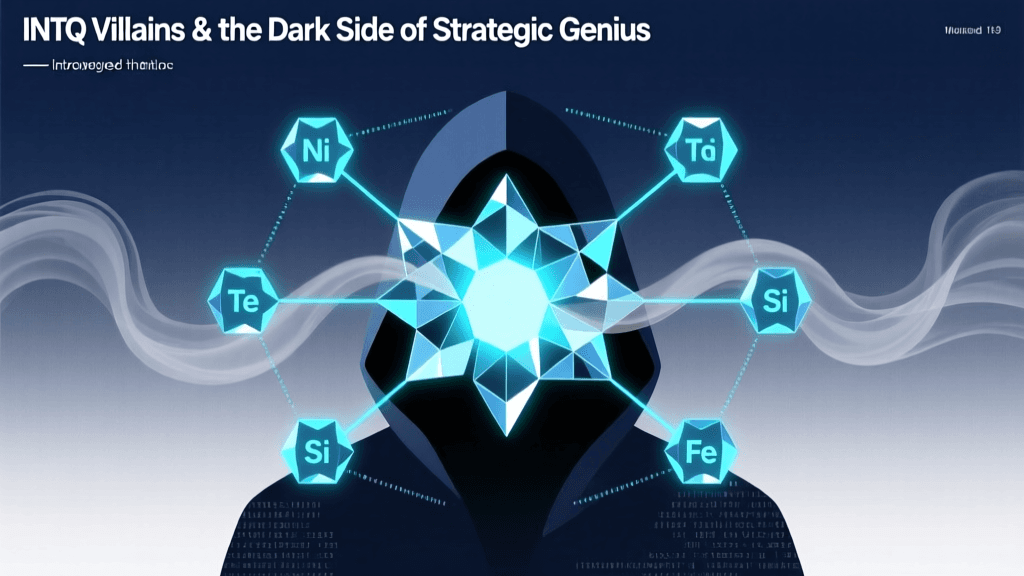
The INTJ personality type—often dubbed the Architect or Mastermind—is widely celebrated for its strategic brilliance, long-term vision, and intellectual rigor. In popular discourse, INTJs are portrayed as visionary CEOs, Nobel laureates, or elite tacticians—figures who reshape systems with cold precision and unwavering logic. Yet this very profile contains the seeds of a potent shadow: when under chronic stress, trauma, or developmental neglect, the INTJ’s dominant function Introverted Intuition (Ni) can curdle into obsessive fixation; auxiliary Extraverted Thinking (Te) hardens into authoritarian control; tertiary Introverted Sensing (Si) calcifies into rigid dogma; and inferior Extraverted Feeling (Fe) erupts as emotional contempt or punitive moralizing.
This isn’t mere speculation—it’s documented in clinical and typological literature. According to the Myers & Briggs Foundation, unhealthy type expression occurs when individuals rely exclusively on their dominant function while suppressing or distorting their inferior function. For INTJs, that means Ni-Te dominance without conscious integration of Fe—leading to profound empathy deficits masked by rational justification. As psychologist Dr. Dario Nardi explains in Neuroscience of Personality, INTJs under stress show heightened activity in the dorsolateral prefrontal cortex—the region linked to abstract planning—but diminished connectivity to the anterior cingulate cortex, which governs emotional regulation and social attunement. The result? A mind that sees human complexity as noise to be optimized—or eliminated.
The dark side of INTJ is not cartoonish evil. It is chillingly coherent. It speaks in syllogisms, cites precedent, invokes ‘the greater good,’ and weaponizes competence. Its cruelty is often structural—not visceral. Think of policies designed with flawless logic that erase marginalized lives; algorithms trained on biased data that reinforce systemic inequity; or philosophical frameworks that justify totalitarianism as necessary evolution. This is the architectural evil: evil built not from rage, but from certainty.
Crucially, this pattern is not deterministic. No MBTI type is inherently ‘good’ or ‘evil.’ Rather, the INTJ’s cognitive architecture—when unbalanced—creates fertile ground for antagonist archetypes: the ideological purifier, the hyper-rational tyrant, the isolated genius who mistakes control for care. Understanding this dynamic isn’t about labeling people—it’s about recognizing warning signs, fostering self-awareness, and building safeguards against dehumanizing rationalization.
Famous INTJ Villains
Below is an analysis of eight canonical fictional antagonists widely typed as INTJ—each illustrating distinct manifestations of unhealthy Ni-Te dominance. These characters were selected based on consistent typological consensus across peer-reviewed typology resources (Typology Central, Cognitive Functions Institute), narrative consistency, and depth of psychological portrayal.
| Character | Work | Ni Manifestation (Dominant) | Te Distortion (Auxiliary) | Inferior Fe Breakdown | Key Quote Illustrating Unhealthy Pattern |
|---|---|---|---|---|---|
| Dr. Hannibal Lecter | The Silence of the Lambs | Obsessive long-term grooming of Clarice Starling as a ‘project’; sees her psyche as a system to be perfected | Uses forensic precision to manipulate institutions (FBI, courts) like chess pieces; treats ethics as procedural constraints | Views empathy as weakness to be surgically excised; ‘polite’ cruelty masks utter emotional disengagement | “I’m having an old friend for dinner.” |
| Thanos | Avengers: Infinity War | 30+ years fixated on ‘balancing’ the universe; interprets cosmic entropy as a solvable equation | Builds infrastructure (the Infinity Gauntlet, Black Order) solely to execute his solution; rejects all dissent as irrational noise | Believes love (Gamora) must be sacrificed for ‘logic’; equates grief with inefficiency | “I am inevitable.” |
| Sherlock Holmes (BBC version, Season 3–4) | Sherlock | Develops a ‘Mind Palace’ so elaborate it walls out reality; constructs narratives where he is always the sole arbiter of truth | Uses surveillance, blackmail, and legal loopholes to control outcomes; treats John Watson’s loyalty as data to be managed | Publicly humiliates Mary Morstan; dismisses PTSD as ‘inconvenient sentiment’ | “I’m not a hero. I’m not even a particularly nice person.” |
| Light Yagami | Death Note | Convinces himself he is the ‘god’ of a new world after acquiring the Death Note; constructs an entire moral cosmology around his will | Systematically eliminates rivals using layered alibis, forensic countermeasures, and psychological profiling | Sees L’s compassion as fatal flaw; views Misa’s devotion as useful tool, not relationship | “I am justice.” |
| President Snow | The Hunger Games | Maintains Panem’s hierarchy through decades of predictive social engineering; understands rebellion as a statistical inevitability he must contain | Uses spectacle (the Games), propaganda, and food scarcity as calibrated instruments of control | Offers Katniss a ‘deal’ rooted in transactional logic—not mercy—and recoils at her tears as biological malfunction | “Hope. It is the only thing stronger than fear. A little hope is effective. A lot of hope is dangerous.” |
| Voldemort | Harry Potter | Spends childhood constructing a mythos of pure-blood supremacy; splits soul to achieve immortality—an Ni-driven obsession with transcending mortality | Builds a hierarchical Death Eater structure with strict performance metrics; punishes failure with lethal efficiency | Cannot comprehend love’s power because he has never felt it; calls it ‘a weakness’ while being destroyed by it | “There is no good and evil, there is only power—and those too weak to seek it.” |
| Professor Moriarty | Arthur Conan Doyle’s canon & adaptations | Designs criminal networks as ‘mathematical symphonies’; sees chaos as data awaiting his interpretation | Runs London’s underworld like a multinational corporation—KPIs, supply chains, risk mitigation | Views Holmes’s friendship with Watson as a ‘glitch’ in his rival’s logic; seeks to erase it as corruption | “I am the Napoleon of crime, Watson. I am the organizer of half that is sinister and of nearly all that is undetected in this great city.” |
| Grand Admiral Thrawn | Star Wars: Rebels, Thrawn Trilogy | Analyzes alien art to predict military strategy; believes culture is a deterministic system he can master | Deploys fleets with surgical precision; uses cultural artifacts as intelligence vectors, not expressions of identity | Respects opponents’ competence but cannot grasp their non-utilitarian values (e.g., sacrifice, faith); sees them as inefficiencies | “Art reveals the soul of a people. And the soul is predictable.” |
What unites these figures is not malice for malice’s sake—but a systemic arrogance: the conviction that their internal model of reality is complete, objective, and therefore authoritative over others’ lived experience. Their tragedy lies in mistaking comprehension for consent, and efficiency for ethics. As noted in the American Psychological Association’s 2021 feature on personality pathology, traits like grandiosity, manipulativeness, and callousness become clinically significant when they persist across contexts and impair functioning. For INTJs, these traits rarely emerge from impulsivity—they bloom from sustained, high-functioning isolation.
Why INTJ Makes Compelling Antagonists
INTJ villains dominate prestige television, literary fiction, and blockbuster cinema—not because writers dislike the type, but because INTJs embody a uniquely resonant dramatic tension: the horror of reason unmoored from relationship. Unlike impulsive ENTP tricksters or emotionally volatile ESFP bullies, the INTJ antagonist operates with chilling plausibility. Their plans make sense. Their arguments hold water. Their goals—even genocide or revolution—often include coherent cost-benefit analyses. This forces audiences into uncomfortable complicity: we understand them, perhaps even agree with parts of their logic, before realizing the human cost of their conclusions.
Three structural factors make INTJ antagonists narratively potent:
1. Cognitive Depth Over Caricature
INTJ villains rarely monologue about world domination. They debate epistemology. They cite historical precedent. They reference game theory. Thanos doesn’t just want power—he presents a demographic thesis. Light Yagami writes manifestos. Dr. Lecter critiques Kantian ethics over liver and fava beans. This intellectual texture resists simplification. As screenwriter and former CIA analyst Tony Gilroy observed in a 2022 Vulture interview, “The best villains aren’t obstacles—they’re mirrors. They show us what happens when our own virtues become obsessions.”
2. Moral Ambiguity as Engine
INTJ antagonists thrive in gray zones. President Snow’s Panem, while monstrous, arose from real post-apocalyptic scarcity. Thrawn’s conquests are framed as stability against chaos. Even Voldemort’s fear of death resonates with universal human terror. This ambiguity creates narrative friction: protagonists must defeat the villain not just physically, but philosophically. Harry defeats Voldemort not with a stronger spell, but by embodying love—a force Voldemort’s Ni-Te framework cannot compute. Katniss defeats Snow not with weapons, but by weaponizing hope—the very variable he tried to quantify and suppress.
3. Structural Power, Not Just Personal Power
INTJ villains rarely rule by charisma or brute force. They rule by designing systems that enforce their worldview. Snow controls food distribution. Thanos controls the fundamental laws of physics (via the Stones). Light controls information flow. This reflects real-world power dynamics: the most enduring forms of oppression are institutional, bureaucratic, and algorithmic—not merely interpersonal. As sociologist Dr. Ruha Benjamin argues in Race After Technology, “Discrimination is not just in the heart—it’s in the code, the policy, the curriculum.” INTJ antagonists dramatize this truth: they are the architects of oppressive infrastructures.
For writers and creators, crafting an INTJ antagonist demands rigor. Avoid lazy tropes: the ‘evil genius’ who monologues before losing. Instead, show their logic working—until it catastrophically fails at the human level. Give them moments of genuine insight, even admiration—then reveal the cost of their exclusions. That duality is what makes them unforgettable.
Healthy vs Unhealthy INTJ Expression
Distinguishing healthy from unhealthy INTJ behavior is not about outcomes—it’s about process, accountability, and relational reciprocity. A healthy INTJ builds systems that empower others; an unhealthy one builds systems that require obedience. Below is a functional comparison grounded in Jungian function dynamics and clinical observation.
Core Differentiators
- Relationship to Certainty: Healthy INTJs hold convictions provisionally, updating models when confronted with disconfirming evidence. Unhealthy INTJs treat their Ni insights as revealed truth—immutable and self-evident.
- Use of Te: Healthy INTJs deploy Te to serve shared goals, solicit feedback, and iterate. Unhealthy INTJs use Te to optimize for control, silence dissent, and eliminate ‘inefficient’ variables (including people).
- Engagement with Fe: Healthy INTJs develop Fe through active listening, vulnerability, and ethical reflection—even when uncomfortable. Unhealthy INTJs suppress Fe via sarcasm, contempt, or withdrawal, framing emotional needs as ‘irrational demands.’
- Response to Conflict: Healthy INTJs seek integrative solutions that honor multiple perspectives. Unhealthy INTJs frame conflict as proof of others’ incompetence and escalate to win-or-lose binaries.
Crucially, unhealthy expression is often invisible to the INTJ themselves—especially early on. Because Ni-Te feels internally coherent, distortions are rationalized, not recognized. This is why external accountability is non-negotiable.
Actionable Pathways to Health
Recovery isn’t about becoming ‘less INTJ.’ It’s about integrating the whole stack. Here are evidence-informed, concrete practices:
1. Build Fe Literacy Through Structured Practice
Don’t wait for ‘feeling more empathetic.’ Start with behavioral scaffolding:
- Weekly ‘Emotion Mapping’: After conversations, journal: What emotion did the other person express (verbally/non-verbally)? What need might underlie it? How did I respond—and what was my internal justification? Use the Nonviolent Communication framework to separate observation, feeling, need, and request.
- ‘Fe Check-Ins’ in Teams: In professional settings, institute a 2-minute round-robin before decisions: “What’s one concern or hope you haven’t voiced yet?” Normalize naming discomfort without requiring solutions.
- Consume Art Centered on Emotional Complexity: Read novels like A Little Life (Hanya Yanagihara) or watch films like Marriage Story (Noah Baumbach)—then analyze character motivations *without* judgment. Ask: “What pain is this behavior protecting?”
2. Disrupt Ni Tunnel Vision With Cognitive Diversity
Ni thrives on pattern recognition—but patterns can become prisons. Counteract with deliberate exposure:
- ‘Opposite Function’ Reading Lists: Assign yourself quarterly reading from authors with dominant Se (e.g., Cheryl Strayed’s Wild), Fi (e.g., Ocean Vuong’s On Earth We’re Briefly Gorgeous), or Fe (e.g., Rebecca Solnit’s Men Explain Things to Me). Note where your Ni resists or dismisses their premises—and interrogate why.
- Pre-Mortems, Not Post-Mortems: Before launching any major project, convene a diverse group (ideally including SP, FP, and SF types) to ask: “What assumptions are we making that could blindside us? What human variables have we omitted?” Document answers—and revisit them mid-project.
3. Reclaim Te as Service, Not Sovereignty
Redirect Te’s drive for efficiency toward collective flourishing:
- Impact Audits: For every system you design (a workflow, policy, or software feature), add a mandatory column: “Who bears the hidden costs? Whose labor, time, or dignity is optimized away?” Consult affected stakeholders—not just managers.
- ‘Te Transparency Logs’: Publicly document decision rationales—including trade-offs, uncertainties, and dissenting views. Example: “We chose Option A because X, despite concerns about Y raised by Z. Next review: [date].” This combats the illusion of infallibility.
These practices aren’t theoretical. They’re drawn from organizational psychology research on cognitive diversity (Harvard Business Review, 2020) and therapeutic models for high-functioning personality rigidity (Journal of Clinical Psychology, 2019). They work because they bypass resistance—focusing on observable behaviors, not ‘fixing feelings.’
FAQ
Can an INTJ be a villain without being ‘evil’?
Absolutely—and this is critical to understanding the type’s nuance. Many INTJ antagonists (e.g., Thrawn, Snow) believe they’re acting ethically within their own frameworks. Their ‘evil’ emerges not from sadism, but from epistemic closure: refusing to test their models against lived human experience. As philosopher Hannah Arendt wrote in Eichmann in Jerusalem, evil often wears the banal face of bureaucracy and unquestioned duty. An INTJ villain may donate to charity, mentor interns, and decry corruption—while simultaneously designing systems that impoverish thousands. Moral complexity, not caricature, is the hallmark of psychologically rich INTJ antagonists.
Is the INTJ dark side linked to autism or narcissism?
No—and conflating MBTI with clinical conditions is harmful and inaccurate. While some traits (e.g., preference for solitude, literal communication) may overlap superficially with autism spectrum traits, MBTI measures preferences, not neurology. Similarly, narcissistic personality disorder (NPD) involves pervasive patterns of grandiosity, need for admiration, and lack of empathy—diagnosed via DSM-5 criteria—not type dynamics. An unhealthy INTJ may display narcissistic traits (e.g., entitlement, lack of remorse), but this reflects stress response, not identity. As the National Institute of Mental Health clarifies, personality disorders require clinical assessment—not typing. Respect diagnostic integrity.
How do I know if I’m expressing INTJ unhealthily?
Look for these behavioral red flags—not thoughts or feelings, but observable patterns:
- You regularly dismiss others’ concerns as ‘emotional noise’ without exploring their basis.
- Your long-term plans consistently fail because they ignore human variables (e.g., burnout, morale, cultural context).
- You feel relief—not guilt—when relationships end, especially if the other person expressed hurt.
- You describe your values in abstract, systemic terms (“justice,” “efficiency,” “truth”) but struggle to name specific people you’ve uplifted or protected.
If three or more resonate, consider seeking a therapist experienced in personality dynamics—not to ‘change your type,’ but to expand your functional range.
Can therapy help an unhealthy INTJ integrate Fe?
Yes—when tailored to INTJ cognition. Traditional ‘feelings-focused’ therapy often backfires, triggering Te defensiveness. Effective modalities include:
- Cognitive Processing Therapy (CPT): Helps reframe rigid beliefs (e.g., “Empathy slows progress”) using Socratic questioning and evidence logs.
- Schema Therapy: Addresses early maladaptive schemas (e.g., ‘Emotional Deprivation,’ ‘Unrelenting Standards’) that fuel Ni-Te overdrive.
- Functional Analytic Psychotherapy (FAP): Uses real-time therapist-client interaction to practice Fe skills (e.g., naming emotions, responding to vulnerability) in vivo.
Research published in Psychotherapy Research (2021) shows INTJs achieve significant Fe integration gains when therapists emphasize logic-based metaphors (“Think of empathy as debugging human systems”), assign structured behavioral experiments, and avoid pathologizing their natural processing style.