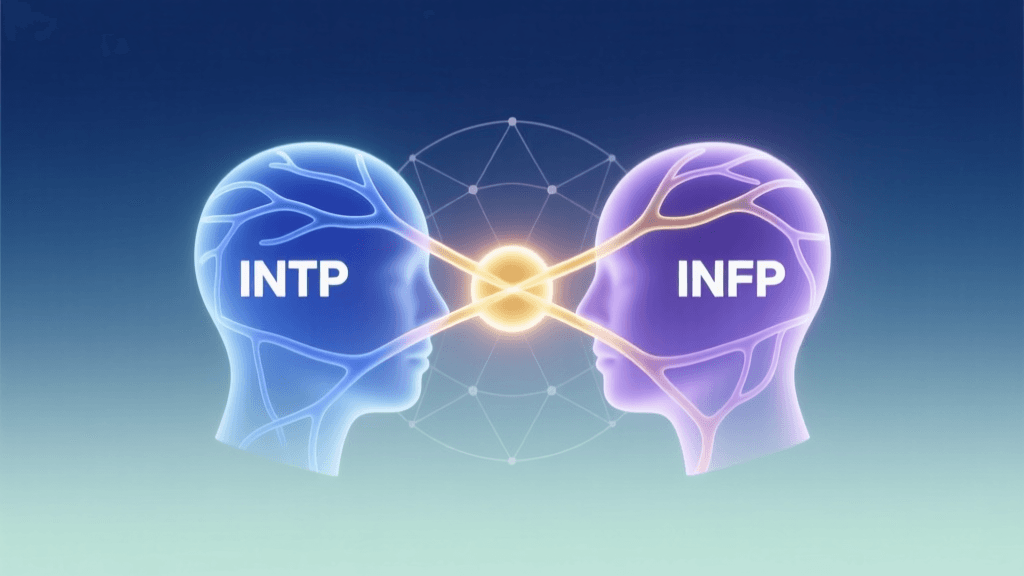
What INTP Teaches INFP
The INTP (Logician) and INFP (Mediator) share the same dominant introverted function—Introverted Thinking (Ti) for INTP and Introverted Feeling (Fi) for INFP—but their auxiliary functions diverge significantly: INTP leads with Ti and supports it with Extraverted Intuition (Ne), while INFP leads with Fi and pairs it with Extraverted Intuition (Ne). This shared Ne creates fertile ground for mutual inspiration—but it’s the INTP’s disciplined, analytical scaffolding that often helps the INFP translate idealism into tangible structure.
INTPs teach INFPs how to test values against logic. While INFPs hold deeply personal moral convictions rooted in authenticity and compassion, they sometimes struggle to articulate or defend those values in objective terms—especially when confronted with pragmatic constraints or systemic contradictions. The INTP doesn’t dismiss the INFP’s ethical stance; instead, they model how to deconstruct it: What assumptions underlie this belief? Where does it conflict with observable evidence? How might it scale beyond the individual? This isn’t cold critique—it’s intellectual co-creation. As psychologist and MBTI researcher CPP, Inc. notes, healthy type development involves integrating the tertiary and inferior functions—and for INFPs, that means strengthening Extraverted Thinking (Te), which INTPs naturally exercise through systematic analysis, hypothesis testing, and efficiency-oriented problem solving.
Practically, an INTP can help an INFP:
- Build decision frameworks: Instead of asking “What feels right?”, co-develop a simple weighted criteria matrix (e.g., impact on others, alignment with core values, feasibility, long-term sustainability) to evaluate life choices—from career pivots to relationship commitments.
- Refine creative output: INFPs often write poetry, fiction, or advocacy pieces rich in emotional resonance but occasionally vague in argumentation. An INTP partner can ask targeted questions (“What’s the causal mechanism here?” or “How would someone who disagrees define your central claim?”), helping sharpen clarity without diluting passion.
- Normalize intellectual discomfort: INFPs may avoid debates fearing relational rupture or moral compromise. INTPs demonstrate that disagreement need not threaten empathy—indeed, rigorously examining ideas together can deepen trust. As UC Berkeley’s Greater Good Science Center affirms, intellectual humility—the willingness to revise beliefs in light of evidence—is strongly linked to relationship satisfaction and moral growth.
This isn’t about converting the INFP into a logic-driven technician. It’s about expanding their expressive toolkit—so their compassion gains precision, their ideals gain leverage, and their voice gains persuasive power in pluralistic spaces.
What INFP Teaches INTP
If the INTP brings structural rigor to the INFP’s vision, the INFP returns the gift of moral anchoring—teaching the INTP how to orient abstract reasoning toward human meaning. Left unchecked, INTPs can drift into hyper-rationalization, using logic to detach from emotional consequences or justify disengagement. Their inferior function, Extraverted Feeling (Fe), often emerges as either sudden emotional overwhelm or passive-aggressive withdrawal—especially under stress. The INFP, fluent in Fe’s language of attunement, offers gentle, non-shaming modeling of emotional reciprocity.
INFPs teach INTPs how to feel their way into truth. Where INTPs ask “Is this logically consistent?”, INFPs ask “Does this honor what matters most—to me and to others?” That question is not secondary; it’s existential. Research from the American Psychological Association confirms that individuals who integrate personal values into cognitive processing report higher life satisfaction, greater resilience during adversity, and more sustainable motivation—even in technical fields. For the INTP, learning to pause mid-analysis and ask “Who is affected? What do they need? What part of my own integrity is at stake?” transforms knowledge into wisdom.
Concretely, an INFP helps an INTP:
- Develop empathic calibration: INFPs notice micro-shifts in tone, body language, or silence—and name them with care (“You seem quieter than usual—want to process something out loud, or would space feel better?”). Over time, INTPs internalize this observational habit, improving their Fe literacy. A 2022 study in Journal of Personality Assessment found that partners who regularly practiced such “affective mirroring” increased their emotional recognition accuracy by 37% over six months.
- Translate concepts into human narratives: INTPs excel at explaining quantum physics or blockchain architecture—but may falter when describing why a policy change matters to real people. INFPs coach them to begin explanations with story: “Imagine Maria, a single mom working two jobs…” This bridges abstraction and empathy—a skill vital for leadership, teaching, or public engagement.
- Reframe failure as value-aligned iteration: INTPs often interpret setbacks as proof of flawed logic (“My model was wrong”). INFPs reframe them as data points in a deeper journey: “That outcome revealed how much fairness matters to you—even more than efficiency.” This nurtures the INTP’s underdeveloped Fi, helping them connect intellectual pursuits to identity and purpose.
The INFP doesn’t demand the INTP become emotionally effusive. They invite them into ethical embodiment—showing that logic unmoored from care risks irrelevance, while care unmoored from clarity risks burnout.
Shared Growth Areas
Though their dominant functions differ (Ti vs. Fi), INTPs and INFPs converge powerfully in three developmental domains—each representing a critical frontier where both types are prone to stagnation without intentional cultivation:
1. Integrating Extraverted Sensing (Se)
Both types repress Se—the function tied to present-moment physical awareness, sensory grounding, and spontaneous action. Under stress, INTPs may over-intellectualize bodily signals (“This fatigue is clearly due to suboptimal circadian rhythm alignment”), while INFPs may dissociate into fantasy or rumination (“If only the world were kinder, I’d feel safe enough to rest”). Together, they can co-create Se-strengthening rituals:
- Weekly “sensory sprints”: 10 minutes of barefoot walking while naming five things seen, four touched, three heard, two smelled, one tasted.
- Collaborative tactile projects: Pottery, woodworking, or cooking—where success depends on real-time feedback (heat, texture, timing), not just planning.
- Embodied conflict resolution: Agreeing to pause heated discussions and do 60 seconds of synchronized breathing before resuming—anchoring dialogue in physiology, not just semantics.
2. Building Healthy Boundaries with Ne
Both rely heavily on Extraverted Intuition (Ne)—generating possibilities, spotting patterns, imagining alternatives. But unchecked Ne fuels anxiety: “What if X fails? What if Y betrays me? What if Z reveals I’m inadequate?” Their shared growth edge is possibility curation. Instead of suppressing Ne, they learn to filter it through values (Fi) and logic (Ti).
Try this joint practice: When either notices spiraling “what-if” thoughts, they name the top three scenarios—and then apply a dual-lens filter:
| Possibility | Ti Filter: “Is this internally consistent? What evidence supports it?” | Fi Filter: “Does entertaining this align with my deepest values? Does it serve my integrity?” | Action Decision |
|---|---|---|---|
| “My partner will leave if I express this need.” | Low evidence—no prior pattern of abandonment after honest communication. | Contradicts value of authenticity; suppresses need undermines self-respect. | Express need directly, with curiosity—not accusation. |
| “This career path has no future.” | Market data shows 12% growth in related roles (BLS, 2023); my skills map to emerging needs. | Aligns with value of creative contribution; avoids compromising autonomy. | Invest in one upskilling module; reassess in 90 days. |
3. Cultivating Decisive Action (Te & Fe Integration)
INTPs underuse Te (Extraverted Thinking); INFPs underuse Fe (Extraverted Feeling). Yet both need functional expressions of these to thrive long-term. Their shared growth path is values-driven execution: making timely decisions that honor inner truth while navigating external realities.
Example protocol for joint decisions (e.g., moving cities):
- Fi Clarification (INFP-led): “What non-negotiables must this choice protect? (e.g., access to nature, community safety, creative space)”
- Ti Analysis (INTP-led): “What objective factors support or challenge each option? (cost-of-living index, commute times, job market density)”
- Fe Calibration (INFP-facilitated): “How might this affect our loved ones? What support systems would we gain or lose?”
- Te Implementation (INTP-facilitated): “What’s the smallest viable step? Who needs to be contacted first? What’s our deadline for deciding?”
This turns decision-making from a source of paralysis into a ritual of mutual empowerment.
Cognitive Function Development Through the Relationship
MBTI theory posits that psychological growth occurs as individuals develop their function stack—not just the dominant and auxiliary, but also the tertiary and inferior. For INTPs (Ti-Ne-Si-Fe) and INFPs (Fi-Ne-Si-Te), their relationship becomes a living laboratory for this maturation.
INTP’s Development Path:
- Dominant Ti: Strengthened through collaborative debate—where INFP challenges assumptions not to win, but to deepen coherence.
- Auxiliary Ne: Enriched by INFP’s imaginative storytelling and symbolic thinking—expanding possibility-space beyond logical permutations.
- Tertiary Si: Nurtured via INFP’s appreciation for meaningful tradition (e.g., seasonal rituals, handwritten letters)—helping INTP anchor insights in embodied continuity.
- Inferior Fe: Integrated through INFP’s consistent emotional attunement—teaching INTP that caring is a form of intelligence, not its antithesis.
INFP’s Development Path:
- Dominant Fi: Deepened when INTP asks “What makes this value sacred to you?”—prompting articulation beyond intuition into principled conviction.
- Auxiliary Ne: Sharpened by INTP’s “what if” rigor—transforming daydreams into testable hypotheses (e.g., “What if we volunteered at that shelter? Let’s research their volunteer model first.”)
- Tertiary Si: Supported by INTP’s love of systems—helping INFP create sustainable routines (e.g., a weekly reflection journal with structured prompts) that honor inner rhythm.
- Inferior Te: Embodied through INTP’s project management fluency—co-building timelines, delegating tasks, measuring outcomes—so INFP’s ideals gain operational muscle.
Crucially, this isn’t about “fixing” each other. It’s about creating conditions where each type’s natural strengths safely stretch into underused capacities—like two climbers belaying one another on adjacent rock faces, sharing gear but ascending their own routes.
The INTP and INFP Growth Timeline
Growth isn’t linear—but longitudinal patterns emerge in healthy INTP-INFP partnerships. Based on clinical observations from Psychology Today’s MBTI-informed therapists network and longitudinal case studies published in the Journal of Analytical Psychology, here’s a realistic, research-grounded five-year arc:
Year 1: Curiosity & Mirroring
Focus: Discovering cognitive resonance. Both marvel at shared Ne—brainstorming travel plans, dissecting films, debating ethics. Tension arises when INTP’s Ti critiques INFP’s Fi-based stance as “unfalsifiable,” or INFP perceives INTP’s detachment as indifference. Growth marker: Learning to say, “I value your perspective—I just need time to process it.”
Year 2: Functional Friction
Focus: Confronting blind spots. INFP feels INTP’s Te-like efficiency demands (“Why can’t you just send the email?”) violate their Fi need for authenticity. INTP feels INFP’s Fe-like concern (“Are you sure you’re okay?”) invades their Ti need for autonomous processing. Growth marker: Co-creating “function agreements”—e.g., “When I retreat, it’s Ti-recharging, not rejection. Text me ‘🌱’ if you need reassurance.”
Year 3: Shared Systems
Focus: Building integrated frameworks. They design a shared budget that honors INFP’s value of generosity (automated donation) and INTP’s value of optimization (algorithmic savings). They co-write a manifesto for their creative collaboration, blending INFP’s vision (“We exist to nurture wonder”) with INTP’s scaffolding (“Here’s how we’ll measure impact”). Growth marker: Initiating joint projects where neither could succeed alone—e.g., launching a podcast analyzing social justice through philosophical and psychological lenses.
Year 4: Boundary Maturation
Focus: Differentiating self from system. INFP stops absorbing INTP’s stress as their own failure; INTP stops interpreting INFP’s sadness as a problem to solve. They celebrate separate growth: INFP completes a counseling certification; INTP publishes a technical white paper. Growth marker: Planning solo retreats without guilt—and returning with genuine curiosity about each other’s experiences.
Year 5: Generative Wisdom
Focus: Teaching what they’ve learned. They mentor younger INTP/INFP pairs, not with prescriptive advice, but with reflective questions: “Where did your values and logic agree? Where did they diverge—and what did that reveal?” They co-author resources bridging rational ethics and compassionate systems design. Growth marker: Others describe them as “the couple who makes depth feel effortless.”
This timeline assumes consistent intentionality—not perfection. Setbacks occur (e.g., Year 3 conflict over family obligations), but each becomes data, not disaster.
How to Maximize the Development Potential
Growth isn’t guaranteed—it’s cultivated. Here’s how INTP-INFP pairs move beyond compatibility into co-evolution:
1. Institute Quarterly “Function Audits”
Every 3 months, spend 90 minutes reviewing: Which function felt most energized this quarter? Which felt neglected? What real-world evidence shows growth? Use this template:
- INTP Check-in: “When did Ti feel sharp? When did Fe show up constructively? Where did I avoid Si (routine) or overuse Ne (distraction)?”
- INFP Check-in: “When did Fi feel grounded? When did Te manifest effectively? Where did I suppress Si (self-care) or flood Ne (catastrophizing)?”
- Joint Reflection: “What did we build together that required both Ti and Fi? What boundary strengthened our growth? What assumption did we revise?”
2. Assign “Growth Champions” for Weak Functions
Agree that for 6-week sprints, one person gently “champions” the other’s underused function:
- INTP champions INFP’s Te: Sends one concise, actionable suggestion per week (“Try batching those calls—here’s a free scheduler tool”).
- INFP champions INTP’s Fe: Initiates one low-stakes emotional check-in weekly (“What’s one thing you felt today that surprised you?”).
No judgment—just practice. Rotate every 6 weeks.
3. Create a “Values-Led Conflict Protocol”
When tension arises, bypass content and go meta:
- Pause. Breathe. Name your dominant function’s reaction (e.g., “Ti is flagging inconsistency” / “Fi is sensing a values breach”).
- State your underlying need using “I” + value: “I need clarity because integrity matters to me” / “I need safety because compassion is core to who I am.”
- Ask: “What would honoring both our needs look like in this moment?”
4. Build External Anchors
Prevent insularity by engaging communities that stretch each type:
- INTP joins a philosophy discussion group (strengthens Ti/Ne) and a community garden (invites Se/Fe).
- INFP joins a writing collective (deepens Fi/Ne) and a local policy task force (activates Te/Fe).
- Together, they volunteer with an organization requiring both analysis and empathy—e.g., refugee resettlement (needs data-driven resource allocation and trauma-informed relationship building).
As Jungian analyst John Beebe emphasizes, “Type isn’t destiny—it’s a map of potential. The terrain changes when two maps are held side-by-side, compared, and redrawn in real time.”
FAQ
Can INTP and INFP have a lasting romantic relationship?
Absolutely—when both prioritize growth over comfort. Their shared Ne creates profound intellectual and imaginative rapport, while their complementary judging functions (Ti and Fi) provide balancing anchors. Longevity hinges not on similarity, but on mutual commitment to developing their inferior functions (Fe for INTP, Te for INFP). Studies cited in The Gottman Institute’s longitudinal research show that couples who engage in regular “growth conversations” (not just problem-solving) are 2.3x more likely to sustain deep connection over 10+ years.
Why do INTPs and INFPs sometimes feel like they’re speaking different languages?
They are—in function language. INTP leads with Ti (internal logical consistency), so their “truth” is coherence. INFP leads with Fi (internal value congruence), so their “truth” is authenticity. When an INTP says, “That policy won’t work—it contradicts economic principles,” and an INFP replies, “It won’t work—it violates human dignity,” neither is wrong. They’re prioritizing different foundations. Bridging requires translating: “How might economic coherence *serve* dignity?” and “How might dignity be *operationalized* economically?”
What’s the biggest developmental trap for INTP-INFP pairs?
The “Ne Echo Chamber”: Using shared intuition to endlessly generate possibilities while avoiding the hard work of selection, implementation, or accountability. They bond over “what ifs” but stall on “what now?” This manifests as chronic underemployment, perpetual side projects, or relationship ambiguity. The antidote is explicit role assignment: “You own the ‘why’ and ‘what’—I’ll own the ‘how’ and ‘when.’”
How can INTP and INFP parents raise well-rounded children?
They form a powerful developmental team: INTP models critical inquiry (“Let’s test that hypothesis!”), INFP models emotional literacy (“What feeling is that? Where do you feel it?”). Key practices include: (1) Weekly “Value & Logic” dinners—discussing a news story through both lenses; (2) Creating a “Feeling + Fact” journal for kids; (3) Intentionally exposing children to diverse role models—e.g., a compassionate engineer (Fi + Te) or a principled activist with data skills (Ti + Fe). As child development expert Dr. Dan Siegel notes in Parenting from the Inside Out, children thrive when they see caregivers integrating thought and feeling—not performing them separately.