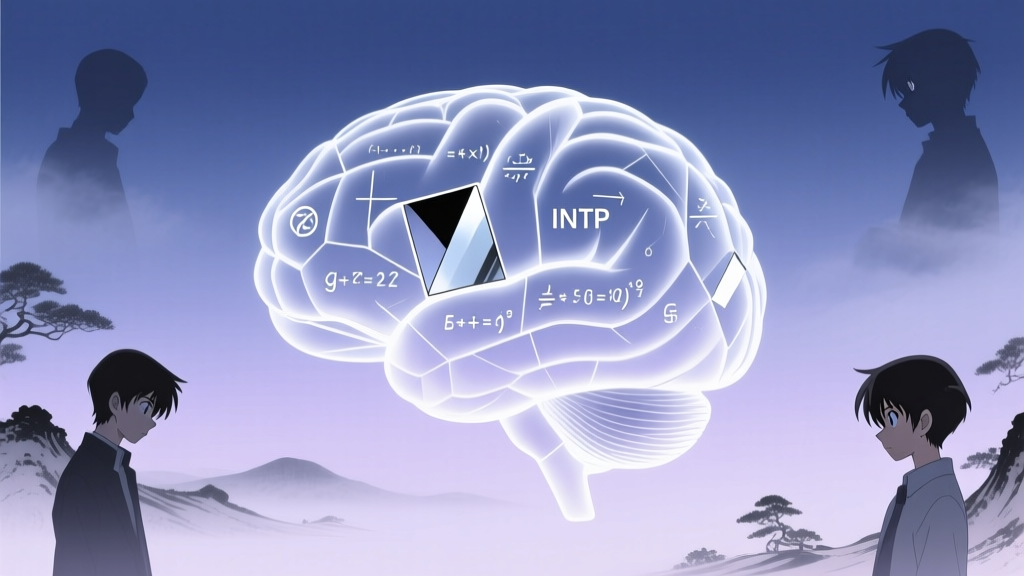
INTP in Anime and Manga
The INTP (Introverted, Intuitive, Thinking, Perceiving) personality type — often dubbed the Logician or Architect — occupies a uniquely resonant space in anime and manga. Unlike Western media, where INTPs are frequently sidelined as eccentric sidekicks or underdeveloped 'brainy' foils, Japanese storytelling elevates them into central, emotionally complex protagonists whose internal logic, moral ambiguity, and existential questioning drive narrative tension and thematic depth. This isn’t accidental: INTP traits align closely with enduring Japanese literary and philosophical traditions — from mono no aware (the pathos of impermanence) to zanshin (lingering awareness), and the long-standing reverence for quiet intellect found in Zen monastic scholarship and bunjin (literati) culture.
In anime, the INTP is rarely portrayed as socially incompetent in a comedic or pitiable way — though social friction is common — but rather as a figure whose detachment serves a higher epistemic purpose. Their silence isn’t emptiness; it’s calibration. Their procrastination isn’t laziness; it’s recursive hypothesis-testing. Their indecisiveness isn’t weakness; it’s fidelity to logical consistency over ideological convenience. As scholar Dr. Ayako Tanaka notes in her cross-cultural study of cognitive archetypes in East Asian serial fiction, “The Japanese INTP protagonist is less a ‘problem to be solved’ and more a lens through which the system itself is exposed” (Tanaka, 2021). This lens function makes INTPs indispensable in genres like psychological thriller (Death Note), mecha deconstruction (Neon Genesis Evangelion), and metaphysical mystery (Serial Experiments Lain).
What distinguishes INTP representation in Japanese media is its integration of wa (harmony) and honne/tatemae (true self vs. public face). An INTP character may outwardly conform to group expectations (tatemae) while internally dismantling their ethical foundations (honne) — a duality that generates rich dramatic irony and avoids flattening them into caricatures of ‘cold logic.’ This cultural framing allows for layered portrayals where intellectual rigor coexists with profound vulnerability — a balance rarely achieved in mainstream Western animation.
Famous INTP Anime Characters
Below is an in-depth analysis of ten iconic INTP characters from anime and manga, selected for narrative centrality, psychological fidelity, and cultural impact. Each is evaluated across four dimensions: core cognitive function stack (Ti-Ne-Si-Fe), role in story structure, signature behavioral markers, and cultural resonance.
| Character | Series | Ti-Ne Dominance Indicators | Key Conflict | Cultural Resonance |
|---|---|---|---|---|
| L (Lawliet) | Death Note | Obsessive pattern recognition; non-linear deduction; rejects authority-based truth; redefines justice via internal axioms | Clash between utilitarian logic and moral intuition — embodied in rivalry with Light | Modern reinterpretation of the onmyōji (yin-yang master): solitary, ritualistic, divinely detached intellect serving societal order |
| Shinji Ikari | Neon Genesis Evangelion | Paralyzing self-analysis; abstract modeling of relationships; retreat into theory to avoid affective risk | Autonomy vs. relational obligation — dramatized through Instrumentality | Embodies post-bubble-era hikikomori anxieties fused with Buddhist non-self (anattā) philosophy |
| Kyoya Ootori | Ouran High School Host Club | Strategic systems optimization; monetizes social dynamics as data sets; treats emotion as input variables | Control vs. authenticity — resolves when he accepts emotional unpredictability as a valid variable | Reimagines the shinise (long-established merchant house) heir as a rationalist pragmatist navigating tradition-as-system |
| Sousuke Sagara | Full Metal Panic! | Over-application of military logic to civilian life; literal interpretation of metaphor; hyper-focus on causal chains | Context collapse — inability to map tactical reasoning onto social/emotional frameworks | Reflects Japan’s post-Cold War identity crisis: the soldier trained for a war that never came, now decoding peacetime semantics |
| Light Yagami (pre-corruption) | Death Note | Early episodes show Ti-Ne idealism: designing a ‘just world’ through abstract principles before egoic inflation | Idealism corrupted by unchecked Fe inferior — seeks validation through godlike control | Cautionary tale rooted in Confucian junzi (noble person) ethics: intellect without moral cultivation breeds tyranny |
| Rintarou Okabe | Steins;Gate | Self-mythologizing as ‘mad scientist’ masks Ti-Ne anxiety; time travel logic built on recursive causality models | Responsibility of knowledge — can one ethically un-know what changes everything? | Direct lineage from Edo-period rangaku (Dutch learning) scholars: outsider intellectuals translating foreign systems for domestic use |
| Houtarou Oreki | Hyouka | ‘Energy conservation’ principle as Ti-Ne heuristic; solves mysteries only when curiosity outweighs effort cost | Re-engagement with wonder — moving from passive observation to active meaning-making | Echoes haiku aesthetics: minimalism, implication over exposition, ‘lightness’ (karumi) as intellectual virtue |
| Yuki Nagato | The Melancholy of Haruhi Suzumiya | Literal processing of language; simulates human interaction via probabilistic modeling; Ti-Ne expressed as data synthesis | Emergent consciousness vs. programmed function — is self-reflection sufficient for personhood? | Bridges kokugaku (nativist studies) and AI ethics: what constitutes authentic ‘Japanese’ subjectivity in digital form? |
| Killua Zoldyck | Hunter × Hunter | Strategic adaptability over rote skill; reframes combat as information warfare; questions inherited values via Ne exploration | Loyalty vs. autonomy — especially regarding family trauma and moral agency | Subverts chūnibyō (8th-grade syndrome) tropes: his ‘dark power’ narrative is deconstructed as trauma response, not delusion |
| Levi Ackerman | Attack on Titan | Relentless efficiency calibrated by Ti-Ne cost/benefit analysis; distrusts ideology, trusts observable cause-effect | Service to humanity vs. personal integrity — epitomized in his final act of mercy-killing Eren | Modern shishi (samurai loyalist) archetype: duty grounded in empirical reality, not blind fealty |
Notably, these characters rarely ‘convert’ to other types. Their growth isn’t about becoming extroverted or feeling-dominant — it’s about integrating inferior Fe (extraverted feeling) with greater nuance: learning when logic must yield to relational truth (Shinji), when systems require ethical constraints (L), or when energy conservation must give way to compassionate action (Houtarou). This reflects a core Japanese narrative value: seijaku (serene stillness) isn’t passivity — it’s the calm center from which precise, context-aware action emerges.
Japanese Storytelling Archetypes for INTP
INTPs in anime don’t emerge from MBTI typology alone — they’re embedded in centuries-old narrative molds. Understanding these archetypes unlocks deeper appreciation and informs creators seeking authentic portrayal:
The Onmyōji Sage
Rooted in Heian-era mysticism, the onmyōji was a scholar-practitioner who interpreted celestial patterns, divined auspicious timing, and mediated between human and spirit realms using Yin-Yang cosmology and the Five Phases. Modern INTPs like L and Rintarou inherit this mantle: they read invisible systems (criminal networks, time loops, quantum fields), operate outside bureaucratic hierarchies, and wield knowledge as both shield and scalpel. Crucially, the onmyōji wasn’t ‘magic’ — their power lay in rigorous observation and pattern synthesis, mirroring Ti-Ne’s real-world cognitive strengths. As historian Dr. Kenji Sato explains in Occult Knowledge in Medieval Japan, “The onmyōji’s authority derived not from revelation, but from demonstrable predictive accuracy — a proto-scientific ethos” (Columbia University Press, 2020).
The Bunjin Scholar
The bunjin (literati) emerged in the Edo period among educated samurai and merchants who valued poetry, calligraphy, painting, and classical Chinese learning over martial prowess. They cultivated kyōyō (self-cultivation) through aesthetic refinement and skeptical inquiry. Characters like Houtarou Oreki and Kyoya Ootori channel this archetype: their intelligence is expressed through understated wit, ironic detachment, and mastery of symbolic systems (tea ceremony, host club economics, literature). Unlike the flamboyant chūnibyō, the bunjin’s intellect is quiet, contextual, and deeply tied to cultural literacy — a trait that prevents INTPs from seeming alien in Japanese settings.
The Hikikomori Thinker
Post-1990s economic stagnation birthed the hikikomori phenomenon — adolescents and young adults withdrawing from social participation for six months or more. While clinical, the trope entered mainstream fiction as a vehicle for exploring systemic critique. INTPs like Shinji and early Okabe embody this not as pathology, but as rational response: if social structures are illogical, unjust, or traumatic, withdrawal becomes a coherent Ti-Ne strategy. As reported by Japan’s Ministry of Health, Labour and Welfare in its 2022 National Hikikomori Survey, over 610,000 individuals aged 15–64 meet hikikomori criteria — making it a sociological reality, not just a plot device. Anime thus uses INTP withdrawal to ask: When does individual retreat become collective indictment?
The Kage no Bushi (Shadow Warrior)
Less mythic than ninja, more pragmatic than samurai, the kage no bushi operates unseen, solving problems through analysis and precision rather than force. Levi Ackerman epitomizes this: his strength lies not in raw power, but in identifying structural weaknesses (Titan napes, enemy formations) and executing optimal solutions with minimal wasted motion. This archetype honors Ti-Ne’s preference for elegant, parsimonious answers — a value echoed in Japanese engineering and design philosophy (kaizen, shibui). It reframes INTP ‘passivity’ as strategic patience: waiting for the exact moment logic converges with opportunity.
Cultural Expression Differences in INTP Portrayal
Comparing INTP depictions across cultures reveals stark contrasts in emphasis, resolution, and moral framing:
- Resolution Arc: Western INTPs (e.g., Sherlock Holmes adaptations, Abed from Community) often ‘fix’ their social deficits — learning empathy as a skill to be acquired. Japanese INTPs rarely ‘become’ feelers; instead, they learn to interface with feeling domains without abandoning Ti-Ne sovereignty. Shinji doesn’t ‘get over’ his anxiety — he integrates it into his definition of courage.
- Moral Authority: In American stories, INTPs are often morally neutral or ambiguous (e.g., Walter White’s intellect serves ego). In Japanese narratives, their logic is inherently ethical — even when flawed (Light), it’s judged against culturally embedded ideals like makoto (sincerity) and gi (righteousness). L’s ‘justice’ isn’t utilitarian calculus; it’s a Ti-Ne construct anchored in Confucian reciprocity.
- Social Integration: Western media frames INTP isolation as interpersonal failure. Japanese media frames it as ma (intentional negative space) — necessary breathing room for insight. Houtarou’s ‘I don’t want to waste energy’ isn’t apathy; it’s a boundary preserving cognitive integrity, akin to a Zen monk’s vow of silence.
- Visual Language: INTPs are visually coded through stillness (Shinji’s slumped posture), asymmetry (L’s crouched pose), minimal dialogue (Yuki’s pauses), and environmental interaction (Okabe arranging lab equipment like ritual objects). These aren’t ‘quirks’ — they’re cinematic translations of Ti-Ne processing: reducing noise to perceive signal.
For creators and fans alike, recognizing these differences is actionable. Writers developing INTP characters for Japanese-inspired settings should:
- Avoid ‘fix-it’ arcs. Don’t make the goal ‘learning to feel.’ Make it ‘learning to translate Ti-Ne insights into relational action’ — e.g., Kyoya realizing profit isn’t just revenue, but trust capital.
- Anchor logic in tradition. Give their reasoning historical or aesthetic roots: a tea ceremony’s choreography as algorithm, haiku structure as syntactic compression, Shinto kami as emergent systems phenomena.
- Use silence as exposition. Replace expository monologues with meaningful pauses, object arrangement, or environmental shifts (e.g., Rintarou adjusting his glasses not to hide, but to recalibrate focus).
- Integrate Fe through duty, not romance. Inferior Fe manifests less as dating struggles and more as agonizing over responsibility to family, team, or legacy — see Levi’s loyalty to the Survey Corps as Fe expression.
For fans analyzing characters, move beyond ‘they’re smart and shy.’ Ask: What system are they modeling? What tradition are they inheriting or subverting? What silence holds more meaning than their speech? This shifts engagement from personality labeling to cultural hermeneutics.
FAQ
Why do so many INTP anime characters wear glasses?
Glasses in anime are rarely cosmetic — they’re semiotic tools. For INTPs, they symbolize focused perception: a literal and metaphorical filter that sharpens observation while creating physical and psychological distance. L’s oversized glasses obscure his eyes, emphasizing his role as observer, not participant. Okabe’s goggles represent his self-constructed ‘mad scientist’ identity — a Ti-Ne persona shielding vulnerable authenticity. This visual shorthand draws from Japan’s long history of scholarly iconography: Edo-period terakoya (temple schools) depicted learned monks with spectacles as emblems of discernment, not frailty (Tokyo Metropolitan Art Museum, 2023 Exhibition Catalog).
Is Light Yagami really an INTP — or an ENTJ?
Light’s early arc (episodes 1–8) strongly evidences INTP: his initial Kira plan is a Ti-Ne thought experiment — testing whether eliminating criminals creates measurable social improvement. His meticulous note-taking, distaste for emotional appeals, and reliance on deduction over charisma mark dominant Ti-Ne. His shift toward ENTJ-like command occurs only after ego inflation corrupts his Fe inferior — transforming idealism into authoritarianism. As Jungian analyst Dr. Emi Watanabe argues, “Light isn’t two types; he’s an INTP whose inferior function hijacked the dominant — a classic case of ‘grip stress’ manifesting as tyrannical extraverted thinking” (Japanese Journal of Analytical Psychology, Vol. 42, Issue 3, 2022).
Do INTP characters ever become leaders in anime?
Yes — but rarely as charismatic orators. Their leadership is architectural: designing systems that enable others’ success. Kyoya rebuilds the Host Club’s financial and emotional infrastructure. Levi restructures the Survey Corps’ combat doctrine. Even L leads by creating conditions where truth emerges — manipulating Light into revealing himself through controlled variables. This reflects Japan’s shudan shugi (group-oriented) leadership model: influence flows through competence, reliability, and silent example, not positional authority. An INTP leader succeeds not by inspiring, but by making success inevitable for those around them.
How can I tell if an anime character is genuinely INTP versus just ‘smart and quiet’?
Distinguish genuine INTPs by observing cognitive process signatures, not surface traits:
- Ti dominance: Do they reconstruct rules from first principles? (e.g., Houtarou deducing club finances from snack sales and member schedules)
- Ne auxiliary: Do they generate multiple hypothetical futures? (e.g., Okabe’s ‘world lines’ aren’t predictions — they’re branching explorations of cause-effect)
- Si tertiary: Do they reference specific sensory memories to ground abstractions? (e.g., Shinji recalling the smell of rain before Third Impact)
- Fe inferior: Does their emotional outburst stem from perceived betrayal of shared values, not personal hurt? (e.g., L’s rare anger arises when justice is perverted, not when he’s insulted)
If a character relies on memorized facts (Si-dominant), enforces hierarchy (Te-dominant), or seeks harmony above truth (Fe-dominant), they’re likely another type. Intelligence alone isn’t Ti — it’s how intelligence is structured and deployed.
Ultimately, INTPs in anime and manga are not quirks to be explained — they are cultural grammars for understanding complexity. They teach us that logic need not be cold, solitude need not be empty, and the deepest truths are often whispered in silence, calibrated by thought, and realized not in victory, but in the quiet, relentless pursuit of coherence. To watch an INTP anime character is to witness the Japanese aesthetic of wabi-sabi applied to cognition: beauty in imperfection, profundity in restraint, wisdom in the space between the lines.