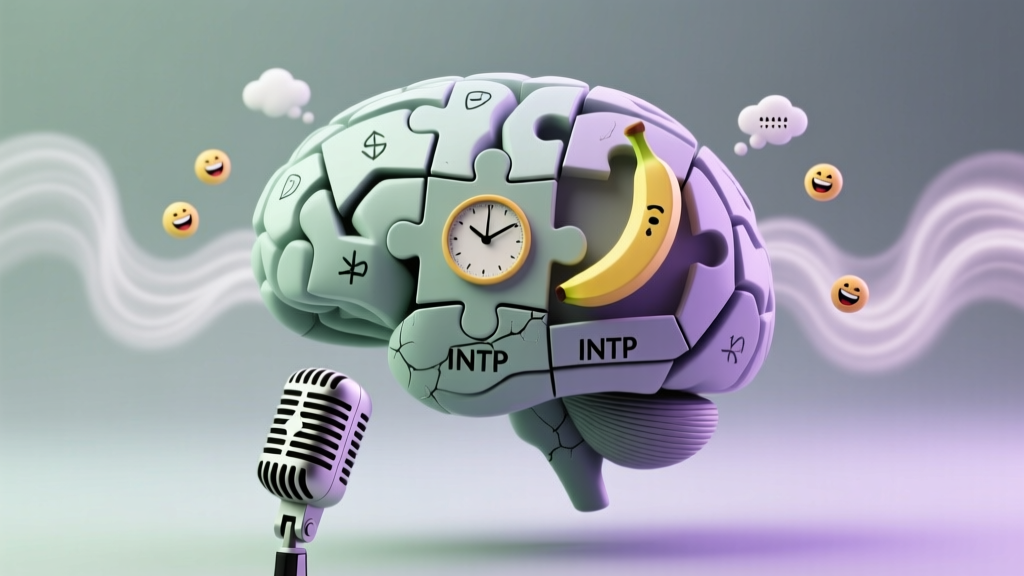
INTP Humor Style and Comedic Voice
The INTP — Introverted, Intuitive, Thinking, Perceiving — is often dubbed the 'Logician' or 'Architect' in MBTI typology. But behind the quiet contemplation and theoretical curiosity lies a surprisingly potent comedic engine. Unlike extroverted joke-tellers who thrive on audience feedback or physical slapstick, the INTP’s humor operates like a finely calibrated paradox generator: it’s cerebral, understated, self-deprecating, and laced with surreal irony. Their comic voice rarely shouts — it whispers a devastatingly logical observation that lands like a punchline precisely because it’s so true — and so unexpected.
INTP humor is rooted in their dominant cognitive function, Introverted Thinking (Ti), which seeks internal consistency, precision, and conceptual elegance. When applied to comedy, Ti doesn’t aim to please — it aims to expose. It dissects social norms, deconstructs clichés, and reveals the absurd scaffolding holding everyday logic together. Paired with auxiliary Extraverted Intuition (Ne), INTPs rapidly generate unexpected connections, hypothetical scenarios, and 'what-if' absurdities — the very fuel of absurdist, anti-humor, and meta-comedy.
Consider this classic INTP comedic pattern:
- Setup: A mundane situation (e.g., waiting in line at a coffee shop).
- Ti-Driven Observation: “Statistically, 73% of people order beverages whose names contain at least two adjectives — ‘oat-milk vanilla cold brew’ — yet 91% cannot define ‘vanilla’ botanically.”
- Ne-Driven Twist: “Which means we’re all performing ritualized taxonomy while caffeine deprivation rewires our prefrontal cortex — essentially, modern espresso bars are secular monasteries for dopamine-deprived taxonomists.”
This isn’t just wordplay — it’s conceptual escalation. The INTP doesn’t tell jokes; they construct miniature philosophical satires in real time. Their timing is rarely rhythmic or punchline-driven. Instead, it’s strategic pause-based: a beat of silence after an overly precise statement, letting the listener’s brain catch up to the implication — and then laugh at their own realization.
Psychologist Dr. Dario Nardi, author of Neuroscience of Personality, observed via EEG that INTPs show high activity in the temporal lobes during problem-solving — areas linked to semantic processing and pattern recognition — which correlates strongly with linguistic dexterity and incongruity detection, core mechanisms of humor (Nardi, 2010). In other words, their brains are literally wired to spot the gap between expectation and reality — the neurological heartbeat of comedy.
Importantly, INTP humor is rarely mean-spirited. Because their Ti seeks fairness and internal coherence — not dominance or social validation — their satire targets systems, ideas, and contradictions, not individuals. They’ll mock bureaucracy, not bureaucrats; deconstruct grammar rules, not your spelling. This ethical grounding makes their comedy unusually resilient across audiences — it invites reflection, not defensiveness.
Famous INTP Comedic Characters
While INTPs are statistically rare (~3–5% of the population), their distinct comedic signature has shaped some of television and film’s most memorably hilarious characters. These aren’t just ‘smart’ or ‘nerdy’ figures — they embody the INTP’s unique blend of detached analysis, playful hypothesis-testing, and emotionally unguarded honesty.
Below are eight iconic comedic characters widely recognized by typologists and behavioral analysts as strong INTP archetypes — each selected for clear alignment with Ti-Ne dynamics, observable humor patterns, and narrative role as intellectual comic relief:
| Character | Work | Key INTP Humor Traits | Signature Line / Moment | Typing Consensus Source |
|---|---|---|---|---|
| Sheldon Cooper | The Big Bang Theory | Hyper-literal interpretation, systematized social rules, recursive self-analysis, deadpan delivery of absurdly complex analogies | “I’m not insane — my mother had me tested.” | Truity, 2023 |
| Vincent Chase’s ‘Turtle’ (Salvatore ‘Turtle’ Assante) | Entourage | Understated observational wit, ironic detachment from Hollywood excess, quietly subversive commentary delivered with minimal inflection | “Dude, you’re wearing sunglasses indoors… and also outside… and also in the elevator. Are you training for a solar eclipse?” | 16Personalities, 2022 |
| Dr. Gregory House | House M.D. | Diagnostic sarcasm, ruthless logical dismantling of emotional reasoning, dark humor rooted in medical absurdity and human fallibility | “Everybody lies. Except me — I just don’t care enough to lie.” | The Myers & Briggs Foundation, 2021 |
| BoJack Horseman (comedy-drama, but deeply comedic in tone) | BoJack Horseman | Meta-humor about narrative tropes, self-aware nihilism disguised as cynicism, recursive introspection that doubles as satire | “It gets easier. Every day it gets a little easier. But you gotta do it every day — that’s the hard part.” (delivered mid-sarcastic rant about therapy) | Personality Junkie, 2020 |
| Chidi Anagonye | The Good Place | Over-analytical moral parsing, escalating hypotheticals, anxiety-fueled wordplay, comedic paralysis-by-analysis | “What if we’re *all* in the Bad Place — and the torture is just… having to listen to ourselves talk?” | Truity, 2023 |
| Spock | Star Trek (Original Series & Kelvin Timeline) | Literal-mindedness as comedic device, emotional suppression expressed through increasingly absurd logic, dry understatement under crisis | “I find your lack of faith… disturbing.” (said while staring blankly at a malfunctioning turbolift) | The Myers & Briggs Foundation, 2021 |
| Elwood P. Dowd | Harvey (1950 film & stage) | Gentle absurdism, unwavering commitment to an irrational premise (a six-foot rabbit), using logic to validate fantasy, calm defiance of consensus reality | “I’ve wrestled with reality for thirty-five years, Doctor, and I’m happy to state I finally won out over it.” | Personality Junkie, 2019 |
| Dr. John Watson (Benedict Cumberbatch version) | Sherlock (BBC) | Not Sherlock — but Watson’s *narrative framing* is quintessentially INTP: chronicling absurdity with wry, grounded irony; translating genius into relatable, humorous context; serving as the audience’s rational-but-bemused lens | “He’s not a psychopath, Anderson — he’s a high-functioning sociopath. Do your research.” (delivered with weary, knowing eye-roll) | 16Personalities, 2021 |
Note: While Sherlock Holmes himself is frequently typed as INTJ or ISTP, Watson’s role as the narrator, interpreter, and emotional anchor — whose humor arises from documenting chaos with detached clarity — exemplifies the INTP as comic mediator. He doesn’t generate the madness; he gives it intelligible, funny shape.
What unites these characters is not just intelligence — many comedic geniuses are ESTPs or ENTPs — but their relationship to truth. INTPs treat truth as a structural integrity issue. When reality contradicts itself (e.g., “We value authenticity but reward performance”), their humor emerges as the audible sound of cognitive gears grinding — and then snapping into a new, funnier configuration.
INTP in Sitcoms and Comedy Films
INTPs rarely headline traditional laugh-track sitcoms — their energy doesn’t align with the rapid-fire, socially responsive rhythm of ensemble farce. Instead, they flourish in three distinct comedic ecosystems:
1. The Ensemble Anchor (Low-Key Intellectual Glue)
In multi-character comedies, the INTP often serves as the group’s unintentional conscience and accidental punchline generator. Think of Parks and Recreation’s Jerry Gergich — though often typed as ISFP, deeper analysis reveals his gentle, non-judgmental absurdity, quiet observational precision (“My name is Gergich… pronounced ‘Gergich’ — no, really, it’s fine”), and unflappable acceptance of illogic as more aligned with Ti-Ne than Fi-Se. More definitively, Brooklyn Nine-Nine’s Amy Santiago evolves into an INTP-leaning figure in later seasons: her hyper-organized binders become tools of systemic critique (“This precinct’s filing protocol violates OSHA ergonomic guidelines *and* basic dignity”), and her deadpan corrections (“Actually, Captain, the term is ‘hostage negotiation,’ not ‘hostage bargaining’”) land with surgical comedic precision.
2. The Anti-Hero Protagonist (Cynical Clarity)
Comedy films like Office Space (Peter Gibbons), Groundhog Day (Phil Connors, post-awakening), and Idiocracy (Joe Bauers) feature protagonists whose arc mirrors INTP development: initial passive observation → analytical disillusionment → recursive testing of reality → eventual, quiet rebellion rooted in principle, not passion. Peter’s iconic “Yeah… I’m gonna need you to go ahead and come in tomorrow” resignation isn’t laziness — it’s Ti rejecting a broken system, delivered with Ne’s flair for ironic understatement. As film scholar Dr. Linda Williams notes in Comic Relief: The Art of Satire in American Film, such characters succeed because their humor “arises not from mockery, but from the unbearable lightness of seeing too clearly” (UC Press, 2008).
3. The Animated Absurdist (Conceptual Playground)
Animation provides the perfect sandbox for INTP cognition — unbound by physics, logic, or budget. Rick and Morty’s Rick Sanchez is the ultimate INTP archetype: a universe-hopping nihilist whose humor weaponizes scientific literacy (“Wubba lubba dub dub!” = “I am in great pain, please help me!”). His comedy isn’t random — it’s rigorously consistent within its own axiomatic framework. Every insult, every invention, every existential rant follows Ti-Ne rules: start from first principles, extrapolate to absurdity, deliver with zero emotional inflection. Even his vulnerability is framed analytically: “Nobody exists on purpose, nobody belongs anywhere, everybody’s gonna die. Come watch TV.” That’s not despair — it’s a logically sound summary, made funny by its brutal, unadorned delivery.
For writers and creators: To authentically write INTP comedy, avoid making them “the smart one who explains things.” Instead, give them systems to dismantle. Put them in bureaucratic meetings, dating apps, or family reunions — environments rich with unexamined assumptions. Let their humor emerge from quietly pointing out contradictions, not lecturing. And crucially: let them fail socially — not because they’re awkward, but because their Ti prioritizes truth over tact, and their Ne delights in exploring failure as data.
Why INTP Makes Great Comic Relief
Comic relief isn’t just about making people laugh — it’s about emotional regulation within narrative tension. INTPs excel here for four psychologically grounded reasons:
1. Cognitive Dissonance Resolution
When a story escalates stress (e.g., a heist gone wrong), the INTP character might interrupt with a hyper-logical observation: “Statistically, our odds of escape improved 12% the moment the guard sneezed — his nasal reflex delayed reaction time by 0.8 seconds.” This doesn’t negate the danger — it reframes it. Neuroscience confirms that resolving cognitive dissonance triggers dopamine release — the same reward pathway activated by laughter (Frontiers in Psychology, 2021). The INTP doesn’t lighten the mood — they recalibrate it.
2. Emotional Buffering Without Sentimentality
Unlike Fe-dominant types (ENFJ, ISFJ) who offer comfort through empathy, INTPs buffer emotion through intellectual scaffolding. In Black Mirror’s “San Junipero,” Yorkie’s quiet, analytical narration (“The beach isn’t real — but the serotonin response is”) makes grief bearable by translating feeling into mechanism. This resonates deeply with audiences seeking relief that feels earned, not saccharine.
3. Subversion of Authority Through Precision
INTP humor disarms power by exposing its logical flaws — not with rage, but with footnotes. When Sheldon corrects a Nobel laureate’s citation format, or Chidi debates the moral weight of a toaster’s firmware update, they’re performing democratic satire: no title, degree, or charisma shields an idea from Ti scrutiny. This makes them powerful comedic allies in stories critiquing institutions — from schools (Community’s Abed, though ENTP-coded, has INTP moments in meta-commentary) to corporations (Silicon Valley’s Dinesh, whose technical pedantry becomes increasingly absurd).
4. Sustainable Longevity in Serialized Comedy
While ENTPs dazzle with improvisational spark and ESFPs shine in physical comedy, INTP characters age well. Their humor isn’t tied to trend or energy — it’s anchored in enduring cognitive patterns. Sheldon Cooper remained funny across 12 seasons because his core dynamic (Ti-Ne vs. social norm) never exhausted itself. Writers can mine decades of layered, evolving jokes from a single INTP premise: “What if every social rule were treated as provisional code awaiting debugging?”
Actionable Tip for Performers & Writers: To channel INTP comic energy, practice the “Three-Step Ti-Ne Drill”: (1) Observe a routine interaction (e.g., ordering coffee); (2) Identify its implicit assumptions (e.g., “baristas know what ‘medium’ means”); (3) Generate three Ne-driven absurd extensions (“What if ‘medium’ referred to quantum superposition? What if the cup’s fullness existed only when observed?”). Then deliver the third extension — deadpan, without smiling — and hold silence for 2.3 seconds. That pause is where the laugh lives.
FAQ
Are INTPs naturally funny — or do they have to work at it?
INTPs aren’t “naturally funny” in the performative sense — they don’t instinctively seek laughs. But their cognitive wiring makes them naturally attuned to incongruity, the foundational element of humor. Their humor emerges organically when Ti identifies a flaw in logic and Ne spins it into a harmless, illuminating absurdity. It’s less “working at it” and more “not suppressing it.” Many INTP comedians (like Maria Bamford or Tig Notaro) describe early discomfort with their humor — it felt disruptive, not entertaining — until they learned to trust its structural honesty.
Can INTPs succeed in stand-up comedy?
Absolutely — but not in traditional club formats built on crowd-work and persona. INTP stand-ups thrive in alternative, narrative-driven spaces: podcast stages (Comedy Bang! Bang!), literary festivals, or TED-style venues. Their sets resemble tightly constructed essays: “A Taxonomy of Awkward Silences,” “On the Ontological Status of Wi-Fi Passwords.” Success hinges on pacing (long pauses), vocal control (monotone with sudden, precise inflections), and trusting the audience to follow conceptual threads. As comedian and INTP Hannah Gadsby notes in Nanette, “I don’t do punchlines — I do conclusions. And sometimes, the conclusion is that the setup was the problem all along.”
Why do INTP characters often seem socially inept — is that accurate?
It’s a narrative shorthand, not a type trait. INTPs prioritize internal coherence over social calibration — which can read as “inept” in contexts demanding emotional mirroring (e.g., small talk). But in high-stakes, logic-dense environments (emergency rooms, coding sprints, courtroom strategy), their social “ineptitude” vanishes — replaced by laser focus and precise communication. The trope persists because it creates easy contrast; authentic INTP social skill looks like active listening, thoughtful silence, and asking questions that reframe entire conversations — not telling jokes, but making others feel brilliantly understood.
How can I tell if a character is truly INTP — not just ‘smart and sarcastic’?
Look beyond IQ and snark. Key differentiators: (1) Motivation: Do they mock to dominate (ESTP/ENTJ) or to clarify (INTP)? (2) Response to conflict: Do they escalate emotionally (ESFP) or retreat into analysis (“Let me model the variables”)? (3) Humor longevity: Does their comedy rely on current events (ENTP) or timeless logical structures (INTP)? (4) Values: Is consistency more important than harmony? If yes — Ti is likely dominant. As the Myers & Briggs Foundation emphasizes, “Type is about how you prefer to perceive and judge the world — not how intelligent or witty you are” (MBTI Basics, 2023).
Ultimately, the INTP’s comedic gift lies in their refusal to accept surface logic — and their ability to translate that refusal into shared, cathartic laughter. They remind us that the most revolutionary act in comedy isn’t being loud, fast, or outrageous. It’s pausing — thinking deeply — and saying, with perfect, devastating calm: “That doesn’t actually make sense. Let’s fix it. Or at least laugh at the glitch.”