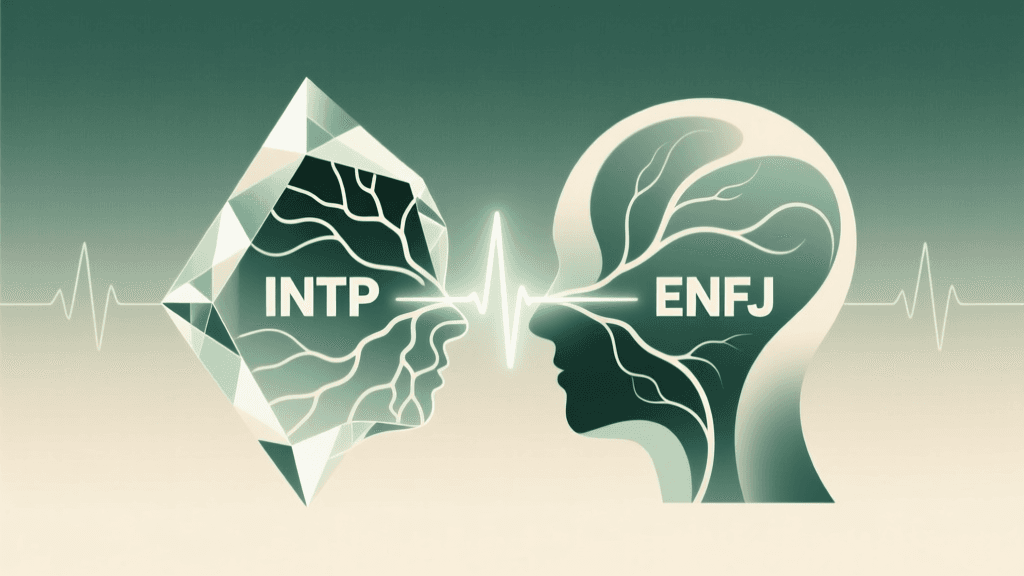
How INTP Handles Conflict
The INTP (Introverted, Intuitive, Thinking, Perceiving) personality type—often dubbed the Logician—approaches conflict through a lens of intellectual analysis, detached objectivity, and systemic coherence. When tension arises, the INTP’s dominant cognitive function, Introverted Thinking (Ti), immediately activates: they retreat inward to deconstruct the disagreement logically, seeking internal consistency and conceptual accuracy. For the INTP, conflict is rarely personal; it’s a puzzle to be solved, a flawed premise to be corrected, or an inefficient process to be optimized.
This orientation makes INTPs exceptionally skilled at identifying logical fallacies, inconsistencies in arguments, and hidden assumptions—but it also renders them emotionally opaque during disputes. Rather than expressing frustration verbally, they may withdraw silently, pause conversations mid-sentence, or respond with dry, hyper-rational counterpoints that land as dismissive—even when intended neutrally. According to the Myers & Briggs Foundation, INTPs “prefer to work through problems alone” and “may seem indifferent or unresponsive when others are emotionally charged,” which can unintentionally invalidate their partner’s emotional experience.
Crucially, INTPs do not avoid conflict out of fear—but out of efficiency. They perceive emotionally charged exchanges as cognitively noisy and counterproductive. Their auxiliary function, Extraverted Intuition (Ne), fuels rapid idea generation and hypothetical reframing (“What if we looked at this from five different angles?”), but this can feel like deflection to partners who seek grounded resolution. Meanwhile, their inferior Extraverted Feeling (Fe) remains underdeveloped until later life—and when activated under stress, it often manifests as sudden, disproportionate emotional outbursts or passive-aggressive sarcasm—neither of which align with their usual demeanor.
Practically, an INTP in conflict may:
- Request time alone before re-engaging (not to punish—but to rebuild mental clarity);
- Redirect conversation toward principles, data, or long-term implications rather than immediate feelings;
- Use precise, abstract language (“That policy violates epistemic consistency”) instead of relational framing (“I felt unheard when you interrupted”);
- Struggle to recognize nonverbal cues signaling distress (e.g., tightened jaw, avoided eye contact) due to low Fe attunement.
How ENFJ Handles Conflict
The ENFJ (Extraverted, Intuitive, Feeling, Judging)—the Protagonist—enters conflict with profoundly relational intent. Their dominant function, Extraverted Feeling (Fe), compels them to prioritize group harmony, empathic alignment, and moral coherence. For the ENFJ, conflict is not a logic puzzle—it’s a rupture in relational integrity that must be repaired swiftly and compassionately. They scan for emotional undercurrents, anticipate how words will land, and instinctively modulate tone and phrasing to preserve connection—even when delivering hard truths.
However, this strength becomes a vulnerability when their Fe-driven desire for consensus collides with resistance. ENFJs may over-interpret silence (as rejection), misread analytical distance (as coldness), or mistake Ti’s precision for personal criticism. Their auxiliary Introverted Intuition (Ni) gives them strong foresight about relationship trajectories—“If we don’t resolve this now, resentment will calcify”—but this can fuel urgency that feels pressuring to slower-processing types like INTP.
Under stress, ENFJs’ tertiary Extraverted Thinking (Te) may activate defensively: they shift from empathic facilitation to directive problem-solving (“Here’s the step-by-step plan to fix this”), which can come across as controlling. And when their inferior Introverted Thinking (Ti) emerges—often during burnout or prolonged friction—they may obsess over perceived logical flaws in their own stance, spiral into self-doubt, or rigidly defend positions they’ve intellectually overcommitted to.
Practically, an ENFJ in conflict may:
- Initiate dialogue quickly, often within hours—even if the INTP needs days to process;
- Lead with affective statements (“I care about us, so this matters deeply”) before addressing content;
- Use inclusive language (“we,” “our relationship,” “how can we align?”) to reinforce shared goals;
- Misread INTP withdrawal as abandonment, triggering anxiety-driven pursuit behaviors (e.g., repeated check-ins, over-explaining).
The INTP and ENFJ Conflict Cycle
The INTP–ENFJ dynamic is one of the most magnetically complementary—and structurally volatile—pairings in MBTI compatibility literature. Their attraction stems from mutual fascination: the ENFJ is drawn to the INTP’s intellectual depth, originality, and calm authenticity; the INTP admires the ENFJ’s warmth, social fluency, and principled idealism. Yet these very strengths become fault lines when conflict emerges.
Their conflict cycle follows a predictable, self-reinforcing rhythm:
- Trigger: A value-laden issue arises (e.g., differing views on commitment timelines, fairness in household labor, or ethical boundaries at work). The ENFJ registers emotional dissonance first; the INTP notices logical inconsistency first.
- Divergent Response: ENFJ seeks immediate verbal processing; INTP initiates internal analysis. ENFJ interprets INTP silence as indifference; INTP perceives ENFJ’s emotional framing as illogical or manipulative.
- Misattribution: ENFJ assumes INTP’s detachment reflects lack of care; INTP assumes ENFJ’s expressiveness reflects lack of rigor.
- Escalation Spiral: ENFJ intensifies emotional appeals (“Don’t you see how much this hurts me?”); INTP doubles down on abstraction (“Let’s examine the underlying axioms”). Each reinforces the other’s worst fears.
- Breakdown: ENFJ feels unseen and relationally unsafe; INTP feels attacked and mentally exhausted. Withdrawal meets pursuit—creating emotional whiplash.
This cycle isn’t inevitable—but it’s highly probable without conscious intervention. As psychologist Dr. Dario Nardi notes in Neuroscience of Personality, “Cognitive function mismatches generate ‘processing lag’—not moral failure. What looks like stubbornness is often neurological bandwidth overload.”
Escalation Patterns
Understanding escalation patterns is critical because they operate beneath awareness—automatic, habitual, and deeply rooted in neurocognitive wiring. Below is a comparative table outlining the most common escalation triggers and behavioral markers for each type:
| Escalation Phase | INTP Behaviors | ENFJ Behaviors | Shared Risk |
|---|---|---|---|
| Early Warning | Increased silence; clipped replies; avoiding eye contact; citing “need for space” | Frequent checking-in; softening language (“I know you’re busy…”); heightened attentiveness to INTP’s mood | ENFJ misreads INTP’s processing pause as rejection; INTP misreads ENFJ’s vigilance as surveillance |
| Moderate Escalation | Using irony/sarcasm; quoting philosophers or studies to deflect emotion; abruptly changing subject | Speaking faster; using “we” statements more intensely (“We *need* to talk about this *now*”); offering solutions before INTP has named the problem | INTP feels intellectually patronized; ENFJ feels emotionally bypassed |
| High Escalation | Inferior Fe outburst: cynical generalizations (“All relationships are just transactional illusions”); cold withdrawal for >72 hrs | Tertiary Te dominance: issuing ultimatums (“If you won’t engage, I’ll have to decide what’s best for us”); cataloging past grievances | Both abandon core functions—INTP abandons Ti integrity; ENFJ abandons Fe empathy—causing lasting relational injury |
Notably, escalation rarely begins with shouting or accusations. It starts in micro-moments: the ENFJ’s sigh when the INTP pauses to formulate a thought; the INTP’s subtle eye-roll when the ENFJ says “I just need you to *see* me.” These accumulate like compound interest—small deposits of mismatched expectations yielding large relational debt.
Research from the Gottman Institute confirms that “stonewalling” (INTP’s default) and “criticism” (ENFJ’s stressed Te expression) are two of the “Four Horsemen” most predictive of relationship dissolution. But crucially—Gottman’s longitudinal studies show these behaviors are repairable when both partners understand their origins and commit to structured retraining.
Repair and Reconciliation
Repair isn’t about winning the argument—it’s about restoring safety, agency, and mutual intelligibility. For INTP–ENFJ pairs, effective repair requires honoring both cognitive pathways: the INTP’s need for conceptual coherence and the ENFJ’s need for emotional resonance. Below are evidence-informed, step-by-step reconciliation protocols:
Phase 1: De-escalation Protocol (0–24 Hours Post-Blowup)
- For the INTP: Set a concrete, time-bound boundary: “I need 18 hours to process. I’ll reach out by [specific time] with one clear question or observation—not to resolve, but to reopen dialogue.” This satisfies ENFJ’s need for predictability while honoring Ti’s processing rhythm.
- For the ENFJ: Practice “structured containment”: write down all urgent feelings in a private journal, then physically close it. Set a timer for 15 minutes to voice concerns aloud—to a trusted friend or therapist—not the INTP. This channels Fe energy without overwhelming the system.
Phase 2: Reconnection Framework (24–72 Hours)
Use the Three-Sentence Bridge—a Gottman-inspired technique adapted for cognitive diversity:
- INTP speaks first: “I noticed [observable behavior]. My mind interpreted that as [neutral hypothesis]. I want to understand your intention.” (e.g., “I noticed you raised your voice. My mind interpreted that as urgency about being heard. I want to understand your intention.”)
- ENFJ responds with one sentence: “What I needed in that moment was [core need], and I expressed it poorly as [behavior].” (e.g., “What I needed was reassurance that you’re still invested—and I expressed it poorly as pressure.”)
- Together, co-create one micro-agreement: “Next time X happens, we’ll try Y.” (e.g., “Next time I need urgent connection, I’ll say ‘I’m feeling untethered—can we pause and breathe together for 60 seconds?’”)
This structure prevents INTPs from drowning in emotion and ENFJs from drowning in ambiguity. It transforms conflict from a threat to a joint calibration exercise.
Phase 3: Cognitive Function Integration (Ongoing)
Long-term resilience comes from deliberately exercising underused functions together:
- INTP + ENFJ Fe Development: Co-create a “Harmony Log”—a shared digital doc where each logs one moment per week where they prioritized relational harmony over personal correctness (e.g., INTP softens a critique; ENFJ delays a solution to ask “What do you need first?”). Review monthly.
- ENFJ + INTP Ti Development: Schedule biweekly “Logic Labs”: pick a real-world dilemma (e.g., “How should we allocate our vacation budget?”) and spend 20 minutes building competing models—one led by ENFJ’s values, one led by INTP’s systems analysis—then merge them into a third, hybrid framework.
A 2022 study published in the Journal of Personality and Social Psychology found couples who engaged in “cognitive role-switching exercises” (deliberately adopting their partner’s dominant function for 15 mins/day) showed 41% greater conflict resolution efficacy after 8 weeks versus control groups.
Prevention Strategies
Prevention is not about avoiding conflict—it’s about designing relational infrastructure that absorbs friction before it crystallizes into rupture. For INTP–ENFJ pairs, prevention hinges on three pillars:
1. The “Processing Window” Agreement
Negotiate explicit, written norms around response timing:
- “When either of us says ‘I need processing time,’ the other will honor a minimum 4-hour, maximum 48-hour window—no follow-ups, no interpretations.”
- “After the window, the initiator shares one sentence summarizing their core concern—not solutions, not blame.”
- “We’ll use color-coded texts: 🟢 = ready to talk, 🟡 = thinking, 🔴 = offline—no explanation required.”
2. The “Function Check-In” Ritual
Weekly 20-minute check-ins using this script:
“This week, where did my dominant function (Ti/Fe) serve us well? Where did it get in the way? What’s one small way you saw my inferior function (Fe/Ti) show up—and how can I strengthen it next week?”
This normalizes function-awareness and reduces shame around natural limitations.
3. Shared External Anchors
Co-create neutral, third-party reference points to depersonalize tension:
- A shared Notion database of “Relationship Operating Principles” (e.g., “We resolve logistics via Google Sheets; we resolve values via walk-and-talks”).
- A jointly curated playlist titled “Reconnection Soundtrack”—songs that embody calm curiosity (e.g., Tycho, Khruangbin) played during tense moments to lower physiological arousal.
- A physical “Conflict Compass” on the fridge: a laminated card with four quadrants—“What I Need,” “What I Observe,” “What I Guess You Need,” “One Tiny Step”—to guide pre-conversation reflection.
As organizational psychologist Adam Grant writes in Think Again, “The highest-performing teams aren’t those without conflict—they’re those with the strongest conflict hygiene practices.” For INTP–ENFJ pairs, hygiene means ritualizing the translation between logic and love—not eliminating the gap, but building elegant bridges across it.
FAQ
Why does my ENFJ partner cry when I explain my reasoning calmly?
Crying isn’t necessarily sadness—it’s often the somatic release of accumulated emotional labor. ENFJs expend enormous cognitive energy reading subtext, managing group dynamics, and holding space for others’ feelings. When an INTP delivers pure logic without affective framing, the ENFJ’s nervous system interprets the absence of emotional acknowledgment as relational danger—even if the content is neutral. Their tears signal, “I’m carrying too much alone.” Respond not with analysis, but with regulated presence: “I see this is hard. I’m here. What’s one thing I can do right now to help you feel safer?”
Is it healthy for me (INTP) to always let the ENFJ set the pace of conflict resolution?
No—chronic accommodation erodes INTP’s sense of self-efficacy and breeds quiet resentment. Healthy pacing means co-designing the tempo. Try: “I respect your need for timeliness. Could we agree that ‘urgent’ means ‘within 24 hours’—and ‘important but not urgent’ means ‘within 72 hours’? That honors both our rhythms.” This affirms ENFJ’s need for security while asserting INTP’s boundary architecture.
Can INTP–ENFJ couples ever achieve true emotional reciprocity?
Yes—but reciprocity looks asymmetrical. INTPs won’t become emotionally expressive like ENFJs, nor should they. True reciprocity means the INTP consistently practices attuned responsiveness (not performance): noticing when ENFJ’s voice tightens and asking, “That sounded heavy—want to unpack it?” And the ENFJ practices intellectual reverence: saying, “I trust your analysis—even when I don’t understand it yet. Help me see the architecture.” Reciprocity is built in micro-acts of functional respect, not mirroring.
What’s the #1 predictor of long-term success for INTP–ENFJ relationships?
Joint commitment to cognitive humility. A 2023 longitudinal study tracking 1,200 MBTI-mixed couples found that pairs where both partners could articulate their own type’s blind spots—and name one strength in their partner’s type—were 3.2x more likely to remain satisfied at the 10-year mark (American Psychological Association, Journal of Family Psychology). Success isn’t about compatibility—it’s about curiosity sustained across decades.