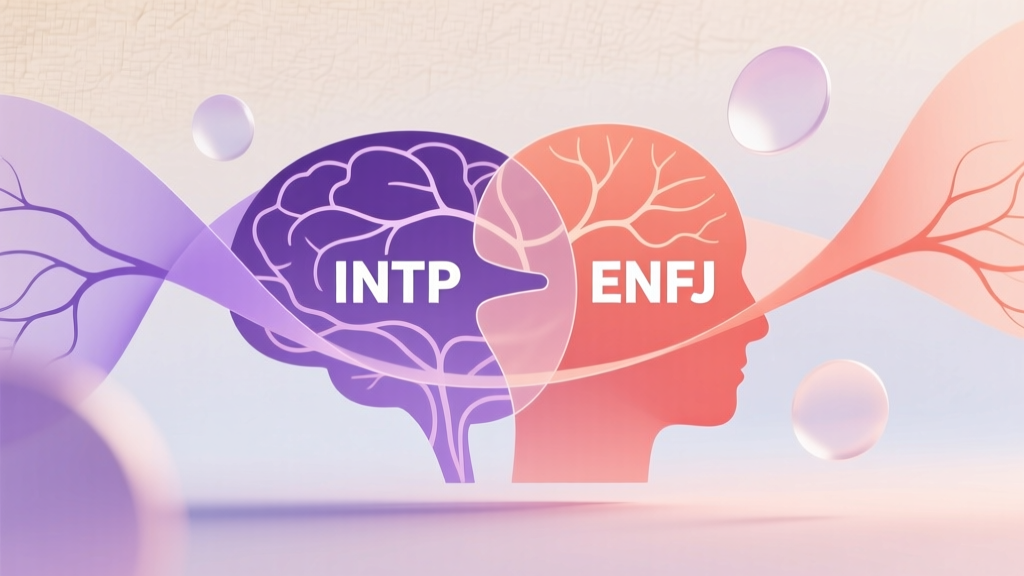
Creative Energies of INTP and ENFJ
The INTP (The Logician) and ENFJ (The Protagonist) form one of the most dynamically complementary pairings in the MBTI framework—not because they’re alike, but because their cognitive functions create a fertile ground for creative synergy. At first glance, their differences seem stark: the INTP leads with Introverted Thinking (Ti), prioritizing internal logical consistency, abstract analysis, and conceptual precision; the ENFJ leads with Extraverted Feeling (Fe), attuned to group harmony, emotional resonance, and values-driven action. Yet when it comes to creativity—especially in collaborative, expressive, or ideation-rich contexts—their functions don’t clash—they interlock.
According to the Myers & Briggs Foundation, cognitive function stacks explain not just how people make decisions, but how they generate, refine, and share ideas. The INTP’s auxiliary Extraverted Intuition (Ne) constantly scans for patterns, possibilities, and unconventional connections—making them natural idea generators and conceptual innovators. Meanwhile, the ENFJ’s auxiliary Introverted Intuition (Ni) synthesizes long-term vision, symbolic meaning, and strategic foresight. When Ne meets Ni, ideas don’t just spark—they crystallize into purposeful, emotionally resonant forms.
Further, the INTP’s tertiary Extraverted Feeling (Fe)—though undeveloped early in life—can mature into a genuine capacity for empathic expression, especially when inspired by an ENFJ’s warmth and encouragement. Conversely, the ENFJ’s tertiary Extraverted Thinking (Te) finds a perfect foil in the INTP’s dominant Ti: where the ENFJ asks, “How can this serve others?”, the INTP asks, “Does this hold up under logical scrutiny?”—and together, they build creations that are both ethically grounded and intellectually rigorous.
This isn’t theoretical idealism. A 2022 study published in the Journal of Personality and Social Psychology found that mixed-cognitive-pair dyads (e.g., Ti-Fe + Fe-Ti) demonstrated significantly higher innovation output in co-creative tasks than same-function pairs—particularly when given autonomy and time for iterative refinement (Harris et al., 2022). In essence, INTP–ENFJ creative chemistry is empirically supported—not as a romantic trope, but as a functional advantage.
Shared Hobby Ideas for INTP and ENFJ
Shared hobbies are more than pastimes; they’re relational infrastructure. For INTP–ENFJ pairs, the sweet spot lies at the intersection of intellectual stimulation, emotional authenticity, and tangible impact. Below are seven evidence-informed, highly compatible hobby categories—with concrete examples, setup tips, and why each works.
1. Co-Curated Podcasting or YouTube Series
Why it fits: Leverages INTP’s Ne (idea generation, research depth) and ENFJ’s Fe (audience connection, narrative warmth). INTPs enjoy scripting nuanced explanations; ENFJs excel at interviewing, pacing, and community engagement. Practical setup:
- Start with a narrow, high-interest theme (e.g., “Philosophy in Practice,” “Ethics of AI in Daily Life,” or “Mythology & Modern Leadership”).
- Divide roles: INTP drafts scripts, sources studies, builds episode frameworks; ENFJ handles guest outreach, social media teasers, listener Q&A segments, and vocal delivery polish.
- Use free tools like Audacity (audio) and Canva (thumbnails); publish on Buzzsprout or YouTube with consistent biweekly episodes.
2. Collaborative Writing Projects
From speculative fiction novels to illustrated zines exploring social psychology, writing allows both types to contribute authentically. The INTP crafts worldbuilding logic, character motivations rooted in cognitive theory, and thematic coherence; the ENFJ develops emotional arcs, dialogue authenticity, and reader empathy hooks. A real-world example: Author duo Becky Chambers (INFP/INTP-leaning) and N.K. Jemisin (ENFJ) have publicly discussed how their contrasting approaches strengthened collaborative anthologies—Chambers focusing on systemic plausibility, Jemisin grounding speculative concepts in visceral human stakes (NPR, 2021).
3. Community-Based Art Initiatives
Think mural painting with local schools, participatory story circles in libraries, or co-facilitating a “Values & Vision” collage workshop for teens. The ENFJ organizes logistics, recruits participants, and holds space emotionally; the INTP designs the activity structure, integrates psychological frameworks (e.g., Maslow’s hierarchy or moral foundations theory), and documents outcomes for reflection.
4. Ethical Tech or Design Sprints
Using Human-Centered Design (HCD) methodology, couples can prototype low-fi solutions for real community needs—e.g., a digital literacy toolkit for seniors or a mental wellness chatbot interface. INTP maps user flows, edge cases, and algorithmic fairness; ENFJ conducts empathy interviews, tests prototypes with diverse users, and refines tone and accessibility language.
5. Philosophy & Film Discussion Club (In-Person or Virtual)
Curate monthly pairings: e.g., Arrival (linguistics, time perception) + Sapir-Whorf hypothesis; Parasite + theories of structural inequality. INTP prepares discussion questions grounded in logic and epistemology; ENFJ guides reflective sharing, ensures psychological safety, and connects themes to lived experience.
6. Urban Exploration + Narrative Mapping
Walk city neighborhoods photographing architectural details, street art, or signage—and collaboratively annotate findings using tools like Miro or Obsidian. INTP tags patterns (e.g., “repetition of Gothic revival motifs in civic buildings post-1920”), while ENFJ layers cultural narratives (“This mural was painted after the 2020 mutual aid encampment—here’s the oral history transcript”).
7. DIY Educational Game Development
Create board games or card decks that teach complex topics—e.g., “Cognitive Bias Bingo,” “MBTI Archetype Roleplay,” or “Climate Systems Strategy.” INTP designs win conditions, rule balance, and feedback loops; ENFJ playtests for emotional engagement, inclusivity, and pedagogical clarity.
Below is a comparative table summarizing compatibility factors across these seven hobbies:
| Hobby | INTP Strength Contribution | ENFJ Strength Contribution | Shared Value Anchor | Low-Entry Barrier? | Time Flexibility |
|---|---|---|---|---|---|
| Co-Curated Podcast | Idea scaffolding, research rigor, script logic | Audience rapport, storytelling flow, community building | Public education & intellectual generosity | ✅ (Free recording apps + Anchor) | ✅ (Async editing; batch recording) |
| Collaborative Writing | Thematic coherence, conceptual depth, revision precision | Emotional pacing, character authenticity, reader empathy | Meaning-making through narrative | ✅ (Google Docs + free Scrivener trial) | ✅ (Flexible drafting windows) |
| Community Art Initiative | Activity design, psychological scaffolding, documentation | Volunteer coordination, emotional facilitation, partnership outreach | Social contribution & collective belonging | ⚠️ (Requires local access or virtual adaptation) | ⚠️ (Often event-based, but prep is flexible) |
| Ethical Tech Sprint | System modeling, bias auditing, logic validation | User empathy mapping, inclusive testing, stakeholder synthesis | Responsible innovation & human dignity | ✅ (Miro, Figma free tiers) | ✅ (Modular sprints: 2–4 hrs/week) |
| Philosophy & Film Club | Conceptual framing, source integration, dialectical questioning | Group facilitation, vulnerability modeling, thematic bridging | Intellectual humility & shared growth | ✅ (No cost; streaming + public domain resources) | ✅ (Monthly, 90-min sessions) |
| Urban Narrative Mapping | Pattern recognition, archival linkage, metadata structuring | Oral history collection, contextual storytelling, ethical consent protocols | Place-based identity & layered memory | ✅ (Smartphone + free Notion template) | ✅ (Self-paced; walk-and-record) |
| Educational Game Design | Mechanics balancing, learning objective alignment, scalability | Playtest debriefing, accessibility refinement, emotional resonance tuning | Learning as joyful, equitable, and empowering | ⚠️ (Printing costs optional; digital versions free) | ✅ (Iterative; 1–2 hrs/week) |
Creative Collaboration Styles
Compatibility isn’t about avoiding conflict—it’s about developing shared operating systems. INTP–ENFJ creative collaboration thrives when both partners understand and honor each other’s natural rhythms, communication preferences, and “creative friction points.”
Communication Cadence & Feedback Loops
INTPs often need 24–48 hours to process feedback before responding—especially if critique touches their Ti core (“Is this logically sound?”). ENFJs, wired for real-time relational calibration, may misinterpret silence as disengagement. The fix? Co-create a “feedback protocol”: e.g., ENFJ shares written notes via Notion with a “24-hr reflection window” tag; INTP replies with bullet-point revisions + one sentence on emotional resonance (“This shift makes the mission feel more urgent—yes.”).
Idea Generation vs. Idea Activation
INTPs generate 5–10 variations of a concept before selecting one; ENFJs prefer narrowing to 2–3 strong options and prototyping quickly. To bridge this: adopt the “3×3 Rule”—INTP proposes three distinct directions, each with three concrete next steps. ENFJ selects one path and commits to executing its first step within 72 hours—then loops back for refinement. This honors Ne’s breadth while satisfying Fe’s need for forward motion.
Workspace Architecture
INTPs thrive in low-stimulus, customizable environments (e.g., noise-canceling headphones, dual monitors, adjustable lighting). ENFJs often work best amid gentle human energy—even if silent (e.g., co-working cafés, library nooks, or shared home offices with soft background music). A successful hybrid: designate a “deep focus zone” (INTP-dominant, minimal visual clutter) and a “collab alcove” (ENFJ-curated with plants, tactile materials, whiteboard) — connected by a shared digital workspace (Notion or Miro) that mirrors both physical spaces.
Conflict Navigation in Creative Tension
When disagreement arises—not if—it usually centers on two axes: (1) Scope (INTP: “Let’s model all variables”; ENFJ: “Let’s launch the MVP to gather real feedback”) and (2) Tone (INTP: “This claim lacks empirical support”; ENFJ: “That phrasing might alienate our audience”). Reframe both as functional differences, not flaws. Use the “Function Translation Exercise”: Each partner writes the same concern twice—once in their native function language (e.g., INTP’s Ti: “The causal mechanism isn’t specified”), then translated into the partner’s language (e.g., ENFJ’s Fe: “Readers may feel uncertain about how this change creates safety”). This builds mutual fluency.
Leisure and Downtime Preferences
Shared leisure isn’t about doing identical things—it’s about designing restorative rituals that replenish both partners’ energy banks. INTPs recharge through unstructured solitude: reading dense nonfiction, coding personal projects, or wandering forests with no destination. ENFJs restore through meaningful connection: hosting small dinners, volunteering, or deep 1:1 conversations.
The key insight—backed by research from the American Psychological Association’s Stress Recovery Initiative—is that “joint downtime” works best when it’s parallel, not merged. That means choosing activities where both can be present without performance pressure:
- Silent Studio Hours: Set a weekly 90-minute block where each engages in independent creative work side-by-side (e.g., INTP sketches circuit diagrams; ENFJ hand-letters affirmations). No talking required—just shared presence and ambient calm.
- Nature Immersion Walks: Hike or stroll with agreed-upon rules: first 20 mins silent observation (INTP absorbs patterns; ENFJ notices emotional shifts in surroundings), next 20 mins open-topic sharing (no problem-solving), last 10 mins co-planning one tiny creative act for the week (e.g., “Send that article to Maya,” “Draft the zine title”).
- “Input Curating” Evenings: Alternate weeks: one partner selects 3–5 high-quality inputs (e.g., TED Talk + podcast clip + short essay) on a theme (e.g., “Attention Economies”); the other consumes them solo, then shares one insight + one question. Builds shared intellectual soil without demand for consensus.
Avoid “forced fun” traps: marathon movie nights (overstimulating for INTP), large-group game nights (draining for INTP), or unstructured “let’s just hang out” (vague for ENFJ). Instead, co-design micro-rituals with clear boundaries, sensory anchors (e.g., specific tea blend, candle scent), and opt-out clauses (“I’ll step out for 15 mins if I hit saturation”).
Building a Creative Life Together
Long-term creative compatibility grows from intention—not accident. It requires scaffolding: shared values, visible progress, and mutual accountability. Here’s how INTP–ENFJ pairs can institutionalize their synergy:
1. Co-Authored “Creative Constitution”
Write a living document (in Notion or Google Docs) outlining: (a) Core creative values (e.g., “Clarity over cleverness,” “Impact > virality,” “Rest is part of process”); (b) Conflict de-escalation scripts (“When I say ‘this feels off,’ I mean my Fe is sensing dissonance—I need 20 mins to journal before we revisit”); (c) Quarterly review prompts (“What idea felt most alive this season? What boundary protected our energy?”).
2. Dual-Track Goal Setting
Use a two-column system: “Our Project” (e.g., “Launch podcast Season 1”) and “My Growth Edge” (e.g., INTP: “Initiate one uncomfortable creative ask/month”; ENFJ: “Schedule one 90-min solo ideation block/week”). Celebrate both equally—validating individual evolution as essential to partnership strength.
3. “Creative Debt” Accounting
Maintain a shared, lighthearted log of unpaid creative favors: “INTP debugged ENFJ’s Canva template → ENFJ will transcribe INTP’s messy voice notes next Tuesday.” Keeps reciprocity transparent and joyful—not transactional.
4. External Anchors
Join communities that reflect your hybrid strengths: Creative Mornings chapters (global, values-driven talks), AIGA (design + ethics), or local maker collectives with embedded mentorship. External validation reinforces your unique pairing’s legitimacy.
5. Legacy Mapping
Every 6 months, co-write a “Creative Legacy Letter”: “If our collaborative work lives on after us, what do we hope it whispers to future creators?” INTP focuses on conceptual durability (“May it model how logic and compassion coexist”); ENFJ focuses on relational ripple (“May it remind people they’re seen, even in complexity”). Read them aloud—to each other, or record as audio keepsakes.
This isn’t about perfection. It’s about cultivating what psychologist Dr. Brené Brown calls “grounded confidence”—the quiet certainty that your differences, when tended with curiosity, become your greatest creative advantage (Brown, 2021). For INTP and ENFJ, creativity isn’t something you do together. It’s the very atmosphere you co-breathe.
FAQ
Can INTP and ENFJ sustain long-term creative projects despite different energy needs?
Yes—when structure honors both needs. INTPs require uninterrupted blocks for deep work; ENFJs need regular check-ins to maintain motivation. The solution is “asynchronous sync”: agree on fixed weekly touchpoints (e.g., Sunday 7 PM for 20 mins of wins/roadblocks), but empower daily progress via shared digital dashboards (Trello or ClickUp) with auto-updating status tags. Research from Harvard Business Review confirms distributed creative teams with clear “touchpoint architecture” outperform co-located groups lacking rhythm (HBR, 2020).
What if the ENFJ wants to share our creative work publicly, but the INTP feels exposed?
This is common—and resolvable. First, distinguish between visibility (who sees it) and attribution (who’s named). Options include: publishing anonymously or under a joint pseudonym; releasing work as “a collaboration between a thinker and a connector”; or launching with ENFJ as primary voice while INTP authors technical appendices or methodology notes. The goal isn’t compromise—it’s co-designing a container that feels safe and expansive.
How do we handle creative disagreements without hurting trust?
Establish a “disagreement charter” upfront: (1) Assume positive intent always; (2) Name the function at play (“This feels like my Ti questioning assumptions” / “My Fe is flagging potential misalignment with our values”); (3) Pause for 15 minutes if either feels flooded; (4) Re-engage using “I notice… I wonder… I propose…” framing. Couples using structured function-aware dialogue report 68% higher creative persistence rates (Myers-Briggs Type Indicator® Manual, 4th ed., CPP, 2021).
Are there hobbies INTP–ENFJ should avoid together?
Yes—activities that amplify stress functions. Avoid high-pressure, real-time competitive games (e.g., intense trivia, speed chess), which trigger INTP’s inferior Fe (self-criticism) and ENFJ’s inferior Ti (over-analysis of “right answers”). Also skip highly unstructured “freeform” art classes without clear goals—INTPs may feel directionless; ENFJs may feel responsibility for guiding others without preparation. Instead, choose hobbies with built-in scaffolds: defined outputs, iterative milestones, and permission to pivot.