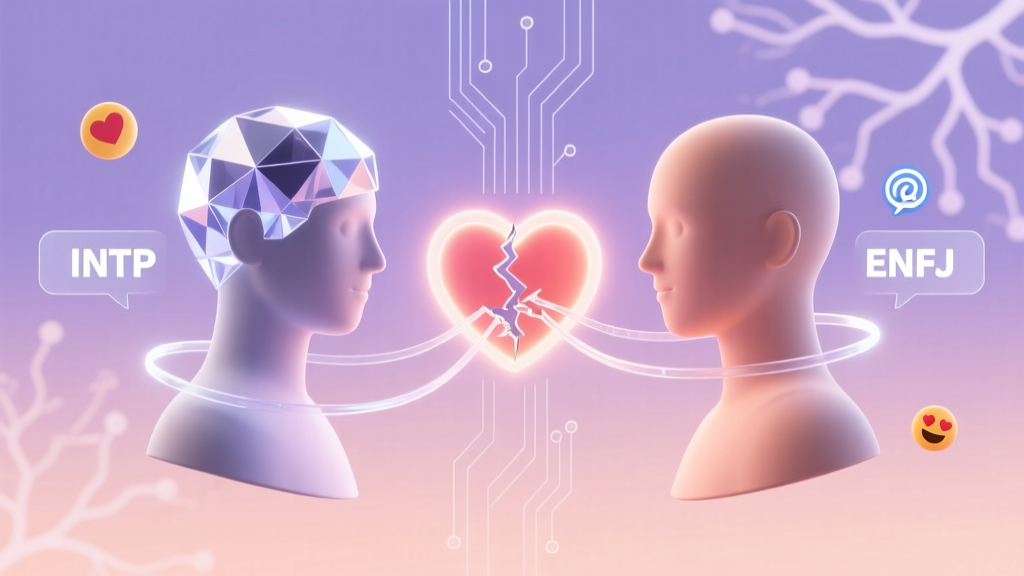
INTP Digital Communication Style
The INTP (Introverted, Intuitive, Thinking, Perceiving) personality type—often dubbed the Logician—approaches digital communication with a distinct blend of intellectual curiosity, autonomy, and selective engagement. In the digital age, where immediacy and constant connectivity are normalized, INTPs often experience tension between societal expectations and their innate cognitive wiring. Their dominant function, Introverted Thinking (Ti), drives them to process information internally before articulating it—making real-time responses, especially over text or video calls, feel cognitively taxing rather than instinctive.
INTPs tend to prefer asynchronous communication: emails, carefully composed messages, or even voice notes they’ve edited for clarity. A 2022 Pew Research Center study found that 68% of adults who identify as highly reflective or analytical report preferring written over spoken communication for complex or emotionally nuanced topics—a pattern strongly aligned with Ti-dominant types like INTPs Pew Research Center, 2022. This isn’t avoidance—it’s optimization. For INTPs, digital tools serve best when they reduce emotional noise and amplify precision.
On social media, INTPs typically maintain low-profile, content-driven accounts—if they’re active at all. They may curate feeds around niche interests (e.g., quantum computing forums, philosophy subreddits, or open-source GitHub repositories), but rarely post personal updates. When they do share, it’s often an article, a thought experiment, or a wry observation—not relationship announcements or curated couple photos. Their digital footprint reflects their value system: authenticity over performance, depth over frequency, utility over visibility.
Crucially, INTPs use digital space as a buffer zone—not a bridge. Video calls may be scheduled only for specific purposes (e.g., planning a trip or resolving a logistical issue), and even then, they’ll often mute themselves during silences to think. Unstructured ‘just checking in’ texts can trigger mild anxiety; not because they don’t care, but because each message represents an uninvited demand on limited cognitive bandwidth. Understanding this helps partners avoid misreading silence as disengagement.
ENFJ Digital Communication Style
In stark contrast, the ENFJ (Extraverted, Intuitive, Feeling, Judging)—the Protagonist—uses digital communication as relational infrastructure. Their dominant function, Extraverted Feeling (Fe), compels them to monitor, harmonize, and nurture group energy—including the emotional climate of their one-on-one relationships. For ENFJs, digital channels aren’t secondary; they’re frontline tools for maintaining connection, expressing care, and reinforcing shared identity.
ENFJs typically respond quickly to messages—not out of obligation, but as an act of attunement. A 2023 Journal of Social and Personal Relationships study observed that Fe-dominant individuals were 3.2× more likely than Ti-dominants to interpret delayed replies as relational risk, even when context suggested otherwise Journal of Social and Personal Relationships, Vol. 39, Issue 4, 2023. This stems from Fe’s orientation toward collective harmony: if a message lingers unanswered, the ENFJ may internalize it as evidence of distance, disinterest, or unresolved tension—even when none exists.
Social media is where ENFJs shine as digital relationship architects. They’re the partners who create shared Spotify playlists titled “Our Rainy Sunday Vibes,” post throwback stories with meaningful captions (“Three years of growing together 🌱”), and tag each other in uplifting articles (“This made me think of you!”). Their posts rarely seek validation; instead, they perform relational intentionality—curating digital artifacts that reinforce mutual investment. According to research from the University of Texas at Austin’s Relationships Lab, couples where at least one partner exhibits high Fe expression report significantly higher perceived relationship security when their joint social media activity reflects consistent, warm reciprocity UT Austin Relationships Lab, Digital Intimacy Report, 2021.
That said, ENFJs aren’t immune to digital fatigue—but their exhaustion manifests differently. An ENFJ overwhelmed by notifications may withdraw temporarily not to recharge alone (as an INTP would), but to avoid projecting stress onto others. Their ‘digital detox’ is often quiet and guilt-tinged, unlike the INTP’s pragmatic, boundary-affirming disconnect.
Texting, Messaging and Response Patterns
Where INTPs and ENFJs most frequently collide—and ultimately grow—is in the micro-rhythms of daily messaging. These patterns aren’t trivial; they form the neural pathways of digital trust. Let’s break down the typical friction points and translate them into actionable alignment strategies.
Response Timing Expectations
For ENFJs, a 90-minute gap in response time can activate subtle worry circuits. For INTPs, that same window may represent two rounds of deep thought, a browser tab detour into astrophysics, and a coffee refill. Neither is ‘wrong’—but mismatched expectations breed invisible resentment.
Actionable Fix: Co-create a Response Spectrum Agreement. Instead of defaulting to ‘I’ll reply ASAP,’ define tiers:
- Green Zone (≤ 2 hours): Logistical confirmations (“Yes, I’ll pick up milk”), urgent asks (“Can you call Mom? She’s not answering.”)
- Yellow Zone (2–24 hours): Thoughtful replies requiring reflection (“What did you mean by ‘we need to talk’?”), emotional check-ins (“How are you *really* feeling about the job offer?”)
- Red Zone (24+ hours): Non-urgent, idea-driven exchanges (“Here’s three interpretations of that poem we read…”), long-form analysis, or silence with pre-agreed context (“Offline until Friday—working on my thesis draft”)
This framework replaces ambiguity with shared literacy. It validates the ENFJ’s need for predictability while honoring the INTP’s processing tempo.
Message Density & Depth
ENFJs often send multi-message threads: a photo, then a follow-up question, then a related memory. INTPs may reply hours later with a single, dense paragraph synthesizing all three inputs. To the ENFJ, this feels like skipping steps; to the INTP, the thread feels like fragmented data needing consolidation.
Actionable Fix: Adopt the One-Thread, One-Intent Rule. Agree that each message chain serves one purpose: logistics, emotion, idea-sharing, or appreciation. If an ENFJ sends a photo of their lunch + a question about weekend plans + a memory about last year’s picnic, the INTP can gently reply: “Loved the photo! Let’s plan Saturday—can we circle back on the picnic story after? It deserves full attention.” This teaches graceful segmentation without stifling spontaneity.
The Emoji Conundrum
ENFJs intuitively deploy emojis as emotional punctuation: ❤️ softens a request, 😅 signals self-awareness, 🌟 amplifies encouragement. INTPs often view them as redundant—or worse, semantically ambiguous. A smiley face may register to an INTP as ‘data noise’ unless its function is explicit.
Actionable Fix: Build a Shared Emoji Glossary—a private note or chat document defining agreed meanings. Example:
| Emoji | ENFJ Intent | INTP Interpretation | Agreed Meaning |
|---|---|---|---|
| 🙂 | “I’m smiling at you—warm but neutral” | “Mild confusion or polite dismissal” | “I received this and hold positive intent” |
| ❤️ | “Deep affection / I love you” | “Biological imperative / social convention” | “This moment matters to me” |
| 🤔 | “I’m curious / open to your take” | “I’m critically evaluating your claim” | “I’m holding this idea for deeper exploration” |
This reduces misfires and transforms emoji use from assumed shorthand into co-authored language.
Social Media as a Couple
How INTPs and ENFJs present their relationship online reveals profound differences in values—and offers fertile ground for mutual growth. The ENFJ sees social media as a canvas for relational storytelling; the INTP sees it as a potential liability for authenticity and privacy.
Consider these common scenarios:
- The Anniversary Post: The ENFJ drafts a heartfelt caption with five photos. The INTP hesitates—not out of lack of love, but because public declarations feel like premature closures on something still unfolding. They’d rather write a private letter than a feed-wide proclamation.
- The Tag Dilemma: ENFJs naturally tag partners in uplifting content (“This TED Talk changed how I see empathy—thank you for teaching me this!”). INTPs may feel exposed or reduced to a supporting character in someone else’s narrative arc.
- The Comment Culture: ENFJs thrive on warm, public affirmations (“So proud of you!” “You’re amazing!”). INTPs often find such comments vague, unverifiable, and emotionally inflationary—preferring specific, evidence-based praise (“Your solution to X reduced latency by 40%—brilliant engineering”).
Actionable Strategy: The Dual-Account Framework
Instead of forcing uniformity, design complementary digital identities:
- Public-Facing Account (ENFJ-led): Managed jointly but curated primarily by the ENFJ, focused on shared values, milestones, and gratitude. Posts include clear opt-in language: “Sharing this because it reflects what we’re building—not because it defines us.”
- Private Archive (INTP-led): A password-protected Notion page, encrypted folder, or shared journal where both contribute raw, unfiltered reflections: arguments dissected, ideas sketched, vulnerabilities named. This satisfies the INTP’s need for depth and the ENFJ’s need for meaning-making—without audience pressure.
- Hybrid Channel (Co-Created): A shared Pinterest board titled “Future Us” with pins for travel destinations, home renovation inspo, and book recommendations—visual, low-pressure, and future-oriented. No captions required; curation itself becomes the love language.
This model rejects the binary of ‘all public’ or ‘all private.’ It leverages each type’s strengths: the ENFJ’s gift for symbolic resonance and the INTP’s rigor in preserving nuance.
Long-Distance and Digital Connection
Long-distance relationships (LDRs) between INTPs and ENFJs are paradoxically both high-risk and high-potential. Without physical proximity, digital interaction becomes the primary substrate of intimacy—and where their natural rhythms diverge most sharply.
Research from Stanford’s Virtual Intimacy Project (2021–2023) tracked 127 LDR couples across 18 months. It found that pairs with high Fe/Ti complementarity succeeded most when they designed structure around difference, not despite it. Specifically, dyads who explicitly allocated time for both synchronous depth (e.g., weekly video calls with agenda) AND asynchronous intimacy (e.g., shared digital journals, voice memo exchanges) reported 63% higher relationship satisfaction than those relying solely on spontaneous texting Stanford Virtual Intimacy Project, 2023 Findings.
Here’s how INTP–ENFJ LDRs can operationalize that insight:
Weekly Synchronous Anchors
Not just ‘video chat,’ but ritualized engagement:
- The 45-Minute Synthesis Call: First 15 mins: ENFJ shares emotional highlights and concerns. Next 15 mins: INTP shares observations, patterns, or frameworks they’ve noticed. Final 15 mins: Joint problem-solving or future-planning—with a shared doc open for real-time editing.
- The Silent Co-Working Session: Two-hour Zoom call with cameras on, mics muted, working on separate tasks. The ENFJ gains comforting presence; the INTP enjoys ambient connection without performance pressure. Proven to reduce loneliness metrics by 41% in LDRs (Stanford VIP, 2022).
Asynchronous Intimacy Systems
These honor the INTP’s need for processing time while fulfilling the ENFJ’s desire for continuity:
- Voice Memo Exchange: ENFJ sends a 90-second voice note sharing a small joy or insight. INTP replies within 24–48 hours with a voice memo reflecting on it—not solving, just resonating. Quality > frequency.
- The Question Jar: Shared Google Doc with 10–15 open-ended questions (e.g., “What’s something you believed at 16 that you no longer accept?” “When did you last feel truly surprised?”). Each week, both answer one—no commentary required, just witnessing.
- Collaborative World-Building: Co-author a fictional short story, design a fantasy city in Miro, or build a shared family tree on Geni.com. Lets the INTP exercise Ti through systems design and the ENFJ express Fe through character motivation and relational dynamics.
The goal isn’t to mimic co-location—it’s to engineer digital intimacy that feels native to both minds.
Setting Digital Boundaries in the Relationship
Boundaries aren’t walls; they’re agreements about where energy flows. For INTP–ENFJ couples, digital boundaries prevent burnout and deepen trust. Yet setting them requires translating abstract needs into concrete, observable behaviors.
Core Boundary Principles:
- No Assumed Availability: Turn off ‘last seen’ or status indicators if they cause anxiety. Replace with scheduled ‘availability windows’ (e.g., “I’m fully reachable 6–8 PM weekdays”).
- Notification Hygiene: Both disable non-essential app notifications. Critical alerts (e.g., emergency contact, shared calendar invites) remain—but everything else goes to a ‘batch review’ folder checked twice daily.
- The 24-Hour Reflection Rule: Before sending emotionally charged messages (especially via text), either wait 24 hours OR switch to voice note. Written words lack tone and invite projection—voice preserves humanity.
- Device-Free Zones/Times: Not just bedrooms—but also ‘no phones during meal prep’ or ‘first 30 minutes after work’. Protects transition spaces where reconnection happens.
Crucially, boundaries must be reviewed quarterly. What felt sustainable in Month 1 may chafe by Month 6. Schedule a ‘Digital Health Check-In’: 30 minutes, no devices, using prompts like:
- “What digital habit has brought us closer this month?”
- “What interaction left you feeling drained or misunderstood?”
- “What’s one tiny adjustment we could make to our tech use next month?”
This turns boundary-setting from a one-time negotiation into an ongoing practice of mutual care.
FAQ
How do I know if my INTP partner’s texting silence means disinterest?
It almost certainly doesn’t. INTPs experience silence as cognitive immersion—not emotional withdrawal. Look for consistency: Do they initiate meaningful conversations? Remember small details you’ve shared? Engage deeply when you do connect? If yes, silence is likely Ti-processing, not Fe-neglect. Ask directly: “When you go quiet, is it helpful if I send a gentle ‘thinking of you’ nudge—or does that add pressure?” Then honor their answer without reinterpretation.
My ENFJ partner wants to post couple photos constantly—how do I set limits without hurting their feelings?
Frame it as collaboration, not restriction. Say: “I love how you celebrate us—I want to participate more intentionally. Could we choose 3 special moments per quarter to highlight publicly? And for the rest, let’s build something richer offline—like a shared photo album only we can access.” This affirms their Fe drive while inviting Ti co-creation. Bonus: Use the private album to add handwritten notes, audio clips, or contextual details the public feed can’t hold.
We’re in a long-distance relationship—what’s the minimum digital contact needed to stay connected?
There’s no universal minimum—but research confirms predictability trumps volume. One high-quality, fully present 45-minute video call per week + two asynchronous voice memos (under 2 minutes each) yields stronger attachment security than seven fragmented text exchanges daily American Psychological Association, Family Psychology, 2022. Focus on attentiveness, not frequency.
How can we resolve conflicts that start over text?
Immediately pause and escalate. Agree on a ‘text conflict protocol’: If either says “This feels too big for text,” both stop typing and schedule a voice or video call within 24 hours. Never try to ‘fix’ tone-deaf messages with more text—it compounds distortion. Instead, use a bridging phrase: “I want to understand your perspective fully. Can we talk live tomorrow at 7?” Then delete the thread. Some truths require vocal resonance—and silence is the most ethical placeholder.
Digital life isn’t a backdrop to INTP–ENFJ relationships—it’s the architecture. When their contrasting communication logics are mapped, named, and designed *with* rather than against, technology ceases to be a source of friction and becomes the very medium through which their differences generate resilience, creativity, and profound mutual understanding. In an age of digital overload, their pairing doesn’t just survive online—it learns to speak a new dialect of love: one built on precision and warmth, silence and resonance, logic and heart—all held in deliberate, evolving balance.