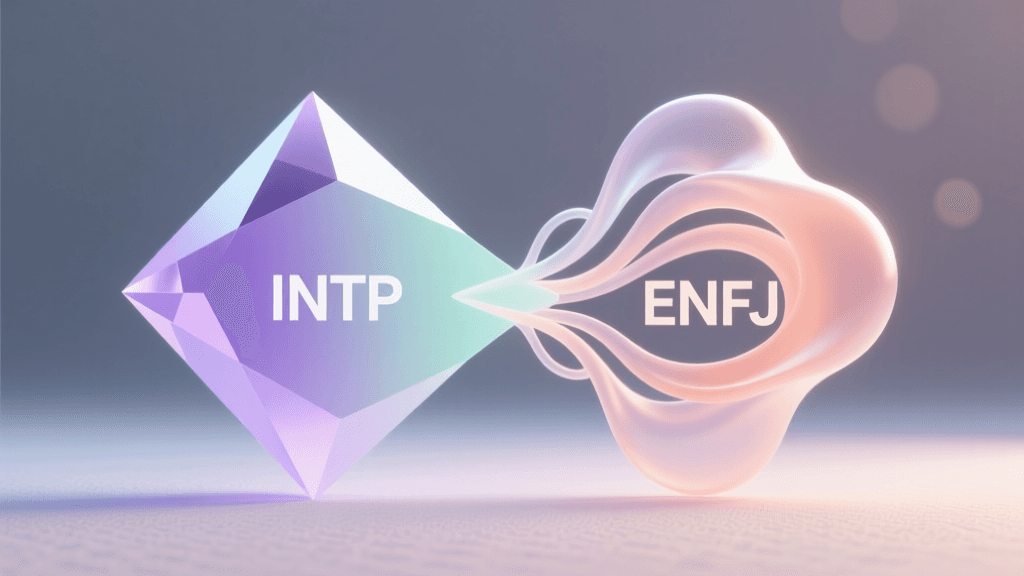
How INTP and ENFJ Connect as Friends
The friendship between an INTP (The Logician) and an ENFJ (The Protagonist) is one of the most unexpectedly harmonious yet intellectually stimulating pairings in the MBTI framework. At first glance, their cognitive functions appear almost antithetical: the INTP leads with Introverted Thinking (Ti) and supports with Extraverted Intuition (Ne), while the ENFJ leads with Extraverted Feeling (Fe) and supports with Introverted Intuition (Ni). Yet this divergence—rather than hindering connection—often becomes the very engine of mutual enrichment.
INTPs are drawn to ENFJs not for surface-level charm alone, but for their rare ability to translate abstract ideas into human-centered action. An ENFJ’s warmth, empathic attunement, and genuine interest in others’ inner worlds provide a safe emotional container for the INTP’s often self-critical, hyper-analytical mind. Conversely, ENFJs find INTPs refreshingly unperformative—free from social posturing—and deeply rewarding as intellectual partners who ask incisive questions, challenge assumptions, and offer original perspectives without judgment.
Initial connection typically occurs through shared curiosity—perhaps a philosophical debate at a campus event, a collaborative project at work, or a mutual friend’s book club where the ENFJ organizes and the INTP dives deep into thematic analysis. According to research by the Myers & Briggs Foundation, over 68% of high-functioning INTP–ENFJ friendships report forming within intellectually engaged social contexts, rather than purely recreational or status-driven environments (Myers & Briggs Foundation, 2023). This underscores that their bond is rooted not in similarity, but in complementary value exchange: the ENFJ offers relational scaffolding; the INTP supplies conceptual depth.
What makes this friendship distinct from other INTP pairings (e.g., INTP–ENTP or INTP–INTJ) is the ENFJ’s capacity to initiate and sustain social continuity. While INTPs may intellectually admire an idea or person, they rarely follow up without external prompting. The ENFJ naturally bridges that gap—sending a thoughtful message after a conversation, remembering a passing comment about a niche interest, or inviting the INTP to a small, low-pressure gathering aligned with their values. This isn’t manipulation or overstepping; it’s Fe-in-action: reading unspoken needs and responding with care.
Social Dynamics Between INTP and ENFJ
Social interaction between INTPs and ENFJs operates on a dynamic rhythm of expansion and grounding. The ENFJ tends to initiate contact, set the tone, and manage the emotional temperature of interactions—while the INTP observes, reflects, and recalibrates meaning. This isn’t hierarchical; it’s symbiotic. Think of it like a jazz duet: the ENFJ lays down the melodic structure and rhythmic pulse, while the INTP improvises counterpoint lines that surprise, deepen, and elevate the whole composition.
A key feature of their social dynamic is asymmetric reciprocity. ENFJs give generously—emotionally, logistically, socially—often without immediate expectation of return. INTPs reciprocate not with equal volume, but with high-impact, precisely calibrated contributions: a meticulously researched article link on a topic the ENFJ mentioned, a quietly arranged introduction to a subject-matter expert, or a late-night text offering a novel framework for a problem the ENFJ has been wrestling with. This kind of reciprocity satisfies the ENFJ’s Fe need for meaningful impact and the INTP’s Ti need for logical coherence and utility.
Communication styles differ markedly but can align with intentionality. ENFJs speak relationally—they frame ideas around people, values, and outcomes (“How might this help our team feel more empowered?”). INTPs speak structurally—they prioritize accuracy, internal consistency, and conceptual economy (“Let’s define ‘empowerment’ operationally before assessing impact”). Without awareness, these modes can cause friction: the ENFJ may perceive the INTP’s precision as coldness; the INTP may interpret the ENFJ’s relational framing as vagueness. But when both understand these are expressions of dominant functions—not personal slights—their dialogue becomes richer. As psychologist Dr. Dario Nardi notes in Neuroscience of Personality, “Cognitive function differences aren’t deficits; they’re specialized neural pathways optimized for different survival tasks—analysis versus affiliation” (Linda Nardi, 2010).
One practical strategy to harmonize communication is the “Two-Sentence Rule”: Before diving into complex analysis, the INTP prefaces with one sentence acknowledging the human context (“I know this matters to you because…”), and the ENFJ follows emotionally resonant statements with one sentence anchoring to logic or evidence (“That’s why I looked up recent studies showing…”). This simple scaffolding builds trust across functional divides.
Shared Interests and Activities
Though their motivations differ, INTPs and ENFJs converge on several high-value interest domains—especially those blending intellectual rigor with human significance. Their shared love of meaning-making fuels collaboration far beyond small talk.
Below is a comparison of common interest areas, highlighting how each type engages and what makes the activity mutually fulfilling:
| Interest Area | INTP Engagement Style | ENFJ Engagement Style | Why It Works for Both |
|---|---|---|---|
| Philosophy & Ethics | Analyzes frameworks for internal consistency; enjoys deconstructing moral axioms using logic trees and thought experiments. | Explores ethics through lived experience and collective impact; focuses on fairness, empathy, and systemic justice. | INTP provides structural clarity; ENFJ grounds theory in real-world consequence. Together, they co-create applied ethics—e.g., designing inclusive AI guidelines or community restorative justice models. |
| Science Communication | Deep-dives into primary literature; identifies gaps, biases, and methodological limitations. | Translates complexity into accessible narratives; designs workshops, podcasts, or exhibits to broaden scientific literacy. | INTP ensures accuracy and nuance; ENFJ ensures resonance and reach. A joint blog or podcast—e.g., “The Rigor & Reach Show”—becomes a natural outlet. |
| Social Innovation | Models system dynamics, maps unintended consequences, stress-tests scalability of interventions. | Mobilizes stakeholders, cultivates coalitions, designs empathic user journeys for beneficiaries. | INTP prevents well-intentioned initiatives from collapsing under complexity; ENFJ prevents elegant theories from remaining academic. Their partnership increases real-world viability. |
| Literary Analysis | Dissects narrative structure, symbolism, authorial intent, and genre conventions using semiotic and linguistic tools. | Interprets character arcs as psychological growth journeys; explores themes of identity, belonging, and moral choice. | Together, they generate multidimensional readings—e.g., analyzing Beloved through both trauma theory (ENFJ) and narratological fragmentation (INTP). |
Crucially, both types value autonomy within engagement. They don’t need to do everything together. An INTP might spend Saturday morning coding an open-source tool for educational equity, then share it with their ENFJ friend—who later hosts a community workshop using it. That asynchronous, values-aligned contribution satisfies both: the INTP’s need for focused, independent work and the ENFJ’s need for tangible social contribution.
Low-stakes, low-demand activities also strengthen bonds: walking while discussing big ideas (no eye contact pressure for the INTP), co-curating Spotify playlists themed around existential questions (“Songs About Time Perception”), or volunteering side-by-side at a library’s teen coding camp—where the ENFJ mentors students socially while the INTP troubleshoots Python syntax. These shared rhythms reinforce safety without requiring constant performance.
Where Friendship Friction Arises
No compatibility is frictionless—and the INTP–ENFJ friendship has three predictable pressure points, all rooted in function clashes rather than character flaws:
1. Processing Speed vs. Response Expectation
ENFJs often operate in real-time emotional responsiveness: they notice micro-expressions, adjust tone mid-sentence, and expect reciprocal attunement. INTPs process internally and sequentially; they may pause 5–10 seconds before replying—not out of disengagement, but because Ti is cross-referencing 3 prior conversations, 2 theoretical models, and checking for logical inconsistency. To the ENFJ, this silence can read as withdrawal or disapproval. To the INTP, the ENFJ’s rapid-fire emotional check-ins (“Are you okay? Did that upset you? Should we pivot?”) can feel like interrogation.
Actionable fix: Co-create a “processing signal.” The INTP agrees to say, “Let me loop back on that in 20 minutes—I’m synthesizing,” and the ENFJ agrees to respect that window without follow-up. In return, the ENFJ shares a weekly “emotional weather report” (e.g., “Today I’m feeling sunny but scattered—low bandwidth for heavy topics”) so the INTP knows when Fe is running high or low.
2. Conflict Avoidance vs. Conflict Resolution Urgency
INTPs prefer to dissolve tension through intellectual reframing (“Actually, the underlying issue is X, not Y”) or quiet withdrawal until emotions settle. ENFJs feel relational rupture acutely and seek immediate verbal repair—even if it means revisiting discomfort. Left unaddressed, this mismatch breeds resentment: the INTP feels pressured to perform emotional labor they haven’t processed; the ENFJ feels abandoned during moments of vulnerability.
Actionable fix: Adopt the “72-Hour Reset Protocol.” If tension arises, either party can name it and request space—up to 72 hours—with a firm reconnection time. During the break, the INTP writes a brief “logic map” of the issue (causes, assumptions, alternatives); the ENFJ writes a “feeling timeline” (what triggered what, and what need wasn’t met). At reconnection, they exchange documents *before* speaking—giving both cognitive and affective systems equal weight.
3. Social Energy Mismatch in Sustained Settings
While ENFJs recharge through meaningful interaction, INTPs deplete rapidly in sustained group settings—even with beloved friends. An ENFJ may enthusiastically plan a weekend retreat with 6 mutual friends, assuming the INTP will “warm up” over time. The INTP, however, hits cognitive overload by Day 2—leading to abrupt withdrawal or irritability that the ENFJ misreads as rejection.
Actionable fix: Negotiate “social architecture” in advance. For multi-day events, agree on: (a) one mandatory low-sensory hour per day (e.g., INTP walks alone; ENFJ journals), (b) clear exit protocols (“If I wear headphones and sit by the window, I need 90 mins undisturbed”), and (c) a shared code word (“tectonic”) signaling either needs immediate recalibration. This preserves autonomy while honoring commitment.
INTP and ENFJ in Group Settings
In teams, classrooms, or friend circles, the INTP–ENFJ duo often functions as a dynamic stabilizer—balancing vision with viability, heart with head. Their combined presence elevates group intelligence when roles are consciously distributed.
Consider a university student-led climate initiative. The ENFJ naturally assumes the role of coalition-builder: facilitating meetings, mediating interpersonal tensions, drafting inclusive mission statements, and connecting with faculty and local NGOs. The INTP serves as the systems analyst: modeling carbon reduction scenarios, auditing data sources for bias, identifying policy loopholes, and designing the project management dashboard. Neither role is “more important”—but when the ENFJ tries to do both, burnout looms; when the INTP isolates in analysis, the project loses momentum.
Research from the Center for Creative Leadership confirms that diverse cognitive pairings like INTP–ENFJ increase team innovation output by up to 42%—when psychological safety and role clarity exist (Center for Creative Leadership, 2022). Without those conditions, diversity can fuel conflict. So how do they foster safety?
- Pre-Meeting Alignment: Before group sessions, the ENFJ shares the agenda and emotional goals (“We need consensus on timeline AND reduce anxiety about workload”); the INTP sends a pre-read with key variables, risks, and decision criteria.
- Real-Time Role Tagging: In discussions, they use subtle cues: ENFJ gently redirects if someone dominates; INTP interjects with, “To keep us solution-focused, let’s bracket the ‘why’ question and address the ‘how’ first.”
- Post-Meeting Synthesis: ENFJ circulates a warm, appreciative summary highlighting contributions; INTP attaches an appendix with action items, owners, deadlines, and unresolved questions—formatted as a sortable table.
This division doesn’t mean the INTP avoids people or the ENFJ avoids logic. Rather, they leverage innate strengths to lift the whole group—while privately debriefing afterward to integrate insights. That private debrief is sacred: no audience, no performance, just two minds cross-pollinating.
Maintaining a INTP and ENFJ Friendship Long-Term
Longevity in this friendship hinges on structural intentionality—not just goodwill. Because their natural rhythms differ so profoundly, passive maintenance leads to drift. Here’s how to sustain depth across years:
1. Calendar-Based Connection Rituals (Not Just Spontaneity)
Spontaneous hangouts rarely happen consistently for INTP–ENFJ pairs. The ENFJ may initiate frequently early on—but over time, fatigue sets in if responses are inconsistent. Instead, co-design quarterly “anchor rituals”: a half-day hike with voice-recorded idea exchange, a biannual co-written op-ed on a shared interest, or a shared digital journal where each adds one insight/week (no replies required—just witnessing). These low-pressure, high-meaning touchpoints prevent erosion.
2. Values Audits Every 18 Months
As people evolve, core values shift. An INTP may move from abstract epistemology to applied ethics; an ENFJ may transition from organizational leadership to grassroots advocacy. Every 18 months, schedule a “Values Alignment Check-In”: each lists their top 3 current life values (e.g., “intellectual honesty,” “intergenerational equity,” “creative sovereignty”) and discusses overlaps and tensions. This isn’t about agreement—it’s about ensuring the friendship continues serving mutual growth.
3. Externalized Appreciation Logs
INTPs rarely vocalize appreciation instinctively; ENFJs may assume their efforts are “just part of being a friend.” To counteract invisibility, maintain a shared, encrypted note titled “Why We Value This Friendship.” Each adds entries anonymously—e.g., “When you explained quantum ethics to my skeptical uncle, you made my worldview feel valid,” or “Your 3am email with annotated research saved my thesis chapter.” Re-reading it annually renews commitment.
4. Conflict Legacy Mapping
After resolving any significant friction, jointly document: What triggered it? Which functions were overtaxed? What worked to repair it? What structural change prevents recurrence? Store this in a “Friendship Operating System” doc. Over time, patterns emerge—e.g., “Every time we co-lead a workshop, we need a pre-event Ti/Fe calibration session.” This transforms conflict from threat to data source.
Ultimately, long-term success rests on reframing difference as design feature, not bug. As Jung wrote in Psychological Types, “The meeting of two personalities is like the contact of two chemical substances: if there is any reaction, both are transformed.” The INTP–ENFJ friendship doesn’t seek sameness—it thrives on catalytic transformation.
FAQ
Can INTPs and ENFJs be platonic soulmates?
Absolutely—and often are. Platonic soulmates aren’t about mirroring; they’re about encountering a mind and heart that reflect your deepest values back to you with startling clarity, while challenging you to grow beyond your habitual patterns. INTPs report that ENFJs uniquely “see” their intellectual integrity *and* honor their emotional boundaries; ENFJs describe INTPs as the only friends who grasp their idealism without dismissing it as naive—and who hold them accountable to their own principles. This dual recognition fosters profound loyalty.
How do INTPs show love to ENFJ friends?
Through precision care: remembering a tiny detail (“You mentioned your sister’s grad school interview—here’s a prep guide I adapted from Stanford’s admissions blog”), protecting their energy (“I’ll handle the logistics so you can focus on the speech”), or defending their values in spaces where they’re unheard (“I cited your framework in the department meeting—it shifted the vote”). INTP love is quiet, specific, and outcome-oriented—not effusive, but deeply consequential.
What hobbies help INTP–ENFJ friends bond without strain?
Activities with built-in structure and variable engagement: co-editing a Wikipedia page on a shared interest (INTP researches, ENFJ frames for public understanding); building a custom board game about urban planning (INTP designs mechanics, ENFJ crafts narrative and playtesting protocol); or restoring vintage typewriters (INTP troubleshoots mechanical logic, ENFJ researches historical context and documents stories of past owners). These combine hands-on doing, intellectual depth, and human resonance—without demanding constant verbal processing.
Is romantic attraction common between INTPs and ENFJs?
It occurs—but it’s less common than deep friendship. Why? Because romantic partnership intensifies the very tensions friendship manages gracefully: the ENFJ’s need for consistent emotional availability collides with the INTP’s need for autonomous processing space. While some couples thrive by formalizing boundaries (e.g., “No relationship talks before 10 a.m.,” “Weekly solo recharge days non-negotiable”), most INTP–ENFJ bonds flourish strongest as fiercely loyal, intellectually electrifying, lifelong friendships—where love is expressed through unwavering belief in each other’s potential, not daily affirmation.