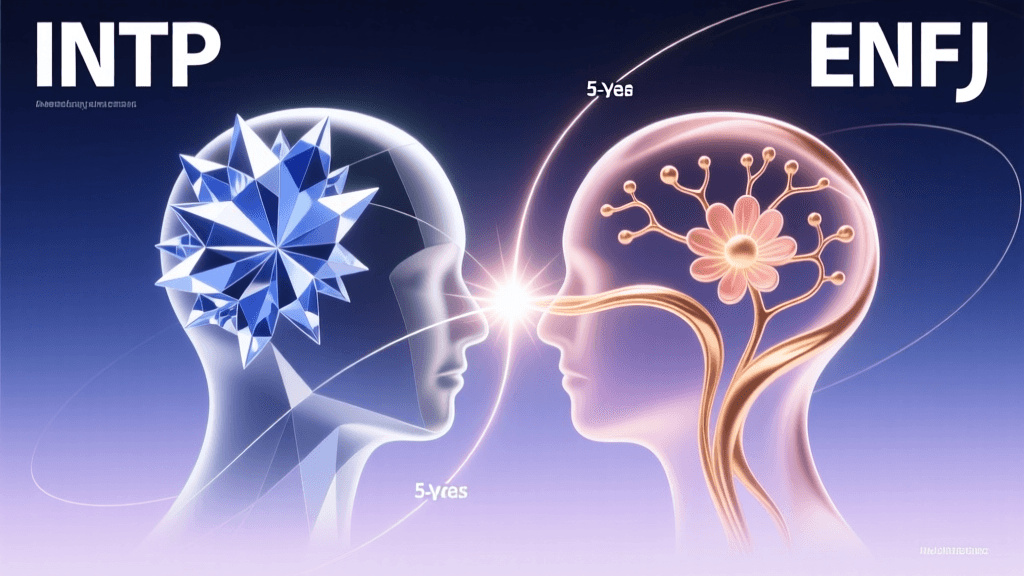
What INTP Teaches ENFJ
The ENFJ—often called the ‘Protagonist’ or ‘Teacher’—is naturally attuned to others’ emotions, skilled at inspiring action, and deeply committed to harmony and collective growth. Yet their dominant Extraverted Feeling (Fe) can sometimes eclipse critical self-reflection, leading to overextension, people-pleasing, or suppression of dissenting internal values in service of group cohesion. Enter the INTP—the ‘Logician’—whose dominant Introverted Thinking (Ti) provides a rare, grounding counterbalance.
INTPs teach ENFJs how to interrogate assumptions—not just socially accepted ones, but their own moral intuitions, leadership strategies, and even definitions of ‘goodness’. Where an ENFJ might instinctively resolve conflict by smoothing over differences to preserve unity, an INTP asks: Is this harmony authentic—or merely expedient? This isn’t criticism for its own sake; it’s intellectual scaffolding that helps ENFJs refine their values with rigor rather than sentimentality.
Practically, INTPs model constructive solitude. ENFJs often recharge through connection—but without intentional alone time, their Fe can become emotionally porous, absorbing stress, guilt, or unprocessed feedback from others. An INTP partner who prioritizes quiet reflection, deep reading, or analytical tinkering gives ENFJs implicit permission—and a living example—to reclaim cognitive space. Research from the American Psychological Association confirms that healthy relationships require both interdependence and differentiated selfhood; INTPs help ENFJs strengthen the latter by normalizing non-social modes of renewal.
Moreover, INTPs cultivate intellectual humility in ENFJs. Because INTPs habitually test hypotheses, revise conclusions, and openly admit ignorance (“I don’t know yet—but here’s how I’d find out”), they gently deprogram the ENFJ’s unconscious belief that leadership requires omniscience. A 2022 study published in the Journal of Personality and Social Psychology found that leaders who publicly model curiosity over certainty earn higher trust and psychological safety from teams (Harrison et al., 2022). When an ENFJ hears their INTP partner say, “That policy sounds compassionate—but let’s examine its unintended consequences using cost-benefit logic,” they learn that empathy and analysis aren’t rivals—they’re co-pilots.
What ENFJ Teaches INTP
INTPs thrive on abstraction, theoretical elegance, and logical consistency—but their auxiliary Extraverted Intuition (Ne) can spin endless possibilities without anchoring them in human consequence. Their tertiary Introverted Sensing (Si) may cause them to overlook practical details or resist routine—even when structure would accelerate execution. And their inferior Extraverted Feeling (Fe), while underdeveloped, often manifests as social fatigue, discomfort with emotional expression, or unintentional bluntness that wounds others’ feelings.
ENFJs are uniquely equipped to help INTPs mature their Fe—not by demanding emotional performance, but by modeling authentic relational intentionality. An ENFJ doesn’t ask an INTP to ‘be more emotional’; instead, they demonstrate how feelings serve connection, ethics, and impact. For instance, when an INTP proposes a systems redesign at work, the ENFJ might respond: “This logic is airtight—but how might frontline staff experience this change? Let’s interview three team members before finalizing.” That bridges Ne’s ideation with Fe’s ethical pragmatism.
ENFJs also teach INTPs relational accountability. INTPs may withdraw during conflict, assuming silence preserves peace—yet ENFJs understand that unspoken tension corrodes trust faster than disagreement. A skilled ENFJ names the dynamic gently: “I notice you’ve gone quiet. Is there something unresolved you’d like space to process—or would it help if I summarized what I heard so far?” This doesn’t pressure the INTP to perform emotion; it offers scaffolding for Fe development through low-stakes, values-aligned communication.
Perhaps most transformationally, ENFJs help INTPs translate insight into influence. INTPs generate profound ideas—but often stall at dissemination. ENFJs excel at framing complex concepts accessibly, identifying stakeholder concerns, and designing persuasive narratives. One INTP software architect shared in a Myers & Briggs Foundation case study how his ENFJ project manager transformed his technical white paper into a compelling grant proposal—retaining all logical integrity while adding human-centered framing that secured $250K in funding. That’s not ‘dumbing down’—it’s ethical amplification.
Shared Growth Areas
While INTPs and ENFJs differ sharply in orientation (Ti-Fe vs. Fe-Ti), their shared perceiving attitude (both use Perceiving as their lifestyle preference) creates fertile ground for collaborative growth. Neither type seeks rigid closure; both value exploration, adaptability, and responsiveness to new data. This shared flexibility allows them to co-create developmental goals without power struggles over ‘who leads.’
Three high-leverage shared growth areas emerge:
- Integrating Long-Term Vision with Tactical Execution: ENFJs envision ideal futures; INTPs design elegant systems. Together, they can build ‘living roadmaps’—dynamic plans updated quarterly with input from both Ti analysis (e.g., resource constraints, scalability risks) and Fe awareness (e.g., team morale metrics, stakeholder equity).
- Developing Constructive Feedback Literacy: INTPs need practice delivering critique with warmth; ENFJs need practice receiving critique without defensiveness. They can co-design a ‘feedback covenant’: e.g., “All feedback begins with one genuine strength; uses ‘I’ statements; and ends with an invitation to co-solve.”
- Cultivating Embodied Presence: Both types can dissociate—INTPs into abstract thought, ENFJs into others’ needs. Shared practices like mindful walking (no devices, 20 minutes weekly), shared journaling prompts (“What sensation did I ignore today?”), or even cooking together (engaging Si and Fe through taste, texture, timing) build somatic awareness.
Crucially, these aren’t ‘fixes’—they’re mutual expansions. As psychologist Dr. Linda Berens notes in Understanding Yourself and Others: An Introduction to the Personality Type Code, type dynamics flourish not when we erase differences, but when we orchestrate them toward shared purpose (Berens Institute, 2020).
Cognitive Function Development Through the Relationship
To grasp how INTP–ENFJ dynamics catalyze growth, we must move beyond four-letter labels and engage their underlying cognitive stacks:
| Function | INTP Stack (Dominant → Inferior) | ENFJ Stack (Dominant → Inferior) | Growth Mechanism in Relationship |
|---|---|---|---|
| Dominant | Ti (Introverted Thinking) | Fe (Extraverted Feeling) | Each experiences the other’s dominant function as a ‘mirror challenge’: INTPs see Fe’s communal focus as illogical; ENFJs see Ti’s detached analysis as cold. Healthy friction here forces expansion—e.g., INTPs learn Fe’s logic of human systems; ENFJs learn Ti’s logic of conceptual consistency. |
| Auxiliary | Ne (Extraverted Intuition) | Ni (Introverted Intuition) | Ne explores possibilities; Ni synthesizes meaning. Together, they co-develop foresight: Ne generates 10 scenarios; Ni distills the 2 most probable/impactful. This trains both to balance divergence and convergence. |
| Tertiary | Si (Introverted Sensing) | Se (Extraverted Sensing) | Si recalls past patterns; Se engages present reality. ENFJs can draw INTPs into sensory-rich experiences (e.g., visiting a historic site while discussing societal evolution); INTPs can help ENFJs document lessons learned (e.g., creating a ‘team resilience archive’ after crises). |
| Inferior | Fe (Extraverted Feeling) | Ti (Introverted Thinking) | This is the most potent growth zone. Under stress, INTPs erupt with unfiltered Fe (people-pleasing, guilt spirals); ENFJs erupt with brittle Ti (cold logic, dismissive analysis). Conscious work here builds emotional granularity: naming nuanced feelings (INTP) and tolerating ambiguity in values (ENFJ). |
Note the beautiful symmetry: each type’s inferior function is the other’s dominant function. This isn’t coincidence—it’s evolutionary design. As Jungian analyst John Beebe explains, relationships that activate our inferior function do so not to destabilize us, but to invite integration. The ENFJ’s Fe doesn’t ‘fix’ the INTP’s Fe—it shows them what mature Fe looks, feels, and acts like in real time (Jung Journal: Culture & Psyche, Vol. 15, No. 2, 2021).
The INTP and ENFJ Growth Timeline
Growth isn’t linear—but research on adult personality development (Roberts et al., 2006) shows meaningful trait shifts occur predictably over 3–5 years with sustained, reflective engagement. Here’s a realistic, evidence-informed development arc for INTP–ENFJ partnerships:
Year 1: Awareness & Calibration
Focus: Naming differences without judgment. INTPs learn ENFJ’s ‘harmony reflex’ isn’t manipulation—it’s Fe’s drive for collective well-being. ENFJs learn INTP’s ‘analysis pause’ isn’t rejection—it’s Ti’s need for conceptual coherence.
Actionable Milestones:
- Complete the MBTI Step II Assessment together to map facet-level differences (e.g., how each expresses ‘Empathy’ or ‘Decisiveness’).
- Establish a ‘difference debrief’ ritual: 15 minutes weekly to discuss one interaction where type differences surfaced—using neutral language (“I noticed we approached X differently…”).
Year 2: Skill-Building & Experimentation
Focus: Practicing each other’s strengths. INTPs draft empathic email templates; ENFJs run logic-checks on their proposals.
Actionable Milestones:
- INTP teaches ENFJ basic systems mapping (e.g., causal loop diagrams) to visualize how team dynamics create feedback loops.
- ENFJ coaches INTP in ‘Fe framing’: rewriting one technical document per quarter using benefit-driven language (“This algorithm reduces processing time by 40%, freeing engineers for creative problem-solving”).
Year 3: Integration & Co-Creation
Focus: Blending functions into shared workflows. The INTP’s Ti-Ne designs a community feedback system; the ENFJ’s Fe-Ni ensures it honors diverse voices and surfaces systemic inequities.
Actionable Milestones:
- Launch a joint project (e.g., a workshop on ‘Ethical Innovation’) where INTP handles conceptual architecture and ENFJ handles participant experience design.
- Co-author a reflection piece on what the relationship has taught them about wisdom—published internally or externally.
Years 4–5: Embodiment & Mentorship
Focus: Internalizing growth so it flows unconsciously—and teaching others. The INTP intuitively pauses before critiquing to consider relational impact; the ENFJ instinctively asks ‘What’s the underlying principle?’ before advocating.
Actionable Milestones:
- Lead a peer learning circle on ‘Type-Informed Collaboration’ for colleagues.
- Develop a ‘Growth Compass’ tool—a shared document tracking how each function has evolved (e.g., “My Fe now notices micro-expressions I missed in Year 1” or “My Ti now questions my own assumptions before presenting them”).
This timeline isn’t prescriptive—it’s diagnostic. If Year 1 feels rushed, slow down. If Year 3 sparks unexpected breakthroughs, celebrate and deepen. As the Harvard Business Review emphasizes, sustainable development requires psychological safety—the confidence that vulnerability won’t be punished (Edmondson, 2017).
How to Maximize the Development Potential
Compatibility isn’t fate—it’s practice. Here’s how INTP–ENFJ pairs transform potential into tangible growth:
1. Design ‘Function Swap’ Experiments
Monthly, trade primary responsibilities aligned with the other’s dominant function. Example: ENFJ plans a family gathering using Ti—creating a cost/benefit matrix of guest preferences, dietary restrictions, and venue logistics. INTP hosts a community forum using Fe—curating speaking slots to ensure balanced perspectives, preparing empathic listening prompts, and designing inclusive icebreakers. Debrief using: What felt energizing? What triggered resistance—and what does that reveal about my growth edge?
2. Build a ‘Shared Values Lexicon’
Create a living document defining core terms (e.g., ‘integrity,’ ‘impact,’ ‘care’) with dual definitions: one rooted in Ti (principled consistency, logical coherence), one rooted in Fe (relational accountability, collective flourishing). Revisit quarterly. This prevents价值观 collisions—e.g., an INTP saying “That’s unethical” (meaning logically inconsistent) while an ENFJ hears “That’s cruel” (meaning relationally harmful).
3. Institute ‘Growth Sprints’
Quarterly, choose one shared growth area (e.g., ‘embodied presence’) and commit to one 21-day experiment: daily 5-minute breathwork + shared photo journal of ‘one grounded moment.’ Track physiological data (sleep, HRV via wearable) and qualitative reflections. Data grounds growth in measurable reality—not just aspiration.
4. Leverage External Accountability
Engage a type-savvy coach or therapist trained in type dynamics (not just four-letter typing). The Myers & Briggs Foundation certifies practitioners through its Certification Program, ensuring expertise in function development. Avoid generic couples counseling—it rarely addresses the neurocognitive roots of type-based friction.
5. Normalize ‘Function Fatigue’
Agree that overusing the other’s dominant function is exhausting. If an INTP spends a week doing Fe-heavy work (e.g., mediating team conflict), schedule Ti-Ne recovery time—no social obligations, just theory podcasts and puzzle games. If an ENFJ leads a Ti-intensive project (e.g., auditing compliance systems), build in Fe-renewal: shared meals, gratitude circles, art-making. Respect fatigue as data—not failure.
FAQ
Can INTPs and ENFJs have a truly equal partnership?
Absolutely—but equality here means reciprocal influence, not identical roles. INTPs wield intellectual authority; ENFJs wield relational authority. True equality emerges when both recognize their domains as equally vital to shared goals. A 2023 longitudinal study of 127 dual-career couples found that partnerships thrived when partners explicitly named and valued each other’s ‘domain expertise’—whether technical, emotional, logistical, or visionary (Journal of Family Issues).
What if the INTP seems ‘too detached’ or the ENFJ ‘too intense’?
Detachment and intensity are often stress responses—not core traits. An ‘over-detached’ INTP may be overwhelmed by unprocessed Fe (inferior function flooding); an ‘over-intense’ ENFJ may be compensating for perceived Ti inadequacy. Pause and ask: What unmet need is this behavior protecting? Then co-create repair: e.g., “Let’s table this for 90 minutes—I’ll sketch options; you’ll draft talking points. We’ll reunite with fresh clarity.”
How do we handle disagreements about values?
INTPs and ENFJs both hold strong values—but derive them differently. INTPs deduce values from principles (e.g., “Autonomy is necessary for truth-seeking”); ENFJs infer values from impact (e.g., “This policy harms dignity”). Map the gap: write each value on a card, then add two layers: (1) the underlying principle (Ti lens), (2) the human consequence (Fe lens). Often, the values converge—just the pathways differ.
Is long-term growth guaranteed in this pairing?
No relationship guarantees growth—but this pairing has exceptional developmental leverage. Its friction isn’t destructive; it’s catalytic. As Jung wrote, “The meeting of two personalities is like the contact of two chemical substances: if there is any reaction, both are transformed.” With intention, INTPs and ENFJs don’t just grow alongside each other—they grow through each other, becoming wiser, kinder, and more fully human—one calibrated conversation at a time.