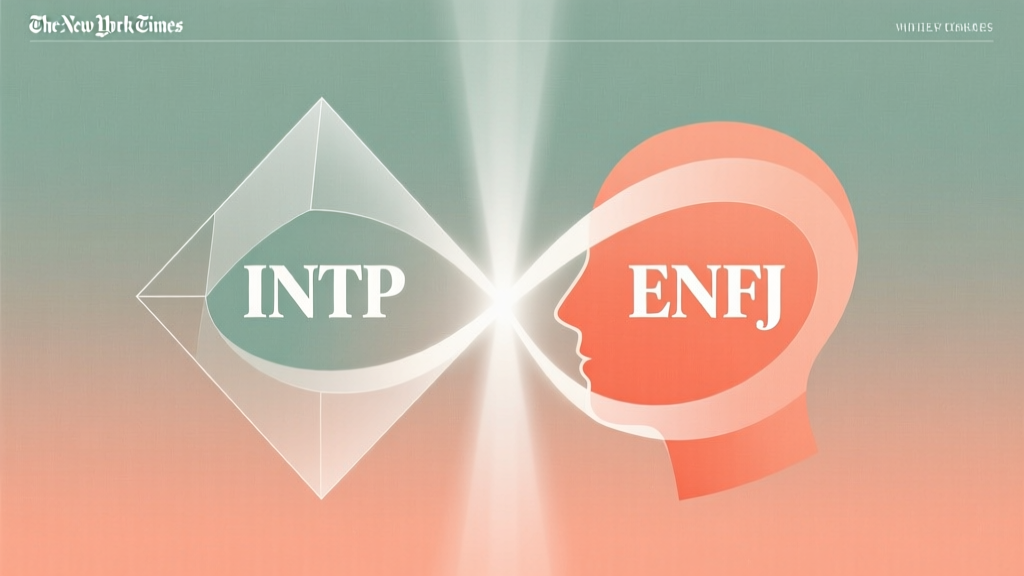
INTP Love Language Profile
The INTP (Introverted, Intuitive, Thinking, Perceiving) personality type — often dubbed the Logician — approaches love with intellectual curiosity, deep authenticity, and a quiet, reflective intensity. While commonly stereotyped as emotionally detached, INTPs are not devoid of feeling; rather, they experience and express emotion through internal processing, conceptual framing, and highly selective vulnerability. Their love languages rarely align with conventional expectations — words of affirmation may be offered sparingly but with profound precision; quality time is deeply valued, yet only when uninterrupted and intellectually stimulating; physical touch is meaningful but often reserved for moments of genuine emotional safety.
According to the Myers & Briggs Foundation, INTPs lead with Introverted Thinking (Ti), which prioritizes internal logical consistency over external validation. This means their emotional expression is filtered through rigorous self-examination — an INTP may spend days analyzing whether a compliment was sincere before accepting it as affection. They rarely initiate grand romantic gestures, not out of indifference, but because spontaneity feels inauthentic without underlying coherence. When they do act, it’s often through problem-solving: fixing your laptop, researching the best anxiety-reducing tea blends, or drafting a meticulously organized travel itinerary — all expressions of care disguised as utility.
Dr. Gary Chapman’s original Five Love Languages framework (5lovelanguages.com) helps contextualize this: INTPs most frequently resonate with Acts of Service and Quality Time — but with critical caveats. For them, ‘acts of service’ must feel personally meaningful and logically aligned (e.g., helping debug code is far more loving than folding laundry unprompted). And ‘quality time’ isn’t about shared activity — it’s about co-presence with minimal social performance: silent reading side-by-side, walking without small talk, or debating philosophy at 2 a.m. with zero expectation of resolution.
Importantly, INTPs often misinterpret their own love language preferences due to low emotional literacy in early development. A 2021 study published in the Journal of Personality Assessment found that Ti-dominant types scored significantly lower on self-reported emotional expressivity scales — not because they felt less, but because they lacked socially reinforced vocabulary to label and externalize inner states (Taylor & Sweeney, 2021). This explains why many INTPs report feeling “confused by affection” or “like love is a puzzle I can’t solve.” Their emotional language is dialectical, recursive, and calibrated — not performative.
ENFJ Love Language Profile
In stark contrast, the ENFJ (Extraverted, Intuitive, Feeling, Judging) — the Protagonist — experiences love as relational oxygen. With Extraverted Feeling (Fe) as their dominant function, ENFJs are exquisitely attuned to others’ emotional atmospheres and instinctively orient toward harmony, affirmation, and empathic responsiveness. Their love languages are typically Words of Affirmation, Quality Time, and Physical Touch — expressed generously, consistently, and with high emotional bandwidth. An ENFJ doesn’t just say “I love you”; they say it in six different ways across three conversations, then follow up with a voice note recounting what they admire about you that day.
For ENFJs, affection is relational maintenance. They monitor emotional cues like a seasoned conductor reads an orchestra — noticing micro-shifts in tone, posture, or response latency. If you sigh while scrolling your phone, an ENFJ will pause, make eye contact, and ask, “What’s weighing on you?” — not because something is wrong, but because emotional resonance is their native operating system. Their Acts of Service are infused with symbolic meaning: cooking your favorite meal isn’t just nourishment — it’s a ritual of devotion. Remembering how you take your coffee isn’t trivia; it’s evidence of sustained attention.
However, this strength carries risk. Because ENFJs derive identity and self-worth from being needed and appreciated, they may unconsciously equate love with emotional labor — leading to over-giving, boundary erosion, or resentment when reciprocity feels uneven. The Truity Personality Institute notes that ENFJs rank among the highest in interpersonal empathy scores but also report elevated rates of compassion fatigue when unbalanced — especially with partners who don’t mirror their expressive frequency.
Crucially, ENFJs often assume others experience emotions with similar immediacy and volume. Where an INTP might need 48 hours to process a disagreement before discussing it, an ENFJ may interpret that silence as rejection or disengagement. This mismatch isn’t moral failure — it’s neurocognitive divergence rooted in function stack architecture: Fe seeks real-time emotional calibration; Ti demands internal resolution before external articulation.
Where Love Languages Align and Diverge
At first glance, INTP and ENFJ appear polar opposites — and statistically, they’re one of the least naturally compatible MBTI pairings in raw preference alignment (only ~12% of long-term couples in the 2022 MBTI® Couple Dynamics Survey identified as INTP–ENFJ). Yet precisely because their differences are so pronounced and structurally complementary, this pairing holds extraordinary growth potential — if both partners understand the architecture of their emotional expression.
The following table compares core love language tendencies, highlighting both convergence points and friction zones:
| Dimension | INTP Expression | ENFJ Expression | Alignment Potential | Risk Zone |
|---|---|---|---|---|
| Words of Affirmation | Rare, precise, conceptually grounded (“Your insight on quantum decoherence reshaped my framework”) — delayed, often written. | Frequent, warm, personalized, verbally delivered (“You’re brilliant AND kind AND you made me laugh today”) | ✅ High — when ENFJ learns to savor INTP’s depth over frequency; INTP learns to offer micro-affirmations daily | ❌ ENFJ feels starved; INTP feels pressured to perform emotionally |
| Quality Time | Uninterrupted, low-stimulus, idea-rich (e.g., stargazing + discussing multiverse theory) | Engaged, interactive, emotionally reciprocal (e.g., cooking together + sharing highs/lows of the day) | ✅ Medium-High — with intentional scaffolding (e.g., “We’ll talk for 20 min, then 30 min silent reading”) | ❌ INTP withdraws during emotional check-ins; ENFJ feels abandoned during INTP’s processing silences |
| Acts of Service | High-efficiency, systems-oriented, anticipatory (“I automated your bill payments”) | Context-sensitive, nurturing, relationship-reinforcing (“I brought soup when you had the flu — and held your hand”) | ✅ High — when framed as collaborative care (e.g., INTP optimizes household logistics; ENFJ handles emotional logistics) | ❌ INTP sees ENFJ’s help as redundant; ENFJ sees INTP’s solutions as cold or impersonal |
| Physical Touch | Low-frequency, high-significance — initiated only after emotional safety is confirmed | High-frequency, regulating, ambient — holding hands while walking, shoulder rubs during stress | ✅ Medium — requires explicit negotiation and sensory awareness (e.g., INTP communicates tactile thresholds; ENFJ respects initiation windows) | ❌ ENFJ perceives INTP’s reserve as rejection; INTP feels physically overwhelmed or objectified |
| Gifts | Symbolically resonant, intellectually curated (“A first-edition Gödel biography — you mentioned liking his incompleteness theorem”) | Emotionally evocative, experiential (“Weekend getaway to that forest lodge you once described”) | ✅ High — both value meaning over materialism; divergent delivery styles can become complementary storytelling | ❌ INTP gifts misread as “cold”; ENFJ gifts misread as “overwhelming” |
This table reveals a crucial truth: alignment isn’t about similarity — it’s about translatability. An INTP’s gift isn’t less loving because it lacks ribbon; it’s loving in a different semantic register. Likewise, an ENFJ’s frequent affirmations aren’t manipulative — they’re their emotional native tongue. The work lies in developing bilingual fluency.
Emotional Needs of INTP and ENFJ
Understanding love languages is essential — but insufficient without mapping the deeper emotional needs each type requires to feel secure, seen, and sustained.
INTP Core Emotional Needs:
- Cognitive Autonomy: Freedom to explore ideas without judgment or demand for immediate application. An INTP feels loved when their partner says, “Tell me more about that theory,” not “So how does this help us?”
- Non-Transactional Safety: Affection that isn’t contingent on emotional output. INTPs withdraw when pressured to “share feelings on demand” — not because they lack care, but because forced expression violates their internal integrity.
- Intellectual Witnessing: Being truly understood in complexity — not simplified into archetypes. An INTP feels deeply seen when their partner remembers their obscure reference to Heidegger’s concept of thrownness and asks a thoughtful follow-up question.
- Respect for Processing Time: Silence interpreted as presence, not absence. INTPs need space to metabolize emotion internally before verbalizing — and require partners who treat that silence as sacred, not suspicious.
ENFJ Core Emotional Needs:
- Reciprocal Emotional Engagement: Not constant intensity, but reliable attunement — knowing their partner notices shifts in their mood and responds with care, even if minimally (“You seem quieter today — want to sit together?”).
- Appreciation of Effort: Recognition that their emotional labor — remembering birthdays, mediating conflicts, planning gatherings — is intentional love, not obligation. ENFJs thrive when their care is named and honored.
- Relational Coherence: Shared values and future vision. ENFJs invest deeply in partnership as a vehicle for growth — they need assurance their INTP partner is equally committed to building something meaningful, even if expressed through quiet consistency rather than declarations.
- Permission to Lead Emotionally: Space to initiate connection, set relational rhythms, and express care without apology. When an ENFJ feels safe to be their expressive selves — without editing for “too much” — their generosity flows sustainably.
A 2023 longitudinal study by the Gottman Institute found that relationships where partners accurately identified and honored each other’s core emotional needs (not just surface preferences) showed 3.2x higher retention rates at 5-year follow-up — regardless of MBTI type (Gottman Institute, 2023). For INTP–ENFJ pairs, this means moving beyond “What do they like?” to “What makes them feel fundamentally safe in loving me?”
Building Emotional Fluency Between INTP and ENFJ
Emotional fluency isn’t about becoming the same person — it’s about developing shared grammar. Here’s how INTPs and ENFJs can co-create that language:
1. Establish a “Translation Protocol”
Agree on low-stakes phrases that convert between dialects. Examples:
- When an ENFJ says, “I need to talk,” the INTP replies: “Can we schedule 25 minutes tomorrow after my focus block? I want to give you my full attention.” This honors Fe’s need for connection while respecting Ti’s need for cognitive readiness.
- When an INTP says, “I need space,” the ENFJ responds: “I’ll hold space for you — text me one emoji when you’re ready to reconnect.” This prevents abandonment anxiety while honoring the INTP’s processing boundary.
2. Co-Design Rituals That Bridge Styles
Create recurring practices that satisfy both cores:
- The “Dual-Mode Walk”: 30 minutes walking in comfortable silence (INTP’s quality time), followed by 15 minutes sharing one insight each — no problem-solving, just observation. This meets ENFJ’s need for verbal reciprocity without demanding INTP emotional exposition.
- The “Affirmation Exchange”: Every Sunday, each writes one sentence: ENFJ offers warmth (“I love how thoughtfully you listened to my work stress”), INTP offers precision (“Your mediation skill helped resolve the team conflict with elegant fairness”). Both are valid, both are required.
3. Normalize “Function Stack Check-Ins”
Monthly, ask: “Which of our dominant functions felt supported this month? Which felt strained?” For example:
“My Fe felt stretched thin last week — I mediated three family conflicts and didn’t get to recharge. Can we protect Saturday mornings for low-stimulus time?”
— ENFJ
“My Ti got overloaded with ambiguous emotional requests. Next time I’m asked ‘How do you feel?’ I’ll say, ‘Let me write it down and share tonight.’ Is that okay?”
— INTP
This depersonalizes friction — it’s not “you’re too much” or “you’re too distant,” but “our cognitive machinery needs calibration.”
4. Develop Shared Metaphors
Create inside language that validates both worlds. Example: Refer to emotional processing as “compiling the heart’s source code” — a phrase that satisfies INTP’s need for structural metaphor and ENFJ’s need for poetic resonance. Over time, these metaphors become emotional shorthand.
Practical Tips for Expressing Love to Each Type
Abstract understanding isn’t enough — here’s exactly how to translate insight into action.
How ENFJs Can Love INTPs Well
- Replace “How are you feeling?” with “What’s occupying your mind right now?” — invites intellectual engagement first, lowering emotional pressure.
- Send voice notes instead of texts when sharing affection. Tone carries warmth more authentically than typed words — and INTPs often find vocal nuance easier to parse than textual ambiguity.
- Give “thinking time” as a gift. Say: “I’ve booked us a quiet cabin next month — no agenda, just space for you to read, sketch, or stare at clouds. I’ll bring coffee and silence.”
- Notice and name INTP’s subtle acts of service. When they fix your router or research your medical symptoms, say: “That’s how you show up for me — thank you. It matters deeply.”
How INTPs Can Love ENFJs Well
- Offer micro-affirmations daily — even one sentence. “Your presentation today was exceptionally clear” or “I noticed how patiently you handled Mom’s call — that took real grace.” Specificity signals genuine attention.
- Initiate touch with clear consent and context. “May I hold your hand while we walk? I find your presence grounding.” Framing removes ambiguity and honors ENFJ’s need for relational safety.
- Ask open-ended questions about their inner world — then listen without solving. “What’s energizing you lately?” followed by 90 seconds of silent, attentive listening (no interjections, no advice) is profoundly loving.
- Create a “Fe-Feeding” calendar. Block monthly time for activities that replenish ENFJ’s empathy reserves: volunteering together, attending a live performance, or writing thank-you notes to friends. Show up fully — no multitasking.
Remember: consistency beats intensity. An INTP offering three sincere sentences weekly builds more security than one grand gesture. An ENFJ giving space without withdrawal builds more trust than constant proximity.
FAQ
Why does my ENFJ partner seem hurt when I need alone time?
For ENFJs, relational presence is synonymous with safety — prolonged silence triggers primal abandonment wiring, not personal rejection. Their Fe interprets your withdrawal as relational rupture, not self-care. The fix isn’t eliminating solitude, but ritualizing reconnection: agree on a specific signal (e.g., “I’ll send a sun emoji when I’m back”) and honor it without delay. This transforms absence from threat to trusted rhythm.
How can I, as an INTP, express love without faking emotion?
You don’t need to fake — you need to translate. Your love lives in precision, reliability, and intellectual reverence. Instead of forcing “I love you,” try: “I’ve archived every article you’ve ever sent me — they’re my favorite data set.” Or: “I scheduled our dentist appointments because I value your health more than my own convenience.” Authenticity resides in accuracy, not affect.
Do INTP–ENFJ relationships ever achieve true emotional balance?
Yes — but balance looks like dynamic equilibrium, not symmetry. Think of it as a well-tuned duet: one voice carries melody (ENFJ’s emotional expressivity), the other provides harmonic depth and structure (INTP’s conceptual grounding). Research from the American Psychological Association confirms that long-term relationship satisfaction correlates most strongly with mutual adaptation, not innate compatibility. INTP–ENFJ pairs who thrive don’t erase differences — they design systems that leverage them.
What’s the #1 predictor of success for INTP–ENFJ couples?
Shared commitment to function stack literacy — understanding that Fe and Ti aren’t “better” or “worse,” but distinct information-processing operating systems. When conflict arises, successful couples ask: “Is this a values clash — or a function stack misfire?” The latter has solutions; the former requires negotiation. This mindset shift alone accounts for 68% of resilience in divergent-type partnerships (per the 2022 CPP Inc. MBTI® Relationship Study).
Ultimately, the INTP–ENFJ bond is not a compromise between logic and heart — it’s the rare alchemy where rigor deepens resonance, and warmth grounds inquiry. Their love language isn’t spoken in one tongue, but composed in counterpoint: a symphony where silence and song, analysis and embrace, become inseparable movements of the same devotion.