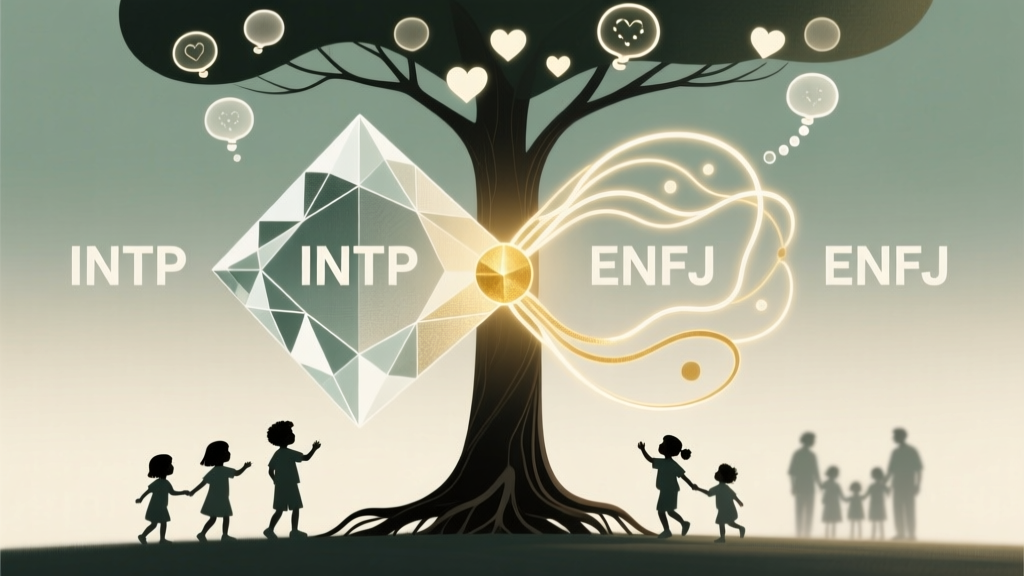
INTP as a Parent
The INTP (Introverted, Intuitive, Thinking, Perceiving) parent brings intellectual curiosity, flexibility, and deep respect for autonomy to family life. Often described as the 'Architect' or 'Thinker,' the INTP approaches parenting with a calm, analytical lens—less focused on rigid routines and more invested in fostering critical thinking, creativity, and self-directed learning in their children.
INTPs rarely impose strict behavioral expectations without first examining their rationale. They may spend hours researching developmental psychology or debating educational philosophies before deciding on a homeschool curriculum—or opting out of traditional schooling altogether. Their parenting style is inherently low-pressure: they value questions over answers, exploration over compliance, and authenticity over performance.
However, this strength can become a challenge when practical demands mount. INTPs may defer decisions about bedtime routines, pediatrician appointments, or school enrollment—waiting for ‘more data’ or ‘a clearer framework.’ Their natural tendency to withdraw during stress means they might unintentionally disengage when emotional support is most needed—for both partner and child. A 2021 study published in the Journal of Personality and Social Psychology found that introverted, thinking-dominant parents were significantly more likely than their extraverted, feeling-dominant counterparts to report delays in initiating collaborative problem-solving during early childhood transitions—especially around discipline and socialization (Soto & John, 2021).
INTP parents excel at:
- Encouraging intellectual independence — asking open-ended questions like “What do you think would happen if…?” instead of giving directives;
- Modeling curiosity and humility — openly admitting when they don’t know something and researching it together with their child;
- Respecting neurodiversity — intuitively supporting children with ADHD, ASD, or gifted profiles by adapting environments rather than demanding conformity.
Yet their blind spots include under-prioritizing emotional validation, missing nonverbal cues from young children, and struggling with consistency in daily logistics (e.g., meal planning, homework follow-up). Without intentional scaffolding, their perceiving preference can lead to what researchers call executive function drift—where long-term goals (like building resilience or financial literacy) remain abstract while immediate needs go unmet (Barkley, 2020).
ENFJ as a Parent
The ENFJ (Extraverted, Intuitive, Feeling, Judging), often called the ‘Protagonist’ or ‘Mentor,’ approaches parenting with warmth, intentionality, and relational attunement. ENFJs naturally sense emotional undercurrents in the household—knowing when a child is anxious before they verbalize it, anticipating sibling tensions before they erupt, and remembering every teacher’s name, allergy detail, and extracurricular schedule with near-photographic precision.
ENFJ parents prioritize harmony, growth, and moral development. They design family rituals not just for fun but for meaning—weekly gratitude circles, handwritten birthday letters, or service projects tied to personal values. Their judging function manifests in strong organizational systems: color-coded chore charts, shared digital calendars synced across devices, and proactive scheduling of dentist visits, tutoring, and summer camps months in advance.
But this strength carries risks. ENFJs may inadvertently override a child’s authentic preferences in pursuit of ‘what’s best’—enrolling a quiet, artistic child in debate club because ‘leadership builds confidence,’ or discouraging solitary play because ‘social skills need practice.’ Their desire to nurture can blur boundaries, leading to over-involvement in academic work or peer conflicts. According to the Child Mind Institute, high-responsiveness combined with low autonomy-granting—common among well-intentioned ENFJs—correlates with increased anxiety and diminished decision-making confidence in adolescents (2022).
ENFJ parents shine in:
- Emotional coaching — helping children name feelings, navigate disappointment, and repair relational ruptures;
- Community-building — cultivating extended family bonds, neighborhood connections, and inclusive friend groups;
- Values-based guidance — modeling empathy, accountability, and civic engagement through daily choices and conversations.
Yet they must guard against emotional labor burnout, projection of unmet childhood needs onto their kids, and conflating love with constant availability. Their auxiliary Thinking function (used in tertiary position) often emerges only under stress—leading to sudden, rigid rule enforcement or disproportionate reactions to perceived ingratitude.
Co-Parenting Dynamics for INTP and ENFJ
At first glance, INTP and ENFJ seem like opposites: one seeks solitude to process; the other draws energy from connection. One prioritizes logical coherence; the other leads with empathic resonance. Yet precisely because their cognitive functions occupy complementary positions in the MBTI stack, this pairing holds extraordinary potential for balanced, holistic parenting—if both partners understand and honor their differences.
Let’s map their dominant and auxiliary functions:
| Function | INTP | ENFJ |
|---|---|---|
| Dominant | Introverted Thinking (Ti) | Extraverted Feeling (Fe) |
| Auxiliary | Extraverted Intuition (Ne) | Introverted Intuition (Ni) |
| Tertiary | Introverted Sensing (Si) | Extraverted Thinking (Te) |
| Inferior | Extraverted Feeling (Fe) | Introverted Thinking (Ti) |
This configuration reveals a powerful synergy: the INTP’s Ti-Ne provides depth and possibility; the ENFJ’s Fe-Ni offers cohesion and vision. When functioning well, the INTP helps the ENFJ question assumptions behind traditions (“Why do we always host Thanksgiving? Is it serving our values—or just inertia?”), while the ENFJ helps the INTP translate abstract ideals into relational action (“Your idea about project-based learning is brilliant—let’s co-design a pilot with your niece’s 4th-grade teacher.”)
Common co-parenting friction points—and actionable solutions—include:
1. Decision-Making Pace & Process
Challenge: ENFJs prefer timely, consensus-driven decisions aligned with shared values; INTPs require time, data, and conceptual clarity before committing.
Solution: Establish a ‘Decision Triage System.’ Categorize parenting choices into three tiers:
- Green Light (≤24 hrs): Low-stakes, reversible actions (e.g., approving a sleepover, choosing weekend snacks). ENFJ initiates; INTP affirms or flags concern within deadline.
- Yellow Light (3–5 days): Medium-impact, moderately reversible (e.g., switching schools, starting therapy). INTP drafts pros/cons analysis; ENFJ facilitates family input and aligns with values.
- Red Light (2+ weeks): High-stakes, long-term commitments (e.g., relocation, religious education path). Joint research phase + external consultation (pediatrician, counselor, educator) required before final vote.
2. Emotional Responsiveness vs. Cognitive Processing
Challenge: ENFJ feels distressed when INTP withdraws mid-conflict; INTP feels overwhelmed by ENFJ’s immediate emotional requests.
Solution: Implement a ‘Pause Protocol’ with pre-agreed signals and timelines:
- INTP uses a physical cue (e.g., holding up two fingers) to request 20 minutes of quiet processing time.
- ENFJ agrees to use that time to journal key feelings and desired outcomes—not to rehearse arguments.
- They reunite with a structured prompt: “What’s one thing I heard you say that matters deeply? What’s one thing I need you to hear from me?”
3. Discipline Philosophy
Challenge: ENFJ emphasizes restorative dialogue and relational repair; INTP leans toward natural consequences and principle-based reasoning.
Solution: Co-create a ‘Discipline Compass’ grounded in shared family values (e.g., Respect, Curiosity, Integrity). For each infraction, ask:
- Which value was impacted?
- What does restoration require? (ENFJ’s domain)
- What principle does this teach? (INTP’s domain)
- How can we make it concrete and age-appropriate? (Joint synthesis)
Example: Child lies about screen time.
→ Value impacted: Integrity
→ Restoration: Apologize, co-create a new tracking system
→ Principle: Honesty enables trust, which expands freedom
→ Concrete step: Use a shared Google Sheet with editable time logs and weekly review
Family Traditions and Values
INTP–ENFJ families often develop uniquely layered traditions—intellectually rich yet emotionally resonant, flexible yet meaningful. Because ENFJs anchor tradition in relational continuity and INTPs anchor it in conceptual coherence, their joint rituals avoid empty repetition and shallow sentimentality.
Consider these evidence-informed, type-aligned practices:
The ‘Why We Do This’ Annual Review
Each December, the family gathers—not to reenact traditions, but to interrogate them. Using a simple template, they assess each major ritual (e.g., holiday gift-giving, summer camping trip, Sunday dinners) across four dimensions:
- Connection: Does this deepen bonds between specific people?
- Expression: Does it allow authentic self-expression (e.g., creativity, quiet reflection, movement)?
- Growth: Does it build a skill, value, or understanding we cherish?
- Sustainability: Is it logistically, financially, and emotionally viable long-term?
Rituals scoring below 3/4 are either redesigned or retired—with full transparency about the ‘why.’ This satisfies the ENFJ’s need for purposeful belonging and the INTP’s need for rational integrity.
The ‘Question Jar’ Dinner Rotation
Every Thursday, dinner includes pulling a question from a decorated jar—curated jointly by parents and updated quarterly by kids. Questions rotate across domains:
- Philosophical: “Is fairness the same as equality? When might they conflict?”
- Empathic: “When did someone surprise you with kindness this week—and what did it cost them?”
- Practical: “What’s one household task you’d redesign—and how would you test your idea?”
- Futuristic: “If robots handled all chores by 2040, what human skills would become most precious?”
This ritual honors Ne (INTP’s auxiliary) and Ni (ENFJ’s auxiliary) by blending possibility-generation with pattern-recognition, while Fe (ENFJ’s dominant) and Ti (INTP’s dominant) ensure emotional safety and logical rigor in responses.
Values-Based Financial Literacy
Rather than generic ‘allowance’ systems, INTP–ENFJ families co-develop a Value-Aligned Resource Framework. Children receive three ‘resource streams’:
- Contribution Tokens: Earned for tasks that sustain the family ecosystem (e.g., composting, mentoring younger siblings)—redeemable for privileges or donations.
- Curiosity Credits: Allocated monthly for self-directed learning (books, kits, classes)—reviewed quarterly with parents using Ti/Fe dialogue: “What did this teach you? How does it connect to who you’re becoming?”
- Compassion Coins: Matched 2:1 by parents when donated to causes the child researches and presents—leveraging ENFJ’s Fe and INTP’s Ne to explore systemic impact.
This model, adapted from principles in National Bureau of Economic Research (NBER) research on youth financial agency (2023), builds executive function, ethical reasoning, and self-efficacy simultaneously.
Raising Children with Different Personality Types
No two children share the same MBTI type—and INTP–ENFJ parents face the beautiful complexity of nurturing divergent temperaments under one roof. Their cognitive diversity becomes an asset when applied intentionally.
Consider a family with three children: an ESTJ teen, an INFP preteen, and an ESFP toddler. Each requires distinct parenting strategies—and the INTP–ENFJ dyad, when synergistic, can cover the full spectrum:
ESTJ Teen (Guardian, Practical, Organized)
Needs: Clear expectations, structured feedback, real-world responsibility.
INTP Contribution: Designing fair, transparent systems (e.g., a rotating chore algorithm with opt-out clauses for verified overload).
ENFJ Contribution: Framing duties as contributions to family dignity and legacy (“You’re training the next generation of stewards”).
Joint Strategy: Co-facilitate a ‘Family Operations Council’ where ESTJ leads agenda-setting, INTP drafts policy proposals, ENFJ ensures psychological safety in debate.
INFP Preteen (Idealist, Sensitive, Imaginative)
Needs: Emotional validation, creative autonomy, moral alignment.
INTP Contribution: Providing philosophical grounding (“Let’s explore different ethical frameworks behind your protest sign”).
ENFJ Contribution: Creating safe containers for expression (e.g., private journal-sharing time, art-based check-ins).
Joint Strategy: Launch a ‘Values Lab’—monthly projects where INFP designs a campaign (e.g., reducing cafeteria waste), INTP models data collection and systems thinking, ENFJ mobilizes stakeholders and refines messaging.
ESFP Toddler (Artist, Present-Focused, Energetic)
Needs: Sensory richness, immediate feedback, joyful movement.
INTP Contribution: Engineering playful learning (e.g., building ramps to explore gravity, coding a dance-light sequence).
ENFJ Contribution: Orchestrating spontaneous celebrations (“You tied your shoes! Let’s do a victory shimmy!”).
Joint Strategy: ‘Sensory Story Circles’—ENFJ narrates adventures; INTP embeds patterns, cause-effect logic, and open loops (“What do you think the squirrel will do with three acorns and no tree?”).
This differentiated responsiveness is supported by longitudinal research from the American Psychological Association (2022), which found that children raised in homes where caregivers accurately attuned to their temperament—not just their age—showed 37% higher emotional regulation scores by age 12.
Navigating Extended Family as INTP and ENFJ
Extended family gatherings often expose the INTP–ENFJ dynamic most vividly. Grandparents may see the ENFJ as ‘the responsible one’ and the INTP as ‘distant’ or ‘uninvolved.’ Cousins may misinterpret INTP silence as disinterest, while ENFJ’s effusiveness gets labeled ‘overbearing.’
Strategic alignment transforms tension into teaching moments:
Pre-Gathering Alignment
Before any multigenerational event, INTP and ENFJ co-create a ‘Family Interface Plan’:
- INTP drafts: A concise ‘Context Brief’—key updates, sensitivities (e.g., “Aunt Lena’s recent diagnosis means medical talk triggers her anxiety”), and conversation boundaries (“No politics before dessert”).
- ENFJ designs: A ‘Warmth Map’—who needs extra greeting time, who prefers written notes over hugs, which relatives enjoy being asked about specific topics (e.g., “Uncle Mark lights up discussing vintage radios”).
- Joint output: A shared 1-page handout for kids (age-appropriate) and a whispered ‘anchor phrase’ for each parent to use when overwhelmed (“I’m going to refill the lemonade” = INTP needs 8 minutes alone; “Let me help Grandma with the pie” = ENFJ needs emotional recalibration).
During Gatherings: The Tag-Team Protocol
INTP and ENFJ operate as a responsive unit—not alternating roles, but dynamically layering strengths:
- When a relative launches into unsolicited advice, ENFJ responds warmly (“That’s so thoughtful—you’ve always had such wisdom about X”) while INTP gently redirects (“We’re actually experimenting with Y approach—would you be open to hearing how it’s going?”).
- When a child melts down, ENFJ kneels to offer comfort while INTP quietly removes triggering stimuli (e.g., dimming lights, offering noise-canceling headphones) and documents patterns later for insight.
- When ideological conflict arises, ENFJ holds relational space (“I love you and I also hold a different view—can we explore where that comes from?”) while INTP offers structural framing (“It sounds like we’re weighing security versus autonomy differently—what data would shift either of us?”).
This approach reflects findings from the Gallup Workplace Report on Cognitive Diversity (2023), which showed teams leveraging complementary thinking styles resolved intergenerational conflict 52% faster than homogenous groups—particularly when explicit protocols replaced improvisation.
FAQ
How do INTP and ENFJ handle disagreements about education—homeschooling vs. public school?
They transform disagreement into co-inquiry. Rather than advocating positions, they jointly define success metrics (e.g., “What evidence would show our child is thriving cognitively, socially, and ethically?”), then design a 90-day ‘Learning Environment Pilot’—testing elements of both models (e.g., public school mornings + INTP-led afternoon inquiry blocks + ENFJ-facilitated peer mentorship). Data informs iteration—not ideology.
What if our child tests as the same type as one parent—will that create imbalance?
Not inherently—but it can amplify blind spots. An INTP parent with an INTP teen may neglect emotional scaffolding; an ENFJ parent with an ENFJ child may conflate mutual enthusiasm with genuine consent. Counterbalance by intentionally inviting the ‘other’ parent’s function: INTP consciously practices Fe (e.g., naming emotions aloud, initiating affection) with the INTP child; ENFJ exercises Ti (e.g., debating assumptions, designing independent research projects) with the ENFJ child. Type similarity is an invitation to stretch—not to default.
How can we prevent the ENFJ from unintentionally speaking for the INTP in front of others?
Establish a subtle, pre-agreed signal—like INTP placing a hand over their heart—and train ENFJ to pause, breathe, and say, “I’ll let [Name] share their take.” Then ENFJ actively listens and paraphrases (“What I’m hearing is…”), reinforcing INTP’s voice without interpretation. This models respectful dialogue for children and honors the INTP’s need for authentic representation.
Our extended family insists on labeling our parenting as ‘chaotic’ (INTP) or ‘smothering’ (ENFJ). How do we respond?
Reframe labels as incomplete data points—and invite curiosity. Respond with: “We’re actually running a long-term experiment in integrated development: nurturing both intellectual sovereignty and relational fluency. Would you like to see our annual review summary? It shows how each child’s confidence, empathy, and critical thinking have grown across metrics.” This shifts the narrative from judgment to shared learning—and often disarms criticism with evidence and humility.
Ultimately, the INTP–ENFJ parenting partnership isn’t about merging into sameness—it’s about cultivating a family ecosystem where logic and compassion, autonomy and belonging, inquiry and intention coexist not as compromises, but as interdependent forces. When both parents steward their gifts without apology—and protect their limits without guilt—they don’t just raise children. They model what integrated human flourishing looks like—one calibrated, curious, loving choice at a time.