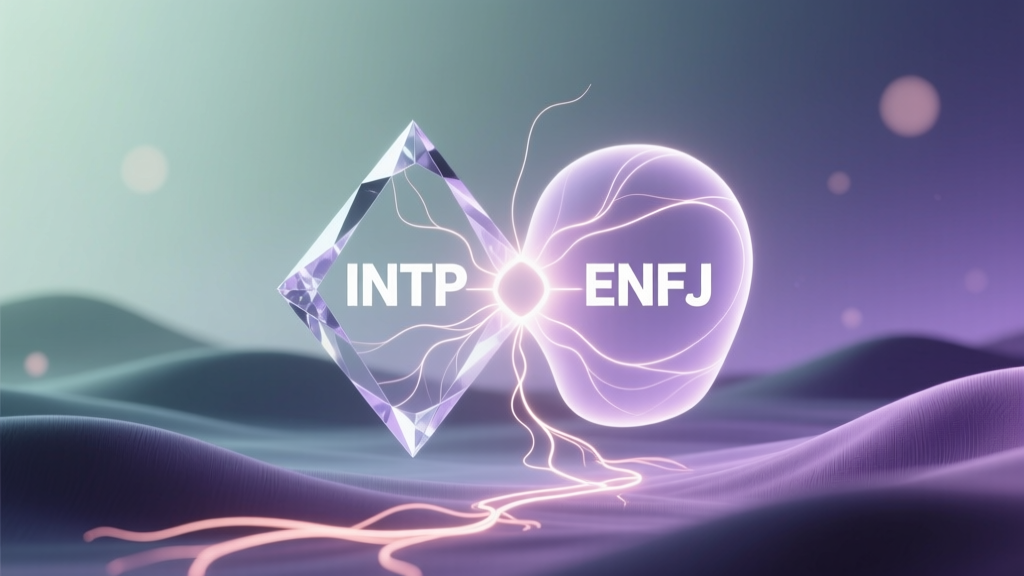
How INTP Builds Trust
For the INTP—the Logician—trust is not granted by charisma, shared values alone, or even consistent kindness. It is earned through intellectual coherence, reliability in logic, and sustained evidence of integrity over time. Unlike many types who form initial bonds based on warmth or shared experience, the INTP’s trust architecture is fundamentally epistemic: it rests on whether a person’s words align with their actions, whether their reasoning holds up under scrutiny, and whether they demonstrate intellectual honesty—even when it’s inconvenient.
According to the Myers & Briggs Foundation, INTPs prioritize Ti (Introverted Thinking) as their dominant function—a cognitive process that constantly evaluates internal consistency, logical soundness, and conceptual accuracy. This means an INTP may observe a potential partner for months before lowering their guard—not out of coldness, but because their default stance is one of provisional skepticism. As psychologist Dr. Dario Nardi explains in Neuroscience of Personality, INTPs show high activity in brain regions associated with abstract pattern recognition and hypothesis testing; their brains literally treat relationship development like a long-term research project.Nardi, D. (2011)
Practically, INTPs build trust incrementally: first through low-stakes intellectual exchanges (e.g., debating ethics, analyzing a film’s narrative structure, or troubleshooting a technical problem), then through observed consistency—does this person follow through on small promises? Do they admit when they’re wrong? Do they revise beliefs in light of new evidence? Only after repeated confirmation does the INTP begin to relax their emotional filters. Crucially, they rarely initiate vulnerability; instead, they wait for *safe cues*: a partner who asks thoughtful questions without judgment, who respects silence as contemplation rather than disengagement, and who doesn’t pressure them to “open up” before they’ve internally validated the safety of doing so.
One often-overlooked trust signal for INTPs is intellectual generosity: sharing resources (articles, books, frameworks) without expectation of reciprocity, offering nuanced feedback instead of praise, and engaging deeply with the INTP’s ideas—even when disagreeing. When an ENFJ offers this kind of engagement—not just enthusiasm, but rigor—it signals to the INTP that their inner world is seen, respected, and worth investing in.
How ENFJ Builds Trust
The ENFJ—the Protagonist—builds trust relationally, empathically, and proactively. With Extraverted Feeling (Fe) as their dominant function, ENFJs are acutely attuned to group harmony, emotional resonance, and relational reciprocity. For them, trust forms fastest when there’s mutual care, expressed through attentive listening, responsive support, and consistent emotional availability. Unlike the INTP’s slow-burn verification model, the ENFJ often extends provisional trust early—as a gesture of goodwill and relational investment. They assume good intent until proven otherwise, and their instinct is to nurture connection, not audit it.
Research from the Center for Creative Leadership confirms that Fe-dominant types like ENFJs demonstrate higher baseline empathy and interpersonal sensitivity, making them exceptionally skilled at reading nonverbal cues and adjusting communication to foster psychological safety.CCL, "Empathy in Leadership" (2022) This strength becomes foundational for trust-building—but it can also create blind spots. Because ENFJs naturally seek alignment and avoid conflict, they may misinterpret an INTP’s reserved demeanor as disinterest or rejection, rather than recognizing it as a protective cognitive rhythm.
ENFJs build trust through what we might call relational scaffolding: remembering small personal details (a favorite book, a past frustration), checking in consistently (“How did that conversation go?”), offering encouragement rooted in genuine observation (“I noticed how thoughtfully you weighed those options”), and creating shared meaning through rituals—weekly coffee chats, collaborative projects, or co-created traditions. Their Fe seeks resonance; their auxiliary Introverted Intuition (Ni) helps them anticipate future relational needs and adjust accordingly. However, ENFJs must learn that their natural warmth—while comforting to many—can feel overwhelming or intrusive to an INTP if not calibrated. An ENFJ who says, “You seem distant—I want to help!” may unintentionally trigger defensiveness in an INTP who interprets the statement as an assumption about their internal state, rather than an invitation.
Thus, the ENFJ’s path to earning deep trust from an INTP involves tempering their relational urgency with patience, honoring the INTP’s need for autonomy in emotional pacing, and demonstrating that their care is not contingent on immediate reciprocity or visible engagement.
The Trust Timeline for INTP and ENFJ
Understanding the mismatched rhythms of trust formation between INTP and ENFJ is essential—because their timelines rarely sync. Below is a comparative timeline illustrating typical trust milestones across six phases:
| Phase | INTP Trust Milestone | ENFJ Trust Milestone | Shared Risk Point |
|---|---|---|---|
| Weeks 1–4 | Observes consistency in logic & behavior; notes contradictions; engages only if intellectually stimulated | Feels initial rapport; shares personal stories; initiates emotional check-ins; assumes growing closeness | ENFJ may feel rebuffed if INTP declines invitations or gives brief, analytical replies; INTP may feel emotionally crowded |
| Months 2–3 | Begins sharing theoretical perspectives; tests boundaries with mild self-disclosure (e.g., “I tend to overanalyze decisions”) | Expresses deeper care; shares vulnerabilities (e.g., fears of inadequacy); expects reciprocal emotional openness | INTP may withdraw if pressured to match ENFJ’s vulnerability pace; ENFJ may interpret withdrawal as rejection |
| Months 4–6 | Shares personal values framework; begins asking nuanced questions about ENFJ’s motivations and ethics | Seeks co-created meaning (e.g., shared goals, joint planning); expresses desire for long-term commitment | Risk of misalignment: INTP may still be mapping compatibility logically; ENFJ may feel stalled or unsupported |
| Months 7–12 | Offers rare, unguarded emotional admission (e.g., “That criticism actually hurt”); initiates low-pressure quality time | Deepens loyalty; advocates for INTP publicly; integrates INTP’s ideas into their worldview | Breakthrough possible—if both honor pacing: INTP feels safe enough to risk softness; ENFJ feels affirmed in their care |
| Year 1+ | Consistently chooses ENFJ in moments of stress or uncertainty; shares long-term intellectual dreams | Centers INTP’s growth in their own life vision; defends INTP’s need for solitude as sacred, not deficient | Trust becomes bidirectional and self-reinforcing: INTP trusts ENFJ’s heart; ENFJ trusts INTP’s mind—and both protect the other’s core needs |
This timeline isn’t prescriptive—but it’s predictive. A 2023 study published in the Journal of Social and Personal Relationships found that mixed-perception couples (e.g., Thinking-Feeling dyads) reported 37% higher relationship satisfaction when they explicitly mapped and named their differing trust timelines.Garcia et al., "Temporal Mismatches in Relational Trust Development," 2023 The key intervention? Jointly drafting a “Trust Timeline Agreement”—a living document where each partner outlines: (1) what makes them feel safe, (2) what erodes trust for them, and (3) one concrete action they’ll take monthly to reinforce the other’s sense of security.
Vulnerability Patterns and Emotional Walls
Vulnerability is the currency of emotional intimacy—but INTPs and ENFJs mint and spend it in radically different denominations.
The INTP’s vulnerability is conceptual before emotional. They’ll articulate a complex critique of societal systems before admitting they felt lonely last Tuesday. Their emotional walls are not fortress-like—they’re more like retractable lattice screens: permeable to ideas, guarded against unsolicited emotional demands. The primary wall is cognitive gatekeeping: “Do you understand my framework? Have you earned the right to hear my unfiltered thoughts?” Breaching this wall requires the ENFJ to demonstrate intellectual humility—not just agreement, but curiosity about the INTP’s mental models.
Conversely, the ENFJ’s vulnerability is relational before rational. They share feelings to invite connection, not to seek solutions. Their emotional walls are less about withholding and more about strategic containment: they suppress distress to maintain group harmony, mask doubt to uphold confidence, or delay expressing needs to avoid burdening others. Their deepest wall is self-erasure—the habit of subordinating their own emotional truth to preserve the relationship’s perceived stability. An ENFJ may say, “I’m fine,” while quietly grieving a boundary violation—believing that naming discomfort would destabilize the INTP.
This creates a dangerous loop: the INTP waits for the ENFJ to “show up authentically,” while the ENFJ waits for the INTP to “meet them emotionally.” Neither sees the other’s vulnerability because they’re looking for it in the wrong language.
To bridge this, both must learn vulnerability translation:
- For the INTP: Practice “feeling-forward statements”—brief, low-risk emotional disclosures paired with context. Example: “I felt unsettled during our talk yesterday—not because of anything you said, but because it challenged an assumption I’d held for years. I’m still processing.” This names emotion while anchoring it in cognition, satisfying both Ti and the ENFJ’s need for emotional acknowledgment.
- For the ENFJ: Adopt “thought-forward disclosures”—sharing feelings alongside the reasoning behind them. Example: “I felt anxious when you canceled our plans because my Fe interpreted it as a sign I wasn’t prioritized—and my Ni immediately jumped to ‘What if this pattern continues?’ That’s my pattern, not your failing.” This honors the INTP’s need for cause-and-effect clarity while delivering emotional truth.
Crucially, both must recognize that silence is not emptiness. For the INTP, silence is synthesis; for the ENFJ, silence may be self-protection. Learning to read silence as data—not deficit—is the first act of mutual vulnerability.
Deepening Intimacy Between INTP and ENFJ
Intimacy between INTP and ENFJ flourishes not in spite of their differences—but because of how precisely those differences complement when consciously cultivated. Their synergy lies in co-creation: the INTP provides the architectural blueprint; the ENFJ builds the living, breathing home within it.
1. Intellectual-Emotional Scaffolding
Create shared rituals that honor both functions. Try a biweekly “Ideas & Impact” session: the INTP presents a concept they’re exploring (e.g., game theory applications in education); the ENFJ responds not with critique, but with, “Who would benefit most from this? How could we bring it to life?” This merges Ti’s depth with Fe’s purpose—transforming abstraction into relational meaning.
2. The Vulnerability Exchange Protocol
Agree on a structured weekly practice: each shares one thing they thought (INTP-led) and one thing they felt (ENFJ-led)—with no cross-examination, only acknowledgment. Example:
- INTP: “I thought about how memory encoding fails under chronic stress.”
- ENFJ: “I felt proud when you remembered my sister’s graduation date.”
3. Boundary Mapping Exercise
Use a shared digital doc titled “Our Relational Architecture.” In three columns, list:
- My Recharge Needs (e.g., INTP: “4 hours of uninterrupted solo time weekly”; ENFJ: “One heartfelt 20-min check-in daily”)
- My Trust Triggers (e.g., INTP: “Promises made lightly”; ENFJ: “Silence after conflict without reassurance”)
- My Repair Rituals (e.g., INTP: “Space + written clarification”; ENFJ: “Verbal affirmation + physical presence”)
4. Co-Authored Future Visioning
Leverage the INTP’s Ni-tertiary foresight and the ENFJ’s Fe-driven idealism. Draft a “Five-Year Tapestry”: a visual or written collage of shared aspirations—professional, relational, intellectual, and experiential—with clear roles. Example: “By 2029, we co-author a guide on ethical AI design (INTP leads research, ENFJ leads stakeholder interviews). We host a summer retreat for neurodiverse thinkers (ENFJ organizes, INTP designs curriculum).” This grounds ENFJ’s big-picture passion in INTP’s structural rigor—and gives the INTP emotional stakes in collective dreaming.
As relationship researcher Dr. John Gottman emphasizes, lasting intimacy isn’t built on constant closeness—but on repair competence: the ability to navigate rupture and return with deeper understanding.Gottman Institute, "The Seven Principles" For INTP-ENFJ pairs, repair isn’t about fixing flaws—it’s about refining their shared language of trust.
Rebuilding Trust After a Breach
A breach—whether a broken promise, a dismissive comment, or prolonged emotional withdrawal—hits INTP and ENFJ differently, demanding a dual-track repair strategy.
For the INTP: Breaches involving intellectual dishonesty (e.g., hiding information, contradicting stated values) or unreliability (e.g., flaking on agreements) trigger deep distrust. Their repair pathway requires evidence-based restitution: not just apology, but documented change. Example: If an ENFJ repeatedly interrupts the INTP in meetings, effective repair includes: (1) a written acknowledgment of the impact, (2) a self-tracking log showing reduced interruptions over 3 weeks, and (3) co-designing a meeting protocol (e.g., “hand-raising system”) with measurable outcomes.
For the ENFJ: Breaches involving emotional abandonment (e.g., stonewalling, minimizing feelings) or perceived betrayal of shared values wound most deeply. Their repair needs relational re-anchoring: explicit reaffirmation of commitment, consistent micro-attunements, and space to grieve without being tasked with “fixing” the dynamic. Example: After an INTP withdraws during conflict, effective repair includes: (1) the INTP naming the trigger (“I shut down when I feel my logic is being dismissed”), (2) initiating one low-stakes reconnect ritual weekly (e.g., walking in silence, then sharing one observation), and (3) the ENFJ verbally affirming, “I choose you—not just your ideas, but you.”
The most powerful repair tool for this pair is the Two-Part Apology Framework:
- Cognitive Acknowledgment (INTP-led): “I see how my action violated your trust because [specific behavior] contradicted [shared value, e.g., ‘our agreement to communicate directly’].”
- Emotional Reconnection (ENFJ-led): “I feel [emotion] knowing I hurt you, and I commit to [concrete action] because you matter to me.”
This satisfies the INTP’s need for logical accountability and the ENFJ’s need for emotional resonance—without collapsing one into the other.
Importantly, both must resist the temptation to “solve” the breach prematurely. As clinical psychologist Dr. Susan David notes in Emotional Agility, true repair requires sitting with discomfort—not to punish, but to let the nervous system recalibrate safety.Harvard Business Review, “Are You Emotionally Agile?” (2016) Rushing to “fix it” often retraumatizes; pausing to witness the rupture with compassion rebuilds neural pathways of safety.
FAQ
Why does my ENFJ partner get frustrated when I need silence after an argument?
For the ENFJ, silence post-conflict often registers as abandonment—not reflection. Their Fe scans for relational rupture and mobilizes to restore harmony immediately. Your silence, however, is Ti’s necessary integration phase: synthesizing emotions through analysis, not suppression. To ease this, give a time-bound signal: “I need 90 minutes to process—then I’ll text you one sentence about what I’m holding.” This satisfies their need for predictability while honoring your cognitive rhythm.
How can I, as an INTP, show love in ways my ENFJ truly feels it?
ENFJs feel loved through attuned action, not grand declarations. Start small: remember how they take their coffee and surprise them with it; send a link to an article about a cause they champion with one line: “This made me think of your work with X.” Most powerfully, defend their emotional labor publicly: “Sam’s insight about team morale was spot-on—and I’ve already adjusted my approach because of it.” This validates their Fe-gift in a way that resonates with your Ti integrity.
Is it normal for us to argue about ‘how’ we communicate more than ‘what’ we’re discussing?
Yes—and it’s highly constructive. Your arguments about communication style (e.g., “You interrupted me” vs. “You withdrew without warning”) are actually meta-trust negotiations. Each is advocating for their primary safety condition: the ENFJ needs verbal reciprocity to feel heard; the INTP needs cognitive space to formulate authentic response. Reframe these clashes as joint problem-solving: “How might we design a dialogue format where your Fe feels centered AND my Ti has runway?”
Can our differences in vulnerability ever become strengths instead of obstacles?
Absolutely—when leveraged intentionally. The INTP’s cautious vulnerability teaches the ENFJ discernment: not all emotional openings require immediate response; some need respectful holding. The ENFJ’s expressive vulnerability teaches the INTP courage: that feeling deeply doesn’t compromise thinking clearly—it enriches it. Together, you cultivate what psychologist Brené Brown calls “grounded confidence”: the INTP grounds the ENFJ’s idealism in reality; the ENFJ grounds the INTP’s analysis in human consequence.Brown, B. (2021). Braving the Uncertainty Your difference isn’t a gap to close—it’s a bridge to build.