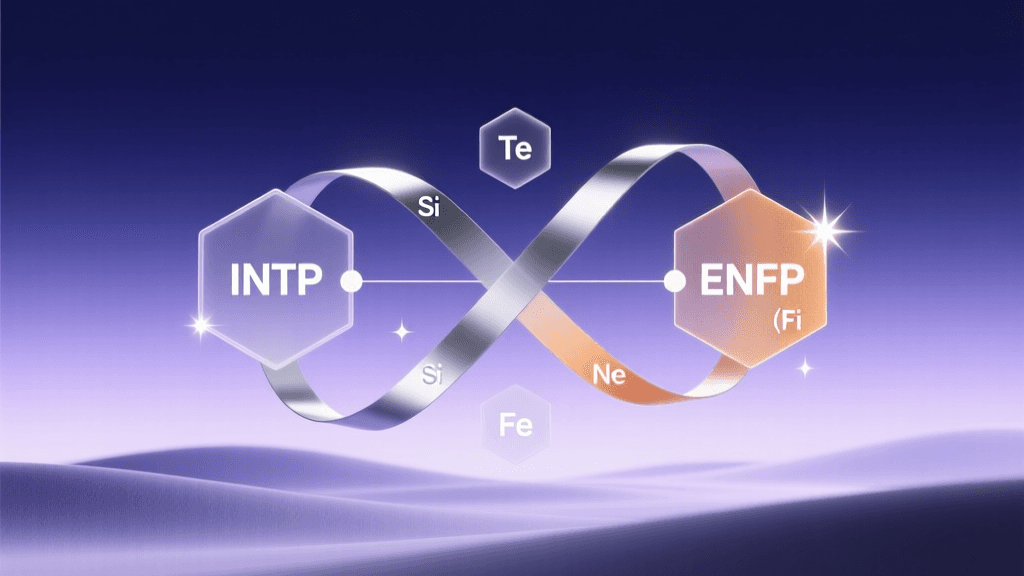
When two of the most intellectually curious, ideation-driven types in the MBTI system—INTP and ENFP—come together, their connection often feels electric, intuitive, and refreshingly unstructured. Yet beneath the surface chemistry lies a rich, nuanced interplay of cognitive functions that shapes everything from how they argue to how they co-create meaning. Unlike compatibility frameworks that rely on letter similarity or surface traits (e.g., 'both are NPs'), this analysis centers exclusively on cognitive function dynamics: how the dominant, auxiliary, tertiary, and inferior functions of INTP and ENFP interact, reinforce, destabilize, or transform one another.
This article is grounded in the Myers-Briggs Foundation’s official framework, which affirms that type is defined not by preferences alone but by the hierarchical ordering of cognitive functions—perceiving (Sensing or Intuition) and judging (Thinking or Feeling), each expressed in either an extraverted or introverted attitude. We use the widely accepted function stacks for INTP (Ti-Ne-Si-Fe) and ENFP (Ne-Fi-Te-Si), as validated by leading typologists including Linda V. Berens (Typology Central archives) and the Center for Applications of Psychological Type (CAPT) (capt.org/cognitive-functions).
INTP Cognitive Stack Overview
The INTP personality type operates from a tightly ordered, internally calibrated cognitive architecture built around introverted Thinking (Ti) as its dominant function. Ti is the engine of logical precision: it dissects concepts, builds internal models, identifies inconsistencies, and seeks coherence above all else. It doesn’t aim to persuade others—it aims to be right *to itself*. This inward orientation makes INTPs appear detached during debate—not because they lack conviction, but because their conclusions emerge only after exhaustive self-auditing.
Their auxiliary function is extraverted Intuition (Ne), which serves Ti like a high-bandwidth data feed. Ne scans the external world for patterns, possibilities, analogies, and ‘what ifs’—constantly generating connections between disparate ideas. While Ti organizes the inner world, Ne populates it with raw, unfiltered novelty. This pairing explains why INTPs can pivot from deep silence to rapid-fire theoretical speculation in under ten seconds: Ti integrates; Ne inspires.
The tertiary function is introverted Sensing (Si). Often underdeveloped in youth, Si emerges later in life as a quiet repository of sensory impressions, routines, and embodied memory. INTPs may express Si through nostalgic music playlists, meticulous note-taking systems, or sudden attachment to familiar objects (e.g., a favorite pen or chair). Though less conscious than Ti or Ne, Si grounds INTPs when overstimulated—offering stability through repetition and sensory anchoring.
Finally, the inferior function is extraverted Feeling (Fe). This is the INTP’s Achilles’ heel—and their greatest growth frontier. Fe governs social attunement, group harmony, emotional reciprocity, and expressive warmth. Under stress, immature Fe manifests as emotional withdrawal, passive-aggressive sarcasm, or blunt criticism disguised as ‘just logic.’ In maturity, however, Fe allows INTPs to recognize others’ emotional needs without sacrificing authenticity—learning to say “I see you’re upset” instead of “Your conclusion contradicts premise X.”
ENFP Cognitive Stack Overview
The ENFP’s dominant function is extraverted Intuition (Ne)—the same perceiving function that serves as the INTP’s auxiliary. But where INTPs use Ne to fuel Ti’s analytical engine, ENFPs deploy Ne as their primary lens on reality: scanning, reframing, and reimagining the world in real time. Their Ne is generative, empathic, and socially expansive—they don’t just notice possibilities; they invite others into them. An ENFP might interrupt a conversation not to dominate, but to spin off a new thread that includes everyone present.
Their auxiliary function is introverted Feeling (Fi), the moral and aesthetic core of the ENFP. Fi evaluates experiences through a deeply personal value system: “Does this align with who I am? Does it feel authentic? Does it honor my integrity?” Unlike Fe (which prioritizes collective harmony), Fi protects inner congruence—even at relational cost. This explains why ENFPs can seem both warm and fiercely boundary-conscious: they’ll host a joyful gathering (Ne), then vanish for three days to journal and recharge (Fi).
The tertiary function is extraverted Thinking (Te). Underdeveloped early on, Te matures into a pragmatic tool for organizing ideas, executing plans, and applying logic to real-world outcomes. ENFPs often develop Te mid-to-late twenties, allowing them to translate visionary ideals into actionable steps—launching a podcast, building a nonprofit website, or designing a curriculum. When stressed, immature Te shows up as impatience with inefficiency, rigid rule-following, or harsh self-criticism (“Why can’t I just *do* the thing?”).
The inferior function is introverted Sensing (Si). Like the INTP’s inferior Fe, ENFPs’ inferior Si represents both vulnerability and latent strength. Under pressure, Si may trigger obsessive attention to bodily sensations (e.g., health anxiety), fixation on past regrets (“I should’ve said yes to that job”), or hyperfocus on minor details (“Why does this coffee taste *slightly* different today?”). With integration, Si becomes a source of embodied wisdom—appreciating ritual, savoring sensory beauty, and honoring lived experience as data.
Where Functions Align
The most immediate and energizing alignment between INTP and ENFP occurs at the Ne–Ne axis. Both types share extraverted Intuition as either dominant (ENFP) or auxiliary (INTP), creating what typologist Dario Nardi calls a “resonant frequency” in cognitive processing (darionardi.com). They don’t just enjoy brainstorming—they need it. A shared Ne orientation means:
- Spontaneous idea generation feels effortless and reciprocal—not competitive, but co-creative;
- Abstract metaphors, lateral thinking, and hypothetical scenarios (“What if gravity were sentient?”) land intuitively;
- They sense each other’s mental leaps without explanation—no need to ‘show your work’;
- Both tolerate ambiguity exceptionally well, preferring open-ended exploration over premature closure.
Equally significant is the Ti–Fi resonance. Though one is a judging function (Ti) and the other a feeling function (Fi), both are introverted and value-coherent. Ti seeks internal logical consistency; Fi seeks internal value consistency. Neither appeals to external authority—both answer to an inner compass. This creates profound mutual respect: the INTP admires the ENFP’s unwavering authenticity; the ENFP honors the INTP’s intellectual integrity. As psychologist and MBTI researcher Dr. Roger Pearman notes, “Introverted judging functions—whether Thinking or Feeling—form the bedrock of identity for types who define themselves by inner standards, not social scripts” (capt.org/pearman-introverted-judging).
A third alignment emerges in their shared low reliance on extraverted Sensing (Se). Neither type leads with Se—the function tied to immediate physical presence, risk-taking, or sensory thrill-seeking. This means they rarely compete for dominance in action-oriented spaces (e.g., sports, fast-paced sales, emergency response). Instead, they bond over slower, deeper modes of engagement: long walks while discussing philosophy, collaborative writing projects, or building shared digital worlds (e.g., Notion wikis, Miro boards, or world-building documents). Their synergy isn’t in doing—but in meaning-making.
Where Functions Clash
Despite strong alignments, friction arises precisely where their function hierarchies diverge—most critically in their attitudes toward judgment. The INTP’s dominant Ti seeks truth via deconstruction; the ENFP’s dominant Ne seeks possibility via expansion. When disagreement arises, their natural responses pull in opposite directions:
“You’re overcomplicating it.”
— ENFP, sensing Ti’s recursive analysis as obstruction
“You’re skipping the logical scaffolding.”
— INTP, perceiving Ne’s associative leaps as ungrounded
This tension is structural—not personal. Ti must verify; Ne must generate. Without awareness, this becomes a cycle: ENFP proposes five solutions → INTP dismantles each for internal consistency → ENFP feels shut down → INTP feels pressured to endorse ideas before they’re vetted.
A second major clash involves Fe vs. Fi in conflict resolution. The INTP’s inferior Fe drives them to avoid emotional confrontation—often retreating into silence, irony, or technical tangents. Meanwhile, the ENFP’s auxiliary Fi demands emotional honesty and relational repair. To the ENFP, the INTP’s withdrawal reads as rejection; to the INTP, the ENFP’s insistence on “talking it out *now*” feels like an assault on their cognitive sovereignty. This mismatch is well-documented in clinical observations of NP–TP pairings: “The Fi user seeks validation of inner experience; the Fe-inferior user interprets that request as a demand to perform emotion” (Pearman & Albritton, Introduction to Type Dynamics, CAPT Press, 2018).
A third friction point lives in tertiary Si vs. inferior Si. While both types have Si in their stack, its role and maturity differ drastically. For the INTP, Si is tertiary—a supportive, stabilizing function used consciously (e.g., maintaining a consistent research workflow). For the ENFP, Si is inferior—an unconscious, reactive force that surges under stress. This asymmetry can create confusion: when an ENFP suddenly fixates on a minor inconsistency in a shared plan (“Wait—you said Tuesday, but your calendar says Wednesday”), the INTP may misread it as nitpicking rather than Si-triggered anxiety. Likewise, the INTP’s reliance on Si routines (e.g., fixed coffee time, designated ‘deep work’ hours) may feel stifling to an ENFP whose Ne craves spontaneity—unless framed as *co-created structure*, not unilateral control.
The Hidden Resonances (tertiary/inferior function connections)
The most transformative dynamics in INTP–ENFP relationships occur not at the dominant level—but in the quieter, often overlooked interplay of tertiary and inferior functions. These connections operate beneath conscious awareness yet exert powerful gravitational influence on long-term bonding, growth, and mutual healing.
INTP’s tertiary Si ↔ ENFP’s inferior Si forms a subtle but potent bridge. Because Si is tertiary for the INTP, they can consciously *offer* Si-support to the ENFP: helping them build gentle routines (e.g., “Let’s block 20 minutes every Sunday to review goals”), archive meaningful memories (e.g., curating a shared photo album with captions), or normalize bodily awareness (e.g., suggesting grounding techniques during overwhelm). In turn, the ENFP’s journey toward integrating Si helps the INTP soften their own Si rigidity—learning that routine need not mean rigidity, but rhythm. A mature ENFP might say, “I love how you keep our library organized—can we apply that same care to planning our trip?” That invitation transforms Si from a point of friction into shared infrastructure.
Even more profound is the INTP’s inferior Fe ↔ ENFP’s auxiliary Fi resonance. At first glance, these functions seem oppositional: Fe seeks group harmony; Fi guards individual authenticity. Yet their interaction catalyzes deep psychological growth—for both. The ENFP’s Fi provides a safe container for the INTP to practice Fe: “It’s okay to say ‘I’m overwhelmed’—I won’t judge you, and I’ll adjust.” Over time, the INTP learns that expressing emotional need isn’t weakness—it’s relational stewardship. Conversely, the INTP’s emerging Fe helps the ENFP regulate Fi’s intensity. When an ENFP spirals into self-doubt (“Was I too intense? Did I offend them?”), the INTP’s calm, non-reactive Fe response—“I heard your concern. Let me reflect and get back to you”—models emotional containment without suppression. This dynamic mirrors findings from the American Psychological Association’s research on secure attachment, which shows that partners who safely hold each other’s vulnerable functions foster lasting resilience.
Finally, consider the ENFP’s tertiary Te ↔ INTP’s auxiliary Ne synergy. While Ne generates possibilities, Te structures them. An ENFP’s maturing Te can help the INTP move ideas into prototypes: “You theorized about decentralized education—let’s draft a 3-slide pitch for a pilot workshop.” In return, the INTP’s Ne prevents Te from becoming dogmatic: questioning assumptions behind metrics, exploring unintended consequences, or reframing success criteria. This pairing mirrors high-performing innovation teams described in MIT Sloan Management Review: “The most adaptive teams pair generative cognition (Ne-like) with executional rigor (Te-like)—not as sequential phases, but as continuous feedback loops” (sloanreview.mit.edu/article/how-the-best-innovation-teams-think).
Leveraging Cognitive Diversity
Compatibility isn’t about minimizing differences—it’s about designing systems that turn cognitive divergence into collective intelligence. Here’s how INTP–ENFP pairs can do that intentionally:
1. Co-Design Your Conflict Protocol
Create a shared, written agreement for disagreements—activated *before* tension rises. Example:
| Phase | INTP Action | ENFP Action | Shared Ritual |
|---|---|---|---|
| Trigger | Notice rising defensiveness or urge to analyze | Notice urgency to resolve or fear of rupture | Say: “Ne-Ne pause activated.” |
| Pause (20 min) | Write 3 logical objections + one underlying value (e.g., “I need accuracy because integrity matters”) | Journal: “What am I afraid will happen? What do I truly need right now?” | No contact except emoji check-in (e.g., 🌿 = calm, ⚡ = activated) |
| Reconnect | Share written reflections *without rebuttal* | Respond with: “I hear your need for ___” + “My need is ___” | Co-create one small action: “We’ll test your model for 48 hours” / “I’ll voice my concern using ‘I’ statements” |
2. Build Dual-Track Projects
Structure collaborations so each type engages their strongest functions *first*, then integrates the other’s. Example: Launching a podcast.
- Week 1 (Ne–Ne sprint): Brainstorm 50 episode titles, guest archetypes, and thematic universes—no filtering.
- Week 2 (Ti–Fi calibration): INTP maps logical flow of season arc; ENFP writes mission statement reflecting core values.
- Week 3 (Te–Si integration): ENFP drafts production checklist; INTP builds archival system for transcripts and show notes.
This honors both the INTP’s need for structural coherence and the ENFP’s need for purposeful expression—while preventing either from defaulting to inferior-stress responses (Fe shutdown or Si rumination).
3. Practice “Function Mirroring”
Once monthly, spend 90 minutes deliberately exercising the *other’s dominant function*:
- INTP practices Ne: Visit a museum *without reading labels*, sketch 3 abstract interpretations of one artwork, then improvise a 2-minute story connecting them.
- ENFP practices Ti: Choose a controversial opinion; write two columns—one listing evidence *for*, one *against*—then draft a third column: “What would change my mind?”
Debrief afterward: “What felt easy? What triggered resistance? Where did your inferior function show up?” This builds neural flexibility and reduces projection.
4. Design Shared “Cognitive Sanctuary” Spaces
Create physical or digital environments optimized for *both* stacks:
- Physical: A bookshelf with dual sections—“Ti Zone” (logic puzzles, philosophy texts, coding manuals) and “Ne Zone” (poetry, speculative fiction, travel blogs)—with a central “Fi–Fe Hearth” (candles, soft lighting, blank journals labeled “What matters today?”).
- Digital: A Notion workspace with tabs: “Ne Spark Bank” (idea fragments), “Ti Architecture” (decision trees, pros/cons matrices), “Fi Compass” (core values list), and “Fe Bridge” (gratitude log, shared appreciation prompts).
These spaces make cognitive diversity visible, honored, and usable—not just tolerated.
FAQ
Can INTP and ENFP have long-term romantic success?
Yes—when both commit to function literacy. Research from the Gottman Institute shows that couples who understand *how* each other processes information (not just *what* they think) report 42% higher relationship satisfaction over 5 years (gottman.com/blog/the-science-of-connection). For INTP–ENFP pairs, success hinges on protecting Ne space (spontaneity, ideation) while building Ti–Fi trust (intellectual and values-based safety). Longevity increases when the INTP develops Fe responsiveness and the ENFP strengthens Te follow-through.
Why do INTPs sometimes feel “emotionally abandoned” by ENFPs?
Not from abandonment—but from Fi boundary enforcement. When an ENFP withdraws to process emotionally (using Fi), the INTP’s inferior Fe interprets silence as rejection—not restoration. The fix isn’t for the ENFP to talk more, but for the INTP to reframe Fi withdrawal as sacred maintenance, not relational failure. Practical step: Agree on a “Fi recharge signal” (e.g., ENFP texts “🌙 heading inward—back by 8pm”) so INTP’s Fe anxiety is preemptively soothed.
How can ENFPs help INTPs access their inferior Fe without pressure?
By modeling Fe *without expectation*. Instead of “Tell me how you feel,” try: “I’m feeling [X] about [Y]—no need to respond, just wanted to share.” Or initiate low-stakes Fe rituals: “Let’s cook together and name one thing we appreciate about each other while chopping veggies.” The goal isn’t extraction—it’s creating Fe-safe conditions where the INTP’s nervous system learns: Expressing emotion here won’t cost me autonomy.
Is the INTP–ENFP friendship more sustainable than romance?
Often—but not inherently. Friendships buffer against Fe–Fi pressure points (e.g., no cohabitation stress, no family integration demands). However, romantic potential unlocks when both types invest in their lower functions: the INTP’s Fe maturity enables attuned partnership; the ENFP’s Te maturity ensures shared life logistics don’t erode Ne–Ti magic. As Jungian analyst John Beebe writes, “The most enduring relationships are those where partners become each other’s ‘function coaches’—not fixing, but inviting fuller consciousness” (johnbeebe.com).
In closing: INTP and ENFP compatibility isn’t written in stars or letters—it’s forged in the daily, deliberate practice of holding space for each other’s cognitive architecture. Their Ne–Ne spark ignites possibility; their Ti–Fi depth anchors it in truth and value; their Si–Fe–Te interplay builds the scaffolding for lasting creation. When both choose curiosity over correction, and function literacy over assumption, this pairing doesn’t just work—it evolves.