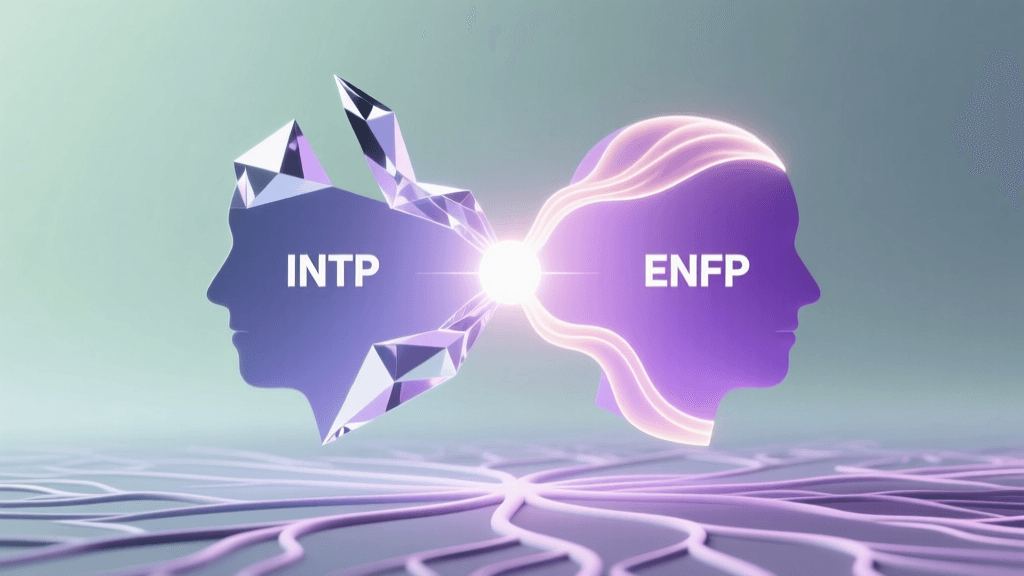
When the quiet, analytical INTP meets the vibrant, empathetic ENFP, the chemistry can feel electric—full of intellectual spark, creative synergy, and mutual fascination. Yet beneath that initial magnetism lies a subtle but persistent tension: two fundamentally different operating systems for processing emotion, expressing needs, and resolving disagreement. Unlike more structurally aligned pairings (e.g., INFJ-ENFP or ISTP-ESTP), the INTP–ENFP dynamic is defined less by shared values and more by complementary yearnings—curiosity meeting warmth, logic meeting intuition, detachment meeting devotion. This very complementarity, however, becomes the engine of their most recurring conflicts.
How INTP Handles Conflict
The INTP (Introverted, Intuitive, Thinking, Perceiving) approaches conflict not as an emotional rupture to be patched, but as a systemic anomaly to be diagnosed. Their dominant cognitive function, Introverted Thinking (Ti), compels them to internally deconstruct the logic of the disagreement—identifying inconsistencies, flawed premises, or unexamined assumptions—before even considering interpersonal impact. To the INTP, fairness is synonymous with internal coherence; if an argument feels illogical or emotionally coercive, they’ll disengage long before conceding ground.
Because Ti operates in solitude, INTPs rarely initiate confrontation. Instead, they retreat into analysis—replaying exchanges, mapping cause-effect chains, and refining mental models of what went wrong. This isn’t avoidance for the sake of peace; it’s cognitive triage. As psychologist Dario Nardi explains in Neuroscience of Personality, INTPs show heightened activity in the brain’s logical integration centers during stress, particularly the dorsolateral prefrontal cortex—where abstract reasoning and self-monitoring converge. Their silence, therefore, is often active problem-solving—not indifference.
When pushed to engage, the INTP may deploy Extraverted Intuition (Ne), their auxiliary function, to generate multiple hypothetical resolutions—"What if we reframed this as X? Or Y? Or consider Z alternative motive?" But this brainstorming can feel destabilizing to partners who seek clarity, not possibility. Worse, under stress, INTPs may access their inferior function, Extraverted Feeling (Fe), in unhealthy ways: sudden emotional outbursts, passive-aggressive sarcasm, or guilt-tripping disguised as objective critique (“If you truly valued honesty, you wouldn’t have omitted that detail”). These moments are rare—but deeply jarring—because they violate the INTP’s usual commitment to rational integrity.
Crucially, INTPs do not equate resolution with reconciliation. For them, a conflict is resolved once the logical inconsistency is corrected—even if no apology is exchanged or affection restored. This creates a frequent disconnect: the INTP believes the issue is closed; the ENFP senses relational distance widening.
How ENFP Handles Conflict
The ENFP (Extraverted, Intuitive, Feeling, Perceiving) experiences conflict as a threat to relational harmony—the very oxygen of their psychological ecosystem. Their dominant function, Extraverted Feeling (Fe), constantly scans the emotional atmosphere, seeking alignment, validation, and shared meaning. When tension arises, the ENFP’s first instinct is not to dissect the argument but to repair the connection: through reassurance, storytelling, humor, or immediate verbal affirmation (“I still love you,” “This doesn’t change how I see you”).
However, Fe’s strength—its attunement to others’ emotions—becomes its vulnerability when unbalanced. ENFPs often absorb their partner’s distress as their own, interpreting silence or withdrawal as rejection rather than processing time. Their auxiliary function, Introverted Intuition (Ni), then kicks in—not as prediction, but as catastrophic synthesis: “If they won’t talk now, they must be done with us”; “Their calm tone means they’ve already checked out.” This Ni-Fe loop can accelerate anxiety faster than facts can intervene.
Under pressure, ENFPs may over-rely on their tertiary Extraverted Thinking (Te), attempting to “fix” the conflict with solutions, schedules, or ultimatums (“Let’s set a time to talk tonight,” “We need clear rules moving forward”). But because Te is undeveloped, these proposals often lack structural grounding—and can feel controlling to the INTP, whose Ti recoils at externally imposed frameworks.
Worse, when ENFPs hit their inferior function—Introverted Thinking (Ti)—they may suddenly adopt hyper-rational, coldly detached language: listing grievances like evidence, demanding logical proof of love, or dissecting past interactions with surgical precision. This ‘Ti flip’ is profoundly unsettling because it mirrors the INTP’s natural mode—but stripped of its reflective depth, weaponized by hurt. As clinical psychologist Dr. Tina Tessina notes in her work on intuitive-feeling types, ENFPs in distress often mimic the thinking style of their opposite type as a defense—creating a painful mirror effect.
The INTP and ENFP Conflict Cycle
Left unexamined, the INTP–ENFP conflict follows a predictable, self-reinforcing arc—a cycle rooted not in incompatibility, but in mismatched repair timelines and incompatible definitions of safety. Below is the typical progression:
| Phase | INTP Behavior | ENFP Behavior | Shared Misinterpretation |
|---|---|---|---|
| Trigger | Perceives inconsistency (e.g., ENFP says “I need space” but texts hourly) | Feels unseen (e.g., INTP misses emotional cue in conversation) | “They’re being dishonest / They don’t care” |
| Withdrawal | Retreats to analyze root cause; goes silent for hours/days | Reaches out repeatedly seeking reassurance; interprets silence as abandonment | “They’re punishing me / They’re shutting me out” |
| Escalation | Responds with detached logic or sarcastic Ne hypotheses (“Maybe you actually want attention, not space?”) | Responds with emotional intensity or Fe-driven pleas (“Why won’t you just tell me what’s wrong?!”) | “They’re mocking me / They’re manipulating me” |
| Breakdown | Shuts down completely; may cite “irreconcilable differences in communication style” | Expresses despair (“Nothing I say matters to you”); may threaten separation | “This relationship is logically unsustainable / This relationship is emotionally dead” |
| Pseudo-Resolution | Offers a Ti-based fix (“Let’s agree not to discuss X topic again”) | Agrees superficially to restore calm, but Fe remains wounded | “We’re fine / We’re pretending to be fine” |
This cycle repeats because neither type recognizes the other’s conflict language as legitimate. The INTP sees the ENFP’s urgency as irrational pressure; the ENFP sees the INTP’s pause as emotional abandonment. Neither realizes the other is acting from deep psychological necessity—not malice.
Escalation Patterns
Three escalation patterns recur with high frequency in INTP–ENFP relationships—and each has identifiable physiological and behavioral markers:
1. The Logic-Emotion Feedback Loop
When the ENFP expresses hurt (“I felt ignored when you didn’t respond to my message”), the INTP instinctively responds with context (“I was debugging code and muted notifications”). The ENFP hears this as justification, not explanation—and replies, “So my feelings don’t matter unless they fit your workflow?” The INTP then doubles down on logic (“Feelings aren’t subject to workflow—they’re subjective data points”), triggering the ENFP’s Fe-Ni loop: “If they reduce my pain to ‘data,’ they don’t see me as human.” This loop spirals until one or both resort to their inferior functions—Ti-blunt or Fe-dramatic—shutting down productive dialogue entirely.
2. The Time-Perception Collision
INTPs experience time as a dimension for reflection: conflict requires incubation. ENFPs experience time as relational continuity: silence equals rupture. Research from the Gottman Institute confirms that perceived stonewalling—defined as withdrawal during conflict—is the strongest predictor of relationship dissolution. Yet for the INTP, withdrawal is not stonewalling; it’s active processing. For the ENFP, it registers identically. Without explicit agreement on time boundaries (“I need 90 minutes to think—then I’ll text you three bullet points”), this collision guarantees escalation.
3. The Values-Translation Failure
Both types value authenticity—but define it differently. To the INTP, authenticity means intellectual honesty: saying what’s logically true, even if socially uncomfortable. To the ENFP, authenticity means emotional congruence: expressing what’s genuinely felt, even if logically inconsistent. When the INTP says, “Your plan won’t work—I ran the numbers,” the ENFP hears, “You don’t believe in my vision.” When the ENFP says, “I’m so excited about this idea!” and the INTP replies, “Statistically, 87% of similar ventures fail,” the ENFP hears, “You’re trying to crush my hope.” Neither is lying—but both are translating core values through incompatible semantic filters.
Repair and Reconciliation
Effective repair requires interrupting the cycle *before* inferior functions activate—and building new bilingual protocols for emotional exchange. Here are field-tested strategies:
For the INTP: Speak the Language of Safety First
- Pre-empt withdrawal with micro-bridges: Before retreating, say: “I need 45 minutes to process this clearly—can I send you three thoughts by 4:30 PM?” Name the timeframe, deliver a concrete output, and honor the deadline. This satisfies the ENFP’s Fe need for predictability without compromising Ti integrity.
- Translate logic into relational impact: Instead of “That assumption is invalid,” try: “When you said X, my brain flagged a contradiction—and I got stuck there. It wasn’t about doubting you; it was my system hitting an error.” This names the internal process *and* separates it from the person.
- Deploy Ne constructively: Use Extraverted Intuition to generate *relational* possibilities: “What if we tried talking while walking? Or wrote notes instead of speaking? What environment helps you feel safest sharing?” This shifts Ne from theoretical critique to collaborative design.
For the ENFP: Honor the Architecture of Thought
- Replace demand with invitation: Swap “Tell me what’s wrong *now*” for “I’m here when you’re ready—and if silence feels kinder right now, I trust that too.” This affirms autonomy while holding space.
- Anchor feelings in narrative, not ultimatum: Instead of “If you don’t talk to me, I’ll assume the worst,” try: “When I don’t hear from you, my mind tells me stories—like ‘you’re done.’ Can we co-write a better story together?” This invites partnership in Ni regulation.
- Practice Fe self-regulation: When anxiety spikes, ask: “Is this feeling mine alone—or am I absorbing theirs? What’s *actually* happening vs. what my Ni is predicting?” Journaling this distinction builds Fe maturity.
Joint Repair Rituals
Establish rituals that bypass the conflict cycle entirely:
- The ‘Two-Channel Check-In’: Once weekly, use separate mediums—one for logic (shared doc with bullet points), one for feeling (voice note or walk-and-talk). Never merge them mid-discussion.
- The ‘Non-Negotiables List’: Co-create 3–5 irrevocable boundaries (e.g., “No name-calling,” “24-hour pause before sending heavy texts,” “Weekly appreciation exchange”). Post them visibly.
- The ‘Function Flip Drill’: When tension rises, consciously swap dominant functions for 60 seconds—INTP speaks from Fe (“How might this land for you?”), ENFP speaks from Ti (“What’s the smallest factual thing we agree on?”). This builds neural flexibility.
As relationship researcher John Gottman emphasizes, successful couples make, and accept, repair attempts 86% of the time—versus 33% in divorcing couples. For INTP–ENFP pairs, repair isn’t about winning—it’s about bilingual fluency.
Prevention Strategies
Prevention means designing the relationship infrastructure *before* conflict emerges. These aren’t compromises—they’re architecture:
1. Cognitive Function Mapping
Co-map your top two functions using this template:
INTP: Ti (internal logic engine) → Ne (possibility generator)
ENFP: Fe (harmony sensor) → Ni (meaning synthesizer)
Shared Bridge: Ne + Ni = Shared future-building (e.g., “What if we designed a conflict protocol together?”)
Post this map where you’ll see it daily. It transforms “Why won’t they get it?” into “How does their system actually work?”
2. The 72-Hour Pre-Mortem
Before major decisions (moving in, career shifts, big purchases), conduct a joint pre-mortem: “Imagine it’s 72 hours after this decision—and it’s gone poorly. What tiny signal would have warned us?” This activates INTP’s Ti (risk analysis) and ENFP’s Ni (pattern sensing) *collaboratively*, preventing post-decision blame cycles.
3. Scheduled Vulnerability Windows
Set fixed 20-minute slots twice weekly labeled “Raw Data Exchange”—no solutions, no fixing, no judgment. INTP shares one unprocessed thought; ENFP shares one unfiltered feeling. The rule: listen only, then repeat back *what you heard*, not what you think. This trains both to receive the other’s native language.
4. External Calibration
Use third-party tools to depersonalize conflict. The VIA Character Strengths Survey (free, research-backed) reveals shared strengths (e.g., curiosity, love of learning) that anchor disagreements in common ground—not opposition. When conflict flares, ask: “Which of our top 5 strengths feels threatened right now?”
FAQ
Why does my ENFP partner cry when I explain my reasoning calmly?
Calm explanation, to an ENFP, can sound like emotional erasure—especially if delivered without vocal warmth or physical presence. Their Fe reads tone, pace, and micro-expressions more than words. A Ti-driven “I just want to clarify the facts” lands as “Your feelings are irrelevant to the facts.” Solution: precede logic with Fe acknowledgment (“I care deeply about how this affects you—so let me share my thinking carefully”).
Why does my INTP shut down when I ask ‘How do you feel about this?’
INTPs don’t experience emotions as discrete, label-able states (“angry,” “hurt”) the way Fe-doms do. Ti processes affect as physiological data (tension, fatigue, mental fog) or conceptual clusters (“this situation violates my principle of X”). Asking for a feeling-label forces them into inferior Fe—causing panic or deflection. Better: “What’s the clearest thought you’ve had about this?” or “What part feels most unstable to you?”
Can INTP–ENFP relationships survive long-term conflict avoidance?
Yes—but only if avoidance is *intentional and reciprocal*, not passive. Healthy INTP–ENFP pairs develop “conflict hygiene”: scheduled processing windows, written dialogue channels, and mutual agreement on which topics require Ti-Fe translation versus which can remain in separate domains. Avoidance becomes strategy—not evasion—when both consent to its design.
What’s the #1 predictor of success in INTP–ENFP relationships?
It’s not shared interests or values alignment—it’s mutual fascination with each other’s cognitive machinery. Couples who regularly geek out on “How does your Ni generate that insight?” or “Why does Ti reject that premise?” build resilience far beyond surface compatibility. As MBTI researcher Isabel Briggs Myers wrote, “Type awareness is the foundation of empathy—not agreement”. When the INTP studies the ENFP’s Fe like a fascinating algorithm, and the ENFP maps the INTP’s Ti like sacred geometry, conflict transforms from threat to shared inquiry.
Ultimately, the INTP–ENFP pairing doesn’t need to become identical to thrive. It needs to become bilingual—to translate Ti’s precision into Fe’s resonance, and Fe’s warmth into Ti’s clarity. Every conflict, then, is less a crack in the foundation and more a seam where light enters: revealing not weakness, but the beautiful, necessary friction of two minds learning to hold each other—differently, deeply, and for good.