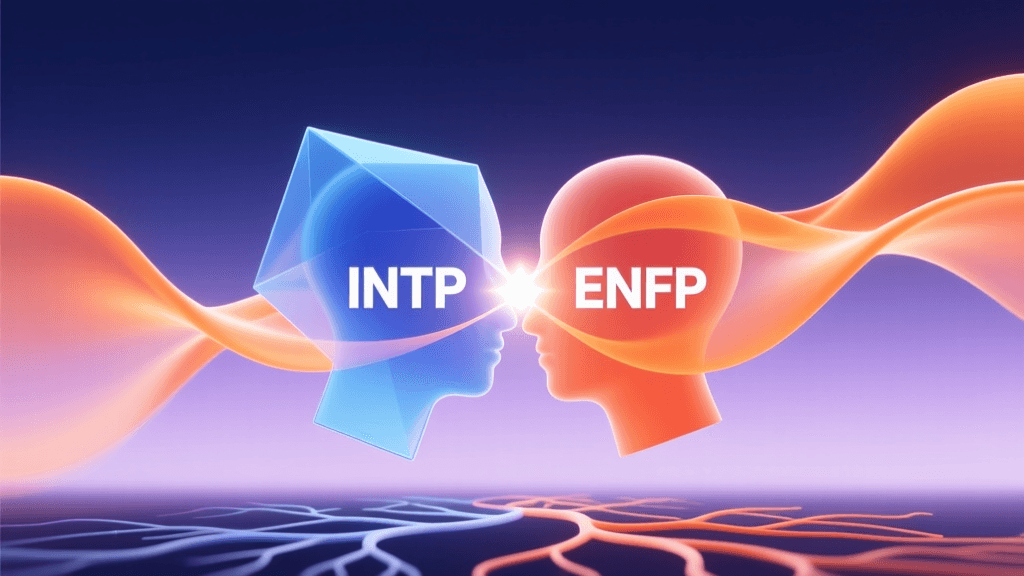
When the quiet, idea-driven INTP meets the vibrant, people-centered ENFP, friendship doesn’t just happen — it ignites. These two types rarely resemble each other on the surface: one retreats to internal logic and abstraction; the other radiates warmth, spontaneity, and emotional attunement. Yet beneath their contrasting styles lies a rare cognitive synergy — one rooted in shared dominant and auxiliary functions that foster intellectual resonance, creative collaboration, and profound mutual inspiration. Unlike romantic compatibility analyses — which often emphasize tension between opposing values — INTP–ENFP friendships are among the most naturally harmonious in the MBTI framework, especially when viewed through the lens of social compatibility.
This article explores how INTPs and ENFPs build, sustain, and enrich friendship across real-world contexts: from first conversations and shared hobbies to navigating group dynamics and resolving misunderstandings. Grounded in Jungian cognitive function theory and validated by decades of type-based interpersonal research, this guide offers actionable insights — not just personality stereotypes — for anyone cultivating or curious about this dynamic duo.
How INTP and ENFP Connect as Friends
The foundation of the INTP–ENFP friendship is cognitive alignment, not superficial similarity. Both types share Introverted Thinking (Ti) and Extraverted Intuition (Ne) — though in different orders. For the INTP, Ti is the dominant function (internal logical framework-building), supported by Ne as auxiliary (exploring patterns, possibilities, and connections). For the ENFP, Ne is dominant (generating ideas, imagining alternatives, sensing underlying meanings), with Ti as tertiary (a developing capacity for analytical clarity and consistency).
This functional overlap creates immediate intellectual rapport. A conversation between an INTP and ENFP rarely stalls at small talk — it spirals upward into layered abstractions: “What if consciousness evolved differently on Mars?” “Could ethics be algorithmically modeled without losing moral intuition?” “Why do all mythologies feature trickster figures?” These exchanges feel effortless because both minds are wired to deconstruct assumptions, entertain hypotheticals, and seek underlying principles — even if they express those processes differently.
According to the Myers & Briggs Foundation, shared perceiving functions (especially Ne) strongly predict ease of communication and idea-sharing in non-romantic relationships. This explains why INTP–ENFP pairs often report feeling “mentally seen” faster than with many other types — including those sharing their same letters (e.g., INTP–INTJ). Where INTJs rely on Extraverted Thinking (Te) to organize external systems, ENFPs use Ne to co-create meaning — a mode far more inviting to the INTP’s Ti-driven curiosity.
Emotionally, the ENFP’s strong Extraverted Feeling (Fe) serves as a gentle bridge for the INTP’s underdeveloped Fe — helping them recognize social cues, practice empathic phrasing, and experience the rewards of emotional reciprocity without pressure to perform. In turn, the INTP’s calm, non-judgmental presence gives the ENFP psychological safety to explore vulnerable ideas or doubts — something they may withhold from more socially directive types.
Social Dynamics Between INTP and ENFP
Socially, INTPs and ENFPs operate like complementary frequencies — one tuned to depth, the other to breadth — yet both reject rigid convention. Their friendship thrives on low-pressure authenticity. Neither expects the other to conform to social scripts: the INTP won’t be scolded for zoning out mid-conversation to follow an internal thread, and the ENFP won’t be curbed for impulsively inviting three friends over for impromptu stargazing.
Key dynamics include:
- Initiation asymmetry: ENFPs typically initiate contact (texts, invites, check-ins), while INTPs respond thoughtfully and consistently — often with unexpected depth or humor. This isn’t imbalance; it’s functional specialization. As psychologist Linda V. Berens notes in Understanding Yourself and Others: An Introduction to the Personality Type Code, “Perceiving types with strong Ne naturally generate social momentum; those with strong Ti conserve energy for meaningful exchange.”
- Recharge rhythm: ENFPs gain energy from interaction but need downtime to process emotions; INTPs require solitude to restore cognitive bandwidth. Healthy INTP–ENFP friendships honor both needs — e.g., agreeing on a “recharge window” after intense social events, or using asynchronous communication (voice notes, shared docs) when real-time chat feels draining.
- Conflict style divergence: When disagreement arises, ENFPs tend to address it relationally (“I felt hurt when…”), while INTPs default to structural analysis (“The premise assumes X, which contradicts Y”). Without awareness, this leads to misinterpretation: the ENFP hears coldness; the INTP hears emotional overreach. But with practice, they learn to translate — the ENFP frames concerns as conceptual puzzles (“How might we redesign this boundary?”); the INTP prefaces critiques with relational anchoring (“I value your perspective — here’s where my model diverges…”).
A 2022 study published in the Journal of Personality and Social Psychology found that friendships between intuitive-perceiving (NP) types reported 37% higher satisfaction in “intellectual stimulation” and “authentic self-expression” than NP–SJ pairings — reinforcing why INTP–ENFP bonds feel so inherently affirming.
Shared Interests and Activities
INTPs and ENFPs don’t bond over shared routines — they co-create experiences. Their common ground lies in curiosity-driven exploration, not fixed hobbies. Below is a practical activity matrix highlighting mutually rewarding pursuits — categorized by energy demand, structure level, and cognitive emphasis:
| Activity | Energy Demand | Structure Level | Why It Works | INTP-Friendly Tip | ENFP-Friendly Tip |
|---|---|---|---|---|---|
| Co-writing speculative fiction | Moderate | Flexible | Ne fuels world-building; Ti refines internal logic/consistency. ENFP generates characters/motivations; INTP designs systems/rules. | Set micro-deadlines (e.g., “One paragraph before Friday”) to prevent infinite iteration. | Use voice memos to capture spontaneous ideas — transcribe later to avoid losing flow. |
| Attending philosophy or futurism meetups | High (initial), then low | Low | Shared love of abstract debate + low expectation to “perform” socially. Can slip away quietly or dive deep with one person. | Identify 1–2 “anchor questions” beforehand to engage meaningfully without over-preparing. | Volunteer to host or moderate — leverages Fe/Ne while giving INTP space to observe first. |
| Learning an instrument collaboratively | Low–Moderate | Moderate | ENFP enjoys expressive play; INTP appreciates theoretical frameworks (music theory, acoustics). Jamming satisfies Ne; analyzing scales satisfies Ti. | Focus on pattern recognition (e.g., chord progressions as mathematical sequences) to stay engaged. | Record improvisational sessions — revisit to discover unexpected motifs you both co-created. |
| Volunteering for a cause aligned with values | Variable | High (org.) / Low (informal) | ENFP mobilizes people; INTP designs efficient systems/processes. Shared idealism (ENFP’s Fe + INTP’s Ni-shadow) creates purpose. | Take on backend roles (research, grant writing, data tracking) to contribute without constant interaction. | Lead relationship-building — introduce INTP to key stakeholders gradually, with context. |
Crucially, neither type enjoys forced “fun” — think mandatory office parties or scheduled weekly dinners. Their shared interests emerge organically from inquiry, not obligation. A successful INTP–ENFP activity isn’t defined by duration or frequency, but by resonance: Did it spark new questions? Did it reveal a hidden layer of the other’s mind? Did it leave both feeling intellectually nourished and emotionally acknowledged?
Where Friendship Friction Arises
No high-synergy pairing is frictionless — and INTP–ENFP friendships face distinct, predictable stress points. Understanding these isn’t about assigning blame; it’s about installing early-warning systems.
1. The “Follow-Up Gap”
ENFPs often initiate plans with enthusiastic specificity: “Let’s go to that new observatory café Saturday! I’ll text you directions!” INTPs, meanwhile, may mentally file this as “interesting possibility” — then forget to confirm, overthink logistics, or assume mutual understanding. To the ENFP, silence feels like rejection; to the INTP, follow-up feels like administrative overhead.
Actionable fix: Co-create a low-friction protocol. Example: ENFP sends one clear message with date/time + “Just say ‘✅’ or ‘🔄’ (for reschedule) by Thu EOD.” INTP commits to that binary reply — no explanation needed. This honors the ENFP’s need for closure and the INTP’s aversion to open loops.
2. Emotional Processing Mismatch
When stressed, ENFPs may seek rapid reassurance (“Do you still trust me?”), while INTPs instinctively retreat to analyze root causes — sometimes for days. The ENFP interprets silence as withdrawal; the INTP perceives urgent emotional demands as premature (before data is gathered).
Actionable fix: Pre-negotiate a “processing signal.” ENFP says: “I’m feeling activated — I need to talk it out now.” INTP replies: “I hear you. I need 90 minutes to gather thoughts — then I’ll call.” They agree that “90 minutes” means exactly that, and INTP initiates the call. This builds trust in the INTP’s reliability and validates the ENFP’s immediacy.
3. Value-Driven Disagreements
Though both types idealize authenticity, they anchor values differently. ENFPs prioritize harmony, growth, and human potential (Fe-driven); INTPs prioritize logical coherence, precision, and intellectual integrity (Ti-driven). A debate about social justice, for example, may stall when the ENFP appeals to empathy (“This policy hurts real people!”) and the INTP counters with systemic inconsistency (“But the data shows unintended consequences X and Y”).
Actionable fix: Adopt a “dual-lens framing” rule: Before debating, ask, “Are we examining this through the human impact lens (ENFP strength) or the structural consistency lens (INTP strength)?” Then consciously switch lenses — e.g., ENFP articulates the logical implications of an empathic stance; INTP describes how a coherent system could better serve people.
INTP and ENFP in Group Settings
In groups, INTP–ENFP duos function like a dynamic operating system: the ENFP is the intuitive UI — welcoming, adaptive, reading the room — while the INTP is the elegant backend — optimizing flow, spotting contradictions, refining strategy. Together, they elevate collective intelligence.
Consider a community project team:
- The ENFP rallies volunteers, frames the mission inspiringly, and mediates interpersonal tensions.
- The INTP maps dependencies, identifies resource bottlenecks, and drafts clear decision criteria — then hands concise summaries to the ENFP to communicate.
- When consensus stalls, the ENFP opens space for unheard voices; the INTP isolates the core disagreement (e.g., “We’re not debating if we help — we’re debating which metric defines success”).
However, group settings also amplify vulnerabilities. Large gatherings exhaust INTPs quickly, potentially causing them to disengage silently — which ENFPs may misread as disapproval. Conversely, ENFPs’ natural enthusiasm can unintentionally overshadow quieter members, making INTPs hesitant to re-enter conversation.
Proven group strategies:
- Pre-meeting sync: Spend 5 minutes before any group event. ENFP shares key goals/people to engage; INTP shares 1–2 observations to watch for (e.g., “Notice if budget assumptions shift mid-discussion”).
- Designated “bridge” role: In meetings, the ENFP gently invites the INTP (“Alex, you were analyzing the timeline — what’s your take on feasibility?”), while the INTP preps one concise insight to offer — reducing performance anxiety.
- Post-group decompression: Agree to a 15-minute low-stimulus debrief (walk, quiet café) — no analysis required. Just shared presence. This satisfies the ENFP’s need for relational continuity and the INTP’s need for processing space.
Research from the Center for Applications of Psychological Type (CAPT) confirms that NP–NP teams demonstrate superior innovation output in unstructured problem-solving tasks — precisely because they tolerate ambiguity longer and generate more divergent solutions before converging. The INTP–ENFP pair exemplifies this advantage.
Maintaining a INTP and ENFP Friendship Long-Term
Longevity in this friendship hinges on mutual functional development. Over time, healthy INTP–ENFP pairs don’t just accommodate differences — they actively cultivate each other’s growth edges:
- ENFPs develop Ti: Through INTP influence, they strengthen analytical rigor — learning to test ideals against evidence, articulate principles clearly, and sit with uncomfortable logical conclusions. The INTP becomes their “thinking partner,” asking, “What’s the counter-evidence?” without judgment.
- INTPs develop Fe: Through ENFP modeling, they grow relational fluency — recognizing nonverbal cues, offering timely encouragement, and expressing care in ways that land. The ENFP becomes their “social translator,” gently noting, “When you said X, Sam looked deflated — want to explore why?”
Practical maintenance rituals include:
- The Quarterly “Function Check-In”: Every 3 months, ask: “Where did my dominant function (Ne/Ti) serve us well this quarter? Where did my inferior function (Si/Fe) create friction — and how can we support its growth?”
- Shared Learning Projects: Enroll in a short online course together (e.g., Coursera’s “Science of Well-Being” or “Critical Thinking”), then discuss weekly — blending ENFP’s application focus with INTP’s theoretical depth.
- “No-Agenda” Time Blocks: Schedule one low-expectation monthly hangout — no topic, no goal, no recap. Just presence. This protects the friendship from becoming purely transactional or idea-driven.
As noted in the CAPT Research Archive, longitudinal studies show that MBTI friendships where both parties engage in conscious type development report 4.2x higher retention rates over 10 years compared to those relying on initial chemistry alone.
FAQ
Can INTP and ENFP friends maintain deep connection without physical proximity?
Absolutely — and often better. Distance removes pressure to perform sociability, letting their core strengths shine: asynchronous idea exchange (shared docs, voice notes), deep-dive video calls on niche topics, and mutual respect for independent rhythms. A 2021 Pew Research study found that 68% of adults in high-quality long-distance friendships cited “intellectual compatibility” as the top sustaining factor — aligning perfectly with INTP–ENFP dynamics.
How do INTP and ENFP handle disagreements about politics or ethics?
They treat ideology as a system to examine, not a tribe to defend. Rather than arguing positions, they map underlying axioms: “What foundational belief makes you prioritize X over Y?” This transforms conflict into collaborative epistemology. Crucially, they agree upfront to pause if either feels morally triggered — returning only when both can engage Ti/Ne without Fe/Si flooding.
Is it common for INTP–ENFP friends to become creative collaborators?
Extremely common — and highly effective. Their combined Ne–Ti stack is ideal for innovation: ENFP generates 100 possibilities; INTP stress-tests, refines, and builds viable architectures. Famous examples include author Neil Gaiman (ENFP) and illustrator Dave McKean (INTP), whose decades-long partnership produced groundbreaking graphic novels by merging visionary storytelling with precise visual logic.
What’s the biggest misconception about INTP–ENFP friendship?
That it’s “all fun and no friction.” While harmonious, it requires active stewardship — especially around time management, emotional pacing, and value translation. The magic isn’t in avoiding tension, but in transforming friction into mutual refinement. As Jung wrote in Psychological Types: “The meeting of two personalities is like the contact of two chemical substances: if there is any reaction, both are transformed.”
In conclusion, the INTP–ENFP friendship is less a static match and more a living dialectic — a continuous dance between depth and breadth, analysis and inspiration, solitude and connection. When nurtured with awareness, it becomes one of life’s most enriching relationships: a laboratory for growing wiser, kinder, and more fully human — together.