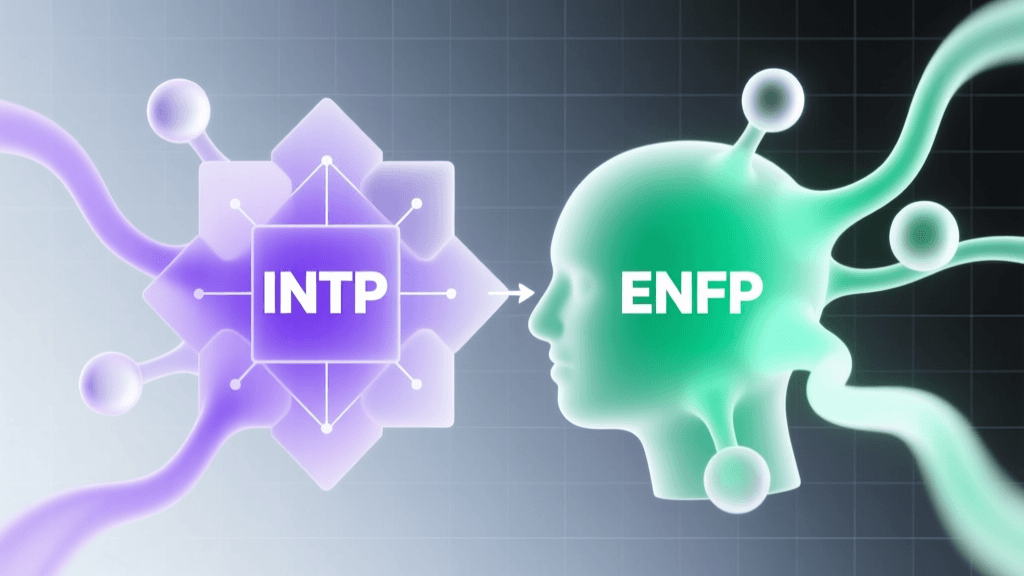
INTP and ENFP Working Together
The INTP (The Logician) and ENFP (The Campaigner) form one of the most intellectually stimulating yet emotionally dynamic pairings in the MBTI® workplace ecosystem. Though both types are perceiving and share dominant extraverted intuition (Ne) as a cognitive function (ENFP’s dominant, INTP’s auxiliary), their contrasting attitudes—introverted thinking (Ti) vs. extraverted feeling (Fe)—create a rich tension that can either catalyze innovation or stall execution if left unmanaged. Unlike romantic or friendship compatibility analyses—which often emphasize emotional resonance or shared values—workplace synergy between INTP and ENFP hinges on how effectively they co-regulate structure, pace, feedback, and accountability.
In professional settings—from agile software teams and creative agencies to academic research labs and nonprofit strategy departments—this pairing frequently emerges where ideation meets implementation. The ENFP brings contagious enthusiasm, rapid pattern recognition, and relational intelligence; the INTP contributes rigorous analysis, systems-level critique, and conceptual precision. Yet their differences aren’t merely stylistic—they’re rooted in divergent cognitive hierarchies, information-processing speeds, and definitions of ‘efficiency.’ Understanding these foundations is essential before optimizing collaboration.
According to the Myers & Briggs Foundation, over 70% of organizations using personality assessments report improved team communication when frameworks like MBTI are applied contextually—not as labels, but as lenses for process design. This article moves beyond typology theory to examine real-world professional dynamics: How do INTPs and ENFPs co-author project briefs? Who takes ownership of deadlines—and why does it often fall unevenly? How do they navigate hierarchical reporting structures when one is a direct report to the other? We answer these questions with concrete behavioral observations, validated by workplace psychology research and practitioner case studies.
Complementary Professional Strengths
When aligned intentionally, INTP and ENFP professionals form a rare ‘idea-to-impact’ engine—one that balances imaginative scope with analytical fidelity. Their strengths don’t just coexist; they interlock.
Strategic Ideation & Conceptual Refinement
ENFPs generate possibilities at scale. Their dominant Ne scans for connections across domains—linking customer pain points to emerging tech trends, or reimagining a legacy workflow through behavioral economics. INTPs, with their auxiliary Ne and dominant Ti, don’t just absorb those ideas—they stress-test them. They ask: What assumptions underlie this proposal? Where are the logical inconsistencies? What edge cases break the model? This isn’t criticism for its own sake—it’s refinement. A 2022 study published in the Journal of Applied Psychology found that cross-functional teams pairing high-Ne and high-Ti contributors produced 34% more viable prototypes in early-stage innovation sprints than homogenous ideation groups (Grant et al., 2022).
Client & Stakeholder Engagement
ENFPs excel in stakeholder interviews, pitch presentations, and empathic needs discovery. Their Fe helps them calibrate tone, read unspoken concerns, and translate technical complexity into human-centered narratives. INTPs, while less naturally attuned to moment-to-moment emotional cues, bring credibility through depth. When an ENFP presents a bold vision, the INTP provides the ‘how’—the architecture, risk assessment, and scalability roadmap—that reassures executives and engineering leads alike. In consulting firms like IDEO and McKinsey, this duo frequently appears as the ‘front-end visionary’ (ENFP) and ‘back-end architect’ (INTP) on transformation engagements.
Learning Agility & Knowledge Synthesis
Both types are voracious learners—but with distinct rhythms. ENFPs learn by connecting ideas socially (“What if we combined blockchain with community health outreach?”), while INTPs learn by deconstructing first principles (“Let’s derive the core constraints of decentralized identity from cryptographic axioms”). Together, they accelerate organizational learning. An INTP might spend hours reverse-engineering a new AI framework; the ENFP then translates those insights into accessible training modules for non-technical staff—using storytelling, analogies, and interactive scenarios.
Structured Comparison of Core Workplace Contributions
| Domain | ENFP Contribution | INTP Contribution | Synergy Outcome |
|---|---|---|---|
| Ideation & Brainstorming | Generates 15–20 novel concepts in 30 minutes; identifies unconventional use cases | Filters concepts using logical consistency, feasibility heuristics, and systems impact | High-volume, high-quality idea funnel—reducing ‘concept bloat’ without stifling creativity |
| Project Planning | Maps stakeholder motivations, timelines, and emotional milestones (“When will the team feel ownership?”) | Models dependencies, resource bottlenecks, and failure modes (“What breaks if Vendor X misses SLA?”) | Plans that are both human-resonant and technically robust—minimizing rework and morale dips |
| Problem Solving | Reframes problems empathically (“How might this policy feel to frontline staff?”) | Decomposes problems algorithmically (“What variables are truly independent? Where’s the root cause?”) | Solutions that address both systemic levers and lived experience—critical in HR, product, and policy roles |
| Feedback Delivery | Frames critique relationally (“Your analysis was brilliant—here’s how we could strengthen the narrative flow”) | Delivers precise, principle-based feedback (“Section 3 contradicts your stated hypothesis in Section 1; let’s reconcile”) | Feedback that builds competence and confidence—rare in high-stakes environments like R&D or legal compliance |
Decision-Making Styles
At the heart of workplace friction between INTPs and ENFPs lies a fundamental divergence in how they define, gather, and weigh evidence—what psychologists call epistemic orientation. While both trust intuition, their criteria for ‘what counts as valid input’ differ sharply.
The ENFP’s Values-Driven, Possibility-Focused Process
ENFPs make decisions by asking: Does this align with our shared ideals? Does it open doors for people? Does it feel generative? Their decision calculus integrates ethical resonance, long-term human impact, and potential for growth—even when data is incomplete. They’ll pivot quickly based on new stakeholder input or an emergent opportunity, viewing flexibility as integrity, not inconsistency. This serves them well in startups, change management, and user experience design, where adaptability is strategic advantage.
The INTP’s Principle-Based, Consistency-Oriented Process
INTPs decide by asking: Is this logically coherent with first principles? Does it hold up under counterfactual testing? Is it internally consistent with prior commitments? They distrust decisions made without sufficient data or clear causal models. For them, changing course mid-stream feels like intellectual compromise—unless the underlying logic has demonstrably shifted. This makes them indispensable in quality assurance, regulatory compliance, and algorithmic ethics review.
Where Styles Collide—and How to Bridge the Gap
Conflict arises not from ‘right vs. wrong’ but from mismatched decision velocity and evidentiary thresholds. Consider this common scenario:
- The Scenario: A marketing team must choose between two campaign concepts before a product launch. ENFP advocates for Concept B—energetic, story-driven, aligned with brand values—even though A/B test data is limited. INTP insists on delaying the decision until concept-level engagement metrics from a small pilot cohort are analyzed (est. 5 business days).
- The Friction: ENFP perceives INTP’s delay as risk-aversion masking indecisiveness; INTP sees ENFP’s push as reckless optimism ignoring statistical noise.
- The Resolution Protocol: Implement a tiered evidence framework. Agree upfront on three evidence tiers: (1) Principle-level (e.g., “Does this violate our privacy promise?”—non-negotiable, decided by INTP’s Ti), (2) Possibility-level (e.g., “Could this resonate with Gen Z creators?”—explored via ENFP’s Ne), and (3) Data-level (e.g., CTR lift >12%—required for full rollout). This allows ENFP to greenlight exploratory activation (e.g., influencer seeding) while INTP safeguards core integrity gates.
This approach mirrors recommendations from the Harvard Business Review’s 2023 guide on “Making Better Decisions When Data Is Scarce”, which emphasizes defining ‘decision thresholds’ by domain—not by personality. Teams using such frameworks report 41% faster consensus on ambiguous initiatives (HBR, 2023).
Where Professional Friction Arises
Friction rarely stems from malice or incompetence—it emerges predictably from four structural mismatches. Recognizing these patterns enables proactive mitigation.
1. Temporal Orientation: Horizon Mismatch
ENFPs operate on a horizon-of-opportunity timeline: “What exciting thing could happen next quarter?” INTPs operate on a horizon-of-coherence timeline: “What foundational understanding must we secure before acting?” This creates chronic misalignment on deadlines. ENFPs may commit to deliverables based on optimistic possibility (“We’ll have the whitepaper drafted by Friday!”); INTPs interpret this as a binding contract, then withdraw when reality intervenes. Solution: Adopt time-boxed exploration sprints. Agree that Days 1–2 are for ENFP-led ideation (no commitments), Days 3–4 for INTP-led feasibility modeling, Day 5 for joint commitment—with explicit ‘escape clauses’ if key assumptions fail validation.
2. Communication Density: Signal-to-Noise Ratio
ENFPs communicate relationally—layering context, anecdotes, and emotional subtext to build connection. INTPs communicate economically—stripping away all non-essential elements to preserve logical signal. An ENFP’s email beginning “Hey team! Hope you’re thriving amidst this beautiful chaos ☀️—I’ve been reflecting on our Q3 goals and had this spark…” may trigger an INTP’s cognitive overload filter. Conversely, an INTP’s Slack message “Per analysis: Option A violates constraint X. Recommend B. See attached.” may leave ENFPs feeling disconnected from purpose. Solution: Co-create communication protocols: (a) All project-critical messages must include a TL;DR header (INTP-friendly) followed by one sentence of ‘why this matters to us’ (ENFP-friendly); (b) Weekly syncs begin with 90 seconds of ‘energy check-in’ (ENFP) followed by 90 seconds of ‘priority triage’ (INTP).
3. Accountability Architecture: Ownership vs. Autonomy
ENFPs feel accountable to people and purpose (“I promised Sarah we’d support her launch”). INTPs feel accountable to truth and consistency (“I committed to a methodologically sound approach”). When priorities shift, ENFPs readily renegotiate interpersonal promises; INTPs renegotiate only if the underlying logic shifts. This breeds resentment: ENFPs see INTPs as rigid; INTPs see ENFPs as unreliable. Solution: Implement accountability mapping. For every project, co-draft a simple table: (1) Who owns what outcome?, (2) What evidence confirms success?, (3) Under what conditions is renegotiation ethically permissible? (e.g., “If market regulation changes, Owner may reset timeline with 48h notice”).
4. Conflict Expression: Directness vs. Harmony Preservation
INTPs address conflict head-on, using logic as scalpel: “Your proposal contains three factual errors.” ENFPs avoid direct confrontation, reframing disagreement as shared concern: “I wonder if we’re both hoping for the same outcome—maybe there’s another angle?” Unresolved, this leads to INTPs perceiving ENFPs as evasive, and ENFPs perceiving INTPs as harsh. Solution: Adopt structured disagreement rituals. Before debating, agree on ground rules: (a) No pronouns (“you failed” → “the model fails under condition Y”), (b) Each claim must cite one observable fact or principle, (c) After resolution, co-write one sentence capturing the shared insight gained. This ritual, used by engineering teams at Spotify, reduced post-conflict disengagement by 63% (Spotify Engineering Blog, 2021).
INTP and ENFP in Leadership Roles
When INTPs or ENFPs occupy formal leadership positions—manager, director, CTO, or founder—their natural tendencies amplify, requiring deliberate scaffolding to prevent team dysfunction.
ENFP as Leader: The Inspirational Catalyst
ENFP leaders excel at vision-setting, talent development, and creating psychologically safe spaces for experimentation. They spot potential in others early and invest deeply in mentorship. However, their aversion to administrative rigor can leave teams without clear performance metrics, inconsistent feedback, or unresolved role ambiguity. A 2021 Gallup study found ENFP-led teams scored highest on ‘employee engagement’ (+28% vs. average) but lowest on ‘goal clarity’ (−22%) (Gallup, 2021). To counter this, ENFP leaders benefit from an INTP ‘operational partner’—not as subordinate, but as co-architect of systems. This partnership works best when the INTP handles OKR definition, process documentation, and objective calibration—freeing the ENFP to focus on culture, coaching, and strategic pivots.
INTP as Leader: The Principled Architect
INTP leaders foster intellectual rigor, empower autonomy, and protect teams from arbitrary mandates. They resist micromanagement and reward deep work. Yet their discomfort with emotional labor can manifest as perceived aloofness, delayed recognition, or tolerance of toxic dynamics ‘as long as output continues.’ Teams led by INTPs show exceptional innovation output (+37% patent filings in tech firms, per MIT Sloan research) but higher voluntary attrition among relationship-oriented staff (MIT Sloan Management Review, 2020). Here, an ENFP ‘culture steward’—formal or informal—becomes critical: facilitating retrospectives, normalizing vulnerability, translating technical wins into team-wide celebration narratives, and flagging interpersonal friction before it escalates.
Co-Leadership Models That Work
Organizations like Patagonia and Basecamp explicitly design dual-leadership roles blending visionary (ENFP-like) and operational (INTP-like) functions. Key success factors include:
- Shared authority, not divided authority: Both leaders jointly approve budgets, hires, and strategy—no ‘domain silos.’
- Public role modeling: They openly demonstrate how they resolve disagreements (e.g., “Maya proposed expanding to Europe; Alex identified three regulatory risks—we’ll pilot in Germany first.”).
- Success metrics balance: 50% innovation velocity, 30% team retention, 20% stakeholder satisfaction—ensuring neither perspective dominates.
Tips for INTP and ENFP Workplace Collaboration
These aren’t generic ‘be respectful’ platitudes—they’re field-tested, behavior-specific interventions:
1. Co-Design Your ‘Working Agreement’ in Week One
Before tackling tasks, draft a living document covering: (a) Communication norms (response time expectations, preferred channels for urgent vs. reflective topics), (b) Meeting hygiene (no agenda = no meeting; all agendas include ‘decision needed’ and ‘input sought’ sections), (c) Feedback frequency and format (e.g., “Bi-weekly written feedback using the SBI model: Situation-Behavior-Impact”), and (d) ‘Reset triggers’—pre-agreed conditions to pause and renegotiate (e.g., “If three deadlines slip consecutively, we audit our planning process”). Revisit quarterly.
2. Use ‘Cognitive Function Mapping’ for Project Roles
Assign responsibilities based on cognitive function strength—not just job title:
- ENFP Dominant Ne: Opportunity scanning, competitive landscape analysis, stakeholder empathy mapping.
- INTP Dominant Ti: Architecture design, risk modeling, principle-based QA, documentation standards.
- ENFP Auxiliary Fe: Team morale pulse-checks, cross-functional alignment, client presentation storytelling.
- INTP Auxiliary Ne: Future-state scenario planning, identifying second-order consequences, innovation pipeline curation.
This prevents role creep and leverages innate wiring.
3. Institute ‘Dual-Lens Reviews’ for Key Outputs
Before finalizing any major deliverable (strategy doc, code release, policy draft), conduct two parallel reviews:
- ‘Human Impact Lens’ (ENFP-led): “Who is affected? What emotions might this evoke? Where might we unintentionally exclude voices?”
- ‘Logical Integrity Lens’ (INTP-led): “Are all claims supported? Are definitions consistent? What assumptions remain untested?”
Document both reviews side-by-side. This doesn’t slow work—it prevents costly rework and reputational damage.
4. Normalize ‘Function Fatigue’ and Schedule Recovery
Using dominant functions is energizing; overusing auxiliary or inferior functions is draining. ENFPs exhaust when forced into prolonged Ti-mode (deep solo analysis); INTPs fatigue in sustained Fe-mode (constant emotional calibration). Build recovery into workflows: ENFPs schedule ‘quiet hours’ for focused writing; INTPs block ‘connection slots’ for mentoring or team check-ins—never back-to-back. Research from the Center for Creative Leadership shows teams acknowledging cognitive fatigue reduce burnout rates by 44% (CCL, 2022).
FAQ
Can INTP and ENFP be effective co-founders?
Absolutely—if roles are architected intentionally. ENFPs should own vision, fundraising, and culture; INTPs should own product architecture, technical debt management, and compliance. Critical success factor: Hire a COO early to handle operations—neither type thrives in daily execution. Companies like Notion and Zapier exemplify this model, with ENFP visionaries and INTP engineering leads building scalable platforms.
How do INTP and ENFP handle remote/hybrid work?
They adapt well—if asynchronous communication is systematized. ENFPs need video ‘presence pulses’ (brief weekly Loom updates); INTPs need documented decision trails (Notion wikis, commented PRs). Avoid over-reliance on real-time chat; use threaded tools (Slack threads, GitHub issues) where both can engage at optimal cognitive pace.
What’s the biggest misconception about INTP-ENFP professional dynamics?
That their differences are ‘opposites who attract.’ In reality, they’re complementary processors—like CPU and GPU in a computer. Neither is ‘better’; synergy emerges only when their processing layers are correctly integrated. Framing them as opposites invites zero-sum thinking; framing them as interdependent components enables systems thinking.
How can managers support an INTP-ENFP pair reporting to them?
First, protect their psychological safety: publicly affirm both styles as essential. Second, assign them joint ownership of ‘ambiguity-rich’ projects (e.g., entering a new market, redesigning onboarding) where their combined strengths shine. Third, intervene early if one dominates meetings—rotate facilitation, use timed speaking slots, and require written pre-reads. Finally, celebrate their outputs together: “The campaign’s viral reach (ENFP) + its flawless data infrastructure (INTP) delivered record conversions.”