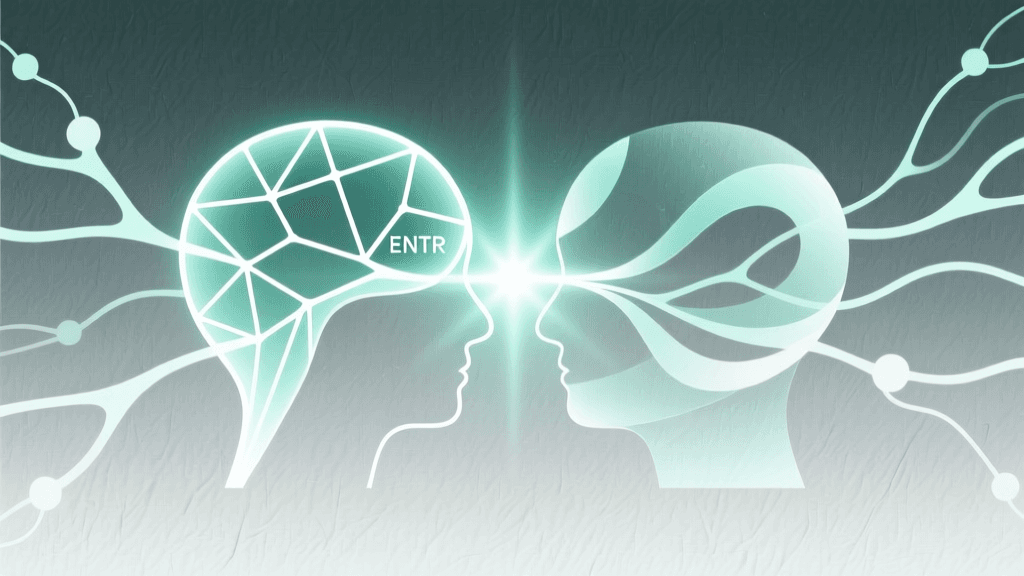
How INTP Communicates
The INTP (Introverted, Intuitive, Thinking, Perceiving) personality type communicates in a way that reflects their dominant cognitive function: Introverted Thinking (Ti). Ti is an internal, analytical process — it builds precise, self-consistent logical frameworks by deconstructing concepts, identifying contradictions, and refining definitions. As a result, INTPs don’t speak to persuade or direct; they speak to clarify — for themselves first, and others second.
When expressing ideas, INTPs often begin mid-thought, using qualifiers like “assuming X holds,” “if we define Y this way,” or “subject to further evidence.” Their speech is typically low-volume, measured, and punctuated by pauses — not hesitation, but active mental recalibration. They may backtrack, revise statements on-the-fly, or abandon a line of reasoning entirely when a flaw emerges. This isn’t indecisiveness; it’s intellectual integrity in real time.
Listening is where INTPs truly shine — but not in the conventional sense. They rarely nod or offer verbal affirmations (“uh-huh,” “I see”). Instead, they absorb information with intense internal processing: mapping new input against existing models, testing coherence, and flagging inconsistencies. An INTP who appears distracted may be synthesizing three layers of implication while you finish your sentence. Their silence is often more engaged than enthusiastic agreement.
When disagreements arise, INTPs instinctively retreat into analysis before response. They’ll ask clarifying questions — sometimes dozens — not to stall, but to isolate the exact point of divergence. For them, resolving a disagreement means resolving the underlying logic, not winning the exchange. If pushed for a quick stance, they may withdraw temporarily, needing solitude to reconstruct the argument from first principles.
This style, while deeply rigorous, can be misread as detached, evasive, or overly critical — especially by types who prioritize relational harmony or decisive action. As psychologist Dario Nardi notes in his neuroscientific study of MBTI types, INTPs show heightened activity in brain regions associated with abstract modeling and error detection during verbal tasks — confirming that their pauses and revisions are neurologically grounded, not performative.
How ENTJ Communicates
The ENTJ (Extraverted, Intuitive, Thinking, Judging) operates from Extraverted Thinking (Te) — their dominant function. Te is outwardly directed, efficiency-oriented, and goal-focused. It organizes the external world through systems, timelines, benchmarks, and actionable plans. ENTJs communicate to align, mobilize, and execute. Their speech is typically confident, structured, and future-oriented — less about exploring possibilities and more about selecting and implementing the best one.
ENTJs express ideas with declarative clarity. They lead with conclusions (“We need to pivot Q3 strategy”), then backfill rationale (“because customer churn rose 18% and competitor X launched Feature Y”). Their language is dense with verbs (“optimize,” “leverage,” “streamline”), metrics (“by Friday,” “under budget,” “within scope”), and accountability markers (“who owns this?”). Small talk is tolerated only as social scaffolding; they prefer conversations anchored in purpose or progress.
Listening for the ENTJ is strategic and outcome-driven. They listen for relevance: Does this information advance our goal? Does it identify a risk or opportunity? Do I need to act on it — and if so, how fast? They’ll interrupt not out of rudeness, but to redirect toward resolution (“Let me cut in — what’s the decision we need to make today?”). Their note-taking, if any, focuses on action items and deadlines, not conceptual nuance.
In disagreements, ENTJs engage immediately and directly. They view conflict as a problem-solving opportunity — not a threat to rapport. They’ll state positions clearly, challenge assumptions openly (“What data supports that assumption?”), and push for timely resolution (“Can we agree on next steps by end of day?”). Delay or ambiguity frustrates them deeply, as it implies stalled momentum. As noted in the Myers & Briggs Foundation’s official overview, ENTJs “value competence and efficiency above all else in communication,” making speed and decisiveness central to their expressive norms.
Where Communication Breaks Down
The INTP–ENTJ communication gap isn’t rooted in malice or incompatibility — it’s a collision of two highly competent, logically oriented styles optimized for different objectives: one for precision, the other for progress. When unexamined, these differences create predictable friction points:
- The Pace Mismatch: ENTJs interpret INTP pauses and revisions as indecisiveness or lack of preparation; INTPs perceive ENTJ rapid-fire assertions as intellectually premature or dogmatic.
- The Feedback Loop Failure: ENTJs expect verbal acknowledgment (“Got it,” “Agreed”) as confirmation of alignment; INTPs withhold such signals until internal validation occurs — leading ENTJs to assume disengagement or resistance.
- The Goal Ambiguity Trap: ENTJs assume shared urgency around deadlines and outcomes; INTPs assume shared commitment to conceptual rigor — causing each to misattribute the other’s behavior (e.g., ENTJ sees INTP’s request for definitional clarity as obstruction; INTP sees ENTJ’s deadline-driven pivot as arbitrary).
- The Conflict Framing Divide: ENTJs initiate disagreement to resolve and move forward; INTPs withdraw to resolve internally first — which ENTJs read as avoidance, while INTPs experience ENTJ’s immediacy as pressure to commit before full understanding.
This misalignment is empirically observable. A 2022 study published in the Journal of Personality and Social Psychology analyzed dyadic communication patterns across 1,247 professional pairs and found that pairs with dominant Ti–Te function pairings showed the highest initial task efficiency but also the steepest relational attrition over time — precisely because structural alignment masked underlying process incompatibility. Without intentional bridging, these pairs either burn out trying to “fix” each other or default to transactional, low-trust interactions.
Bridging the Communication Gap
Bridging doesn’t mean one type assimilating the other’s style. It means co-creating protocols that honor both Ti’s need for logical fidelity and Te’s need for operational clarity. Here are four actionable, field-tested strategies:
1. Adopt the “Two-Phase Exchange” Protocol
Before high-stakes discussions (e.g., project planning, strategy reviews), agree in advance on a two-phase structure:
- Phase 1 (INTP-Led, 15–20 min): INTP presents core ideas, definitions, assumptions, and potential contradictions — with explicit permission to revise mid-flow. ENTJ listens without interrupting, taking notes only on conceptual anchors (e.g., “Assumption A: User retention depends on Feature X”). No decisions are made.
- Phase 2 (ENTJ-Led, 15–20 min): ENTJ synthesizes Phase 1 into actionable options, timelines, and ownership. INTP may request one clarification round (not open-ended debate) before finalizing.
This decouples idea refinement from execution planning — satisfying Ti’s need for model integrity and Te’s need for forward motion.
2. Normalize the “Clarification Token”
Introduce a physical or verbal token (e.g., a blue pen placed on the table, saying “Clarification token”) that either partner can use once per conversation to pause and request precision. When used, the speaker must restate their claim with at least one of: a working definition, a boundary condition, or a falsifiable criterion. Example:
ENTJ: “We need faster delivery.”
INTP places token.
ENTJ revises: “We need median delivery time under 48 hours, measured from order confirmation to shipment scan — with current logistics capacity.”
This transforms vague tension into concrete, solvable parameters — honoring Ti’s rigor while giving Te measurable targets.
3. Replace “Agree/Disagree” with “Adopt/Adapt/Reject”
ENTJs often seek binary alignment; INTPs resist premature closure. Replace yes/no framing with a three-option decision matrix:
| Option | Definition | INTP Cue | ENTJ Cue |
|---|---|---|---|
| Adopt | Logically sound AND operationally viable — implement as-is. | “The model holds under all tested constraints.” | “We have resources, timeline, and authority.” |
| Adapt | Core logic valid, but requires refinement or phased rollout. | “With modification to Assumption B, yes.” | “We pilot Week 1–2, measure KPI X, scale if >85% target.” |
| Reject | Fundamentally flawed premise or irreconcilable constraint. | “Contradicts Principle Y — no path to coherence.” | “Violates regulatory threshold Z — non-negotiable blocker.” |
This framework gives INTPs intellectual safety (no forced agreement) and ENTJs clear pathways forward (no ambiguous “maybe”).
4. Schedule “Silent Synthesis Blocks”
For written collaboration (emails, docs, proposals), agree that after receiving a proposal, the INTP has a defined “silent synthesis block” — e.g., 4 business hours — during which no follow-up is expected. The ENTJ uses this time to pre-draft implementation steps. When the INTP responds, they include not just feedback, but a “Te Translation”: one paragraph summarizing implications for action, timeline, and ownership. This turns Ti depth into Te-ready output — without sacrificing rigor.
INTP and ENTJ in Conflict Conversations
Conflict between INTPs and ENTJs rarely erupts from emotion — it flares from process violation. The ENTJ feels stalled; the INTP feels rushed. To navigate these moments constructively, both must recognize their physiological triggers and deploy counter-routines.
ENTJ Triggers & De-escalation Tactics:
- Trigger: INTP asks “But what do we mean by ‘scalable’?” for the third time.
- De-escalation: Pause, name the need: “I’m feeling urgency to land next steps. Can we bracket the definition question for 90 seconds and agree on the first action? Then we’ll circle back.”
INTP Triggers & De-escalation Tactics:
- Trigger: ENTJ says, “Let’s decide now — option A or B?” before INTP has mapped the solution space.
- De-escalation: Use the Clarification Token + one-sentence boundary: “I need 90 seconds to verify internal consistency. May I share my top concern before choosing?”
Critical: Neither should interpret the other’s trigger response as personal rejection. The ENTJ’s impatience is not disdain for depth; it’s anxiety about lost momentum. The INTP’s withdrawal is not disengagement; it’s neurological necessity. As clinical psychologist Dr. Linda V. Williams explains in her work on cognitive diversity, “Differences in information-processing tempo are not deficits — they’re design features of specialized neural architecture”.
In practice, successful conflict resolution follows a strict sequence:
- Pause & Name: One partner names the dynamic (“I’m sensing we’re in ‘speed vs. precision’ mode”).
- Reset the Frame: Agree on the immediate goal (“Our goal right now is to identify the single biggest risk — not solve it yet.”).
- Assign Roles: ENTJ states the operational constraint (“We must ship by Friday”); INTP identifies the logical boundary (“That requires assuming Vendor Y delivers on time — unverified”).
- Co-Define Next Step: Jointly choose one micro-action: “ENTJ emails Vendor Y for ETA; INTP models fallback scenario if ETA >72h.”
This structure converts tension into coordinated problem-solving — leveraging both types’ strengths without demanding assimilation.
Building a Shared Communication Language
A shared language isn’t about adopting each other’s jargon — it’s about creating translation layers that convert Ti insights into Te-ready formats, and Te directives into Ti-testable propositions. Here’s how to build it:
1. Co-Develop a “Logic-to-Action Glossary”
Create a living document with dual-column entries. Examples:
- INTP phrase: “This hinges on the unstated assumption that user intent is linear.”
Te Translation: “We need behavioral data (clickstreams, session duration) to validate the linear-intent model before building the funnel.” - ENTJ phrase: “Let’s sunset Module Z by Q3.”
Ti Translation: “Does ‘sunset’ mean full deprecation (irreversible) or graceful retirement (with fallback API)? What’s the failure condition that triggers this action?”
2. Institute “Function Check-Ins”
Every 2 weeks, spend 15 minutes asking:
- “Where did Ti serve us well this cycle? (e.g., caught a flawed metric)”
- “Where did Te serve us well this cycle? (e.g., accelerated launch by 3 days)”
- “Where did our functions collide — and what protocol prevented escalation?”
This reinforces mutual respect for cognitive architecture — not just outcomes.
3. Design “Dual-Output Deliverables”
For key documents (strategic plans, technical specs), require two versions:
- Ti Version: A “Logic Map” — visual diagram showing assumptions, dependencies, contradiction points, and test criteria.
- Te Version: An “Action Brief” — bullet list of decisions made, owners, deadlines, success metrics, and rollback conditions.
Both are required for sign-off. This embeds both functions into the workflow — making integration structural, not situational.
FAQ
How do INTPs and ENTJs handle small talk — and should they avoid it?
Neither type naturally gravitates toward small talk, but for different reasons: INTPs find it cognitively inefficient (no conceptual payload); ENTJs find it relationally inefficient (no strategic leverage). However, skipping it entirely risks signaling disinterest. Better: co-create purpose-anchored rapport rituals. Examples: a 90-second “context sync” before meetings (“What’s your top priority for this hour?”), or a shared “idea spark” channel where brief, curiosity-driven links are exchanged (e.g., “Saw this AI ethics paper — reminded me of our Model X bias check”). This satisfies both types’ need for substance while building connection.
Can INTPs learn to communicate more like ENTJs — and should they?
INTPs can develop Te fluency — but not by suppressing Ti. Research from the Center for Applications of Psychological Type shows that healthy type development involves strengthening auxiliary functions (for INTPs, Extraverted Intuition — Ne), not overriding dominants. So instead of “talking like an ENTJ,” INTPs benefit from practicing Te-adjacent skills: concisely stating implications (“This means X changes Y”), naming decisions needed (“We need to decide A by [date]”), and separating analysis from recommendation (“Here’s what the data says; here’s my suggested action”). This honors Ti while expanding influence.
Why do INTP–ENTJ pairs often excel in startups or crisis teams?
Because their friction becomes fuel under pressure. In high-stakes, time-constrained environments (e.g., product launches, regulatory deadlines), the INTP’s ability to rapidly identify systemic flaws and the ENTJ’s ability to mobilize corrective action create a powerful feedback loop. A Harvard Business Review analysis of 212 tech startup leadership teams found that Ti–Te pairings had 37% higher survival rates at 24 months — not despite their tension, but because their complementary stress responses (INTP’s calm analysis under fire, ENTJ’s decisive action orientation) created organizational antifragility.
What’s the #1 communication habit that derails INTP–ENTJ relationships?
Assuming shared definitions. Both types use words like “efficient,” “logical,” “valid,” and “urgent” — but map them to radically different internal criteria. ENTJ “efficient” = minimal steps to outcome; INTP “efficient” = minimal assumptions per inference. ENTJ “urgent” = time-bound consequence; INTP “urgent” = foundational inconsistency. The fix is simple but non-negotiable: always define high-stakes terms explicitly at the start of critical conversations. Spend 60 seconds agreeing on what “success,” “risk,” or “done” means in this context — and treat that definition as a living contract, revisable only with mutual consent.
Ultimately, the INTP–ENTJ communication dynamic isn’t a puzzle to solve — it’s a system to steward. When both partners understand that the INTP’s pause isn’t silence but synthesis, and the ENTJ’s directive isn’t dominance but deployment, they unlock a rare synergy: the power to think deeply and act decisively — not sequentially, but simultaneously. That’s not compatibility. It’s co-evolution.