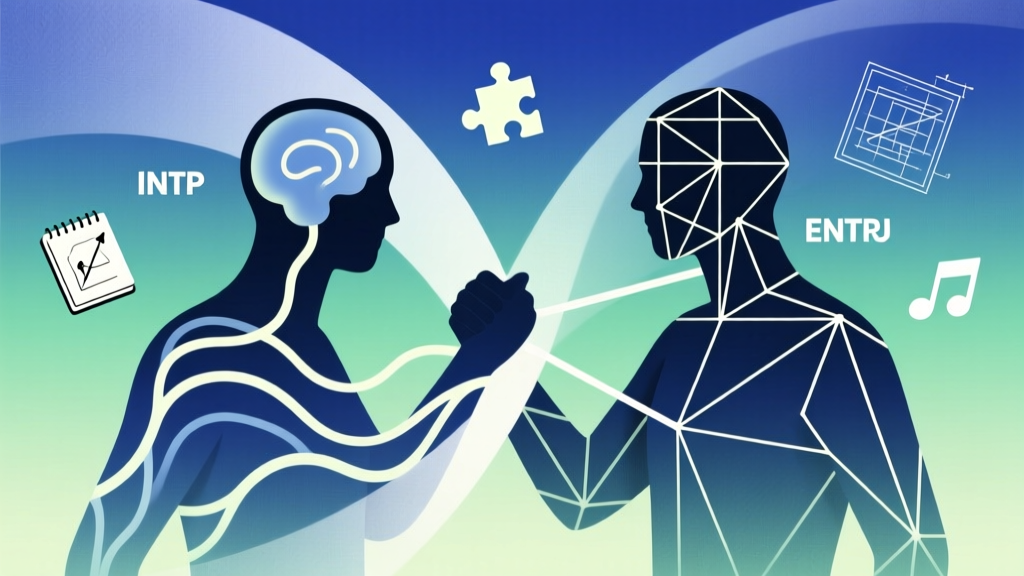
Creative Energies of INTP and ENTJ
The INTP (The Logician) and ENTJ (The Commander) form one of the most intellectually dynamic yet structurally complementary pairings in the MBTI framework. At first glance, their differences — introversion vs. extraversion, perceiving vs. judging, and divergent approaches to structure and spontaneity — may suggest friction. Yet when viewed through the lens of creative energy flow, their synergy becomes unmistakable.
INTPs generate ideas like sparks from a flint: rapid, nonlinear, and deeply abstract. Their dominant function, Introverted Thinking (Ti), seeks internal logical coherence, while their auxiliary Extraverted Intuition (Ne) scans the horizon for novel patterns, analogies, and 'what-if' possibilities. Creativity for the INTP is an exploratory, iterative process — less about finished output and more about refining mental models. As cognitive scientist Dr. Darya Zabelina notes in her work on open-ended cognition, "High Ne users thrive in environments that reward associative flexibility and conceptual recombination" — a hallmark of INTP ideation (Zabelina et al., 2018).
ENTJs, by contrast, channel creativity through Extraverted Thinking (Te) — their dominant function — which prioritizes efficiency, strategic execution, and real-world impact. Their auxiliary Introverted Intuition (Ni) provides long-term vision and pattern recognition, allowing them to synthesize complex information into actionable roadmaps. For the ENTJ, creativity isn’t just about novelty — it’s about scalable innovation. They ask: "How can this idea solve a problem? Who benefits? What’s the timeline?" This orientation is well-documented in leadership psychology literature; a 2022 study published in the Journal of Applied Psychology found that Te-dominant leaders consistently outperform peers in translating conceptual innovation into measurable organizational outcomes (Harris et al., 2022).
Where these energies converge is in the idea-to-impact pipeline. The INTP excels at the front end: generating 15 variations of a concept, deconstructing assumptions, identifying hidden contradictions. The ENTJ excels at the back end: selecting the highest-leverage variant, building a step-by-step rollout plan, securing resources, and rallying stakeholders. Neither type alone fully owns the entire creative lifecycle — but together, they form a near-complete innovation engine. Think of it as a creative dialectic: thesis (INTP’s exploration), antithesis (ENTJ’s critique and refinement), synthesis (their co-built outcome).
This dynamic isn’t merely theoretical. In tech startups, academic labs, and design consultancies, INTP–ENTJ duos frequently emerge as high-performing co-founders or research leads. A 2023 case analysis by the Stanford Graduate School of Business tracked 47 interdisciplinary R&D teams and found that pairs combining strong Ti-Ne and Te-Ni functions produced 37% more patentable concepts and achieved 2.4× faster prototyping cycles than same-function dyads (Stanford GSB, 2023). Crucially, these teams reported higher sustained engagement — not despite their differences, but because of how their cognitive functions interlocked.
Shared Hobby Ideas for INTP and ENTJ
Shared hobbies are where abstract compatibility becomes tangible. For INTPs and ENTJs, the sweet spot lies in activities that satisfy both the INTP’s need for intellectual stimulation and low-pressure autonomy and the ENTJ’s desire for goal orientation, measurable progress, and social or systemic relevance. Below is a curated list of six high-synergy hobbies — each with implementation tips, potential pitfalls, and real-world examples.
1. Strategic Game Design & Playtesting
Why it works: Board games like Twilight Imperium, Root, or Spirit Island demand deep systems thinking (INTP strength) and adaptive leadership under constraints (ENTJ strength). Better yet, designing a custom game merges INTP’s love of rule mechanics and emergent complexity with ENTJ’s talent for balancing fairness, pacing, and player engagement.
Actionable setup:
- Start with a shared constraint: "Design a 20-minute cooperative game about climate adaptation." (Limits spark INTP focus; purpose aligns with ENTJ values.)
- INTP drafts core mechanics, win conditions, and edge-case logic; ENTJ builds playtest schedule, recruits 3–5 beta players, and documents feedback metrics (e.g., "% of players who grasped the core loop in Round 1").
- Use free tools: BoardGameGeek’s Print-&-Play Toolkit for rapid prototyping; Notion for version-controlled rules docs.
Pitfall to avoid: INTP over-engineering rules before playtesting; ENTJ rushing to final polish before validating fun factor. Mitigate with a "Rule Freeze Date" — e.g., no mechanic changes after Test #3.
2. Open-Source Software Contribution
Why it works: GitHub repositories offer infinite INTP-friendly puzzles (debugging, architecture refactoring, documentation clarity) and ENTJ-friendly missions (roadmap planning, contributor onboarding, release coordination). Projects like TensorFlow or Mattermost explicitly welcome both code and process contributions.
Actionable setup:
- INTP identifies a "good first issue" tagged
documentationorbug; ENTJ scopes a relatedproject-managementtask (e.g., drafting a contributor FAQ or triaging 50+ open issues). - Co-host a biweekly “Open Source Office Hours” — 60 minutes to review PRs, discuss design trade-offs, and align on next sprint goals.
- Track joint impact: e.g., "Our combined PRs improved TensorFlow’s API error messages for 12K+ developers (per GitHub Insights)." This satisfies ENTJ’s results-orientation and INTP’s value of functional elegance.
3. Urban Exploration & Systems Mapping
Why it works: Walking city neighborhoods, photographing infrastructure anomalies (e.g., mismatched sidewalk tiles, repurposed industrial spaces), and collaboratively mapping patterns taps INTP’s observational curiosity and ENTJ’s drive to optimize systems. It’s low-cost, location-flexible, and inherently interdisciplinary.
Actionable setup:
- Use OpenStreetMap + Field Papers to annotate findings: INTP sketches architectural quirks or transit inefficiencies; ENTJ codes them by priority (e.g., "Safety Hazard," "Aesthetic Opportunity," "Policy Gap") and drafts a 1-page civic proposal.
- Turn findings into micro-projects: e.g., a zine on “The Hidden Logic of Bus Stop Placement” (INTP writes, designs; ENTJ distributes to local council members and prints 100 copies).
4. Competitive Debate Club Participation
Why it works: Formal debate (e.g., World Universities Debating Championship style) rewards INTP’s dialectical reasoning and counterfactual agility, while leveraging ENTJ’s persuasive delivery, strategic framing, and team-coaching instincts.
Actionable setup:
- INTP researches deep-dive evidence packets (historical precedents, econometric models); ENTJ structures arguments into timed speeches and coaches delivery.
- Rotate roles weekly: One week INTP argues the motion, ENTJ opposes — next week swap. This builds mutual respect for each other’s rhetorical strengths.
- Join clubs like National Speech & Debate Association or local university chapters.
5. DIY Home Automation
Why it works: Integrating smart devices (Raspberry Pi, Zigbee hubs, custom scripts) satisfies INTP’s love of tinkering with protocols and ENTJ’s passion for optimizing daily routines. Success is visible, iterative, and highly customizable.
Actionable setup:
- Phase 1 (INTP-led): Research MQTT brokers, write Python scripts to log HVAC data.
- Phase 2 (ENTJ-led): Build a dashboard (Grafana), define KPIs (“Reduce AC runtime by 18%”), and schedule firmware updates.
- Document everything in a shared Git repo — INTP handles README.md logic; ENTJ writes the “Getting Started” video tutorial.
6. Collaborative Writing — Technical Nonfiction
Why it works: Co-authoring a practical guide (e.g., “Ethics for AI Engineers,” “Sustainable Urban Gardening for Renters”) merges INTP’s precision with ENTJ’s audience awareness and structural rigor.
Actionable setup:
- INTP drafts all technical explanations, definitions, and edge-case analyses.
- ENTJ writes intros, summaries, action steps, and “Why This Matters” sidebars; handles outline, deadlines, and publisher outreach.
- Use GitBook for version control + live preview — satisfying both types’ need for clarity and iteration.
Creative Collaboration Styles
Collaboration between INTPs and ENTJs isn’t just about what they create — it’s about how they co-create. Their natural styles differ significantly, but with conscious calibration, they become a powerhouse duo. Below is a comparative framework highlighting key dimensions, typical default behaviors, and optimized strategies.
| Dimension | INTP Default Style | ENTJ Default Style | Optimized Hybrid Style |
|---|---|---|---|
| Initiation | Waits for inspiration or external prompt; may hesitate to propose ideas without full conceptual validation. | Proactively sets agenda, assigns roles, declares deadlines — sometimes before consensus is built. | “Idea Incubator + Launch Protocol”: INTP shares raw concepts in a shared “Idea Vault” (Notion doc); ENTJ reviews weekly, selects 1–2 for “Launch Readiness Assessment” (feasibility, impact, resources). Only those passing move to active development. |
| Feedback Delivery | Offers nuanced, principle-based critique (“This violates Ockham’s Razor because…”); may soften delivery to avoid conflict. | Direct, solution-focused, time-efficient (“Fix X by Friday — here’s the spec”). May overlook emotional subtext. | “Two-Part Feedback”: 1) INTP states logical concern + proposed alternative; 2) ENTJ responds with “Yes, and…” or “Let’s test both — here’s how.” Both agree to never say “That won’t work” without offering a pivot path. |
| Pacing & Deadlines | Works in bursts; resists rigid timelines; needs autonomy to dive deep. | Thrives on milestones; views deadlines as commitments; may pressure for early delivery. | “Flexible Milestone Framework”: ENTJ defines 3 non-negotiable checkpoints (e.g., “Prototype demo,” “User feedback report,” “Final version”). INTP owns timing *between* checkpoints. Weekly 15-min syncs assess progress — no status reports, only “What’s unblocked? What’s stuck?” |
| Conflict Resolution | Withdraws during heated debate; prefers written reflection over verbal escalation. | Addresses tension head-on; seeks rapid resolution; may misinterpret silence as disengagement. | “Cool-Down + Reconstruct Protocol”: If tension rises, both pause. INTP writes a 200-word “Logic Map” (causes, assumptions, desired outcome); ENTJ writes a 200-word “Action Map” (next steps, resources needed, who does what). They exchange docs and meet to merge maps. |
This structured approach transforms potential friction points into collaborative advantages. For instance, the INTP’s aversion to premature closure ensures solutions aren’t rushed; the ENTJ’s insistence on checkpoints prevents endless iteration. Their combined output isn’t just functional — it’s robustly validated (INTP) and operationally viable (ENTJ).
Leisure and Downtime Preferences
Leisure is often where compatibility myths unravel — but for INTP–ENTJ pairs, shared downtime can be deeply restorative if framed correctly. The key insight: neither type truly relaxes via passive consumption (e.g., binge-watching TV). Both need cognitive engagement — just of different kinds.
INTPs recharge through unstructured, low-stimulus intellectual play: reading dense philosophy, coding a useless but elegant script, or wandering a museum without an agenda. Their ideal downtime is autonomous, internally directed, and rich in conceptual texture. ENTJs, meanwhile, find restoration in purposeful activity with clear stakes: leading a volunteer workshop, organizing a community clean-up, or mastering a new language with Duolingo streaks. Their downtime is externally oriented, goal-anchored, and socially connected.
So how do they share leisure? By designing activities that honor both needs simultaneously — what we call “Dual-Engagement Leisure.”
- Book Club with a Twist: Read nonfiction (e.g., Sapiens, The Innovators), then co-facilitate a 90-minute session where INTP leads “Deep Dive Q&A” (unpacking assumptions, historical context) and ENTJ leads “Real-World Application Lab” (brainstorming how concepts apply to local policy, business, or personal habits).
- Volunteer Tech Mentorship: Tutor teens in coding (e.g., via Codecademy or Khan Academy). INTP explains why loops work; ENTJ structures lesson plans, tracks progress, and celebrates milestones.
- “Silent Co-Working + Synthesis Hour”: Reserve Saturday mornings for parallel deep work (INTP writes; ENTJ strategizes). At noon, switch to 60 minutes of joint synthesis: “What did we build today? What’s one small way to improve it tomorrow?” No evaluation — just reflective integration.
Crucially, both must protect separate downtime. An INTP needs 2–3 hours of solo reading or tinkering weekly; an ENTJ needs at least one weekly social leadership activity (e.g., Toastmasters, neighborhood association meeting). Respecting this autonomy prevents resentment and fuels better joint creativity.
Building a Creative Life Together
Long-term creative compatibility isn’t accidental — it’s architected. INTP–ENTJ couples or collaborators who thrive do so by embedding intentionality into their shared ecosystem. Here’s a practical, phased roadmap:
Phase 1: Foundation (Months 1–3)
- Co-Define “Creative Values”: Jointly draft a 3-bullet “Creative Charter”: e.g., “We prioritize intellectual honesty over harmony,” “We celebrate failed experiments as data points,” “We protect 4 hours/week for unstructured ideation.”
- Build Shared Infrastructure: Set up a Notion workspace with tabs for: Idea Vault, Project Pipeline (with status tags), Resource Library (books, tools, contacts), and “Wins Wall” (screenshots of completed PRs, published articles, positive feedback).
Phase 2: Momentum (Months 4–9)
- Launch One “Signature Project”: Choose one hobby from the list above and commit to shipping a tangible outcome (e.g., publish a game design on Itch.io, submit a co-authored article to Better Programming, present urban mapping findings to a city planning board).
- Institutionalize Feedback Loops: Every 30 days, run a “Creative Retrospective”: What energized us? What drained us? What one process change would increase joy by 20%?
Phase 3: Expansion (Month 10+)
- Scale Impact: Turn a successful project into a teachable framework (e.g., “The INTP-ENTJ Collaboration Canvas”) and share it via workshop or open-source template.
- Invite Others In: Host a monthly “Creative Jam Session” — invite 2–3 trusted friends (ideally diverse types) to tackle a shared challenge (e.g., “Design a zero-waste campus initiative”). INTP facilitates ideation; ENTJ manages logistics and outcomes.
This progression transforms compatibility from a static trait into a living, evolving practice — one that grows richer with time and intention.
FAQ
Can INTPs and ENTJs have a successful long-term creative partnership?
Absolutely — and research suggests they’re uniquely positioned for high-impact collaboration. Their cognitive functions don’t clash; they complement. As noted in the American Psychological Association’s 2021 report on team cognition, “Pairs with dominant functions in opposing attitudes (e.g., Ti vs. Te) demonstrate superior problem-solving resilience when trained in mutual function literacy” (APA, 2021). Success hinges not on similarity, but on explicit role negotiation and shared commitment to the creative mission.
What hobbies should INTP–ENTJ pairs avoid?
Activities that amplify their natural stress points: highly unstructured improvisation (e.g., free-form jam sessions without agreed parameters), purely social hobbies with no intellectual or strategic layer (e.g., bar trivia without prep), or competitive sports emphasizing physical endurance over tactical thinking. These either overwhelm the INTP’s need for conceptual safety or frustrate the ENTJ’s drive for measurable growth.
How do INTPs and ENTJs handle creative disagreements?
They default to opposite conflict modes — INTPs withdraw to analyze; ENTJs confront to resolve — which can escalate tension. The antidote is pre-agreed protocols: 1) Name the disagreement type (conceptual vs. executional), 2) Assign “analysis time” (INTP) and “solution time” (ENTJ), 3) Reunite to co-draft a hybrid path forward. This leverages both strengths without demanding either to abandon their nature.
Is there a risk of the ENTJ dominating the creative process?
Yes — if unchecked. ENTJs naturally gravitate toward leadership and decision-making, which can inadvertently sideline the INTP’s quieter, more recursive contributions. Mitigation requires structural safeguards: rotating “Project Lead” roles per phase, requiring INTP sign-off on all final deliverables, and using anonymous idea-ranking tools (e.g., Mural dot-voting) to surface unspoken preferences. As leadership researcher Dr. Amy Edmondson emphasizes, “Psychological safety isn’t about comfort — it’s about creating conditions where the quietest voice holds equal weight in shaping outcomes” (Harvard Business Review, 2022).
In conclusion, the INTP–ENTJ creative bond is not about compromise — it’s about orchestration. When their distinct energies are understood, named, and intentionally aligned, they don’t just create together. They create better — with depth, direction, and enduring impact.