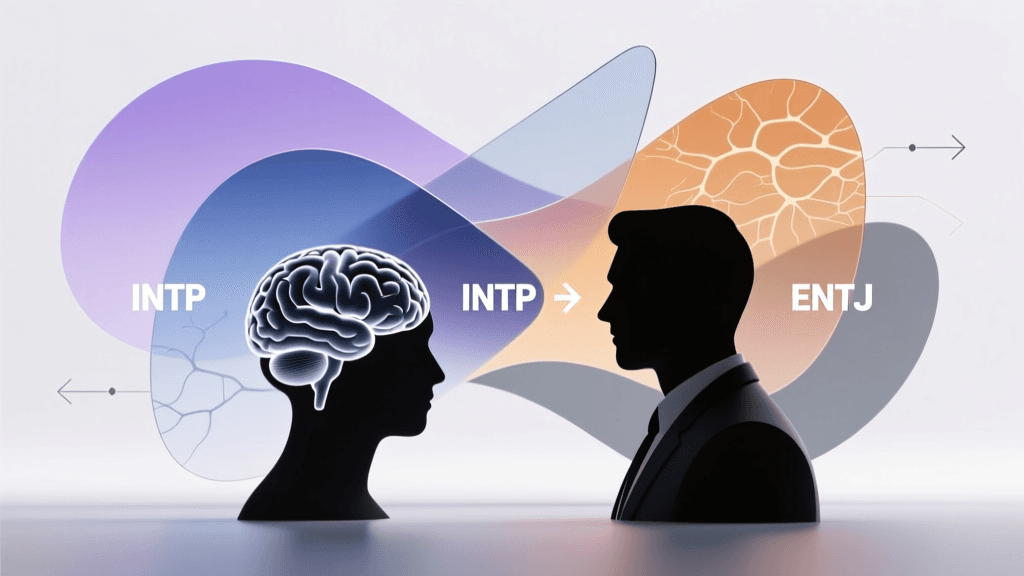
How INTP and ENTJ Connect as Friends
The friendship between an INTP (The Logician) and an ENTJ (The Commander) is one of the most intellectually stimulating yet structurally asymmetrical pairings in the MBTI framework. At first glance, their differences—especially in energy orientation (introversion vs. extraversion), decision-making (thinking vs. thinking—but with different auxiliary functions), and lifestyle rhythm (perceiving vs. judging)—might suggest incompatibility. Yet, when grounded in mutual respect for competence, curiosity, and integrity, this duo often forms a rare and high-functioning friendship rooted not in emotional mirroring but in cognitive synergy.
INTPs are drawn to ENTJs’ clarity of vision, strategic execution, and ability to turn abstract ideas into tangible outcomes. For an INTP—who may generate dozens of theoretical models in a week but hesitate to implement any—one reliable, action-oriented friend who says, “Let’s test that hypothesis *now*,” is invaluable. Conversely, ENTJs appreciate the INTP’s depth of analysis, intellectual honesty, and capacity to identify logical flaws others overlook. As psychologist David Keirsey observed in Please Understand Me II, NT types (including both INTP and ENTJ) share a fundamental drive to “understand systems, improve efficiency, and master complexity”—a common ground that serves as the bedrock of their friendship https://www.keirsey.com/personality/types/.
Unlike romantic or familial bonds, which often rely on affective resonance, INTP–ENTJ friendship thrives on epistemic trust: the confidence that each will uphold intellectual rigor, speak truthfully—even when inconvenient—and engage in good-faith debate. This doesn’t mean they’re always in agreement; rather, they treat disagreement as collaborative problem-solving. A 2021 study published in the Journal of Personality and Social Psychology found that friendships among high-agreeableness individuals tend to prioritize harmony, whereas those among high-openness, high-conscientiousness dyads (like INTP–ENTJ) report higher satisfaction when conflict is used constructively to refine ideas https://doi.org/10.1037/pspp0000342. This aligns precisely with how INTPs and ENTJs relate: friction isn’t avoided—it’s optimized.
Social Dynamics Between INTP and ENTJ
Socially, INTPs and ENTJs operate on divergent wavelengths—but not incompatible ones. The INTP prefers low-stimulus, high-substance interactions: one-on-one coffee chats where conversation meanders through quantum computing, linguistic relativity, or the ethics of AI alignment. Their ideal social unit is small, voluntary, and idea-driven. The ENTJ, by contrast, gravitates toward structured social engagement—planning group outings, hosting strategy dinners, or organizing volunteer initiatives with clear goals and measurable impact. They derive energy from orchestrating collective action and value loyalty expressed through consistent follow-through.
This divergence can cause early misalignment. An ENTJ might interpret an INTP’s silence during a group call as disengagement or indifference, while the INTP may perceive the ENTJ’s rapid-fire agenda-setting as domineering or impatient. But beneath surface behavior lies functionally complementary cognition:
- ENTJ’s dominant function is Extraverted Thinking (Te): outwardly focused on organizing systems, optimizing processes, and achieving results.
- INTP’s dominant function is Introverted Thinking (Ti): inwardly focused on building precise internal logical frameworks, identifying inconsistencies, and refining definitions.
- ENTJ’s auxiliary function is Introverted Intuition (Ni): synthesizing patterns over time to anticipate future implications.
- INTP’s auxiliary function is Extraverted Intuition (Ne): generating multiple possibilities, exploring conceptual connections, and reframing problems.
When these functions interact intentionally, they create a powerful feedback loop: Ne sparks novel angles; Ti refines them into coherent models; Ni projects long-term consequences; Te mobilizes resources to enact viable solutions. In friendship terms, this means the INTP helps the ENTJ avoid premature closure (“What if our assumption about market demand is flawed?”), while the ENTJ helps the INTP escape analysis paralysis (“Which three hypotheses are testable *this month*?”).
A key dynamic is temporal pacing. ENTJs naturally operate on calendar time—deadlines, milestones, quarterly reviews. INTPs inhabit cognitive time—where hours vanish during deep focus, and “tomorrow” is a vague coordinate. Successful INTP–ENTJ friendships develop hybrid time norms: e.g., agreeing that “We’ll schedule two 90-minute ‘idea sprints’ per quarter—no agenda required, but we’ll share notes afterward.” This honors the INTP’s need for unstructured ideation while satisfying the ENTJ’s desire for accountability.
Shared Interests and Activities
Though their hobbies may differ in execution, INTPs and ENTJs converge strongly in thematic interests—particularly those involving systems, strategy, and scalable improvement. Below is a curated list of activities proven to foster connection and sustained engagement:
| Activity Category | INTP Appeal | ENTJ Appeal | Joint Value |
|---|---|---|---|
| Strategic Gaming (e.g., Chess, Go, Terraforming Mars, Twilight Imperium) |
Deep pattern recognition, rule optimization, probabilistic reasoning | Resource allocation, long-term planning, competitive mastery | Real-time application of Ti/Te/Ni/Ne; post-game debriefs become mini-strategy workshops |
| Tech & Innovation Projects (e.g., building a personal knowledge management system, automating household tasks, open-source contribution) |
Architecting elegant logic flows, debugging abstractions | Setting sprint goals, documenting workflows, deploying MVPs | Combines INTP’s design-phase excellence with ENTJ’s implementation discipline |
| Policy or Ethics Debates (e.g., discussing AI governance, universal basic income, educational reform) |
Deconstructing assumptions, mapping moral axioms, identifying hidden trade-offs | Assessing feasibility, stakeholder impact, phased rollout plans | Creates shared intellectual “sandbox” where theory meets praxis |
| Learning Sprints (e.g., 30-day deep dive into behavioral economics, climate modeling, or ancient philosophy) |
Autonomous exploration, cross-disciplinary synthesis | Curated syllabus, progress tracking, peer teaching sessions | Builds mutual credibility; INTP gains structure, ENTJ gains conceptual depth |
Note: Both types generally dislike small talk, performative socializing, or emotionally prescriptive gatherings (e.g., mandatory team-building retreats). They bond most authentically when engaged in co-creation—not just sharing opinions, but jointly constructing something new: a shared Notion database of mental models, a podcast pilot episode dissecting cognitive biases, or even a co-authored Medium article critiquing startup culture.
Practical tip: Initiate shared activities using “low-commitment scaffolding.” Instead of saying, “Let’s start a podcast,” try: “Want to record a 20-minute unedited audio note on why blockchain governance fails epistemically? We’ll listen back separately and send bullet-point reactions.” This reduces pressure, honors INTP’s preference for asynchronous processing, and gives the ENTJ concrete deliverables to organize around.
Where Friendship Friction Arises
No high-potential friendship is frictionless—and INTP–ENTJ bonds face four recurring tension points. Crucially, none are dealbreakers; all are *negotiable* with awareness and intention.
1. Directness vs. Diplomacy Threshold
Both types value honesty—but define “bluntness” differently. ENTJs see candor as efficiency and loyalty (“I’m telling you this because I respect your ability to handle truth”). INTPs see it as intellectual hygiene (“If premises are unsound, the conclusion collapses—so let’s fix the premises”). However, the ENTJ’s Te-driven delivery can land as abrasive to the INTP’s sensitive Ti-Ne loop, especially when critique targets identity-linked interests (e.g., “Your neural net model ignores real-world latency constraints—you should scrap it”). The INTP, in turn, may withdraw or respond with hyper-logical counterarguments that feel dismissive to the ENTJ’s Ni-driven sense of urgency (“Yes, but *why does that matter now*, given Q3 deadlines?”).
Actionable fix: Co-create a “feedback protocol.” Example: “Before offering critique, ask: ‘Is this about accuracy, feasibility, or priority?’ Then preface with intent: ‘I’m flagging a structural inconsistency—not questioning your capability.’” This adds cognitive scaffolding to raw honesty.
2. Planning vs. Emergence
ENTJs schedule friendships like projects: recurring check-ins, defined objectives (“Let’s finalize the conference talk outline by Friday”), and outcome tracking. INTPs treat friendship as an emergent property of aligned curiosity—showing up when inspiration strikes, rescheduling without guilt, and valuing spontaneity as intellectual oxygen. When the ENTJ perceives inconsistency as unreliability, and the INTP perceives scheduling as constraint, resentment accrues silently.
Actionable fix: Adopt “tiered commitment.” Agree on one non-negotiable anchor (e.g., “First Saturday of every month: 90-min video call—agenda-free, but cameras on”) and treat all else as bonus bandwidth. This satisfies the ENTJ’s need for predictability while honoring the INTP’s autonomy.
3. Emotional Expression Mismatch
Neither type prioritizes emotional disclosure—but for different reasons. The ENTJ may suppress vulnerability to maintain leadership credibility; the INTP may omit feelings because they haven’t yet modeled them cognitively (“I haven’t parsed whether this is frustration or disappointment”). When an ENTJ shares a personal stressor (e.g., boardroom conflict), the INTP might respond with systemic analysis (“That power imbalance stems from misaligned KPIs”) instead of validation. The ENTJ feels unheard; the INTP feels unfairly accused of coldness.
Actionable fix: Normalize “feeling labels” as data points. Agree that phrases like “I’m registering elevated cortisol” or “My Ni is projecting 78% likelihood of burnout” count as emotional communication. This bridges the gap between physiological awareness and cognitive framing—both types respect data.
4. Credit Attribution Styles
ENTJs naturally assume ownership of outcomes (“We launched the initiative”); INTPs instinctively attribute success to systemic conditions (“The timing, open-source libraries, and domain overlap enabled it”). In collaborative work, this leads to perceived inequity: the ENTJ feels under-credited for driving execution; the INTP feels over-credited for ideation they consider incidental. A Harvard Business Review analysis of cross-functional tech teams confirmed that mismatches in attribution norms correlate strongly with attrition among high-performing NT pairs https://hbr.org/2022/03/why-brilliant-teams-fall-apart.
Actionable fix: Use explicit contribution mapping. Before launching joint projects, document: “INTP owns concept architecture, edge-case identification, and documentation standards. ENTJ owns timeline governance, stakeholder comms, and resource allocation. Shared ownership: final integration testing and public release.” Refer to it mid-project—not as audit, but as calibration.
INTP and ENTJ in Group Settings
In teams, classrooms, or community organizations, INTP–ENTJ duos often become the architect–executor engine—quietly shaping outcomes far beyond their formal roles. Their group dynamic follows predictable, high-leverage patterns.
In brainstorming sessions: The ENTJ opens with a crisp problem statement and success criteria. The INTP listens silently, then offers a reframing (“What if the real constraint isn’t budget—it’s regulatory latency?”) that shifts the entire discussion. Others pivot; the ENTJ immediately structures the new angle into actionable sub-tasks.
In conflict mediation: When group tensions arise, the ENTJ addresses surface behaviors (“Let’s align on meeting norms”). The INTP diagnoses root causes (“The friction stems from mismatched definitions of ‘urgency’ across departments”). Together, they draft a shared operating agreement—concise enough for adoption, rigorous enough for sustainability.
In volunteer leadership: ENTJs naturally step into visible coordination roles (event lead, committee chair). INTPs excel behind the scenes: designing feedback systems, optimizing sign-up flows, or writing clear role descriptions that prevent future ambiguity. Their combined output is unusually durable—because it balances human factors (ENTJ’s Te/Ni) with systemic coherence (INTP’s Ti/Ne).
However, pitfalls emerge when group norms ignore their needs. Open-office plans exhaust INTPs and scatter ENTJ’s focus. Consensus-driven decisions frustrate both: ENTJs see them as inefficient; INTPs see them as logically incoherent. The healthiest groups they join have asynchronous-first cultures (documentation before meetings), role clarity (no “helping out” without defined scope), and intellectual safety (questions like “What evidence would falsify this assumption?” are welcomed, not penalized).
Pro tip for group facilitators: When INTP and ENTJ are present, replace round-robin sharing with “structured ideation.” Pose a written prompt 24h in advance. Let INTPs submit written responses; ENTJs prepare concise implementation notes. Then synthesize live—leveraging both strengths without forcing either into unnatural modes.
Maintaining a INTP and ENTJ Friendship Long-Term
Longevity in INTP–ENTJ friendship hinges on three non-negotiable practices:
1. Quarterly Cognitive Calibration
Every 90 days, conduct a 60-minute “friendship audit” using this framework:
- Clarity Check: “What’s one idea we explored that changed how you think?”
- Friction Log: “What interaction recently felt misaligned—and what function (Te, Ti, Ne, Ni) was likely dominant?”
- Next-Level Ask: “What skill or domain do you want to co-develop next? (e.g., negotiation tactics, Bayesian reasoning, public speaking)”
This transforms abstract rapport into deliberate growth—a core value for both types.
2. Asynchronous Appreciation Rituals
Replace occasional “Thanks for being awesome!” with specific, function-aware acknowledgments:
- ENTJ to INTP: “Your Ti analysis of the funding deck exposed three unstated assumptions—that saved us 20 hours of rework.”
- INTP to ENTJ: “Your Te-driven deadline cascade made the impossible timeline feasible. I’ve modeled your sequencing logic for future projects.”
These aren’t compliments—they’re cognitive citations, reinforcing mutual professional respect.
3. Exit-Ramp Integrity
Both types value authenticity over obligation. If life circumstances shift (geography, career phase, energy demands), agree upfront that graceful dissolution is preferable to strained maintenance. Draft a “friendship sunset clause”: “If we go 90+ days without substantive exchange, we’ll schedule one final call to reflect—not to fix, but to honor what worked.” This removes guilt and preserves goodwill.
Research from the University of California, Berkeley’s Greater Good Science Center confirms that friendships built on intellectual reciprocity show exceptional resilience during life transitions—precisely because their value isn’t tied to proximity or frequency, but to quality of cognitive exchange https://greatergood.berkeley.edu/article/item/how_intellectual_friendships_boost_well_being. INTP–ENTJ bonds epitomize this: they deepen with time, not despite differences, but because of how those differences are harnessed.
FAQ
Can INTP and ENTJ be platonic best friends?
Absolutely—and often are. Their friendship rarely mimics conventional “bestie” tropes (daily texts, emotional venting, shared aesthetics). Instead, it’s characterized by strategic intimacy: decades-long collaboration on ideas that matter, mutual professional amplification, and unwavering belief in each other’s intellectual integrity. Best-friend status emerges not from duration, but from irreplaceability: “There’s no one else who can both dismantle my argument and rebuild it stronger.”
Do INTPs find ENTJs intimidating?
Initially, yes—especially younger INTPs encountering an assertive, high-achieving ENTJ. The ENTJ’s Te confidence can read as authoritarianism to an INTP still developing their own Ti authority. But mature INTPs recognize this as functional strength, not threat. The intimidation fades when the ENTJ demonstrates humility (“Your critique of my model’s assumptions was spot-on—I’m revising it”) and the INTP asserts boundaries (“I need 48 hours to process this before responding”).
How do INTP and ENTJ handle social events together?
They optimize for selective presence. Rather than attending every gathering, they co-select 2–3 high-value events per year (e.g., an academic conference, a hackathon, a policy forum) and prepare collaboratively: the INTP researches speakers/themes; the ENTJ coordinates logistics and outreach goals. At the event, they deploy complementary roles—the ENTJ navigates networking; the INTP identifies conceptual threads across sessions—then debrief deeply afterward. This turns social expenditure into intellectual ROI.
What’s the biggest myth about INTP–ENTJ friendship?
That it’s “too logical to be warm.” In reality, their warmth manifests as relentless investment in each other’s growth. An ENTJ will rearrange their schedule to review an INTP’s grant proposal; an INTP will spend weekends reverse-engineering an ENTJ’s leadership framework to help them scale. This isn’t cold calculation—it’s love expressed through cognitive craftsmanship. As Jungian analyst John Beebe writes, “The deepest bonds form not where minds agree, but where they challenge each other to evolve” https://www.johnbeebe.com/.
In sum, the INTP–ENTJ friendship is not for the casually curious. It demands rigor, patience, and a shared reverence for truth—even when uncomfortable. But for those willing to engage it on its own terms, it offers something rare in modern life: a lifelong intellectual partnership that sharpens the mind, expands possibility, and proves that the most enduring friendships aren’t built on similarity—but on complementary precision.