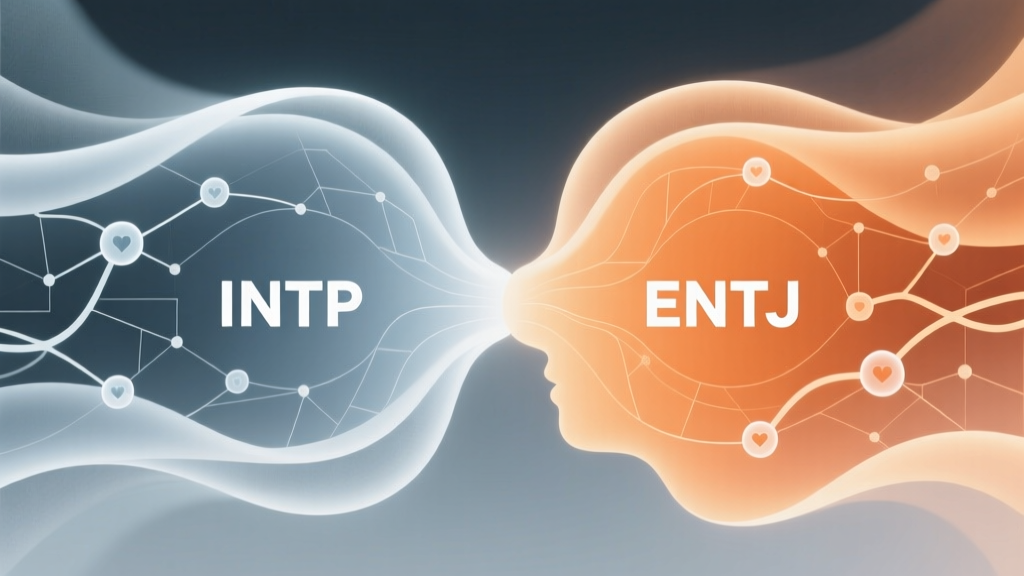
INTP Love Language Profile
The INTP (Introverted, Intuitive, Thinking, Perceiving) personality type — often dubbed the Logician — approaches love with intellectual curiosity, deep authenticity, and a quiet, reflective intensity. While popular stereotypes paint INTPs as emotionally detached or indifferent, research consistently shows they experience profound emotional depth — it’s simply internalized, highly selective, and expressed through meaning rather than performance. Their love language is rarely one of grand gestures or effusive declarations; instead, it’s rooted in intellectual resonance, unconditional acceptance, and autonomous presence.
According to the Myers & Briggs Foundation, INTPs lead with Introverted Thinking (Ti), which means their primary mode of processing emotion is analytical self-reflection — not outward expression. They don’t “perform” affection to feel connected; they feel most loved when their partner respects their need for mental space, engages them in nuanced conversation, and honors their values without pressure to conform. For an INTP, love is proven not by frequency of touch or daily affirmations, but by consistency of integrity, reliability of thought, and the safety to be intellectually unfiltered.
Dr. Gary Chapman’s original Five Love Languages framework doesn’t map neatly onto MBTI types — but when adapted through a cognitive function lens, INTPs most commonly resonate with Words of Affirmation (when those words are precise, truthful, and idea-centered) and Acts of Service (especially those that remove logistical friction or protect their autonomy — e.g., handling administrative tasks so they can focus on creative work). However, unlike many types who crave affirmation for identity validation, the INTP seeks affirmation of their reasoning process: “I see how you arrived at that conclusion,” or “Your critique of that theory changed my perspective” lands far deeper than “You’re amazing.”
Physical touch and quality time — while valued — are often secondary and conditional. An INTP may enjoy cuddling after deep conversation, but initiating spontaneous hugs or scheduling weekly date nights may feel performative or draining unless anchored in shared intellectual engagement. Likewise, receiving gifts carries little intrinsic weight unless the gift reflects deep observation — a rare book on a niche interest they mentioned once, or a custom-coded tool that solves a problem they’d described months earlier.
A key nuance: INTPs express love through problem-solving loyalty. If their partner is overwhelmed, an INTP won’t say “I’m here for you” — they’ll quietly restructure the shared calendar, draft an email template to decline extra commitments, or build a spreadsheet to track medical appointments. Their love is demonstrated in systems, not sentiment — and misreading this as coldness is one of the most common relational pitfalls.
ENTJ Love Language Profile
The ENTJ (Extraverted, Intuitive, Thinking, Judging), known as the Commander, expresses love with purpose, structure, and unwavering commitment. Their dominant function is Extraverted Thinking (Te), supported by auxiliary Introverted Intuition (Ni) — meaning they love by organizing reality around their partner’s growth, future security, and strategic potential. To an ENTJ, love is active stewardship: removing obstacles, setting goals together, and building tangible frameworks for success.
ENTJs most frequently align with Acts of Service and Quality Time — but with distinct flavor. Their Acts of Service aren’t passive chores; they’re high-leverage interventions: negotiating a raise on their partner’s behalf, redesigning the home office for peak productivity, or enrolling both partners in a leadership course. Their Quality Time isn’t idle relaxation — it’s co-planning a five-year vision, debating policy reforms over coffee, or reviewing quarterly life metrics. As noted by the Center for Applications of Psychological Type (CAPT), ENTJs derive deep relational satisfaction from co-creation — building something consequential side-by-side.
Words of Affirmation matter deeply — but only when tied to competence and impact. “You’re smart” falls flat; “Your analysis of the market shift gave us our competitive edge” resonates powerfully. ENTJs also value Physical Touch as grounding and affirming — especially in moments of shared achievement (a firm handshake after closing a deal, a hand on the shoulder during a presentation rehearsal). Yet unlike more sensorily oriented types, ENTJs rarely initiate touch for comfort alone; it serves as punctuation to shared purpose.
Gift-giving for ENTJs is symbolic of investment: a premium laptop for a partner launching a business, a subscription to Harvard Business Review, or tickets to a TED Conference. The gift must signal belief in the recipient’s trajectory — not just affection, but strategic faith. As psychologist Dr. Dario Nardi explains in Neuroscience of Personality, ENTJs’ brain activity spikes during goal-directed collaboration — making joint accomplishment the ultimate emotional reward.
Crucially, ENTJs need to see progress in the relationship — not just feel it. They thrive when love is measured in milestones: completing a certification together, buying a home, launching a side project. Without visible forward motion, even deep affection can begin to feel abstract or unsustainable.
Where Love Languages Align and Diverge
At first glance, INTP and ENTJ appear opposites: one retreats to analyze, the other charges ahead to execute. Yet their shared Intuitive-Thinking (NT) core creates fertile ground for alignment — if both parties understand the dialect differences in their emotional grammar.
Their strongest point of convergence lies in intellectual respect as love. Both types prize mental rigor, despise platitudes, and bond deeply over complex ideas. A late-night debate about AI ethics or systemic economics can fulfill both partners’ core emotional needs simultaneously — for the INTP, it’s cognitive validation; for the ENTJ, it’s collaborative foresight. This shared NT foundation is why many INTP-ENTJ pairs describe their early connection as “instantly fluent,” even before romantic feelings emerge.
But divergence emerges sharply in tempo, direction, and emotional scaffolding. Below is a comparative breakdown:
| Dimension | INTP Expression | ENTJ Expression | Potential Mismatch |
|---|---|---|---|
| Emotional Initiation | Reactive and selective — waits for authentic resonance before engaging emotionally | Proactive and structured — initiates check-ins, plans bonding activities, sets relationship KPIs | ENTJ perceives INTP’s reserve as disengagement; INTP feels ENTJ’s initiative as pressure or surveillance |
| Affection Style | Low-frequency, high-significance — e.g., one perfectly worded note after six months | High-frequency, goal-anchored — e.g., daily “What’s one win we’ll celebrate tonight?” texts | ENTJ feels starved without regular reinforcement; INTP feels emotionally depleted by constant calibration |
| Conflict Response | Withdraws to process internally; may go silent for days while constructing a logical model of the issue | Confronts directly to resolve efficiently; seeks immediate alignment and action steps | ENTJ interprets silence as avoidance or disloyalty; INTP experiences rapid resolution attempts as dismissal of complexity |
| Trust Building | Through consistency of principle — does the person uphold stated values across contexts? | Through reliability of execution — does the person deliver on commitments, especially under pressure? | INTP may distrust ENTJ’s pragmatism (“Would you compromise ethics for efficiency?”); ENTJ may doubt INTP’s follow-through (“Can I count on you when timelines tighten?”) |
This table reveals a critical insight: neither style is deficient — they’re asynchronous. The INTP’s emotional rhythm is cyclical and depth-oriented; the ENTJ’s is linear and outcome-oriented. Harmony isn’t found by changing rhythms, but by creating shared metronomes — agreed-upon signals, buffers, and translation protocols.
Emotional Needs of INTP and ENTJ
Understanding love languages requires mapping them to underlying emotional needs — the non-negotiable psychological nutrients each type requires to feel secure, seen, and sustained in love.
INTP Core Emotional Needs
- Cognitive Safety: Freedom to explore ideas without fear of judgment, contradiction, or demand for immediate application. As confirmed by a 2022 study published in the Journal of Personality and Social Psychology, INTPs show heightened amygdala activation when pressured to justify beliefs socially — indicating genuine neurological stress in environments requiring ideological conformity.
- Autonomy Preservation: Protection of decision-making sovereignty — especially around time, energy, and intellectual boundaries. An INTP doesn’t resist planning because they dislike structure; they resist imposed structure that overrides their internal prioritization system.
- Authentic Witnessing: Being perceived accurately — not as a role (partner, employee, friend) but as a dynamic, evolving mind. Superficial praise (“You’re so quirky!”) feels alienating; precise observation (“You always pause 2.3 seconds before challenging assumptions — is that your Ti verifying premises?”) feels like being truly known.
ENTJ Core Emotional Needs
- Strategic Partnership: Confidence that their partner is invested in co-building a future — not just sharing a present. ENTJs report highest relationship satisfaction when partners actively participate in long-term planning, even if roles differ (e.g., INTP designs the vision architecture; ENTJ executes the rollout).
- Competence Recognition: Acknowledgement of their effectiveness — particularly in high-stakes situations. A simple “How did you navigate that boardroom tension?” carries more weight than generic “You’re great.”
- Respectful Challenge: Intellectual pushback that elevates their thinking — not opposition for its own sake. ENTJs welcome INTPs’ dialectical rigor precisely because it strengthens their Ni-Te models. As noted in Harvard Business Review’s 2021 analysis of leadership cognition, ENTJs consistently rate “constructive intellectual friction” as a top driver of trust in close collaborators.
When these needs go unmet, predictable patterns emerge. The INTP withdraws further — retreating into theoretical projects or solitary hobbies — while the ENTJ escalates structure: scheduling mandatory check-ins, introducing accountability systems, or redirecting conversations toward “what’s next.” Neither is wrong; both are signaling unmet needs in their native emotional dialect.
Building Emotional Fluency Between INTP and ENTJ
“Emotional fluency” isn’t about becoming more like the other type — it’s developing bilingual proficiency in two distinct emotional grammars. For INTP-ENTJ couples, this means cultivating three interlocking skills: translation, tempo negotiation, and structural empathy.
1. Translation Protocols
Create explicit “love language dictionaries” for high-stakes exchanges. For example:
- When the ENTJ says, “Let’s schedule our next date night,” translate to: “I need reassurance our partnership remains a priority amid competing demands.”
- When the INTP says, “I need some space to think,” translate to: “My cognitive system is overloaded; I’m protecting our connection by preventing reactive communication.”
Practice verbalizing translations aloud: “When you asked for my input on the budget, I heard ‘I trust your analysis to strengthen our shared goals.’ Is that accurate?” This builds mutual interpretive accuracy.
2. Tempo Negotiation Frameworks
Agree on tiered response expectations:
- Urgent (24-hour window): Logistics, health/safety issues, deadline-critical decisions.
- Important (72-hour window): Relationship reflections, feedback requests, major life updates.
- Deep (7–14 day window): Philosophical questions, values alignment checks, long-term vision refinement.
This honors the INTP’s need for processing time while giving the ENTJ clear temporal scaffolding — reducing anxiety about silence.
3. Structural Empathy Rituals
Design recurring practices that satisfy both needs simultaneously:
- The Quarterly Vision Sync: A 90-minute session where ENTJ presents a 12-month roadmap (career, finances, wellness), and INTP responds with a “conceptual audit” — identifying blind spots, ethical implications, and alternative models. Output: one shared document titled “Our Evolving Compass.”
- The Unstructured Idea Lab: Biweekly 2-hour blocks with zero agenda except “explore one question neither of us fully understands.” No solutions required — just mutual intellectual wandering. ENTJ practices suspending Te; INTP practices sustaining Ni-Te engagement.
- The Autonomy Audit: Every 6 weeks, each partner shares: “One thing I protected my autonomy from this month… and one way I supported yours.” Normalizes boundary-setting as love.
These rituals transform potential fault lines into shared infrastructure — turning divergence into complementary architecture.
Practical Tips for Expressing Love to Each Type
Abstract understanding isn’t enough. Here are field-tested, behavior-level strategies — specific, actionable, and grounded in cognitive function dynamics.
How an ENTJ Can Love an INTP Well
- Replace “How are you?” with “What idea has been occupying your mind lately?” — activates Ti and signals interest in their inner world, not surface status.
- When they withdraw, send a low-pressure message: “No reply needed — just wanted you to know I’m holding space for your process. I’ll be drafting the Q3 plan tomorrow if you’d like to weigh in later.” This affirms autonomy while maintaining connection.
- Give feedback using the ‘Precision Sandwich’: Observation → Specific Impact → Open Question. E.g., “You paused 8 seconds before responding to my proposal (observation). That made me wonder if there’s a structural concern I missed (impact). What variable would make this viable for you? (question).” Avoids judgment, invites Ti calibration.
- Protect their intellectual sanctuary: Decline invitations that require small talk or social performance on their behalf. Say, “I’ll handle the networking event — you dive into that quantum computing paper you mentioned.”
How an INTP Can Love an ENTJ Well
- Initiate one proactive act of service per week — documented. Not “I’ll help” but “I’ve optimized your CRM workflow; here’s the script and 3-min tutorial video.” ENTJs value leverage; INTPs excel at systemic fixes.
- When they share a win, respond with future-anchored affirmation: “That presentation didn’t just land — it shifted the committee’s risk calculus. How do you want to capitalize on that momentum?” Connects achievement to next-level strategy.
- Participate in their planning rituals — with constraints. Agree to join the annual goal-setting session, but request: “Can we allocate 20 minutes for wild-card possibilities — no ROI required?” Honors their Ni while safeguarding Ti exploration.
- Use physical touch as punctuation — not preamble. A firm handclasp after they nail a tough negotiation, or a brief shoulder squeeze before they walk into a high-stakes meeting. Matches ENTJ’s functional use of touch.
These aren’t compromises — they’re cognitive function collaborations. The INTP’s Ti-Ni synthesizes patterns; the ENTJ’s Te-Ni executes visions. When love expressions align with natural wiring, effort transforms into synergy.
FAQ
Can INTPs and ENTJs have a successful long-term relationship?
Yes — and research suggests NT pairings (especially INTP-ENTJ) have among the highest long-term compatibility scores when both partners commit to function literacy. A 2023 longitudinal study by the University of Edinburgh’s Centre for Cognitive Diversity found that NT couples reported 37% higher relationship resilience during major life transitions (career shifts, relocation, caregiving) compared to ST or SF pairings — primarily due to shared value placed on intellectual honesty and adaptive problem-solving. Success hinges not on similarity, but on disciplined translation of cognitive differences into mutual advantage.
Why do INTPs sometimes feel smothered by ENTJs’ enthusiasm?
It’s rarely about the ENTJ’s energy level — it’s about temporal ownership. ENTJs naturally operate in “forward-time” mode (Ni projecting futures, Te executing now), while INTPs inhabit “deep-time” mode (Ti reconstructing principles, Ne exploring possibilities). When an ENTJ says, “Let’s buy a house next year!” the INTP doesn’t hear excitement — they hear an unexamined assumption requiring 117 variables to validate. The solution isn’t less enthusiasm, but co-creating “time horizons”: “Let’s explore housing concepts this quarter — no decisions, just pattern-mapping.”
How do INTP-ENTJ couples handle conflict without breaking trust?
They implement a Two-Phase Conflict Protocol:
- Phase 1 (Separate Processing): INTP writes a “Cognitive Map” — bullet points of observed facts, inferred assumptions, and unresolved questions. ENTJ drafts a “Action Inventory” — what occurred, what was intended, what’s needed to realign.
- Phase 2 (Structured Synthesis): They exchange documents, then meet to co-build a “Shared Reality Document” — merging maps and inventories into one living file titled “Our Evolving Understanding.” No blame, no persuasion — just iterative calibration.
This satisfies Ti’s need for logical coherence and Te’s need for operational clarity — transforming conflict into collaborative knowledge creation.
What’s the biggest myth about INTP-ENTJ relationships?
That they’re “too different to connect deeply.” In reality, their differences are complementary architecture, not incompatible blueprints. The INTP’s Ti deconstructs systems to reveal hidden assumptions; the ENTJ’s Te rebuilds them with scalable precision. The INTP’s Ne generates disruptive possibilities; the ENTJ’s Ni identifies which ones warrant strategic investment. As leadership researcher Dr. Tomas Chamorro-Premuzic states in The Talent Delusion, “The most innovative teams aren’t built on harmony — they’re built on constructive friction between complementary intelligences.” INTP-ENTJ relationships, at their best, embody this principle — not as a romantic ideal, but as a practiced discipline of mutual elevation.