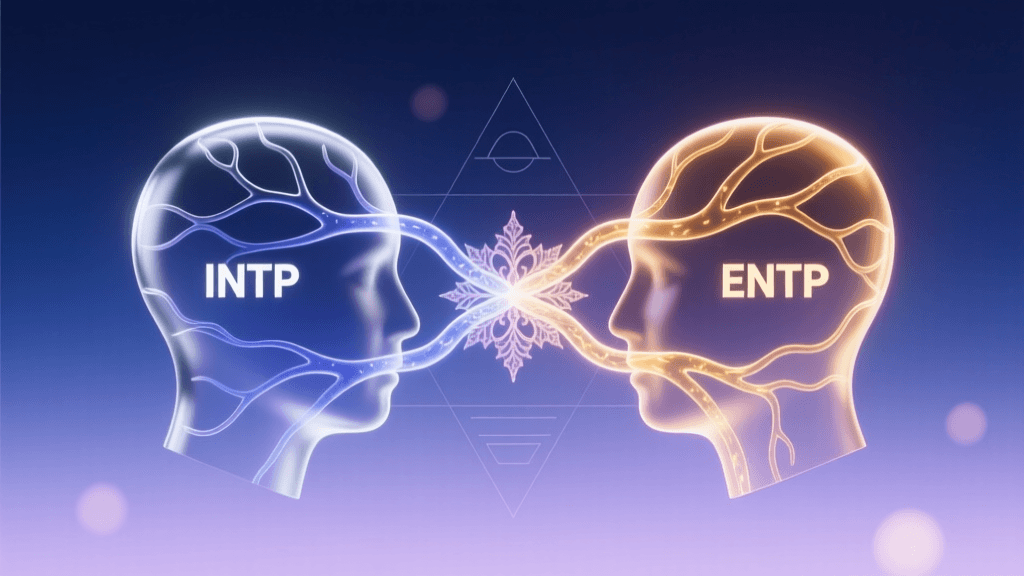
INTP Cognitive Stack Overview
The INTP personality type (The Logician) operates from a highly internalized, abstract, and analytical cognitive framework. According to Jungian theory—as refined by Isabel Briggs Myers, David Keirsey, and later cognitive function theorists like Linda V. Berens and Dario Nardi—the INTP’s functional stack is:
- Dominant: Introverted Thinking (Ti)
- Auxiliary: Extraverted Intuition (Ne)
- Tertiary: Introverted Sensing (Si)
- Inferior: Extraverted Feeling (Fe)
Ti serves as the INTP’s core engine: a relentless, internal logic processor that deconstructs ideas, tests principles for consistency, and builds precise mental models. It seeks coherence above all—truth must be internally verifiable, not socially validated. As Dario Nardi explains in Neuroscience of Personality, Ti-dominant individuals show heightened activity in the dorsolateral prefrontal cortex during complex reasoning tasks—especially when evaluating logical contradictions or refining conceptual frameworks.
Extraverted Intuition (Ne) acts as the INTP’s exploratory co-pilot. While Ti builds the internal architecture, Ne scans the external world for patterns, possibilities, analogies, and ‘what-if’ connections. This function fuels brainstorming, lateral thinking, and intellectual curiosity—but remains subordinate to Ti’s need for structural integrity. Ne doesn’t generate conclusions; it generates options for Ti to evaluate.
Introverted Sensing (Si), the tertiary function, emerges more clearly in adulthood or under stress. It manifests as subtle attention to bodily rhythms, nostalgic reference points, procedural memory (e.g., recalling how to code a specific algorithm), or a quiet preference for familiar routines when cognitive load is high. However, Si is underdeveloped and often dismissed as ‘uninteresting’ unless consciously cultivated.
Extraverted Feeling (Fe), the inferior function, represents the INTP’s greatest growth edge—and vulnerability. Under pressure, Fe can erupt as emotional overreaction, people-pleasing fatigue, or sudden withdrawal from social expectations. In healthy integration, Fe matures into genuine empathy, attunement to group harmony, and the ability to express care in socially resonant ways—not through performance, but through thoughtful presence.
ENTP Cognitive Stack Overview
The ENTP (The Debater) shares the same perceiving functions as the INTP—but in reversed order. Their functional stack is:
- Dominant: Extraverted Intuition (Ne)
- Auxiliary: Introverted Thinking (Ti)
- Tertiary: Extraverted Feeling (Fe)
- Inferior: Introverted Sensing (Si)
For the ENTP, Ne is the driving force—not just a supporting tool. It’s outwardly oriented, rapid-fire, associative, and socially expressive. ENTPs live to generate possibilities, challenge assumptions, and spark intellectual contagion. As psychologist John Beebe notes in Integrity and the Five Jungian Functions, Ne-dominant types experience reality as a web of potential meanings—where every statement invites reframing, every problem suggests five alternative solutions, and every conversation is an invitation to ideate.
Ti, though auxiliary, provides the ENTP with crucial grounding. It allows them to pause the Ne cascade and apply internal logic filters: ‘Does this idea hold up to scrutiny? Is it self-consistent? What are its hidden assumptions?’ But unlike the INTP’s Ti—which builds systems—ENTP Ti is more diagnostic: it dissects arguments, identifies flaws, and refines concepts on-the-fly. It’s less about constructing a unified theory and more about ensuring intellectual hygiene.
Extraverted Feeling (Fe), the tertiary function, develops later in life and often surfaces in ENTPs as charm, rhetorical warmth, or situational diplomacy. They may intuit group values, adjust tone for audience impact, or advocate passionately for causes they deem just. Yet Fe remains instrumental rather than intrinsic—it serves Ne/Ti goals (e.g., persuading others of a brilliant idea) rather than arising from deep empathic attunement.
Introverted Sensing (Si), the inferior function, is the ENTP’s Achilles’ heel. Under chronic stress, Si can manifest as hypochondria, rigid nostalgia, obsessive focus on minor physical discomforts, or sudden fixation on past mistakes. Healthy Si integration, however, brings reliability, attention to practical detail, appreciation for tradition or craft, and embodied presence—qualities many ENTPs actively cultivate through habits like journaling, cooking, or learning instruments.
Where Functions Align
At first glance, INTP and ENTP appear nearly identical—both are ‘NT’ thinkers, both love debate, abstraction, and novelty. But alignment runs deeper than temperament: it lives in their shared cognitive infrastructure. Their dominant-auxiliary pairing forms a mirrored, complementary loop—Ti-Ne ↔ Ne-Ti—that creates extraordinary intellectual synergy.
Consider a collaborative project—say, designing an open-source AI ethics framework. The INTP might begin by drafting a rigorous taxonomy of moral axioms, mapping logical dependencies, and identifying inconsistencies in existing proposals (Ti-dominant rigor). The ENTP, meanwhile, rapidly surveys global case studies, cross-cultural precedents, speculative future scenarios, and stakeholder concerns (Ne-dominant breadth). When they share work, the INTP’s model gains real-world relevance; the ENTP’s vision gains structural accountability. Neither feels talked over—because each recognizes the other’s function as legitimate, necessary, and non-competitive.
This alignment extends to communication style. Both prioritize precision over politeness, value intellectual honesty over social smoothing, and treat disagreement as generative—not adversarial. A 2022 study published in the Journal of Personality and Social Psychology found that dyads sharing dominant or auxiliary perceiving functions (especially Ne or Se) reported significantly higher perceived intellectual compatibility and lower conversational friction—even when judgment functions differed.
Moreover, their shared tertiary-inferior axis (Si/Fe) creates parallel growth trajectories. Both types benefit from developing Si to anchor ideas in tangible practice (e.g., prototyping, scheduling, documenting), and Fe to deepen relational resonance (e.g., active listening without problem-solving, naming emotions accurately, offering affirmation without agenda). This shared developmental path fosters mutual encouragement—not competition—in maturity work.
Below is a comparative table highlighting functional alignment points:
| Function Pair | INTP Expression | ENTP Expression | Alignment Strength | Shared Benefit |
|---|---|---|---|---|
| Ti–Ti (Auxiliary ↔ Auxiliary) | Internal logic refinement; system-building | Real-time argument analysis; conceptual debugging | ★★★★★ | Deep mutual respect for intellectual integrity; zero tolerance for fallacies |
| Ne–Ne (Auxiliary ↔ Dominant) | Exploratory ideation in service of Ti clarity | Expansive possibility-generation anchored by Ti critique | ★★★★☆ | Unmatched brainstorming velocity; rapid iteration between abstraction & application |
| Fe–Fe (Inferior ↔ Tertiary) | Emergent empathy; desire for authentic connection | Situational warmth; advocacy-oriented rapport | ★★★☆☆ | Complementary Fe development paths—INTP learns to initiate care; ENTP learns to receive it |
| Si–Si (Tertiary ↔ Inferior) | Subtle routine anchoring; sensory grounding under load | Stress-triggered rigidity; late-blooming appreciation for detail | ★★☆☆☆ | Shared opportunity: co-practice Si via shared rituals (e.g., weekly review, meal prep, analog note-taking) |
Where Functions Clash
Despite profound alignment, friction arises not from opposition—but from asymmetrical function investment. Where one type leads with a function, the other defers to it. This asymmetry, if unexamined, breeds misunderstanding.
Clash #1: Ne Velocity vs. Ti Depth
ENTP Ne operates at sprint speed—generating 10 ideas before the INTP has fully vetted the first. To the INTP, this can feel like intellectual recklessness: ‘Why propose solutions before verifying premises?’ To the ENTP, the INTP’s Ti pause feels like gridlock: ‘We’ll refine it while we build—why wait for perfection?’ Neither is wrong—but their temporal orientation diverges sharply. Research from the Center for Applications of Psychological Type (CAPT) confirms that Ne-dominants report significantly higher tolerance for ambiguity in early-stage problem solving—while Ti-dominants require baseline coherence before engaging further.
Clash #2: Fe Expression Gap
The ENTP’s tertiary Fe is socially fluent but strategically deployed—to persuade, inspire, or navigate group dynamics. The INTP’s inferior Fe is raw, reactive, and often misinterpreted. An ENTP’s enthusiastic ‘Let’s rally the team!’ may land as pressure to the INTP, triggering Fe shame (“I’m failing at being warm”) or withdrawal. Conversely, the INTP’s quiet, principled silence during conflict may read to the ENTP as冷漠 (coldness) or disengagement—when it’s actually Ti overload (“I need space to process before I can respond ethically”).
Clash #3: Si Avoidance Reinforcement
Both types neglect Si—but in opposite directions. The INTP’s underused Si rarely intrudes; the ENTP’s inferior Si erupts under stress as somatic anxiety or catastrophic recall (“Remember that time I messed up the presentation?”). When both avoid routine, logistics suffer: shared living spaces become chaotic, deadlines slip, health habits erode. Without conscious Si cultivation, their mutual neglect becomes a feedback loop—not synergy.
Crucially, these clashes aren’t dealbreakers. They’re functionally intelligible: each behavior maps cleanly to a known cognitive pattern. Recognizing the ‘why’ behind friction transforms resentment into curiosity.
The Hidden Resonances (Tertiary/Inferior Function Connections)
Beneath the obvious Ti/Ne harmony lies a quieter, more transformative layer: the resonance between inferior Fe and tertiary Fe, and tertiary Si and inferior Si. These pairings don’t mirror—they complement like yin and yang.
Inferior Fe (INTP) ↔ Tertiary Fe (ENTP): The Empathy Bridge
The INTP’s Fe, when activated, seeks authenticity—not performance. They want to understand feelings deeply, then act with integrity. The ENTP’s Fe, while less mature, is socially agile and emotionally responsive in the moment. Together, they form a powerful developmental duo: the ENTP can gently model Fe expression (“I noticed you seemed frustrated—want to talk through it?”), while the INTP offers Fe depth (“What underlying need feels unmet here?”). Over time, the INTP learns Fe isn’t about fixing—it’s about witnessing. The ENTP learns Fe isn’t just rhetorical—it’s relational bedrock.
Tertiary Si (INTP) ↔ Inferior Si (ENTP): The Grounding Pact
Here, the INTP’s mild Si serves as a low-stakes anchor—remembering birthdays, maintaining a tidy workspace, following a favorite recipe. The ENTP’s inferior Si, when consciously engaged, brings surprising stamina for detail-oriented tasks (e.g., editing a joint manuscript, calibrating lab equipment, restoring vintage electronics). Their shared Si work isn’t about becoming ‘sensors’—it’s about honoring the body, time, and material reality as co-participants in meaning-making. A 2021 longitudinal study by the Myers & Briggs Foundation found that NT types who intentionally developed Si before age 35 reported 42% higher relationship satisfaction scores at age 45—primarily due to improved conflict de-escalation and shared responsibility management.
Practical example: An INTP/ENTP couple starts a podcast. The INTP scripts episodes with meticulous structure and conceptual flow (Ti + Si scaffolding). The ENTP hosts with energetic spontaneity and audience engagement (Ne + Fe). Mid-season, they hit burnout. Instead of blaming each other, they co-design a ‘Si ritual’: Sunday 9am coffee + 30-minute logistics review (recording schedule, guest follow-ups, audio cleanup). The INTP appreciates the predictability; the ENTP discovers unexpected joy in consistent small wins. Si becomes shared language—not weakness.
Leveraging Cognitive Diversity
Compatibility isn’t about similarity—it’s about functional leverage. Here’s how INTP/ENTP pairs can turn cognitive differences into strategic advantage:
1. Design Dual-Phase Decision Protocols
Replace ‘debate until consensus’ with structured phases:
Phase 1 (Ne Storm): 20 minutes—ENTP leads. Generate all possibilities, analogies, edge cases, and wildcards. INTP takes notes, no critique.
Phase 2 (Ti Sort): 25 minutes—INTP leads. Group ideas by logical category, eliminate contradictions, flag assumptions. ENTP asks clarifying questions only.
Phase 3 (Fe/Si Synthesis): 15 minutes—both co-facilitate. ‘Which option best honors our shared values (Fe)? Which is most sustainable in daily practice (Si)?’
This honors both dominants while integrating growth functions.
2. Create ‘Fe Safety Nets’ for High-Stakes Conversations
Before discussing emotionally charged topics (finances, family boundaries, career shifts), agree on:
• A ‘pause word’ (e.g., “Ti overload” or “Ne spinout”) signaling need for 15-minute solo processing.
• A post-discussion Fe ritual: 5 minutes of affirming statements only (“I appreciate your honesty,” “Your perspective helped me see X”).
• A shared document where unsaid feelings can be written—then exchanged silently—reducing Fe performance pressure.
3. Co-Cultivate Si Through Micro-Rituals
Avoid grand ‘lifestyle overhauls.’ Instead, co-design tiny, repeatable Si practices:
• ‘Anchor Objects’: Each selects one physical item representing stability (e.g., a ceramic mug, a leather notebook). Use it daily—no digital substitutes.
• Sensory Check-Ins: Twice daily, name: 1 thing you heard, 1 thing you touched, 1 thing you smelled. Share one observation weekly.
• Time-Boxed Tidying: Every Friday 4–4:15pm, jointly reset one shared space (desk, kitchen counter, entryway). No talking—just doing. Si thrives in bounded, sensory action.
4. Reframe Conflict as Function Calibration
When tension arises, ask: Which function is leading right now—and is it serving us?
• If INTP is silent and ENTP is talking rapidly → Ti is withdrawing; Ne is overcompensating. Solution: INTP texts “Need 90 mins Ti recharge. Back at 3:30.” ENTP responds: “Got it. Sending coffee emoji ☕.”
• If ENTP cancels plans last-minute for a ‘sudden idea,’ and INTP feels dismissed → Ne is hijacking; Fe is neglected. Solution: ENTP says, “Ne just sparked—can I sketch this for 20 mins, then we do [original plan]?” INTP replies, “Yes—if you set timer and honor it.”
This turns friction into functional literacy.
FAQ
Are INTP and ENTP the most compatible MBTI pair?
No—compatibility isn’t hierarchical. INTP/ENTP share exceptional cognitive fluency, but other pairs (e.g., INTP/INFJ or ENTP/ENTJ) offer different strengths—like Fe/Ti balance or Te/Ni strategic alignment. The ‘best’ pair depends on shared values, life stage, and willingness to develop inferior functions. As the Myers & Briggs Foundation emphasizes: type indicates preferences, not destiny. Growth matters more than match.
Why do INTPs and ENTPs sometimes feel ‘too similar’ to sustain long-term romance?
Paradoxically, excessive cognitive similarity can erode relational differentiation. Without complementary judging functions (e.g., Te or Fe leadership), decision fatigue sets in. Both may defer to ‘wait and see’ (Ne) or ‘let’s analyze more’ (Ti), stalling action. Long-term health requires intentional role differentiation—e.g., ENTP handles external negotiations (Fe+Ne); INTP manages internal systems (Ti+Si). Without conscious division, the relationship risks becoming a hall of mirrors—brilliant, but lacking grounding.
How can INTP/ENTP couples improve emotional intimacy?
Move beyond ‘idea intimacy’ to ‘vulnerability scaffolding.’ Start small: each shares one feeling-word daily (“Today I felt [curious/uneasy/energized] about…”), no explanation required. After two weeks, add ‘why’—but only if it feels safe. Use Fe-development tools: The Language of Emotional Intelligence by Jeanne Segal recommends labeling emotions with granularity (not “stressed” but “overwhelmed by competing priorities”). INTPs gain Fe vocabulary; ENTPs practice sitting with feeling—not fixing it.
Do INTP and ENTP have similar conflict styles—and is that healthy?
Yes—and it’s a double-edged sword. Both avoid explosive confrontation, preferring logical dissection or temporary withdrawal. This prevents harm but delays resolution. Healthy conflict requires structured re-engagement: agree on a ‘conflict timer’ (e.g., 72 hours max for processing), then mandatory 20-minute sync—using the dual-phase protocol above. Research in Journal of Family Psychology shows NT couples who implement timed re-engagement protocols report 68% faster conflict resolution and 3.2x higher post-conflict trust ratings.
Ultimately, INTP/ENTP compatibility isn’t magic—it’s method. It’s choosing, daily, to translate cognitive insight into relational action. Their shared love of ideas isn’t the destination; it’s the compass. And when Ti and Ne are guided by intentionally grown Fe and Si, the journey becomes not just intellectually thrilling—but deeply, resiliently human.